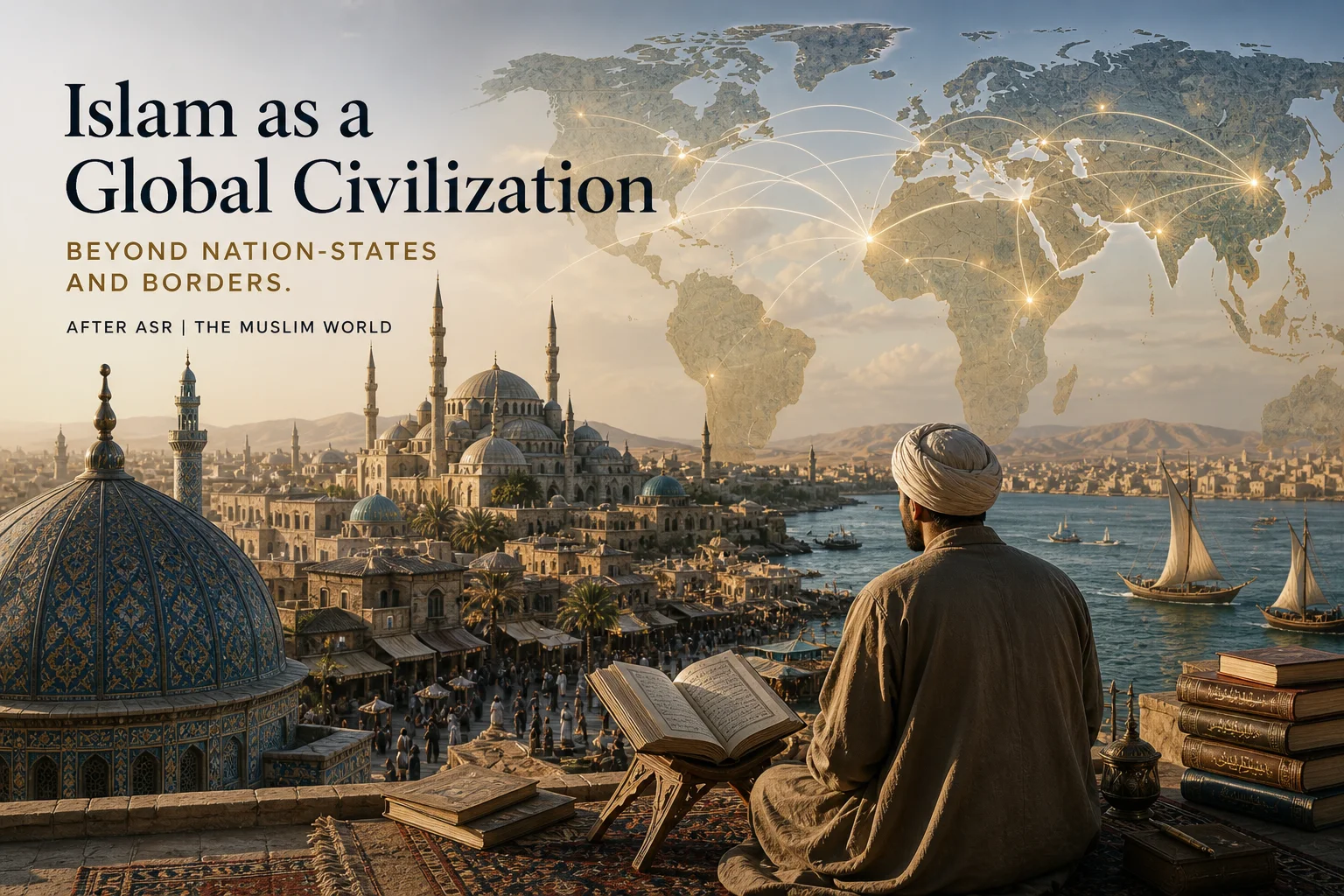
Beyond nation-states and borders
For much of modern history, the world has been organized around the idea of the nation-state. Political borders define identity, loyalty, and belonging. A person is expected to locate themselves within a specific territory, governed by a specific system, and aligned with a specific national interest.
This framework is so dominant that it often feels natural. Yet it is relatively recent. The nation-state, as the primary unit of global organization, emerged only in the last few centuries.
Islam, by contrast, developed as something far broader. It did not begin as a national project, nor did it confine itself to a single people, language, or territory. From its earliest formation, it functioned as a civilization that moved across borders rather than being defined by them.
A Civilization Without a Single Center
Unlike many historical empires, the Muslim world did not depend on a permanent, singular capital to maintain its identity. Political centers shifted over time, from Medina to Damascus, from Baghdad to Cairo, and later to Istanbul.
Despite these changes, the underlying civilizational structure remained intact. Scholarship, trade, law, and religious life continued to operate across regions that were often politically fragmented.
A scholar in Central Asia could influence legal thought in North Africa. A merchant in Yemen could conduct business with partners in India. A traveler could move across vast distances while remaining within a recognizable cultural and religious framework.
This continuity was not enforced by a single state. It was sustained by shared institutions, shared texts, and shared practices.
The Role of Knowledge and Law
One of the defining features of Islamic civilization was its commitment to a transregional intellectual tradition. Religious scholars did not operate in isolation. They formed networks that extended across continents.
Texts were studied, transmitted, and debated across generations. Legal opinions developed in one region could be adopted, adapted, or contested in another. The authority of knowledge was not limited by geography.
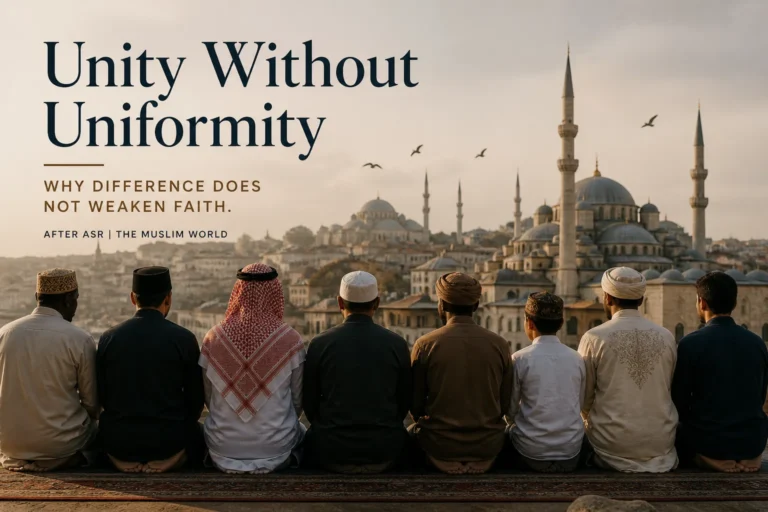
This created a form of unity that did not depend on political uniformity. Even when different regions were governed by separate dynasties, they often participated in the same legal and scholarly traditions.
In effect, law and knowledge functioned as connective tissue, binding together a world that was politically diverse but intellectually linked.
Trade, Movement, and Cultural Exchange
Economic activity played a central role in sustaining this civilizational network. Muslim merchants were active across Africa, Asia, and parts of Europe, facilitating not only the exchange of goods but also the movement of ideas.
Ports and trade routes became points of cultural interaction. Islam spread in many regions not through conquest, but through sustained contact, trust, and integration.
As a result, local cultures were not erased. They were incorporated. Architectural styles, languages, and social customs varied widely across the Muslim world, yet they existed within a broader Islamic framework.
This ability to absorb diversity without losing coherence is one of the defining characteristics of a civilization, rather than a state.
The Disruption of the Modern Order
The transition to a world organized around nation-states introduced a different logic. Borders became rigid. Identities became more narrowly defined. Political authority became tied to territorial sovereignty.
For the Muslim world, this shift was particularly disruptive. Regions that had once been connected through fluid networks of scholarship, trade, and movement were divided into separate national entities.
Over time, these divisions shaped how Muslims understood themselves. National identity began to compete with, and in some cases overshadow, civilizational identity.
The idea of a unified global community did not disappear, but it became more abstract, less visible in everyday structures.
Rethinking Belonging
To describe Islam as a global civilization is not to deny the reality of modern states. Muslims live within political systems that require engagement, responsibility, and participation.
However, it does challenge the assumption that identity must be confined to national categories. A Muslim in Indonesia, Nigeria, Turkey, or the United States may have very different political and cultural experiences. Yet they remain connected through a shared religious and intellectual heritage that transcends those differences.
This dual reality requires a more layered understanding of belonging. It is possible to be a citizen of a state while also being part of a broader civilizational framework.
Beyond Borders, Not Against Them
It is important to clarify that viewing Islam as a global civilization does not imply the rejection of borders or political structures. Rather, it situates them within a larger context.
Borders define governance. They do not define the entirety of identity.
A civilizational perspective allows for cooperation, empathy, and intellectual exchange across national lines. It provides a basis for thinking about shared challenges and collective responsibilities that are not limited to a single country.
In a fragmented world, this perspective offers a different way of understanding connection.
Conclusion
The modern world encourages individuals to think in terms of nations, flags, and borders. These are powerful and often necessary frameworks.
Yet they are not the only ones.
Islam, historically, operated as a civilization that extended across regions without requiring uniform political control. It connected people through belief, knowledge, and practice, creating a network that was both diverse and coherent.
Recovering an awareness of this civilizational dimension does not require abandoning modern realities. It requires recognizing that identity, at its deepest level, has never been limited by lines on a map.