
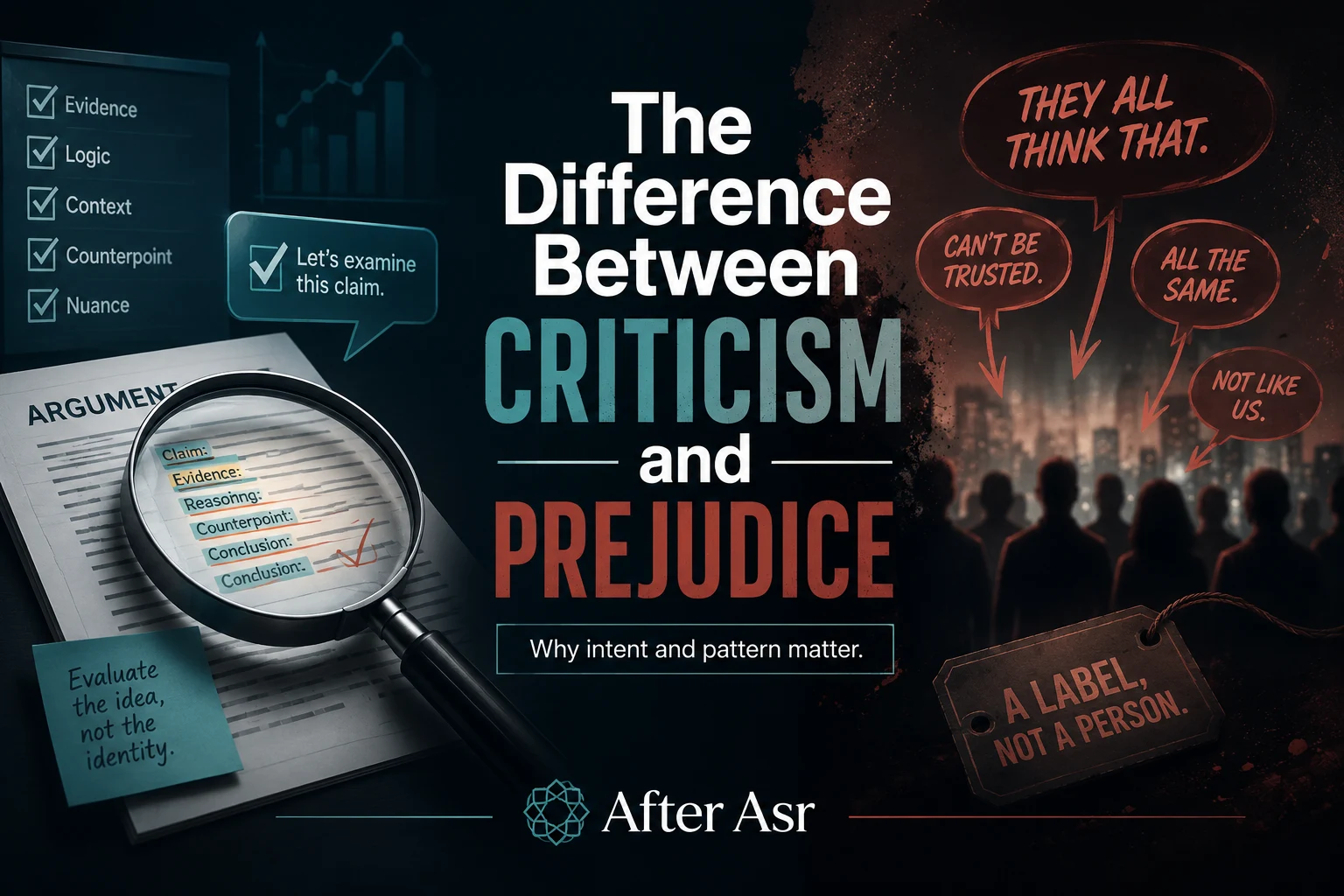
Why intent and pattern matter.
Not every harsh statement about Islam is Islamophobia.
Not every objection to a Muslim leader, institution, government, or interpretation of religion is prejudice.
And yet, prejudice often presents itself as criticism.
That is what makes the distinction worth examining carefully.
In public debate, Muslims are frequently placed in a difficult position. When they name anti-Muslim bias, they may be accused of trying to silence discussion. When they accept every attack as “just criticism,” they risk allowing hostility to pass as intellectual honesty.
A serious society should be capable of both things at once: protecting the right to criticize ideas, and recognizing when criticism becomes a vehicle for suspicion, stereotyping, and unequal treatment.
The difference is not always found in tone alone. It is found in intent, pattern, proportion, and consequence.
Criticism Has an Object
Real criticism identifies what it is criticizing.
It may challenge a theological claim, a political decision, a cultural practice, a legal interpretation, a historical account, or the conduct of a particular person or institution. It may be sharp, uncomfortable, or even deeply unwelcome. But it remains attached to something specific.
Prejudice works differently.
Prejudice takes a specific concern and expands it into a judgment about a people. It moves from “this idea is wrong” to “these people are dangerous.” It moves from “this institution failed” to “Muslims cannot be trusted.” It moves from “this practice should be debated” to “Islam itself is uniquely incompatible with civilized life.”
The object of criticism is a claim, action, or structure.
The object of prejudice is a group.
That difference matters.
Specificity Is a Sign of Good Faith
A good-faith critic can usually explain what they oppose and why. They can distinguish between Muslims, between schools of thought, between governments and populations, between religious doctrine and political misuse.
A prejudiced critic often resists those distinctions.
They speak in sweeping categories. Islam teaches this. Muslims believe that. They want this. Their culture is like that. The language becomes broad enough to hold hundreds of millions of people at once, while remaining too vague to be accountable.
Specificity imposes discipline. It requires the speaker to know what they are talking about.
Generalization offers escape. It allows someone to make grave accusations without doing the work of accuracy.
This is why many forms of Islamophobia are recognizable not because they criticize Islam, but because they criticize in a way that refuses precision.
Pattern Reveals More Than a Single Statement
One statement may be ambiguous. A pattern is harder to ignore.
Someone may raise a legitimate question about extremism, religious authority, gender, political violence, or law. That question alone does not prove prejudice. But if every public comment they make about Muslims frames them through danger, deception, oppression, or civilizational threat, the pattern begins to speak.
Do they ever acknowledge Muslim diversity?
Do they distinguish ordinary Muslims from extremists?
Do they criticize comparable behavior in other communities with similar force?
Do they make room for facts that complicate their argument?
Do they appear interested in understanding, or only in confirming an existing suspicion?
Prejudice is often revealed through repetition. The same fears appear again and again, applied to different events but always reaching the same conclusion: Muslims are the problem.
At that point, “criticism” begins to look less like analysis and more like a worldview.
Intent Matters, But It Does Not Settle Everything
Intent is important. A person who sincerely believes they are defending women’s rights, democratic values, free speech, or public safety may not see themselves as prejudiced. Some are genuinely trying to think through difficult issues. Others are repeating narratives they inherited without examining them.
But intent is not the only measure.
A person can intend to raise a concern and still rely on distorted assumptions. A politician can claim to defend security while treating Muslim identity itself as suspicious. A commentator can say they are criticizing “ideas” while consistently using those ideas to imply that Muslims are collectively unfit for public trust.
The absence of malicious intent does not automatically prevent prejudice from operating.
At the same time, accusing someone of bigotry should not be done carelessly. Intent may not determine everything, but it can help distinguish ignorance, clumsy argument, ideological hostility, and deliberate anti-Muslim animus.
A mature conversation leaves room for correction. It asks whether a person can refine their claim when challenged, or whether they simply retreat into defensiveness and repeat the same pattern.
Double Standards Are a Warning Sign
One of the clearest indicators that criticism has crossed into prejudice is the presence of a double standard.
Are Muslims asked to answer for the worst actions committed by people who share their religion, while others are judged as individuals?
Are Muslim-majority societies treated as evidence of Islam’s essence, while failures in other societies are attributed to politics, economics, history, or human weakness?
Are Muslim statements interpreted in the least generous way possible, while similar statements from others are contextualized?
Are ordinary Muslim practices framed as dangerous simply because they are unfamiliar?
When a standard is applied selectively, it reveals that the issue may not be the principle being defended. It may be the group being targeted.
Criticism says, “This standard should apply.”
Prejudice says, “This standard should apply to you.”
The Problem With “I’m Just Asking Questions”
Questions matter. They are central to inquiry, accountability, and public life.
But questions can also be used strategically.
A person may ask whether Muslims can be loyal citizens, whether mosques are hiding extremism, whether Muslim immigrants want to replace local culture, whether Islamic practices are secretly political. Framed one at a time, these may appear to be open questions. Framed repeatedly, across years of commentary, they can create an atmosphere of permanent suspicion.
The phrase “I’m just asking questions” does not automatically make the questions neutral.
Questions can inform. They can also insinuate.
A genuine question remains open to evidence. A prejudicial question is designed so that merely asking it plants doubt, regardless of the answer.
This is especially potent in an age of clips, headlines, and social media fragments, where implication often travels farther than correction.
Criticism Does Not Require Dehumanization
Even serious disagreement does not require contempt.
A person may believe that a religious argument is flawed, that a political movement is dangerous, or that a social practice should change. None of that requires mocking Muslim names, ridiculing prayer, treating hijab as inherently sinister, portraying Muslim families as breeding grounds for extremism, or speaking about Muslims as if they are a contaminant in public life.
Dehumanization is not a stronger form of criticism. It is a departure from criticism.
It signals that the goal is no longer to analyze a claim or address a harm. The goal is to degrade the people associated with it.
When Muslims are spoken about as a mass to be feared, managed, contained, or saved from themselves, the language has moved beyond disagreement. It has entered the territory of prejudice.
Prejudice Often Borrows Moral Language
One reason prejudice can be difficult to identify is that it rarely introduces itself honestly. It may speak in the language of women’s rights, secularism, free expression, national security, or social cohesion.
These concerns can be legitimate. They should not be dismissed.
But legitimate concerns can be instrumentalized. A person may suddenly care about women only when the subject is Muslim women. They may defend free speech mainly when the speech offends Muslims. They may condemn religious influence in politics only when the religion is Islam. They may speak of protecting democracy while endorsing policies that treat Muslims as second-class participants in it.
The issue is not whether the value itself matters. The issue is whether the value is applied consistently.
When moral language appears only as a weapon against Muslims, it becomes harder to view it as principle.
Muslims Can Be Criticized Without Being Made Symbolic
Muslim individuals and institutions, like all others, can fail. They can abuse authority, misuse scripture, promote harmful ideas, mismanage communities, or participate in injustice. Naming those failures is not Islamophobia. In many cases, Muslims themselves are the ones doing the naming.
But a Muslim failure should not automatically become a symbol of Muslim nature.
A corrupt Muslim official is not proof of Islamic corruption.
An abusive Muslim leader is not proof of Muslim family life.
An extremist Muslim movement is not proof of what ordinary Muslims believe.
A harmful interpretation of religion is not proof that all religious interpretation is harmful.
The leap from the particular to the civilizational is where prejudice often enters.
Criticism becomes distorted when Muslim wrongdoing is treated as revelation, while Muslim goodness is treated as exception.
Why This Distinction Matters
If every criticism is labeled prejudice, public language becomes weak and credibility suffers. People become less willing to hear real concerns about Islamophobia because they assume the term is being used defensively.
If no criticism is ever recognized as prejudice, hostility is given an easy disguise. Bigotry gains access to respectable spaces simply by speaking in analytical tones.
The distinction protects both truth and fairness.
It preserves the right to debate difficult questions. It also preserves the right of Muslims not to be reduced to suspicion under the cover of debate.
These principles are not in conflict. They depend on one another.
A society that cannot criticize ideas becomes intellectually brittle.
A society that cannot recognize prejudice becomes morally careless.
A Practical Test
When trying to distinguish criticism from prejudice, several questions are useful:
Is the claim specific or sweeping?
Is it supported by evidence or driven by implication?
Does it hold Muslims to a standard applied to others?
Does it acknowledge complexity within Muslim communities?
Does it criticize an idea, action, or institution, or does it assign character to a people?
Is the speaker open to correction?
Does the argument make understanding more possible, or suspicion more durable?
No single question settles every case. But together, they reveal direction.
Criticism moves toward clarity.
Prejudice moves toward reduction.
Conclusion
The difference between criticism and prejudice is not whether a statement makes Muslims uncomfortable. Serious criticism can be uncomfortable. Nor is the difference whether a speaker claims good intentions. People often understand themselves more generously than their patterns deserve.
The difference lies in how the argument works.
Criticism is specific, accountable, and open to evidence. Prejudice is sweeping, repetitive, unequal, and resistant to complexity. Criticism challenges a claim. Prejudice constructs a suspect people.
Understanding this distinction is essential, especially in discussions of Islam. It allows public life to remain intellectually honest without becoming morally numb. It permits disagreement without normalizing suspicion. It gives room for difficult conversations without surrendering the dignity of those being discussed.
Not every criticism of Islam is Islamophobia.
But prejudice does not stop being prejudice simply because it has learned to speak in the language of critique.