
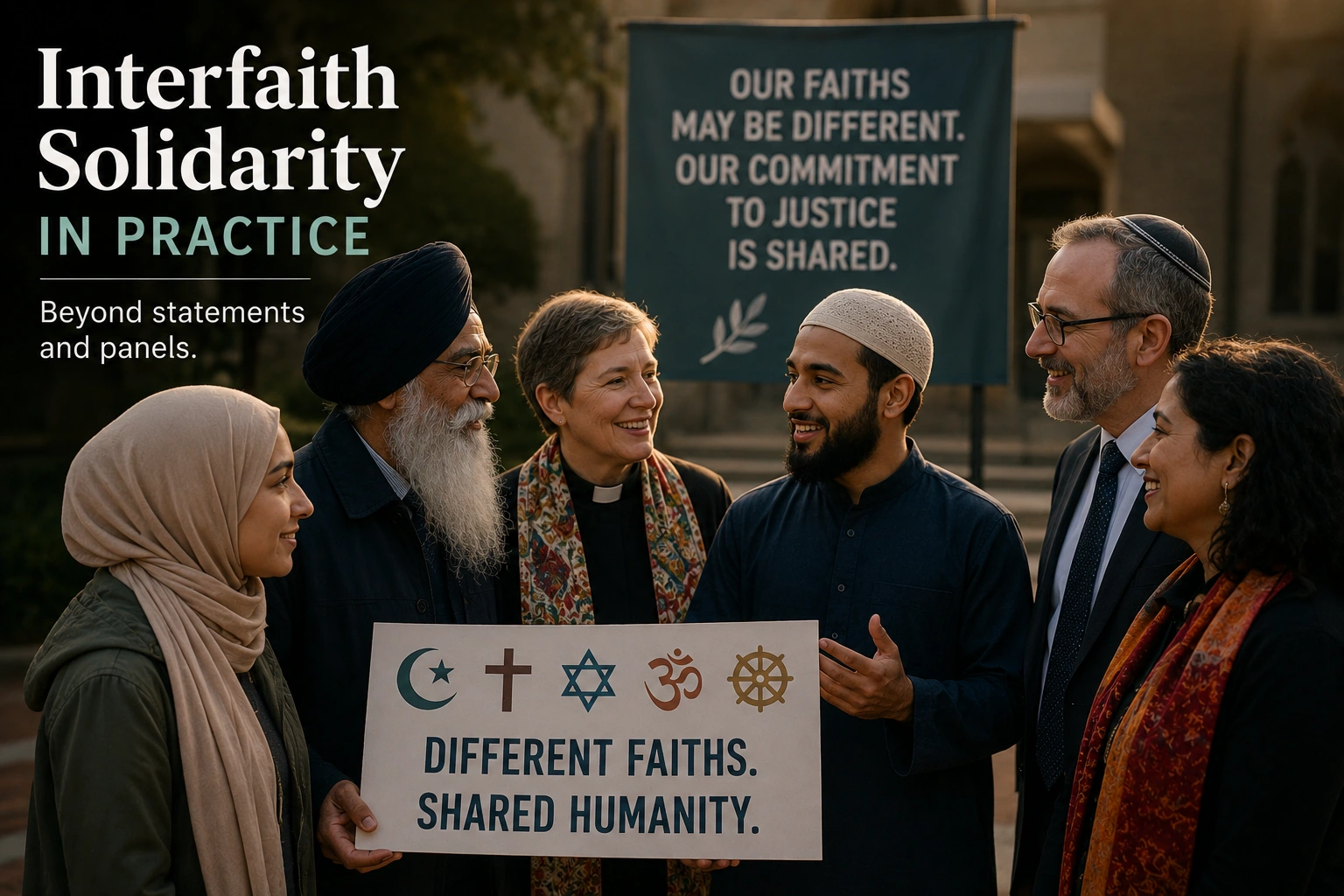
Beyond statements and panels.
Interfaith solidarity is easy to praise in the abstract.
People of different faiths gather beneath a banner of unity. Leaders exchange warm words. Communities issue statements after a tragedy. Panels are organized. Photos are taken. The language is familiar: peace, understanding, shared humanity, mutual respect.
None of that is worthless.
Words matter. Public gestures matter. In moments of fear, it matters when religious leaders refuse division and insist that attacks on one community should concern all communities. Joint statements can interrupt isolation. Public gatherings can make targeted people feel less alone. Interfaith relationships can remain important even when political conditions place enormous strain on them.
But solidarity cannot remain ceremonial.
If interfaith work appears mainly at conferences, after attacks, or in carefully moderated public events, it risks becoming a language of goodwill without the habits of courage. The communities most affected by hate do not need endless assurances that others “stand with them” in principle. They need to know what that standing looks like when there is a cost.
Interfaith solidarity becomes real when it moves beyond symbolism into shared responsibility.
Statements Are a Beginning, Not the Work
There is a reason statements appear after acts of anti-Muslim hatred, antisemitism, or attacks on houses of worship. They establish public clarity. They prevent silence from becoming the loudest response. They tell targeted communities that their suffering is not invisible.
In 2023, a White House toolkit for faith communities described solidarity statements, public education, rapid response, and community coordination as practical ways to confront hate, emphasizing that anti-Muslim, antisemitic, racist, and other forms of bias often reinforce one another.
Still, a statement alone does not escort worshippers safely into a mosque. It does not challenge a zoning campaign rooted in anti-Muslim fear. It does not help a family report harassment. It does not train a congregation to recognize misinformation before repeating it. It does not sustain trust when geopolitical crisis makes interfaith relationships uncomfortable.
Statements name values.
Practice proves them.
Real Solidarity Appears Before the Crisis
Communities that meet only after violence are often trying to build trust under pressure.
The strongest interfaith relationships are formed earlier, when no camera is present and no emergency has forced contact. They grow through recurring local habits: clergy who know one another by name, congregations that visit each other’s spaces respectfully, youth groups that serve together, leaders who can call one another directly when rumors spread, and organizations that have already decided that religious hate against one community is a concern for all.
The Shoulder to Shoulder Campaign, a multifaith coalition focused on countering anti-Muslim hatred, frames this work around connection, equipping faith communities, and mobilizing them before and during moments of crisis. Its basic premise is that anti-Muslim discrimination is not merely a Muslim issue, but a broader threat to pluralistic civic life.
Solidarity built only in emergencies is fragile.
Solidarity practiced in ordinary time has somewhere to stand when emergencies come.
Showing Up at the Point of Vulnerability
The most meaningful interfaith support often appears not on a stage, but at the point where a community feels exposed.
After a mosque receives threats, neighbors from other faith communities may attend a vigil, join a safety meeting, help elevate fundraising needs, or publicly reject the idea that Muslim worship should become a local controversy. When synagogues are attacked, Muslims have organized fundraising, expressed protection, and stood visibly with Jewish neighbors. When churches, temples, or gurdwaras are targeted, solidarity is tested again in the other direction.
These acts matter because hate often seeks to isolate its target. It wants a mosque to feel alone, a synagogue to feel abandoned, a congregation to believe that fear has narrowed the circle of concern.
Solidarity widens that circle.
The history of Jewish-Muslim solidarity after the Pittsburgh synagogue shooting and the Colleyville hostage crisis, along with interfaith responses after the Christchurch mosque attacks, shows how practical support can emerge as fundraising, public presence, moral witness, and shared protection rather than only abstract dialogue.
A panel says, “We care.”
Presence says, “You will not face this alone.”
Protecting Houses of Worship Is Interfaith Work
A house of worship is not merely a building. It is where people pray, grieve, celebrate, teach children, and recover a sense of belonging. When one becomes a target, the harm is communal.
That is why interfaith solidarity should include practical concern for religious security. Faith leaders and civic partners can help targeted communities navigate protective resources, publicize threats responsibly, and advocate for systems that do not force congregations to prove they have already suffered enough before receiving support. In 2026, Muslim leaders in the United Kingdom urged reforms to mosque security funding, arguing that many mosques face serious risk even when they cannot yet provide the kind of documented prior incident required by existing application processes.
Solidarity becomes more credible when it includes questions like:
Who is vulnerable right now?
Who has access to protection?
Who is being asked to carry security burdens alone?
Who can help change that?
A community does not prove its interfaith commitment only by attending another community’s festival.
It proves it by caring whether that community can gather safely.
Solidarity Means Challenging Misinformation Within One’s Own Circles
It is often easier to condemn hate “out there” than to confront it at home.
A pastor may publicly support Muslim neighbors while avoiding anti-Muslim rhetoric circulating among congregants. A rabbi may condemn bigotry generally but hesitate to challenge rhetoric that flattens Muslims into security threats. An imam may denounce antisemitism in theory but fail to intervene when conspiratorial claims circulate locally. An interfaith organization may celebrate harmony while avoiding the specific prejudices alive inside its own circles.
This is where solidarity becomes difficult, and therefore meaningful.
Guidance from anti-Islamophobia organizations emphasizes education, public correction of misinformation, speaking up against biased media coverage and unfair legislation, and resisting narratives that dehumanize Muslims or misrepresent Islam.
Interfaith work cannot merely translate one community to another. It must also discipline each community from within.
A person who only opposes prejudice when it comes from strangers has not yet practiced solidarity fully.
Panels Can Create Contact, But They Cannot Replace Action
Interfaith panels have value. They introduce communities, correct misconceptions, and create moments of humanization. Educational organizations continue to report demand for interreligious learning in schools and civic spaces, and such programs can help audiences recognize Islamophobia and learn about Muslim and Arab communities more accurately.
But a panel is a limited form.
It asks people to listen for an hour. It does not automatically ask them to act for a year. It often favors polished representatives and carefully curated agreement. It can avoid the deeper question of whether participants are willing to expend influence, money, reputation, or institutional capital on behalf of one another.
Interfaith solidarity should not eliminate panels.
It should outgrow dependence on them.
The question after an event should be:
What will change because we met?
Shared Service Builds a Different Kind of Trust
Some of the strongest interfaith relationships are built through shared work rather than shared declarations.
Feeding families.
Supporting refugees.
Responding to local disasters.
Protecting voting access.
Visiting the sick.
Advocating for the unhoused.
Serving neighborhoods that do not divide neatly by faith.
When people work together on common needs, they encounter one another less as symbols and more as dependable partners. ISPU resources on Muslim community service highlight how American Muslim institutions often provide social services to surrounding communities, creating opportunities for cooperation that are not limited to crisis response or image correction.
Service does not solve theological difference. It does something else.
It demonstrates that difference need not prevent shared responsibility.
That kind of experience can sustain relationships when public rhetoric grows harsher.
Solidarity Requires Knowing When Not to Flatten Difference
Interfaith work sometimes confuses peace with avoidance.
It imagines that solidarity requires everyone to soften every disagreement, skip every painful subject, and remain within the safest possible language. This can produce fragile harmony. It looks warm from the outside, but it cannot withstand actual conflict.
Real solidarity does not require theological sameness or political uniformity. It does require honesty, fairness, and a refusal to dehumanize. Faith communities can disagree sharply about war, state power, religious claims, ethics, or history while still defending one another from harassment, bigotry, and collective blame.
Interfaith America’s reflections on dialogue after October 7, 2023, noted how conflict placed significant strain on Jewish-Muslim and broader interfaith spaces, making clear that relationships must be able to hold disagreement rather than depend on the absence of it.
A solidarity that survives only easy conversations is not yet strong.
Supporting Muslims Should Not Mean Erasing Muslim Specificity
There is a temptation in interfaith spaces to move quickly toward universal language:
All hate is hate.
All communities suffer.
We are all human.
We all want peace.
These statements are true. They can also become evasive if they blur the distinct nature of anti-Muslim prejudice.
Islamophobia has particular patterns: the securitization of Muslim identity, suspicion toward mosques, misinformation about Sharia, hostility toward visibly Muslim women, and the treatment of Muslim civic life as a threat. To support Muslims well, allies need to understand those specifics rather than folding everything into vague pluralism.
The Allied Against Hate toolkit and ISPU’s anti-Islamophobia guidance both stress practical education about distinct forms of hate, including anti-Muslim discrimination and the narratives that sustain it.
Universal concern is strongest when it is specific enough to recognize particular harm.
Interfaith Solidarity Includes Advocacy
A statement of support after mosque vandalism is good.
Advocacy that helps prevent the next harm is better.
Faith communities can support legislation that protects religious freedom, oppose discriminatory public measures, challenge anti-mosque campaigns, support hate-crime reporting, advocate for equitable security resources, and insist that public officials speak responsibly about religious minorities.
ISPU’s mosque opposition toolkit documents the long-running reality that Muslim houses of worship in the United States have faced zoning battles, vandalism, arson, and organized anti-mosque activity, making local civic advocacy a necessary part of solidarity.
The practical question for allies is simple:
Are we only willing to comfort Muslims after they are harmed, or are we willing to contest the systems and campaigns that help produce that harm?
Solidarity becomes more than sentiment when it enters public life.
Money Reveals Priorities
Communities often say they care. Budgets reveal whether care has structure.
Funding interfaith safety work, rapid-response coalitions, educational programs, legal defense, community protection, and organizations confronting both antisemitism and anti-Muslim hate shows a willingness to make solidarity durable. In May 2026, Open Society Foundations announced a $30 million commitment over three years to organizations combating antisemitism and anti-Muslim hate, including groups that emphasize multifaith cooperation and community leadership.
Money is not the whole measure of commitment. Some of the most meaningful solidarity is local and unpaid. But sustained work requires resources. Communities that want interfaith action to extend beyond annual gatherings must ask how that action will be supported.
A value without infrastructure is easily exhausted.
Solidarity Should Not Become a Public Relations Exercise
Interfaith work can fail when it becomes a way for institutions to polish their image without accepting meaningful risk.
A university may host an interfaith luncheon while allowing Muslim students’ safety concerns to go unaddressed. A city may issue an inclusive proclamation while ignoring mosque-security needs. A religious institution may invite Muslim speakers for a panel, then remain silent when anti-Muslim rhetoric appears in its own networks.
Such gestures are not always cynical. But they can become superficial when separated from accountability.
The test of solidarity is not whether a photo exists.
It is whether targeted communities experience more safety, more fairness, more responsiveness, and more trust because of it.
Muslims Should Not Have to Perform Gratitude for Basic Decency
When support arrives, Muslims may feel genuinely moved by it. They may be grateful. They may remember it for years.
But gratitude should not be demanded.
A non-Muslim community that opposes anti-Muslim hate is not doing Muslims a favor in some transactional sense. It is upholding a civic and moral standard that protects everyone. Shoulder to Shoulder’s core argument is precisely that anti-Muslim discrimination harms pluralistic society as a whole, not only Muslims.
Solidarity is not charity from the secure to the vulnerable.
It is shared responsibility within a society that cannot remain healthy while any faith community is made into an acceptable target.
What Practical Interfaith Solidarity Looks Like
In practice, interfaith solidarity may include:
- clergy and lay leaders building direct, ongoing relationships before crisis
- faith communities attending one another’s vigils when attacks occur
- public opposition to anti-mosque campaigns and religious discrimination
- shared education that corrects misinformation about Muslims and Islam
- rapid-response networks for threats, vandalism, or harassment
- advocacy for fair security funding and civil rights protection
- joint service projects that build trust through work
- difficult conversations that do not collapse under political disagreement
- funding structures that support long-term cooperation
- the courage to challenge prejudice within one’s own community
These practices align with recent multifaith toolkits and coalition resources emphasizing preparedness, solidarity, public witness, and coordinated local action.
None of this is glamorous by default.
That is why it matters.
Conclusion
Interfaith solidarity is not proven by how warmly communities speak when everyone agrees.
It is proven by what they do when someone else is targeted, when public sentiment turns ugly, when misinformation spreads, when a mosque faces threats, when a difficult issue risks straining relationships, and when defending one another may carry social cost.
Statements matter. Panels matter. Dialogue matters.
But they are not the destination.
Solidarity becomes durable when it is practiced in ordinary time, activated in moments of danger, honest amid disagreement, and willing to move from compassion to responsibility.
A neighbor who says, “You are not alone,” offers comfort.
A neighbor who has already shown up, already learned, already advocated, already stood with you when it was inconvenient, offers something stronger.
They offer trust.
About the Author
Samira Nasser covers civic belonging, social perception, and the quieter ways prejudice shapes ordinary life, with a focus on Muslim communities in public institutions and culture.