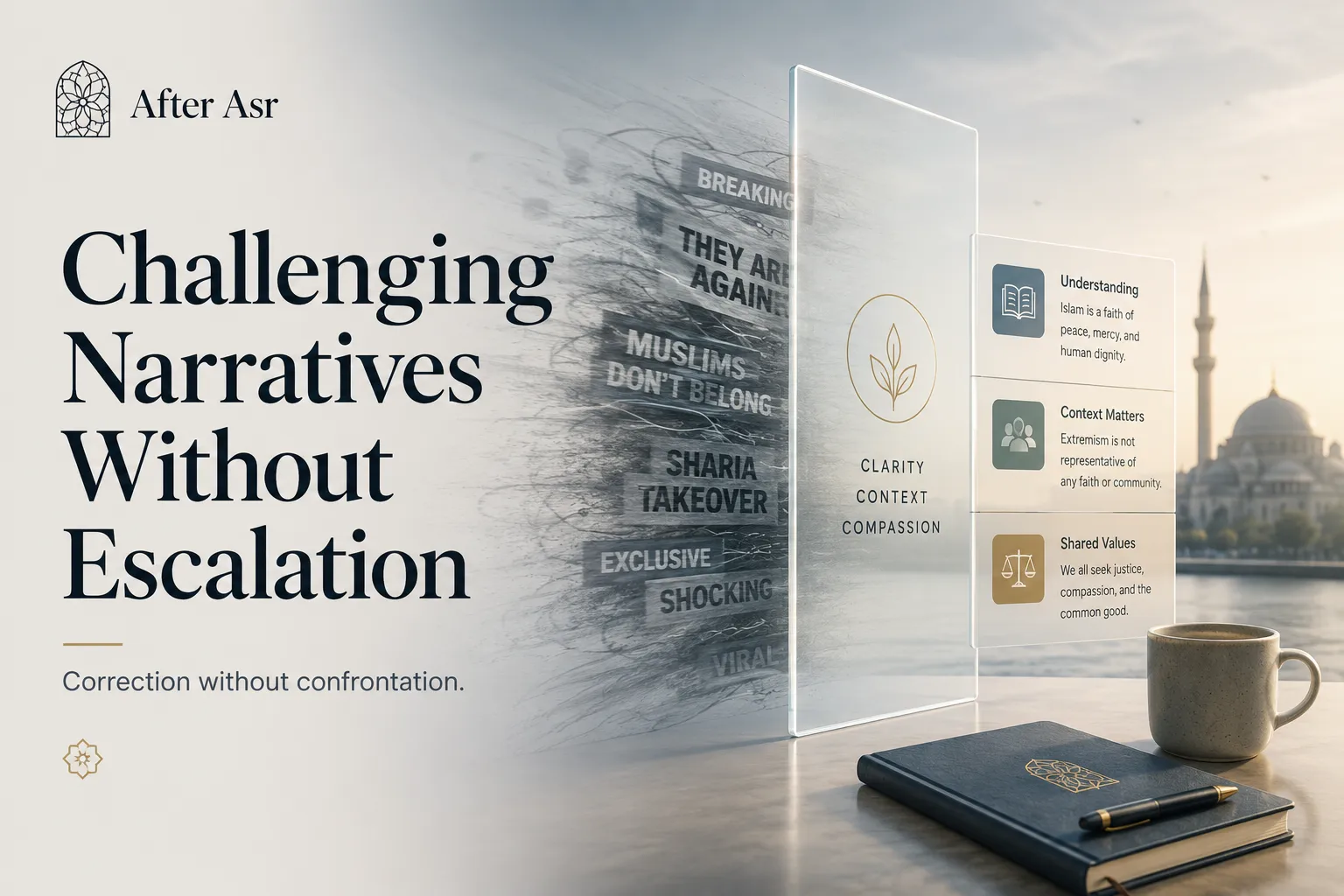
Correction without confrontation.
Not every falsehood needs a fight.
Some do.
Some moments require public clarity, a firm refusal, an unmistakable line drawn against prejudice. When Muslims are dehumanized, when conspiracy theories are used to mobilize hostility, when institutions spread misinformation with consequences, quietness can become complicity.
But not every encounter begins there.
A relative repeats something misleading about mosques.
A coworker makes an anxious claim about “Sharia law.”
A classmate assumes Muslim women have no agency.
A neighbor shares a rumor online because it sounds plausible, not because they are committed to hatred.
In those moments, correction matters. So does the manner of correction.
The goal is not to make prejudice comfortable. The goal is to make truth more likely to be heard. Escalation may satisfy the immediate desire to strike back, but it does not always serve the deeper work of dislodging a false narrative from someone’s mind.
There is a skill in saying, calmly and clearly:
That is not accurate.
And then leaving enough room for the truth to enter.
The Difference Between Silence and Restraint
Restraint is sometimes mistaken for silence. They are not the same.
Silence avoids the issue.
Restraint addresses it without turning the interaction into spectacle.
A Muslim who answers a stereotype with measured correction is not excusing it. A friend who redirects a misinformed conversation without humiliating the speaker is not minimizing Islamophobia. A community leader who chooses strategic language is not being weak.
They may be asking a practical question:
What response has the best chance of preventing this idea from spreading further?
Research on misinformation correction increasingly suggests that debunking should not be avoided out of fear that every correction will “backfire.” While corrections do not always fully erase false beliefs, studies have found that backfire effects are less common than once feared, and that credible corrections can reduce belief in misinformation. (pmc.ncbi.nlm.nih.gov) (pmc.ncbi.nlm.nih.gov)
That matters. It means correction is worthwhile.
But worthwhile does not mean careless.
Begin With the Claim, Not the Person
One of the fastest ways to escalate a conversation is to make the correction about the speaker’s character before addressing the claim itself.
“You’re Islamophobic.”
“You’re ignorant.”
“You people always say this.”
Sometimes those judgments may be accurate. Sometimes a person has shown a long pattern that deserves direct naming. But in lower-intensity moments, beginning with accusation may close the door before the correction arrives.
A more useful starting point can be:
“That specific claim is not right.”
“That statistic is being misused.”
“That story leaves out important context.”
“I think two different things are being collapsed together.”
This approach does not surrender moral clarity. It identifies the falsehood precisely. Debunking guidance emphasizes the value of clearly naming the misinformation and replacing it with accurate information, rather than vaguely insisting that “everything about that is wrong.” (opentextbooks.library.arizona.edu)
Precision helps because it tells the listener what is being challenged. It prevents the conversation from dissolving immediately into wounded pride.
The claim is wrong.
That is enough to begin.
Do Not Repeat the Myth More Than Necessary
False narratives gain power through repetition. A myth heard often can begin to feel familiar, and familiarity can be mistaken for truth. Research on the “illusory truth effect” shows that repeated statements are more likely to be judged as true, including claims that are inaccurate. (theguardian.com)
This has implications for correcting Islamophobic narratives.
If someone says, “Mosques are trying to replace local law,” the response should not spend five minutes dramatically repeating every version of that fear. The myth can be named briefly, then displaced by fact.
For example:
“That is a common conspiracy claim, but mosques in the United States operate under the same legal framework as other houses of worship. If there is a concern about a particular zoning issue or institution, that should be discussed specifically rather than turning Muslim worship into a threat narrative.”
The correction moves quickly toward what is true.
It does not grant the falsehood unnecessary airtime.
Offer an Alternative Explanation
People often cling to false narratives because those narratives explain something that feels confusing. If a correction removes the false explanation but offers nothing in its place, the original story may remain emotionally attractive.
A person hears that Muslims are “refusing to integrate” because they ask for religious accommodations at work. Merely saying, “That is prejudiced,” may be true but incomplete. A fuller correction might be:
“Religious accommodation is part of pluralism, not a rejection of it. We already make room for different observances in workplaces and schools. Muslim requests are being treated as unusual partly because many institutions were built around majority norms.”
Now the person has a new frame.
The issue is not Muslim separation.
The issue is whether institutions treat minority needs as legitimate.
Misinformation research has found that corrections are often more effective when they provide a coherent alternative account rather than only negating the false claim. (pmc.ncbi.nlm.nih.gov)
A strong correction does not simply tear down.
It rebuilds understanding.
Tone Can Protect the Truth From Distraction
There are conversations in which sharpness is necessary. A public figure spreading anti-Muslim conspiracy theories to thousands of people does not require the same response as a confused coworker at lunch.
But in many ordinary interactions, tone determines whether the discussion remains about the falsehood or becomes entirely about the emotional charge of the correction.
A measured tone can prevent the speaker from retreating into, “You attacked me,” instead of confronting the claim itself. This is not about prioritizing the comfort of people repeating harmful ideas. It is about refusing to let defensiveness become an escape route.
Consider the difference:
“That’s racist nonsense.”
versus
“That claim is inaccurate, and it follows a pattern that has been used to make Muslims seem threatening when the facts do not support it.”
The second response may still be firm. It may even be more devastating. It names the issue without allowing the speaker to pretend the only problem was tone.
Correction without escalation is not softness toward falsehood.
It is discipline in service of clarity.
Questions Can Open Where Declarations Cannot
Sometimes the most effective correction is not a counterstatement, but a question.
“Where did you hear that?”
“What do you mean by that?”
“Would you apply that same standard to another religious group?”
“Are you talking about Muslims generally, or a specific government or organization?”
“What evidence would change your mind?”
Questions slow down an idea that was moving too easily. They require the speaker to locate the claim, define it, and sometimes hear its weakness in their own words.
They also help distinguish between confusion and commitment. A person who is repeating something casually may reconsider once asked to examine it. A person who is deeply invested in prejudice may reveal that quickly too.
In either case, the question clarifies the terrain.
You do not need to argue with a fog bank.
You need to find out what is actually being claimed.
Correct the Pattern, Not Only the Sentence
Some Islamophobic narratives persist not because any one claim is persuasive, but because the same frame reappears under different wording.
Muslims are disloyal.
Muslims want special rules.
Muslim worship is secretly political.
Muslim visibility signals threat.
Muslim criticism of injustice is extremism.
A single conversation may involve only one of these claims. But a strong correction can gently name the wider pattern:
“I notice that Muslim practices are often interpreted as suspicious in ways similar practices from other communities are not. That is part of why this claim concerns me.”
This does something important. It prevents the conversation from being trapped in endless isolated fact-checking. It points to the machinery behind the statement.
Organizations countering Islamophobia often recommend confronting misinformation while also recognizing the broader fear-based narratives that make such misinformation persuasive in the first place. (ispu.org)
The fact matters.
The frame matters too.
Know When the Audience Is Not the Speaker
Not every correction is for the person who made the claim.
In public settings, the real audience may be everyone else listening.
A prejudiced comment in a workplace meeting may not be corrected to persuade the person who said it. It may be corrected so Muslim colleagues are not left alone with it, and so others in the room see that the statement is not acceptable common sense.
An Islamophobic post online may not deserve prolonged debate with the original account. But a concise, evidence-based reply may matter for undecided readers who encounter the thread.
This is especially important because misinformation often spreads socially. Corrections can help create friction before a claim travels further, even if the original speaker remains unmoved. Research on misinformation correction on social platforms suggests that correction effectiveness depends partly on how corrections are delivered and how they interrupt false content in networked environments. (pmc.ncbi.nlm.nih.gov)
Correction is not always conversion.
Sometimes it is containment.
Do Not Confuse Calm With Endless Availability
A measured response is useful.
Being perpetually available for correction is not.
Muslims are often expected to educate, contextualize, and debunk on demand. That expectation is unfair. A person may choose to correct a narrative one day and decline entirely the next. They may have the energy to answer a coworker but not a stranger online. They may decide that a particular conversation is not salvageable.
Correction without escalation includes knowing when not to enter.
There is a difference between a person open to understanding and a person baiting for reaction. There is a difference between a mistaken claim and a hostile performance. There is a difference between conversation and extraction.
No one is obligated to donate their composure to every bad argument.
Strategic disengagement can be as wise as strategic correction.
Sometimes Direct Naming Is Necessary
A calm approach should not become an excuse to avoid naming prejudice when it is plainly present.
If someone repeatedly describes Muslims as inherently dangerous, if they argue that Muslim civic life should be restricted, if they use conspiratorial language that treats an entire community as a threat, then correction may need to be direct:
“That is anti-Muslim prejudice.”
“That claim dehumanizes Muslims.”
“That argument treats a religious minority as collectively suspect.”
Clarity matters. There are moments when excessive gentleness muddies the truth.
Correction without confrontation does not mean never confronting. It means not escalating by reflex when precision will do more. It means choosing the form of response that matches the level of harm and the purpose of speaking.
A scalpel and an alarm are both useful.
They are not for the same moment.
Replace Humiliation With Accountability
Humiliation can feel satisfying, especially when a harmful claim is careless or cruel. Publicly embarrassing someone who spreads misinformation may provide a rush of relief.
But humiliation does not always deepen understanding. It can harden identity. It can invite a person to leave not thinking, “I was wrong,” but, “I was attacked.”
Accountability is different.
Accountability says:
You made a claim.
It is inaccurate.
It has consequences.
You should correct it.
That approach can still be strong. It may require public correction, request for retraction, or documentation of a pattern. But its goal is not merely to make the speaker feel small. Its goal is to protect truth and reduce harm.
This distinction matters in community life. A society already saturated with reactive outrage does not need every correction to become another performance of dominance.
It needs more people capable of being firm without becoming reckless.
Correction Works Better Before Myths Harden
False narratives are easier to challenge before they become part of someone’s identity.
A person who casually repeats a misleading claim because they heard it once may respond to correction. A person who has built years of political belonging around that claim may not.
This is why everyday correction matters. Small myths should not be ignored until they become organized hostility. A rumor about a mosque, a joke about Muslim disloyalty, an assumption about hijab, a misleading claim about Islamic law, these are worth addressing while they are still movable.
Prebunking and early inoculation approaches in misinformation research emphasize the value of helping people recognize manipulative narratives before those narratives fully take hold. (opentextbooks.library.arizona.edu)
In personal conversation, that may look like naming a trope early:
“That idea gets circulated a lot, but it is usually used to create fear rather than explain reality.”
You are not only correcting the present statement.
You are helping the listener recognize the next one.
The Power of Repetition on the Side of Truth
If repetition helps falsehoods feel familiar, repetition also matters for truth.
Accurate statements need to be said more than once.
Muslims are not a monolith.
Religious accommodation is not special treatment.
Mosques are houses of worship, not presumptive security concerns.
Criticism of a government is not hatred of a people.
A Muslim’s public presence is not evidence of threat.
These truths may feel obvious to those already convinced. They are not obvious in an environment where fear-based narratives circulate constantly.
Correction without escalation includes patience for repetition. Not patience with abuse, but patience with the work of rebuilding public understanding one accurate sentence at a time.
The lie did not become familiar through one telling.
The truth often needs more than one response.
What This Looks Like in Practice
A few examples:
Claim: “Muslims want Sharia to replace American law.”
Response: “That claim is usually used to create fear. Muslim Americans live under the same legal system as everyone else, and religious ethics in personal life are not the same thing as replacing civil law.”
Claim: “Why are Muslims always offended by criticism?”
Response: “Criticism is not the problem. The issue is when Muslims as a whole are stereotyped or treated as collectively suspect. Those are different things.”
Claim: “Hijab is always oppression.”
Response: “Muslim women have a range of experiences and reasons. Treating every hijab-wearing woman as voiceless erases the agency you say you are defending.”
Claim: “Mosques lead to radicalization.”
Response: “That is a broad and harmful generalization. If there is evidence about a specific institution, discuss that evidence. Otherwise, houses of worship should not be treated as threats because they are Muslim.”
These are not scripts for every situation. They are models of a posture: concise, accurate, firm, and unwilling to inherit the emotional chaos of the claim being corrected.
Correction Is Part of Civic Maintenance
A healthy society requires people who are willing to interrupt distortion before distortion hardens into norm.
That work is not glamorous. It rarely goes viral. It may not produce an immediate breakthrough. But it matters.
Misinformation about Muslims does not exist only in fringe spaces. It enters schools, workplaces, neighborhood debates, media comments, family conversations, and policy discussions. Left unchallenged, it contributes to an environment where exclusion begins to seem reasonable.
Correction is therefore not merely an interpersonal courtesy.
It is civic maintenance.
It keeps public language from decaying unnoticed. It protects neighbors from being turned into abstractions. It reminds a room that fairness requires accuracy.
Conclusion
Challenging anti-Muslim narratives does not always require confrontation in its loudest form.
Sometimes it requires composure.
A clear fact.
A careful question.
A refusal to repeat the myth more than necessary.
A willingness to name the pattern without turning every conversation into combat.
Correction without escalation is not weaker than outrage. It is often more strategic. It preserves the possibility of understanding where understanding is still possible. It interrupts misinformation before it travels further. It protects others in the room from the silence that allows prejudice to masquerade as common sense.
There will be moments that require a sharper response.
But not every falsehood needs a fire.
Some need a steady hand, a clean sentence, and the confidence to say:
No. That is not the truth.
About the Author
Yusuf Rahman covers culture, language, and Muslim public life, with a focus on how communities navigate pressure, perception, and belonging.