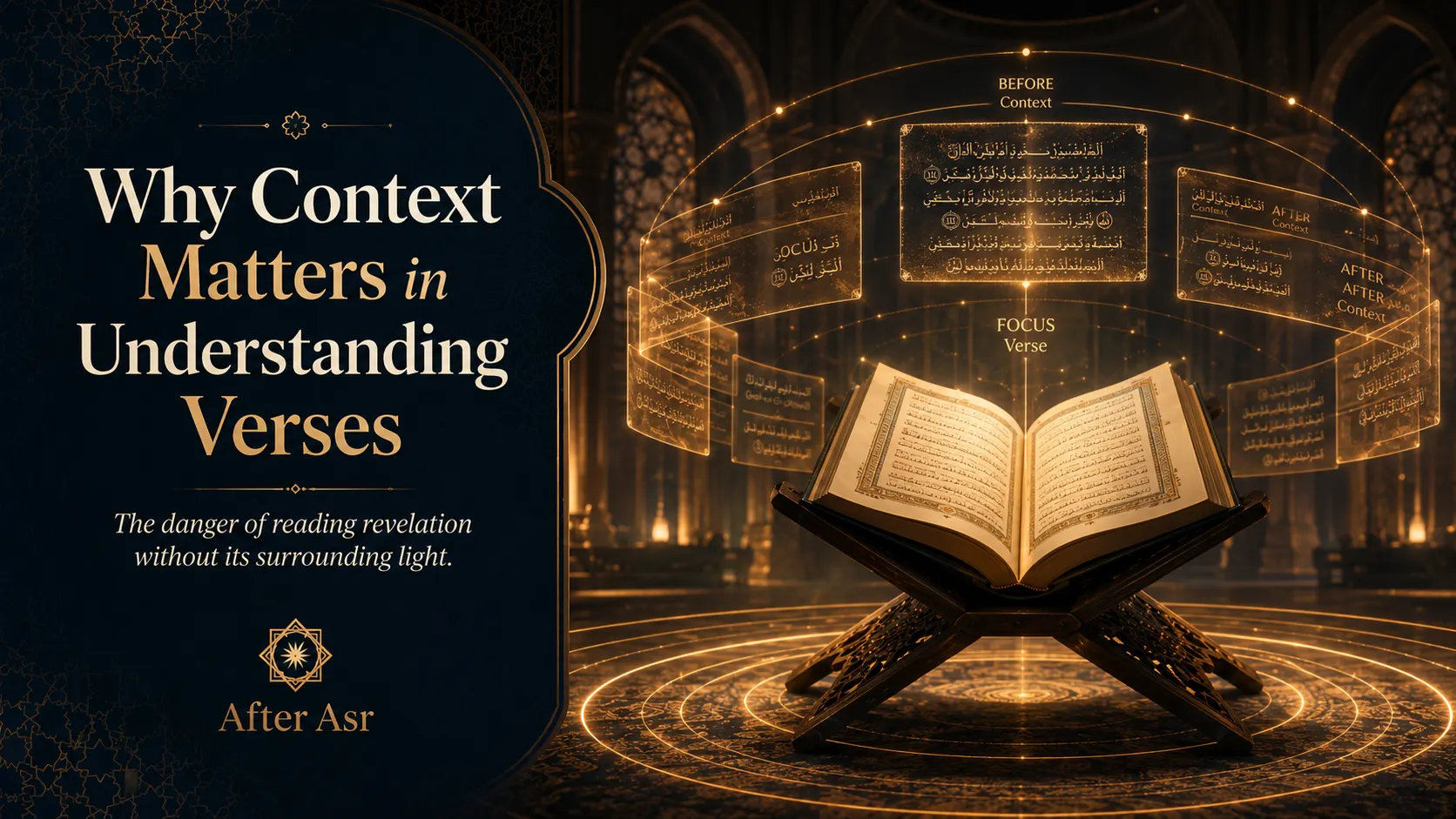
The danger of reading revelation without its surrounding light.
A verse can be beautiful on its own.
It can move the heart in a single line. It can comfort someone in grief, awaken someone in heedlessness, or remind someone of Allah after a long period of distance. The Quran has verses that arrive with immediate force, even when the reader does not know every layer of explanation behind them.
But the Quran is not a collection of isolated quotations.
It is revelation.
Its verses belong to surahs. Its surahs belong to a divine arrangement. Its words were revealed in real circumstances, to real people, through the Messenger of Allah, peace and blessings be upon him, across years of struggle, teaching, patience, migration, community building, and worship.
To understand a verse well, one must be willing to ask where it sits.
What comes before it?
What comes after it?
Who was first addressed by it?
What problem was it correcting?
What mercy was it offering?
What warning was it giving?
What did the Prophet, peace and blessings be upon him, teach through it?
What did the earliest Muslims understand from it?
Context does not make the Quran smaller.
It helps us receive the Quran more faithfully.
The Quran Deserves More Than Quotation
Modern life loves quotations.
A phrase can be lifted from a book, placed over a background image, shared on social media, repeated in a speech, or used in an argument. Sometimes a quotation inspires. Sometimes it clarifies. Sometimes it becomes a doorway into deeper reading.
But quotation can also flatten meaning.
A sentence removed from its setting can be made to sound harsher, softer, broader, narrower, simpler, or more convenient than it actually is. The same words may appear very different when returned to the passage from which they came.
This is especially serious with the Quran.
A verse is not a slogan waiting to be used. It is not a weapon for arguments. It is not a decorative phrase to support whatever one already wanted to say. It is not a fragment detached from revelation’s moral and spiritual whole.
The Quran deserves to be approached with reverence.
Part of that reverence is context.
Not because the verse is weak without it, but because the reader is weak without it.
Context Is Not an Escape From Meaning
Some people hear the word “context” and assume it is a way of avoiding difficult verses.
They imagine that context means explaining away anything that challenges modern habits, personal desires, or cultural assumptions. In this view, to ask for context is to weaken the force of the Quran.
That can happen when people use context dishonestly.
But that is not what careful context means.
Context does not erase meaning. It protects meaning.
It helps prevent a reader from turning a verse into something it was never meant to be. It prevents sincere people from misunderstanding Allah’s guidance. It prevents reckless people from using sacred words to justify cruelty, arrogance, or confusion.
A verse may still challenge us after context.
It may still correct us.
It may still make demands on us.
It may still require submission.
But after context, the demand is clearer. The correction is more precise. The challenge is received with better understanding.
Context is not a way to escape the Quran.
It is a way to stand before it more honestly.
The Surrounding Verses Matter
One of the first forms of context is the passage itself.
A verse may be part of a larger argument, story, warning, command, consolation, or description. When it is read alone, the reader may miss the movement of the passage.
Sometimes the verses before establish the subject.
Sometimes the verses after clarify the limit.
Sometimes a command appears between reminders of mercy and accountability.
Sometimes a warning is surrounded by calls to repentance.
Sometimes a verse that sounds general in isolation is part of a specific discussion.
This is why reading around a verse matters.
The Quran often teaches through flow. It moves the reader from one point to another. It builds moral awareness. It shifts from creation to accountability, from history to warning, from law to mercy, from human weakness to divine knowledge.
A verse is part of that movement.
When we isolate it too quickly, we may interrupt the guidance before it has completed its work on us.
A reader should not only ask, “What does this verse say?”
They should also ask, “What is this passage doing?”
Revelation Came Into Real Life
The Quran was revealed over time.
It did not descend as a detached manual placed outside history. It addressed the Prophet, peace and blessings be upon him, and the first Muslim community through changing circumstances. It spoke during persecution, migration, battle, treaty, grief, victory, family matters, worship, law, social reform, and spiritual formation.
This does not mean the Quran is trapped in the past.
Its guidance is timeless.
But timeless guidance was revealed into real moments. Knowing those moments often helps us understand the force of the verse.
Some verses responded to questions.
Some corrected mistakes.
Some addressed accusations.
Some came during hardship.
Some taught the community how to move from weakness to responsibility.
Some clarified boundaries after confusion.
This is why scholars have long paid attention to what is called asbab al-nuzul, the occasions or circumstances connected to revelation. Not every verse has a specific known occasion, and not every report is equally strong. Still, the principle matters: revelation came to guide human beings in life, not in abstraction.
The circumstances do not limit the Quran to one moment.
They help us understand how that guidance first entered the world.
Language Has Depth
Context is not only historical.
It is also linguistic.
The Quran was revealed in Arabic, with words, structures, rhythms, and layers that can be difficult to carry fully into translation. A translated verse may be meaningful and helpful, especially for non-Arabic speakers, but it cannot contain everything present in the original Arabic.
A single Arabic word may hold a range of meaning.
A phrase may carry force through grammar.
A shift in pronoun may matter.
A repeated word may connect one passage to another.
A command may have a specific legal or rhetorical weight.
A word that appears harsh in one translation may have a more precise meaning in Arabic. A word that appears soft in English may carry more urgency in the original. Different translations may choose different English terms, each highlighting one aspect while losing another.
This does not mean ordinary Muslims cannot read translation.
They can, and they should use translations as doors into meaning.
But it does mean humility is necessary.
When a verse seems confusing, shocking, or unusually simple in translation, the first response should not be instant certainty. It should be patience. It may require checking trusted explanations, comparing translations, or asking someone qualified.
The Quran is accessible.
It is not casual.
The Prophet’s Teaching Is Essential Context
The Quran was not revealed without a living teacher.
The Messenger of Allah, peace and blessings be upon him, recited it, explained it, embodied it, judged by it, prayed with it, and showed the believers how to live under it.
This matters deeply.
A person cannot separate the Quran from the Prophet’s guidance and still claim to understand it properly. The Prophet’s Sunnah provides essential context for worship, law, character, community, mercy, restraint, and application.
The Quran commands prayer, but the Prophet taught how to pray.
The Quran commands zakah, but the Prophet taught its details.
The Quran calls to good character, and the Prophet embodied the character of revelation.
The Quran warns against injustice, and the Prophet showed how justice must be tempered by mercy, wisdom, and accountability.
Without the Prophetic example, verses can be misapplied. People may take a word and ignore the way it was lived. They may claim harshness where the Prophet showed patience. They may claim ease where the Prophet taught responsibility. They may claim certainty where the Prophet taught caution.
The Quran was revealed to a Messenger.
That is not incidental.
It is part of how Allah taught humanity.
The Early Community Matters
The first generations of Muslims were not perfect people beyond all human complexity, but they were the first community formed directly by revelation.
They heard the Quran from the Prophet, peace and blessings be upon him.
They lived through its revelation.
They knew the language, the circumstances, the social world, and the practical questions that surrounded many verses. Their understanding matters because they were closest to the source.
This is why Muslim scholarship has always cared about how the Companions and early generations understood the Quran. Their explanations, questions, disagreements, and applications are not merely historical curiosities. They are part of the inherited discipline of understanding revelation.
A modern reader may feel confident because they have access to many books, translations, lectures, and search engines.
But access is not the same as understanding.
A person with a search bar can still misunderstand what earlier Muslims understood with lived nearness, linguistic depth, and direct teaching.
This does not mean later readers cannot reflect.
They can.
But reflection should be rooted, not arrogant.
Misreading Can Happen From Good Intentions
Not every out-of-context reading is malicious.
Sometimes people misunderstand because they love the Quran but lack tools. Sometimes they read quickly. Sometimes they rely on a poor translation. Sometimes they hear a verse quoted by someone else and assume the quote represents the whole meaning. Sometimes they are emotionally moved and apply a verse too broadly or too narrowly.
Good intentions matter, but they do not automatically produce sound understanding.
A person may sincerely want to defend Islam, yet quote a verse in a way that creates confusion.
A person may sincerely want to comfort someone, yet use a verse without sensitivity to the person’s situation.
A person may sincerely want to correct wrongdoing, yet apply a verse harshly without wisdom.
A person may sincerely want to make the Quran feel relevant, yet bend a passage into a modern message it was never meant to carry.
This is why humility is protective.
The sincere reader does not say, “My intention is good, so my understanding must be correct.”
They say, “My intention may be good, but I still need guidance.”
Misreading Can Also Be Weaponized
While some misreadings are innocent, others are deliberate.
The Quran is sometimes quoted by people who do not believe in it, do not honor it, and do not care to understand it fairly. They extract verses to make Islam appear cruel, irrational, violent, or strange. They ignore surrounding passages, historical settings, scholarly interpretation, and the Prophet’s life. They present isolated lines as if they represent the entire religion.
This is not serious reading.
It is distortion.
But Muslims can also misuse verses.
A person may quote the Quran to win an argument, silence a spouse, shame a child, control a community, justify anger, or appear religiously superior. They may use revelation as a shield for their ego rather than as guidance against it.
This is spiritually dangerous.
The Quran should not become a tool for domination in the hands of someone who refuses to be humbled by it.
A verse quoted without mercy, knowledge, or context can wound people, even when the words themselves are sacred.
The fault is not in the Quran.
The fault is in the misuse of the one quoting it.
Context Protects Against Extremes
Many errors in understanding verses come from imbalance.
One person reads only mercy and ignores accountability.
Another reads only warning and ignores hope.
One person reads commands without wisdom.
Another reads wisdom as an excuse to avoid commands.
One person universalizes a verse that has limits.
Another restricts a verse that has broader guidance.
One person reads the Quran as if it only addresses private spirituality.
Another reads it as if it only addresses public law and social order.
The Quran contains mercy and justice, comfort and warning, law and spirituality, individual responsibility and communal obligation. Context helps preserve that balance.
It reminds the reader that a single verse belongs to the whole Quranic message.
A verse about punishment must be understood alongside Allah’s mercy, justice, knowledge, and the conditions of accountability.
A verse about mercy must be understood alongside repentance, responsibility, and truth.
A verse about community must be understood alongside individual sincerity.
A verse about worship must be understood alongside conduct.
The Quran does not guide by imbalance.
The reader must be careful not to create imbalance by isolating what Allah revealed as part of a whole.
Context Does Not Belong Only to Scholars
It is true that deep interpretation requires knowledge.
Not every person is qualified to issue religious conclusions, derive rulings, or make confident claims about difficult verses. The Quran is too serious for casual authority.
But context is not only for scholars.
Every Muslim can learn to read more responsibly.
Every Muslim can read the verses before and after.
Every Muslim can avoid sharing isolated quotes without checking.
Every Muslim can recognize the limits of translation.
Every Muslim can consult trusted tafsir.
Every Muslim can ask people of knowledge when confused.
Every Muslim can say, “I do not know.”
This is not a barrier between ordinary believers and the Quran.
It is an etiquette of approach.
A person does not need to be a scholar to benefit from the Quran. But they do need humility, caution, and the willingness to be taught.
The Quran is guidance for humanity.
Its interpretation is not a free-for-all.
Reflection Still Matters
The importance of context should not make the Quran feel distant.
Some readers may hear all this and think, “Then maybe I should not reflect at all. Maybe I should leave the Quran only to scholars.”
That would be a mistake.
The Quran repeatedly calls human beings to think, remember, observe, and reflect. It addresses the heart. It speaks to fear, hope, gratitude, repentance, arrogance, patience, family, wealth, death, and the Hereafter. Every believer needs a living relationship with it.
Context does not replace reflection.
It disciplines reflection.
It allows the reader to ask personal and spiritual questions without turning those reflections into unsupported claims. A person can read a verse about gratitude and ask how grateful they are. They can read a verse about arrogance and examine their ego. They can read a verse about patience and consider their impatience. They can read a verse about mercy and return to Allah with hope.
This is good.
The danger begins when personal reflection becomes declared interpretation without knowledge.
There is a difference between saying, “This verse makes me think about my need for patience,” and saying, “This verse definitely means such-and-such,” when one has not studied the matter.
Reflection should soften the heart.
It should not inflate the ego.
Some Verses Are Clear, Some Require More Care
Not every verse is difficult in the same way.
Many verses communicate guidance that is immediately clear: worship Allah, be truthful, give charity, show justice, avoid arrogance, remember death, honor parents, fulfill trusts, return to Allah.
A reader should not use complexity as an excuse to ignore what is plain.
At the same time, some verses require more knowledge. They may involve law, historical events, theological precision, language, abrogation discussions, specific audiences, or matters where scholars have explained different dimensions.
Wisdom means knowing the difference.
A person should not pretend that every verse is too complex to act upon.
Nor should they pretend that every verse can be fully understood by a quick reading in translation.
Some guidance is immediately actionable.
Some guidance requires study.
Both truths protect the reader.
The Surrounding World Can Distort Our Reading
Context also includes recognizing the assumptions we bring with us.
Every reader approaches the Quran from a particular world. Modern people carry modern questions, wounds, pressures, ideologies, fears, and desires. These can affect what we notice and what we resist.
A person shaped by individualism may struggle with verses about obedience and submission.
A person shaped by harshness may overemphasize punishment.
A person shaped by permissiveness may avoid verses about limits.
A person shaped by political anger may read every passage as a weapon.
A person shaped by shame may miss the Quran’s repeated openings toward mercy.
A person shaped by pride may see warnings as meant for others.
This is why the reader must not only study the context of the verse.
They must also examine the context of the self.
What am I bringing to this reading?
What do I want the verse to say?
What am I afraid it will say?
What part of me is resisting?
What part of me is trying to use the Quran rather than be guided by it?
The Quran reveals the reader.
But only if the reader is willing to be revealed.
Context and Mercy
Context often reveals mercy.
A verse that first appears severe may be part of a passage protecting the vulnerable, limiting harm, correcting injustice, or restoring moral order. A command that seems difficult may be tied to wisdom the reader has not yet considered. A warning that feels frightening may be surrounded by invitations to repent.
Without context, the reader may see only the surface of difficulty.
With context, they may see the mercy within the guidance.
This does not mean every verse becomes easy in an emotional sense. Some truths remain heavy. Some commands require struggle. Some warnings are meant to shake the heart.
But context can show that the Quran’s seriousness is not cruelty.
Allah’s guidance is not random restriction. It is not detached from human dignity, social consequence, spiritual health, and ultimate accountability.
The Quran guides because Allah knows what human beings do not know.
Context helps us glimpse that wisdom more clearly.
Context and Accountability
Context also prevents false comfort.
Sometimes people quote merciful verses while ignoring the conditions, warnings, or responsibilities surrounding them. They want reassurance without repentance, hope without change, love without obedience, spirituality without accountability.
But the Quran does not offer hollow comfort.
Its mercy is real. Its doors of repentance are vast. Its call to return is repeated again and again. But it also calls the human being to truthfulness, humility, obedience, and transformation.
Context protects mercy from being turned into self-deception.
It reminds the reader that hope in Allah is not the same as indifference toward sin. Trust in Allah is not the same as refusing effort. Love of Allah is not the same as ignoring His commands.
A verse of mercy should soften the heart.
It should not make the ego careless.
How to Read With Context
A responsible reader can begin with simple habits.
Read more than one verse. Look at the surrounding passage. Notice whether the verse is part of a story, command, argument, warning, or consolation.
Compare translations when possible. If a word or phrase seems confusing, do not rely on one English rendering as the final meaning.
Consult trusted tafsir, especially for verses that involve law, conflict, theology, or historical events.
Pay attention to the Prophet’s example. Ask how the Messenger of Allah, peace and blessings be upon him, embodied the guidance being read.
Avoid using verses as ammunition in arguments.
Be careful with social media graphics and isolated quotations.
Say “I do not know” when needed.
Make dua for understanding.
And most importantly, read with humility.
The goal is not to control the Quran.
The goal is to be guided by it.
The Quran Is Not Fragile
Some people fear that careful context will make the Quran feel dependent on human explanation.
But the Quran is not fragile.
It does not lose power because we study its setting. It does not become less divine because we pay attention to language, revelation, Prophetic teaching, and scholarly interpretation. These are not distractions from the Quran. They are part of the tradition of honoring it.
A jewel does not become less beautiful when placed in proper light.
It becomes easier to see.
Context is that surrounding light.
It allows the verse to shine without distortion. It allows the reader to receive guidance without forcing the verse into the shape of their assumptions.
The Quran does not need us to defend it through shallow readings.
It deserves better from us.
Conclusion
Context matters because the Quran matters.
A verse is not a loose fragment. It is part of revelation’s living whole. It belongs to a passage, a surah, a language, a history of revelation, the teaching of the Prophet, peace and blessings be upon him, and the careful work of generations who approached it with knowledge and reverence.
To read without context is to risk hearing only part of what is being said.
To read with context is to become a better listener.
It does not make the Quran distant. It brings the reader nearer to its intended guidance. It protects against arrogance, haste, distortion, and misuse. It helps the believer distinguish between sincere reflection and careless interpretation.
The Quran was revealed as light.
But light must be received with open eyes.
Context helps us see what we might otherwise miss.
Not because Allah’s words are unclear in themselves, but because human beings are often hurried, wounded, biased, forgetful, and easily satisfied with partial understanding.
The careful reader does not approach a verse asking, “How can I use this?”
They ask, “How should I understand this?”
Then, more quietly and more seriously, they ask:
“How should this change me?”