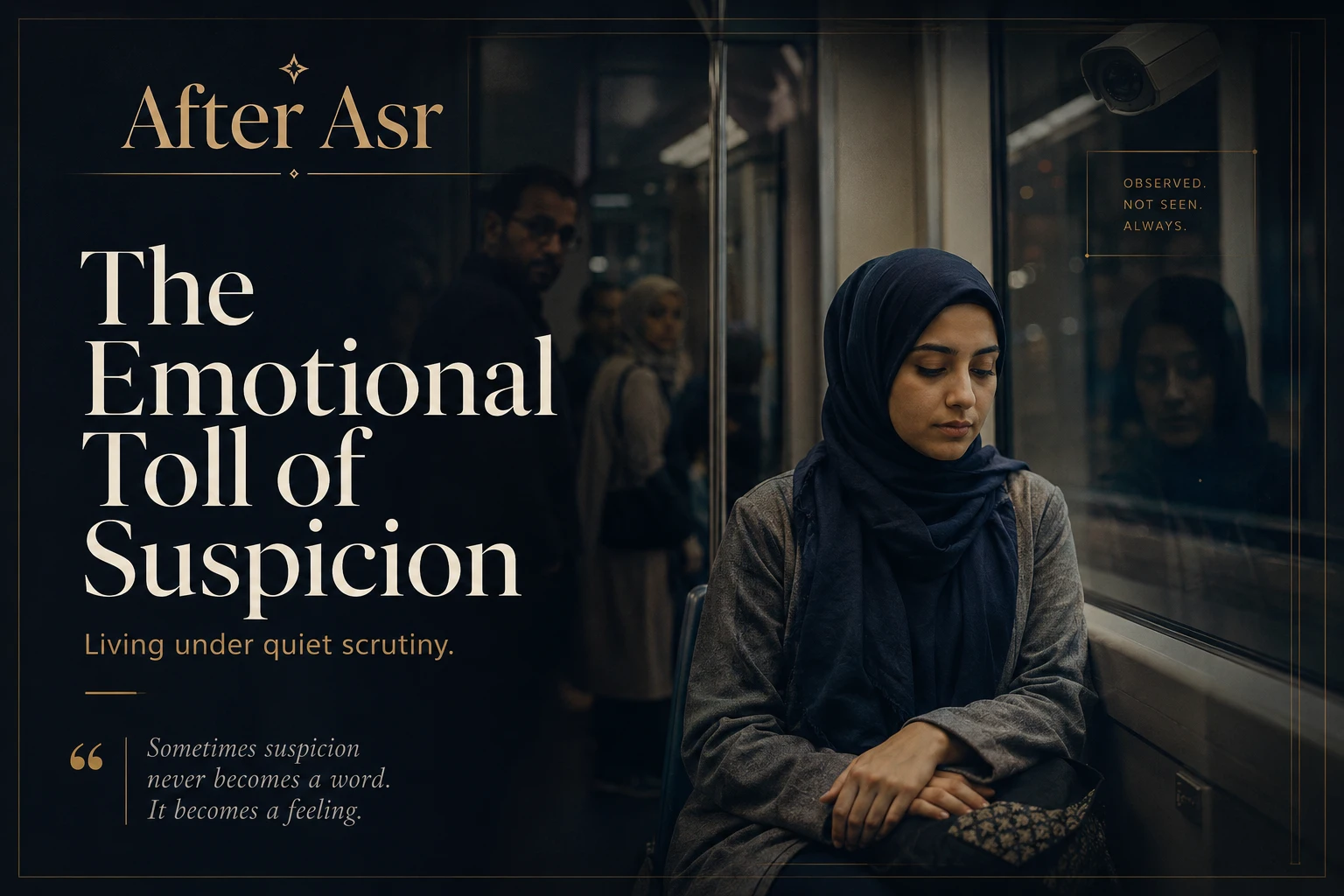
Living under quiet scrutiny.
Suspicion does not need to become an accusation to cause harm.
It can remain unspoken.
A look.
A pause.
A question that lands strangely.
A change in tone.
A sense that one is being assessed before being understood.
For many Muslims, this quiet scrutiny becomes part of ordinary life. It may appear in airports, classrooms, offices, waiting rooms, neighborhoods, public meetings, or casual conversations. It does not always announce itself as hostility. Often, it is subtler than that: the feeling of being watched a little more closely, interpreted a little more quickly, or trusted a little less automatically.
The emotional cost of that experience is difficult to measure from the outside. A person may continue working, laughing, praying, parenting, studying, and showing up for life. Yet beneath that normalcy, suspicion can create a steady layer of vigilance.
Research on Islamophobia and health has repeatedly linked anti-Muslim discrimination with poorer mental health outcomes, including anxiety, psychological distress, and depressive symptoms. A major systematic review found consistent associations between Islamophobia and adverse mental health effects, while more recent research among Muslim American college students found that everyday discrimination was significantly associated with both anxiety and depression.
The scrutiny may be quiet.
Its impact is not.
Living With the Possibility of Misreading
One of the most exhausting parts of suspicion is not knowing exactly when it is present.
Was the cashier curt with everyone, or only after seeing a Muslim name?
Did the interviewer lose interest naturally, or after noticing a hijab?
Was the additional screening random, or familiar?
Did the room grow tense after a political comment, or is that feeling being imagined?
This uncertainty produces a particular form of strain. The person experiencing it is left to interpret a pattern that may be real, but rarely comes with confirmation. Nothing is explicit enough to challenge easily. Everything is subtle enough to doubt oneself.
That doubt can become draining.
When a society repeatedly exposes people to ambiguous forms of suspicion, it forces them into ongoing self-monitoring. They must observe others while also observing themselves. They become attentive to how they appear, how they sound, how their gestures may be read, how their silence may be interpreted, and whether a harmless action might somehow confirm someone else’s bias.
This is not simply discomfort. It is a form of emotional labor.
The Mind Learns to Anticipate
Suspicion changes not only how people respond in the moment, but how they prepare before the moment arrives.
A Muslim traveler may begin an airport day with extra tension before anything has happened. A student may dread a class discussion after a major international news event. A visibly Muslim woman may scan the mood of a space before settling into it. A Muslim employee may rehearse how to answer an anticipated question about politics, terrorism, or religious practice.
The body begins preparing for friction.
A 2024 study of Muslim women in the United States found that discrimination was associated with symptoms of psychological distress, and that certain social conditions, such as being the only Muslim woman in a setting, intensified that distress for hijab-wearing participants.
That finding helps explain something many Muslims describe intuitively: scrutiny becomes heavier when one feels both visible and alone.
The emotional toll is not only in what happens. It is in having to be ready for what might happen.
Hyperawareness Is Not the Same as Oversensitivity
People living under recurring suspicion are sometimes accused of being overly sensitive. They are told they are reading too much into things, assuming bias too quickly, or making ordinary interactions political.
But hyperawareness often develops in response to repeated experience.
A person who has been questioned, stereotyped, singled out, or treated differently over time may become skilled at noticing the earliest signs of it. They hear the hesitation before a remark. They recognize the setup of a familiar question. They notice when politeness becomes strained, when “curiosity” starts to sound like interrogation, when a conversation is drifting toward a role they have played too many times before.
This awareness is not always perfect. No one interprets every moment correctly. But neither is it baseless.
The public health literature on Islamophobia treats anti-Muslim discrimination as more than a series of isolated unpleasant incidents. It identifies it as a chronic social stressor with consequences for well-being, health behaviors, and help-seeking.
A person who expects scrutiny has often learned that expectation somewhere.
The Pressure to Appear Harmless
Quiet suspicion can create a pressure to manage one’s presentation constantly.
Smile before speaking.
Do not look annoyed.
Do not raise your voice.
Avoid appearing confrontational.
Be careful with humor.
Do not seem too political.
Do not seem too religious.
Do not seem withdrawn either.
This pressure is rarely written down. No one may issue the instruction. Yet it can become a lived rule.
Muslims may feel compelled to project reassurance in environments where they suspect they are being read through stereotypes. A frustrated Muslim man may worry his irritation will be interpreted as aggression. A hijab-wearing woman may feel she must be especially warm to counter assumptions of severity or distance. A Muslim student may soften a point in class because they do not want disagreement to be mistaken for extremism.
The result is a kind of emotional compression. Ordinary expressions are filtered before release.
People living without that burden may call it professionalism.
People living with it know it can be survival.
Suspicion Narrows Emotional Freedom
One underappreciated cost of Islamophobia is that it can restrict the range of emotions Muslims feel safe displaying publicly.
Anger becomes risky.
Sadness becomes awkward.
Silence becomes suspicious.
Confidence becomes defiance.
Reticence becomes secrecy.
Devotion becomes intensity.
This is especially cruel because it does not merely judge behavior. It judges the meaning of behavior before it is known.
Everyone deserves emotional complexity. People should be allowed to have a bad day, decline a conversation, speak firmly, grieve privately, or resist a false assumption without worrying that their response will be taken as confirmation of someone else’s fear.
Suspicion denies that freedom. It turns ordinary emotion into evidence.
The person is no longer only feeling. They are managing how feeling may be perceived.
When Public Events Become Personal Stress
Periods of political conflict, terrorism, war, or intense public debate can heighten the emotional toll of suspicion. Muslims may experience anxiety not only because of the events themselves, but because they know those events can reshape how they are treated locally.
A news alert may mean tomorrow’s workplace conversation will be uncomfortable.
A viral claim may mean more questions at school.
A public controversy may mean stares on transit feel heavier.
A political speech may mean the mosque feels more vulnerable.
This effect has been documented across post-9/11 Muslim American life and in more recent studies of discrimination and well-being. Scholars have described Islamophobia as a social condition that influences health not only through direct incidents, but also through stigma, institutional treatment, and the anticipation of hostility.
In this way, public suspicion enters private emotion.
The world outside shapes the body inside.
The Isolation of Carrying What Others Do Not See
Quiet scrutiny can be lonely because it is often invisible to those not experiencing it.
A Muslim person may leave an interaction unsettled while everyone else thinks nothing happened. A coworker may recount a strange exchange and struggle to explain why it felt diminishing. A student may feel watched after speaking in class, yet have no single moment dramatic enough to describe. A parent may notice their child becoming more reserved after repeated comments, while each comment on its own seemed too small to sound serious.
The absence of a dramatic incident can make people less likely to seek support. They may tell themselves they should ignore it. They may fear being dismissed. They may not want to burden others with something that feels hard to prove.
But emotional impact does not require a spectacular event.
Repeated subtle suspicion can wear down a person precisely because it is woven into the ordinary.
Self-Doubt as a Consequence of Bias
Another toll of quiet scrutiny is self-doubt.
Did I overreact?
Should I have answered differently?
Was I too sharp?
Did I make Muslims look bad?
Should I avoid that place next time?
Am I imagining a pattern?
These questions can become part of the aftermath of everyday interactions. The person not only experiences the moment, but reviews themselves afterward.
This internal replay is exhausting. It turns prejudice into self-surveillance.
Research linking discrimination with distress among Muslims helps illuminate why such experiences should not be dismissed as trivial. When everyday discrimination and perceptions of broader Islamophobia are associated with anxiety and depressive symptoms, the small moments cannot be understood only as isolated inconveniences. They are part of a larger psychological environment.
The emotional injury is not always immediate.
Sometimes it accumulates through repetition and reflection.
Children Learn Suspicion Early
The emotional toll of Islamophobia does not begin only in adulthood.
Muslim children and teenagers may learn early that their names, food, holidays, clothing, family practices, or parents’ accents are treated as unusual. They may be asked questions they do not yet know how to answer. They may hear jokes before they understand why the joke hurts. They may sense that a classroom becomes different when Islam enters the discussion.
Over time, children can learn to anticipate embarrassment before it arrives.
They may avoid explaining themselves.
They may become quieter.
They may distance themselves from visible markers of faith.
They may become highly practiced at reassuring others.
While experiences vary widely, research on Muslim college students suggests that discrimination and broader perceptions of Islamophobia remain meaningfully connected to anxiety and mental health in young adulthood.
That matters because the emotional effects of suspicion do not simply appear one day. They can be learned gradually over years of social interaction.
Some Respond by Withdrawing
Not everyone responds to suspicion by confronting it. Some respond by shrinking their public footprint.
They avoid certain conversations.
They stop correcting misconceptions.
They decline invitations.
They choose silence over the risk of being misunderstood.
They make themselves less visible in settings where visibility feels costly.
This withdrawal may be misread as disengagement, aloofness, or lack of civic interest. In reality, it can be a form of self-protection.
When people repeatedly experience their presence as subject to interpretation, quiet becomes appealing. Distance becomes restful. Avoidance becomes a way to reclaim some control over one’s emotional state.
A society that repeatedly scrutinizes a group should not be surprised when some members begin rationing their availability.
Others Respond by Becoming More Deliberate
Suspicion does not only produce withdrawal. It can also produce resolve.
Some Muslims respond by becoming more outspoken, more visibly committed to faith, more active in civic life, more determined to challenge stereotypes rather than accommodate them. This response can be empowering. It can convert pressure into purpose.
But even empowerment does not erase the cost that preceded it.
No one should have to develop extraordinary resilience simply to withstand ordinary public life. Admiring resilience should not distract from asking why it is being required.
The emotional toll of suspicion is not disproven by the fact that people survive it well.
Survival is not the standard by which fairness should be measured.
The Difference Between Safety and Ease
Public conversations often ask whether Muslims are physically safe. That question matters urgently. Violence, harassment, and threats must be taken seriously.
But there is another question:
Are Muslims allowed ease?
Can they enter a room without scanning it first?
Can they speak without translating themselves preemptively?
Can they wear religious clothing without rehearsing for reaction?
Can they be quiet without being interpreted?
Can they be ordinary without being assessed?
Safety means more than avoiding attack. It also includes freedom from chronic suspicion, from the expectation of misreading, from the emotional drain of always wondering how one is being perceived.
The public health framing of Islamophobia is useful precisely because it recognizes that discrimination affects human well-being through more than direct confrontation. It shapes stress, health behaviors, and the conditions under which people move through society.
A person may be safe enough to continue functioning and still not be free enough to feel at ease.
What Careful Attention Requires
Responding to this emotional toll begins with taking subtle experiences seriously without overstating every interaction.
Not every awkward question is prejudice.
Not every stare is hostility.
Not every institutional delay is discrimination.
But patterns matter. Frequency matters. Context matters. The testimony of people who live under recurring suspicion matters.
A more thoughtful society would resist the impulse to dismiss emotional impact simply because bias was not shouted aloud. It would recognize that quiet scrutiny can still alter a person’s behavior, sense of self, and relationship to public space.
It would ask not only whether Muslims are being insulted, but whether they are being made to feel permanently assessable.
Conclusion
The emotional toll of suspicion is not always visible. It often lives beneath composure.
It appears in anticipatory tension, self-monitoring, withheld speech, overmanaged tone, replayed conversations, and the fatigue of being interpreted before being known. It can affect visibly Muslim people intensely, but it is not limited to visibility alone. Any Muslim who has learned that public belonging may be conditional can carry some version of this weight.
Islamophobia is harmful not only when it becomes explicit hatred. It is harmful when it makes ordinary life psychologically narrower.
A society does not need to scream at Muslims to exhaust them.
Sometimes, it only needs to keep watching them as though they might become a problem.