Why old works endure.
A classic often arrives before we meet it.
It comes wrapped in reputation. It has already been praised, assigned, adapted, quoted, summarized, resisted, mocked, and placed somewhere on a shelf of cultural importance. Before a reader opens The Odyssey, Antigone, Don Quixote, Pride and Prejudice, Crime and Punishment, The Conference of the Birds, or The Mu‘allaqat, they may already feel they know something about it. The work has become a name before it becomes an experience.
This is one of the quiet dangers of classics. We inherit their status so early that we may never actually read them.
Some readers approach old books with reverence so rigid that the works become monuments rather than living texts. Others reject them before entry, assuming that anything long canonized must be stale, exclusionary, or overpraised. Both responses avoid the same task: reading.
A classic does not deserve obedience simply because it is old. Nor does it deserve dismissal because it has survived institutions we now view critically. It deserves encounter.
Old works endure for several reasons, and not all of them are noble. Power influences canons. Empires privilege some languages over others. Universities institutionalize some authors while neglecting others. Translation shapes who travels across time and borders. Gender, class, race, religion, and geography have all affected which books are preserved, circulated, and called “essential.” The literary canon is not a natural law. It is a historical construction, and like all constructions, it bears marks of conflict and exclusion. Recent scholarship continues to examine how canonical works remain powerful both inside and beyond academia, while debates over recovered writers such as Ann Radcliffe show that canon formation is still being revised rather than merely received.
Yet it does not follow that classics are only artifacts of power. Some books endure because readers keep finding life in them. They remain arguable. They do not collapse after their first explanation. They expose fears, desires, vanities, loyalties, and moral conflicts that continue to reappear under new costumes. They survive not because they are timeless in the shallow sense of floating above history, but because they are historical works that remain capable of addressing later histories.
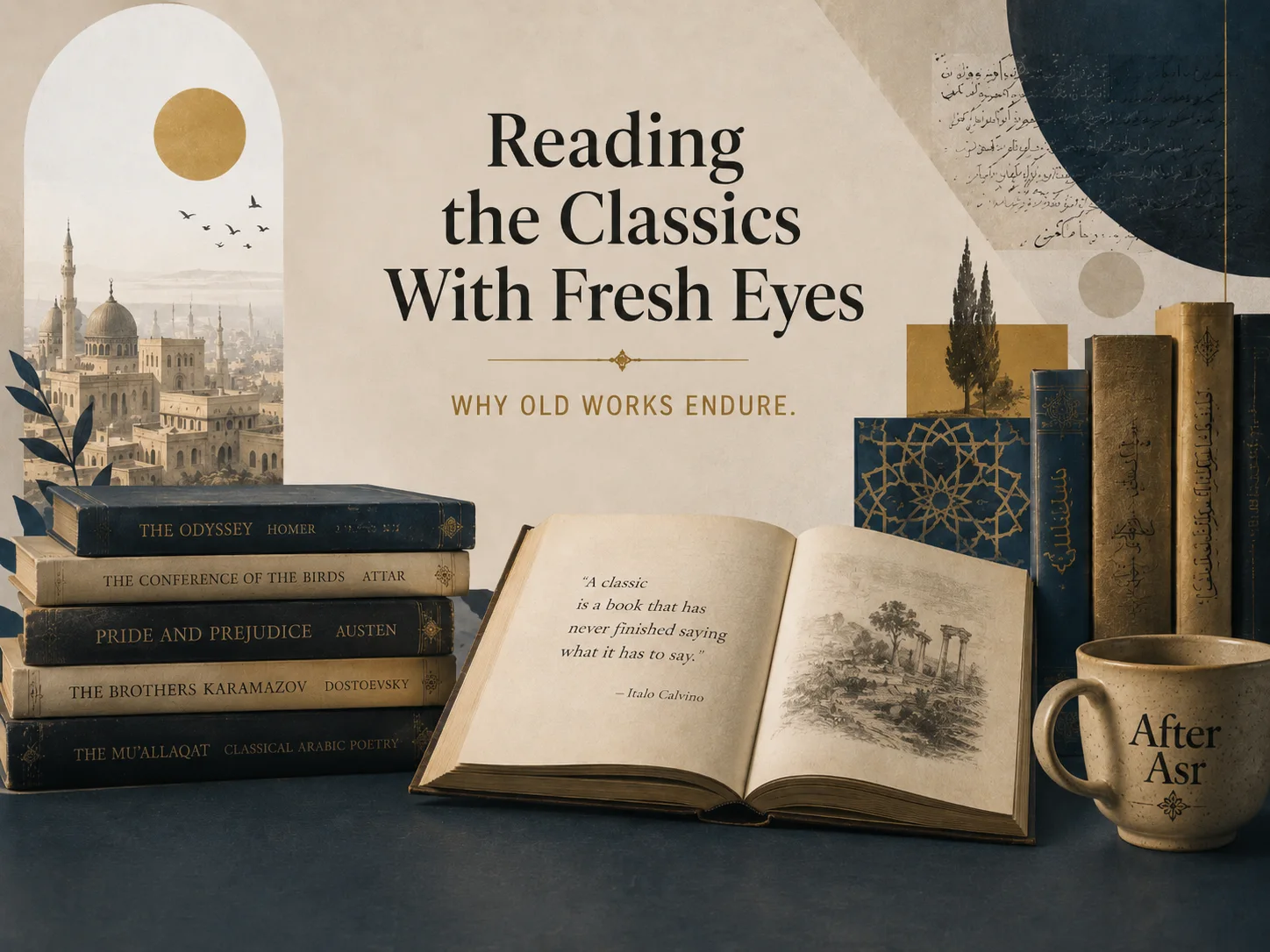
Italo Calvino famously described a classic as a book that “has never finished saying what it has to say.” The phrase endures because it captures something genuine: classics are not old books that escaped change. They are books that change as readers change, while retaining enough force to meet them again.
To read the classics with fresh eyes is therefore not to pretend we are the first readers. It is to refuse both inherited worship and inherited boredom. It is to ask what the work actually does when encountered now, by us, in this moment, with all that history between its first audience and our own.
A Classic Is Not Merely a Famous Old Book
Age alone does not make a work classic. Libraries are full of old books that few people will return to except specialists. Fame alone does not make a work classic either. Some books dominate their season and then disappear, while others gather power slowly across decades or centuries.
A classic is better understood as a work that sustains renewed reading.
It may remain formally inventive. It may offer characters whose contradictions still trouble us. It may establish a genre later writers cannot escape. It may give language to an experience that subsequent readers recognize as their own, even across immense historical distance. It may reveal a world unlike ours with enough seriousness that we learn from the difference rather than demanding immediate familiarity.
This does not mean every classic is universally beloved. Some are admired more than enjoyed. Some matter because they shaped literary history, not because every modern reader will find them personally moving. Some are difficult, morally alienating, or structurally unfamiliar. A classic may deserve to be known without becoming anyone’s favorite book.
The common mistake is to treat “classic” as a certificate of comfort. Many classics endure precisely because they refuse comfort. They provoke argument. They expose readers to societies ordered by assumptions we no longer share. They show us women constrained by marriage markets, enslaved people reduced by legal structures, empires normalizing conquest, religious worlds shaped by metaphysics now unfamiliar to secular readers, and moral codes whose severity may shock us.
Why return to such books? Not because every old worldview merits admiration. Because historical distance can educate. It reveals that our present assumptions are not inevitable, just as the assumptions of earlier eras were not. It teaches us to distinguish between what in a work remains morally luminous and what belongs to a world we must now judge more critically.
Fresh reading does not sanitize the classic. It tests it.
Endurance Is Not Innocence
There is a tempting romance around classics: the idea that great works naturally rise above time because excellence simply announces itself. Literary history is not so pure.
Texts survive through institutions. Manuscripts are copied or neglected. Works are translated or not. Schools adopt them or ignore them. Critics praise some authors while passing over others. Political, religious, and cultural power shapes access. The canon is therefore neither meaningless nor innocent. It is a record of admiration braided together with hierarchy.
Consider how many women writers, colonized writers, non-European traditions, and vernacular voices were long treated as marginal despite shaping literary history in profound ways. Ann Radcliffe, once immensely influential in the development of Gothic fiction and admired by writers from Austen to Dickens, later receded from standard accounts of the canon. Contemporary scholars are now working to restore her fuller place in literary history. Her case reminds us that neglect is not always evidence of insignificance.
The same is true across many traditions. “Classic” has often been defined from the perspective of dominant institutions, and serious readers should be aware of that. A Muslim engagement with literature especially should resist any canon that quietly equates civilization with Europe alone. Greek tragedy matters. So do al-Jahiz, al-Mutanabbi, Rumi, Ibn Hazm, Ferdowsi, Saadi, Nizami, and countless others whose works shaped moral and literary imaginations across the Muslim world and beyond.
To critique the canon is not to abolish the classics. It is to ask better questions about why some old works were protected, why others were not, and how our libraries should widen.
A tradition confident in itself does not fear revision. It welcomes recovery.
The Classics Survive Because Human Problems Recur
Some works endure because human beings continue failing in recognizable ways.
Power still corrupts. Pride still blinds. Families still pass down wounds. Desire still confuses itself with destiny. People still excuse wrongdoing when it benefits them. Nations still tell flattering stories about their origins. Lovers still misread each other. Children still struggle against the expectations of parents. Ambitious people still discover too late that success cannot cure spiritual emptiness.
A reader of King Lear does not need to live in a monarchy to understand the pain of mistaking flattery for love. A reader of Antigone need not belong to ancient Thebes to recognize the collision between state authority and moral obligation. A reader of Pride and Prejudice may inhabit a vastly different marriage economy and still recognize self-deception, class vanity, and the shame of revising one’s judgment. A reader of The Conference of the Birds may come from a secular culture and still feel the force of a journey in which seekers must lose illusions before finding what they sought.
These works endure not because nothing has changed, but because some structures of the soul reappear.
This is where classics can surprise modern readers. We expect them to be remote. Sometimes they are. Their syntax may be unfamiliar. Their social codes may feel alien. Their pacing may resist contemporary expectations. Yet within that distance, a sentence suddenly reaches us with unnerving directness. We realize that a writer centuries gone has named a vanity we still protect, a grief we still cannot organize, a foolishness still praised under modern terms.
A classic endures when it remains capable of recognition.
Fresh Eyes Do Not Mean Present-Day Vanity
Reading old works from the present is unavoidable. We cannot empty ourselves of modern knowledge, nor should we. A twenty-first-century reader brings historical awareness, feminist critique, postcolonial insight, theological commitments, and moral concerns that earlier readers may not have shared. These are not corruptions of reading. They are part of how texts continue to live.
But there is a difference between fresh reading and present-day vanity.
Fresh reading asks: What can this work show me, including about its own limitations?
Vanity asks: How quickly can I judge this work by standards it did not share, so that I may feel superior to it?
Old texts should not be immune from moral judgment. A novel’s racism matters. A poem’s misogyny matters. A heroic epic’s glorification of conquest matters. To notice these things is not anachronistic fragility. It is responsible reading.
Yet if we encounter every old work only to identify where it fails modern tests, we have turned reading into a performance of self-certification. We learn little. We merely confirm that we live later.
The harder, better task is double vision. We see the work within its world and from ours. We ask what it made possible, what it could not imagine, what it perceived brilliantly, what it distorted, and why those distortions themselves may matter historically. We neither excuse nor flatten.
A classic should not be treated as morally perfect. It should be treated as substantial enough to deserve full judgment.
Great Books Are Often Stranger Than Their Reputation
One pleasure of reading classics firsthand is discovering how unlike their public image they can be.
A book famous for one theme may be rich in others. A work remembered as stern may be funny. A novel treated as romantic may be more interested in money, family, and self-knowledge than courtship. A philosophical text known by a slogan may be more tentative and searching than its reputation suggests. A poem celebrated for beauty may contain bitterness that summaries erase.
Calvino observed that classics often feel “new, fresh, and unexpected” precisely because we think we already know them through cultural hearsay. Reading exposes the inadequacy of reputation.
This is especially important in an age of summaries. A work can now be reduced to plot videos, quotation graphics, classroom clichés, and AI-generated explanations before a reader has spent one hour with it. Such aids can be useful. They can open difficult texts. But they can also preempt the encounter. A book becomes a set of conclusions rather than an unfolding experience.
The classic deserves better. So does the reader.
No summary can reproduce the slow estrangement of reading Kafka, the tonal precision of Austen, the moral turbulence of Dostoevsky, the inexhaustible inwardness of Rumi, or the startling shifts between earthiness and metaphysical longing in classical Arabic poetry. The value is not merely in what these works “say.” It is in how they move the mind toward their sayings.
A classic is often fresher than the lesson attached to it.
We Do Not Read Old Works Alone
Classics carry prior readers within them.
Generations have annotated, translated, performed, adapted, disputed, and misread them. When we read an old work, we enter a long conversation already underway. This can be intimidating, but it is also one of the pleasures of literary inheritance. We are not the first to wonder why Hamlet delays, whether Don Quixote is absurd or noble, whether The Odyssey celebrates homecoming or exposes the cost of wandering, whether a Sufi allegory should be read psychologically, spiritually, or both.
Reader-response theory has emphasized that meaning is made in the encounter between text and reader, but older works reveal another layer: readers also inherit interpretive traditions. We meet a classic partly through the sediment of earlier reading communities.
This can constrain us. A text assigned in school may feel dead because it has been overexplained in a narrow way. A religious or civilizational classic may be surrounded by such reverence that readers fear honest engagement. A work central to national identity may be shielded from critique.
But interpretive history can also enrich. Commentaries, translations, adaptations, and disagreements show that a classic has sustained attention. They reveal how one work can generate multiple serious readings without dissolving into anything-goes relativism.
To read freshly is not to ignore all that came before. It is to let inheritance become conversation rather than obedience.
The Classics Teach Us About Difference
One reason to read old books is that they refuse to flatter our assumption that the present is the measure of all things.
They remind us that people have organized love, honor, kinship, piety, shame, leadership, and justice in different ways. Some of those ways we rightly reject. Others challenge the complacency of our own age. A society may have been unjust in one sphere and wiser in another. An old text may preserve a sensitivity to duty that modern individualism thins out, even as it also reflects hierarchies we cannot endorse. Another may reveal a spiritual seriousness now hard to find, while carrying social assumptions that require critique.
This friction is educational.
The best classics do not merely reassure us that people have always been like us. They show us that they have not. They expand the imagination by placing us inside alternate structures of feeling. A reader who opens a premodern work and finds its world unfamiliar should not immediately conclude that the text has failed. The strangeness may be part of the gift.
Reading the classics with fresh eyes means preserving enough patience to be surprised by difference before translating it entirely into our own categories.
Not Every Classic Will Speak to Every Reader
There is unnecessary shame around not loving certain canonical works.
A reader may recognize the importance of a book and remain unmoved by it. Another may fail to connect with a work at twenty and find it astonishing at forty. A difficult text may require more context, a better translation, or simply another season of life. Sometimes a classic’s status is historically justified, but it will not become personally beloved. That is allowed.
Harvard scholars reflecting on classics in 2023 made a point worth retaining: readers need not treat revered books as ordeals to be endured merely because others have declared them great. Serious reading should not become literary self-punishment.
At the same time, impatience should not be mistaken for discernment. A slow beginning is not automatically failure. A strange form is not automatically bad craft. An old work may require readers to adjust their expectations rather than demanding that it conform to contemporary narrative habits.
There is a difference between a book that has not yet opened and a book that has truly failed us.
Fresh reading allows for both generosity and refusal.
Translation Gives Classics New Lives
Many classics endure because translators continually remake access to them.
A work may belong originally to Arabic, Persian, Greek, Latin, Sanskrit, Chinese, Japanese, or another language, yet its afterlife in world literature depends heavily on translation. Each translation offers a new passageway, and often a new historical moment of reception. A stiff Victorian translation may make a work feel remote. A more supple contemporary translation may reveal humor, urgency, or intimacy earlier readers never sensed.
Translation does not merely transport classics. It renews their encounter.
This is especially important for Muslim readers engaging works across civilizations. It also matters for non-Arabic readers approaching Islamic literary inheritances. The continued vitality of Rumi, Attar, al-Ghazali’s literary passages, Ibn Tufayl, classical Arabic poetry, and other works in global reading cultures depends in part on translation, even as translation always carries loss. A classic can cross centuries because it crosses languages, but it never crosses unchanged.
Fresh eyes often belong to translators first.
Some Classics Endure Because They Created the Roads We Still Walk
There are works we read not because they solve us, but because they shaped what came after.
A reader may find an early epic distant, but recognizing its influence clarifies later literature. A medieval allegory may not produce immediate emotional identification, yet it illuminates centuries of symbolic thinking. A pioneering novel may feel less startling because its innovations became normal through imitation. The first path through the forest seems less dramatic once highways have been built over it.
Reading historically restores astonishment.
A form that now feels familiar may once have been radical. A character type now considered common may have entered literature through a writer whose influence became invisible because it succeeded. A genre’s conventions may look natural only because older works taught later authors how to use them.
This is another reason classics matter. They are not merely treasures. They are ancestors.
We need not worship ancestors. We should understand what we inherited from them.
Muslim Readers and the Question of Literary Inheritance
Muslim readers occupy a particularly interesting place in conversations about classics.
On one hand, many global discussions of “the classics” remain overly narrowed around European canons. On the other, Muslim intellectual and literary traditions possess their own deep archives of enduring works, some devotional, some philosophical, some poetic, some historical, some comic, some worldly, many crossing categories modern readers keep separate.
A Muslim literary education worthy of the name should be capacious. It should not abandon Homer, Sophocles, Austen, Tolstoy, or Shakespeare simply because they are Western. Nor should it absorb a Western canon so completely that Attar, al-Jahiz, Ibn Hazm, the maqamat, Persian epic, Ottoman travel writing, Urdu poetry, and the many literatures of Muslim societies become optional side material.
The goal is not competitive canon-building. It is intellectual justice.
A reader formed by multiple inheritances becomes harder to provincialize. They can notice that questions of pride, exile, desire, vanity, hospitality, mortality, and divine longing have been explored across civilizations in distinct forms. They can appreciate difference without flattening all works into sameness.
Fresh eyes are often made possible by plural shelves.
Why Old Works Endure
Old works endure when they continue to generate necessity.
Sometimes the necessity is aesthetic. Their language remains unsurpassed in force, beauty, or invention.
Sometimes it is historical. They reveal the world that produced them and the worlds they later shaped.
Sometimes it is moral. They expose perennial temptations and disciplines of the human heart.
Sometimes it is formal. They show how stories, voices, and structures were built before our own habits hardened.
Sometimes it is civilizational. They carry memories without which a people’s inner history thins out.
Sometimes it is argumentative. We keep reading them because we still disagree with them, and the disagreement remains fruitful.
A classic is not a relic preserved under glass. It is a text that survives contact.
It survives students who resent it, critics who challenge it, translators who remake it, communities who reclaim it, and generations who return with new questions. It survives not by remaining unchanged in reputation, but by enduring renewed scrutiny.
That is what makes it alive.
Reading With Fresh Eyes
To read a classic with fresh eyes is to bring several virtues at once.
Curiosity, so the work is not buried beneath its reputation.
Humility, so we do not assume historical distance makes us superior.
Discernment, so endurance is not mistaken for innocence.
Patience, so the unfamiliar is not dismissed before it has spoken.
Courage, so we can challenge what deserves challenge without reducing a large work to its worst feature.
Gratitude, so we recognize that some books reaching us across centuries is itself a marvel.
The classics do not endure because the past is better than the present. They endure because human beings before us made works strong enough to keep asking something of those who came after.
What they ask is not always agreement. Sometimes they ask resistance. Sometimes correction. Sometimes admiration. Sometimes grief. Sometimes wonder.
But first they ask to be read.
Not as monuments.
Not as burdens.
Not as reputations.
As books still waiting to happen again in the mind of a living reader.