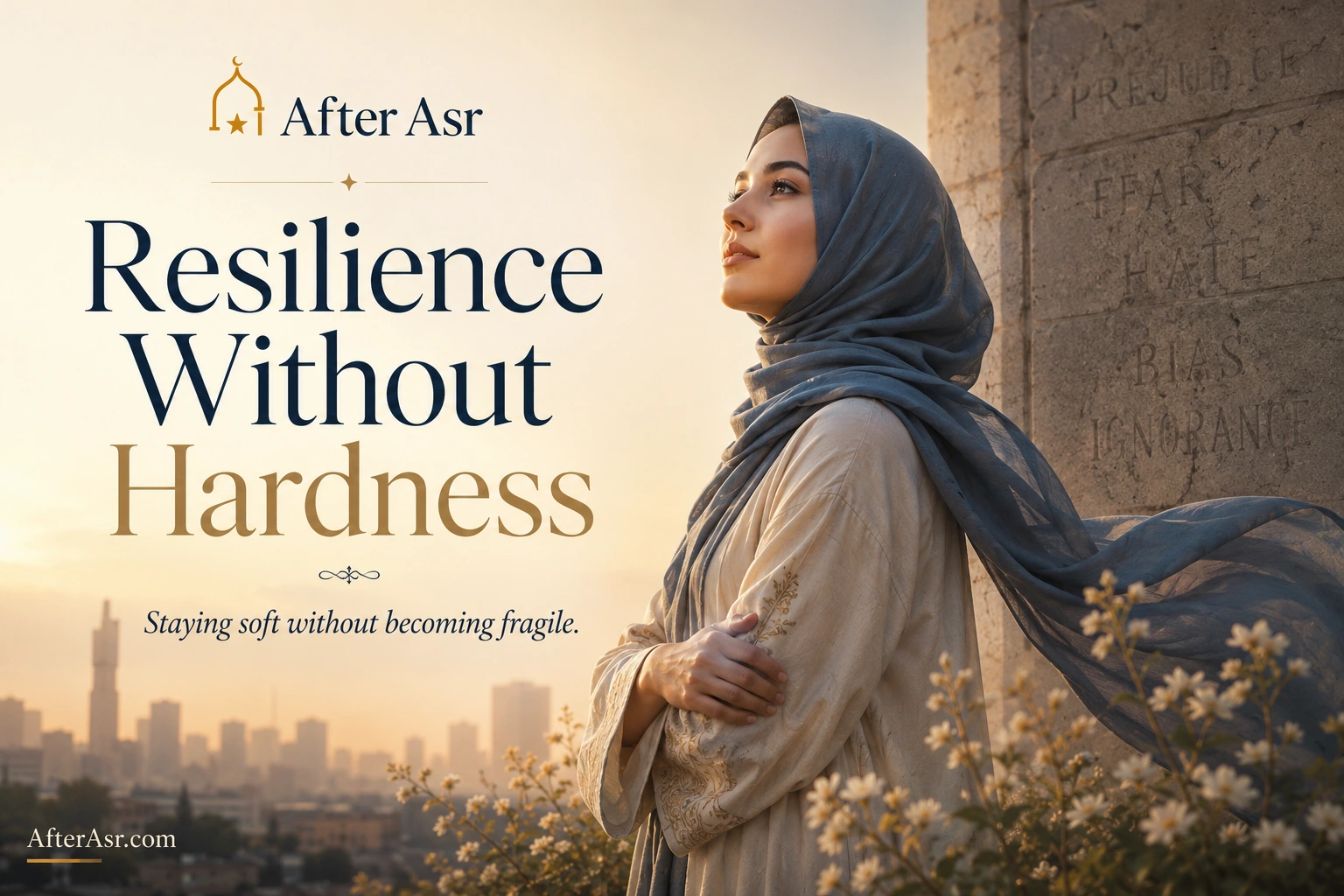
Staying soft without becoming fragile.
Resilience is often misunderstood as the ability to become unaffected.
Do not let it hurt you.
Grow thicker skin.
Ignore it.
Move on.
Be strong.
These phrases are offered as encouragement, but they can carry a hidden demand: become less tender. Feel less. Trust less. Expect less. Protect yourself by closing what remains open.
For Muslims living with prejudice, suspicion, and public hostility, that advice can seem practical. It may even feel necessary. Repeated misreading can exhaust. Repeated explanation can drain. Repeated scrutiny can make guardedness feel like wisdom.
But hardness is not the same as resilience.
Hardness can be a wound that has learned how to hold its shape. Resilience is something more demanding. It is the ability to remain morally alive without pretending harm does not hurt. It is the refusal to let hostility decide what kind of person one becomes.
To stay soft in a harsh environment is not fragility.
It is discipline.
The Pressure to Armor Up
Prejudice teaches people to anticipate injury.
A Muslim woman who is stared at, questioned, or mocked may begin entering public spaces with a defensive posture. A Muslim man who has been treated with suspicion may shorten conversations, avoid eye contact, or assume hostility before it arrives. A student who is repeatedly asked to explain Islam may stop offering warmth altogether. A parent who worries about their children may become cautious in every setting.
These reactions are understandable. They are not character defects. They are often adaptations to stress.
Research on Islamophobia has consistently linked anti-Muslim discrimination to negative mental health outcomes, including psychological distress, anxiety, and depression. A 2018 systematic review found that Islamophobia is associated with poorer psychological well-being, and a public health review described anti-Muslim stigma as a chronic social stressor affecting the health of Muslim communities. (pmc.ncbi.nlm.nih.gov) (pmc.ncbi.nlm.nih.gov)
It is not surprising, then, that people build armor.
The question is what happens when the armor begins attaching itself to the self.
Hardness Can Feel Like Control
Hardness offers certain immediate rewards.
It lowers expectations.
It keeps disappointment at a distance.
It turns vulnerability into sarcasm.
It allows a person to say, “I knew better than to hope.”
When someone has been repeatedly hurt, emotional withdrawal can feel like control restored. If one stops expecting fairness, one cannot be as surprised by unfairness. If one stops offering warmth, one cannot feel as exposed when warmth is not returned.
But the protection is partial.
A hardened person may be less easily wounded, yet also less easily moved. They may become quicker to dismiss kindness, slower to trust sincere questions, less able to receive goodwill when it does appear. They may confuse cynicism with clarity.
Prejudice has already narrowed the world from the outside. Hardness risks narrowing it further from within.
Resilience Is Not Denial
Staying soft does not mean pretending things are fine.
It does not mean smiling through every indignity.
It does not mean explaining endlessly.
It does not mean welcoming disrespect in the name of patience.
It does not mean refusing anger, grief, or exhaustion.
Resilience begins with telling the truth about harm.
A person cannot remain whole by minimizing what has happened to them. They cannot build healthy strength on top of forced denial. Research on minority stress has long emphasized that prejudice-related stress differs from ordinary life stress because it is rooted in stigma and social exclusion. Resilience, in that framework, is not the absence of pain but the presence of resources, meaning, and coping that help people withstand it. (pmc.ncbi.nlm.nih.gov)
Softness is not silence about injury.
Softness is refusing to let injury become one’s entire language.
Tenderness Requires Boundaries
There is a false idea that soft people must be endlessly available.
They must answer every question.
Forgive every offense immediately.
Offer grace without limit.
Remain warm no matter how others behave.
That is not softness. That is depletion.
A resilient person can remain compassionate while also saying no. They can decline a conversation. They can leave a hostile environment. They can correct someone firmly. They can protect their time, their family, and their emotional energy without becoming cruel.
Boundaries are what keep tenderness from becoming self-erasure.
A Muslim who says, “I do not have the energy to explain this today,” is not failing at bridge-building. A parent who removes a child from a harmful space is not overreacting. A student who refuses to debate their humanity in class is not weak. A community that takes safety seriously is not surrendering to fear.
Softness without boundaries collapses.
Softness with boundaries endures.
The Difference Between Gentleness and Passivity
Gentleness is often mistaken for passivity, especially in societies that reward loudness and reaction.
But gentleness can be deliberate. It can be the choice not to mirror hostility. It can be the refusal to let contempt dictate tone. It can be speaking clearly without humiliating. It can be preserving courtesy while rejecting appeasement.
Islamic moral tradition has long valued patience, forbearance, mercy, and restraint, not as signs of weakness, but as qualities requiring strength. In a hostile climate, these virtues can be especially difficult to maintain. The challenge is not to turn them into demands placed only on the wounded, but to recognize them as forms of moral agency when freely chosen.
A person who answers hatred with hatred may feel briefly powerful. A person who refuses to surrender their character to another’s ugliness practices a deeper power.
The first reaction is understandable.
The second is formative.
Anger Has a Place
Softness does not require the absence of anger.
Anger can be truthful. It can signal that something precious has been violated. It can energize protest, advocacy, protection, and reform. A community that never becomes angry at injustice may have confused peace with numbness.
The question is not whether anger is allowed.
It is whether anger becomes one’s permanent climate.
When anger settles into identity, everything begins to look like an attack. Every uncertain interaction becomes evidence. Every disagreement becomes betrayal. Every possibility of connection becomes suspect. In that state, prejudice has succeeded in reorganizing the inner world of the person it targeted.
Resilience allows anger to speak without letting it become the only voice.
It makes room for grief, humor, affection, rest, prayer, and joy alongside resistance.
Joy Is Not Frivolous
Communities under pressure are often expected to speak only in the language of suffering.
To discuss prejudice.
To document discrimination.
To respond to crisis.
To defend their humanity.
All of this matters. But a life organized entirely around injury becomes cramped.
Joy is not a distraction from resilience. It is part of it.
A family meal after a difficult week.
Children laughing at the mosque.
A wedding dance.
A warm Ramadan night.
A friend sending a foolish meme after heavy news.
A quiet prayer that restores proportion.
These moments do not erase hardship. They prevent hardship from monopolizing the self.
Research on well-being among Muslim minorities suggests that identity, belonging, and community connections can buffer some of the negative effects of discrimination. A 2018 study examining Muslims in Italy found that perceived discrimination affected psychological well-being, while multiple identities and belonging played meaningful roles in that relationship. (pmc.ncbi.nlm.nih.gov)
Joy is not denial.
It is evidence that hostility has not acquired total ownership of the soul.
Community Keeps People From Hardening Alone
Resilience is often described as an individual trait. In reality, it is frequently communal.
People remain soft because someone else reminds them that the world is not only cruel. A friend listens without requiring explanation. A parent models dignity. A teacher intervenes. A masjid becomes a place where one is not interpreted through suspicion. A mentor offers perspective before bitterness takes root.
Community does not remove harm, but it can stop harm from becoming isolation.
The public health literature on Islamophobia emphasizes that anti-Muslim hostility affects not only individuals, but communities and systems of belonging. It follows that resilience cannot be reduced to private coping alone. It also depends on social support, institutions, and environments that restore dignity. (pmc.ncbi.nlm.nih.gov)
People harden faster when they feel alone.
They soften more safely when care surrounds them.
The Risk of Mistaking Cynicism for Wisdom
Cynicism often sounds intelligent.
It notices hypocrisy quickly.
It does not trust public promises easily.
It recognizes that institutions can fail and people can disappoint.
These observations may be accurate. But cynicism becomes corrosive when it treats every hopeful act as naive, every gesture of solidarity as insincere, every attempt at dialogue as meaningless.
A cynical person may pride themselves on seeing through illusions. Yet if they can no longer recognize sincerity when it appears, they are not seeing more clearly. They are seeing through a wound.
Resilience asks for discernment instead.
Discernment says: some people are unsafe.
Cynicism says: no one is.
Discernment says: not every invitation deserves acceptance.
Cynicism says: every invitation is a trap.
Discernment protects softness.
Cynicism slowly replaces it.
Resilience Can Include Asking for Help
One of the most damaging expectations placed on people facing discrimination is that they should absorb it gracefully and keep functioning.
But ongoing prejudice can wear on the mind and body. Muslim communities have experienced documented mental health consequences tied to discrimination and Islamophobia, including distress, fear, and anxiety. A public health approach matters precisely because it refuses to treat these effects as private weakness. (pmc.ncbi.nlm.nih.gov)
Seeking help is not fragility.
Speaking with a therapist.
Leaning on family.
Taking rest seriously.
Reducing exposure to harmful media.
Finding spiritually grounded counsel.
Asking one’s community to share a burden.
These are acts of maintenance. A person who wants to remain tender in a harsh world must care for the parts of themselves most likely to grow exhausted.
Even metal fatigues under repeated pressure.
Human beings deserve more gentleness than machines.
Softness Is Not the Same as Accessibility
A person can be warm without being endlessly open.
This matters in public discussions about prejudice, where Muslims are often encouraged to build bridges, answer questions, and model grace. These can be beautiful acts when chosen. But a person is not obligated to make themselves available to everyone who arrives with curiosity, discomfort, or argument.
Remaining soft does not mean remaining reachable by every hand.
One can love people generally and avoid a specific conversation. One can believe in dialogue and decline a particular debate. One can hope for understanding and still recognize that some people are committed to misunderstanding.
Softness protects the human capacity for connection.
It does not require volunteering for every drain upon it.
Moral Clarity Without Cruelty
There is a way to speak plainly about Islamophobia without becoming contemptuous toward everyone outside the community. There is a way to name prejudice without assuming no one can change. There is a way to criticize institutions without forgetting that individuals within them may still act with conscience.
This balance is difficult. It asks for moral clarity without indiscriminate hostility.
Hostility simplifies.
Resilience distinguishes.
Hostility says: hurt back.
Resilience says: respond in a way that does not betray what matters.
Hostility sees softness as vulnerability.
Resilience sees softness as something worth defending.
A person can refuse dehumanization without dehumanizing in return.
That refusal is not always emotionally easy. But it prevents prejudice from reproducing itself through those it harms.
The Right to Be Affected
Sometimes resilience culture becomes another demand.
Do not let it get to you.
Rise above.
Stay positive.
Be bigger than it.
There is wisdom in not letting prejudice define a life. But no one should be shamed for being affected by what is painful. Muslims are allowed to feel tired. Allowed to grieve. Allowed to be angry. Allowed to say that something hurt more than expected.
Resilience is not proven by never trembling.
It is proven by returning to oneself after the tremor.
A person who weeps after humiliation has not failed. A person who needs time after harassment has not become fragile. A child who becomes quiet after bullying does not need a lecture on toughness before they receive care.
The right to be wounded is part of the right to remain human.
What Staying Soft Looks Like
Staying soft may look like many things.
It may look like still greeting people warmly after being stereotyped.
It may look like choosing not to respond harshly when one could.
It may look like laughing again after a difficult season.
It may look like making room for sincere questions while setting limits on bad-faith interrogation.
It may look like raising children to be proud, not brittle.
It may look like refusing to hate oneself, refusing to hate others, and refusing to accept harm as normal.
It may also look like rest.
A person who steps back from public debate to protect their spirit has not abandoned the struggle. They may be preserving the tenderness that gives the struggle its purpose.
The World Needs Muslims Who Remain Whole
A hostile society may expect Muslims to react in predictable ways.
Disappear.
Become apologetic.
Become bitter.
Become constantly defensive.
Become proof of the stereotype.
Resilience disrupts that expectation.
The Muslim who remains thoughtful, affectionate, principled, and awake to beauty does not deny hostility. They deny hostility the final word. They remain capable of friendship without foolishness, critique without contempt, faith without shame, and sorrow without surrender.
That wholeness matters not only for the individual, but for the community. Children need to see adults who are neither naive nor hardened beyond recognition. Communities need leaders who can confront injustice without making anger their only inheritance. Public life needs people who know the cost of cruelty and therefore refuse to imitate it.
Softness is not a decorative virtue.
It is a form of resistance.
Conclusion
Resilience without hardness is the difficult art of remaining open without becoming unprotected, principled without becoming cruel, aware of harm without letting harm hollow out one’s humanity.
Islamophobia can make suspicion feel safer than trust, bitterness feel wiser than hope, and emotional withdrawal feel necessary. Sometimes caution is necessary. Sometimes distance is wise. Sometimes anger is righteous.
But a life built entirely from defense becomes too small for the soul.
The challenge is not to be untouched. It is to be touched without being transformed into what wounded you.
To stay soft is not to be fragile.
It is to guard the part of yourself prejudice most wants to harden.
About the Author
Samira Nasser covers civic belonging, social perception, and the quieter ways prejudice shapes ordinary life, with a focus on Muslim communities in public institutions and culture.