
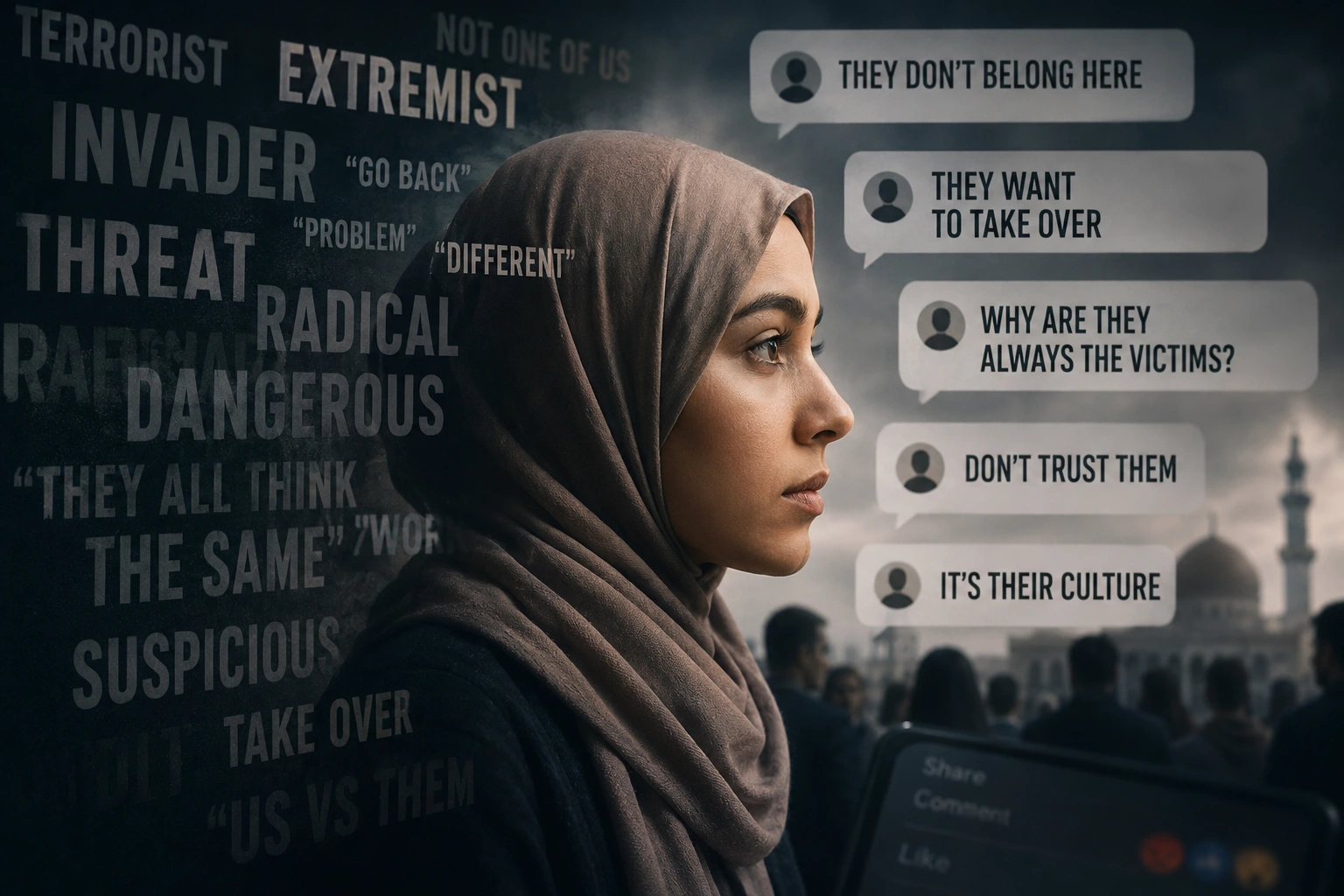
Why wording shapes response.
Language does not merely describe a people.
It prepares us to respond to them.
A word can narrow sympathy.
A phrase can make suspicion sound sensible.
A label can turn a person into a problem.
A metaphor can make cruelty feel like management.
This is why dehumanizing language matters.
It does not always command violence outright. Often, it does something quieter and more foundational: it changes what feels reasonable. It lowers the emotional barrier to exclusion, surveillance, indifference, and aggression. It makes harsh treatment easier to imagine and easier to defend.
For Muslims, this has appeared in repeated descriptions that frame them as threats, infestations, invaders, extremists-in-waiting, incompatible populations, or civilizational dangers. Such language may be presented as politics, security analysis, cultural concern, or blunt honesty. But its effect is often the same. It shifts Muslims away from the category of neighbors and into the category of risks.
The danger of dehumanizing language is not only that it insults.
It reorganizes moral attention.
Words Create Categories Before Policies Do
Before a society acts against a group, it often learns how to speak about that group differently.
People become “waves.”
Communities become “enclaves.”
Faith becomes “ideology.”
Religious practice becomes “radicalization.”
Demographic change becomes “replacement.”
Families become “breeding grounds.”
Entire populations become “problems.”
No single phrase produces public hostility by itself. But repeated language builds categories. It tells audiences what kind of subject they are encountering. Are these people citizens? Believers? Families? Or are they a pressure, a threat, a force entering from outside?
Research on dehumanization shows that explicit denial of another group’s full humanity is associated with more hostile political attitudes and support for punitive responses. In one major four-country study during the European refugee crisis, blatant dehumanization of Muslim refugees was linked to anti-refugee attitudes and behavior even after accounting for political ideology, general prejudice, and empathy.
That matters because language does not merely reflect prejudice already present.
It can give prejudice a structure.
Dehumanization Is Not Always Obvious
When people hear the word dehumanization, they often think of the most extreme historical examples: describing people as vermin, disease, animals, or filth. Those forms are real and dangerous.
But dehumanization can also be more polished.
It can appear when a group is discussed only in terms of danger, burden, utility, or control. It can strip people of complexity without using a slur. It can reduce Muslims to security indicators, migration numbers, voting blocs, demographic anxiety, or public-order concerns.
A 2021 study of British newspaper coverage following a terrorist event found that dehumanizing and distrusting discourse about Muslims appeared more frequently than humanizing and trusting discourse. The study also found meaningful relationships between dehumanization, distrust, and media source orientation.
This is important because language does not need to be vulgar to be dehumanizing.
It only needs to stop treating people as fully human.
The Threat Frame Changes Everything
A person described as “different” may still be approached with curiosity.
A person described as “dangerous” is approached with caution.
A group repeatedly framed as threatening is more easily subjected to exceptional treatment. Ordinary religious practices are interpreted through risk. Public gathering becomes suspicious. Political participation becomes alarming. Advocacy becomes influence. Disagreement becomes evidence of disloyalty.
Threat language compresses interpretation. It asks audiences to notice danger first and humanity second.
A 2024 experimental study found that communicating an outgroup threat in certain linguistic contexts could increase dehumanizing attitudes toward Muslims and Chinese people in India, reinforcing the broader finding that language shapes how groups are perceived under conditions of perceived threat.
The lesson is not that all discussion of danger is prejudiced. Real threats exist and must be addressed accurately.
The lesson is that once threat becomes the dominant frame for an entire population, language begins doing more than warning.
It begins conditioning.
Metaphors Are Moral Instructions
Metaphors are especially powerful because they turn abstract fear into a picture.
If Muslims are described as a “flood,” the implied response is containment.
If Islam is described as a “virus,” the implied response is eradication.
If immigration is described as an “invasion,” the implied response is defense.
If a community is described as “taking over,” the implied response is resistance.
These metaphors may seem rhetorical, but they are not neutral. They place people into categories associated with emergency response, contamination, and war.
Recent linguistic research on dehumanizing metaphor in political discourse has examined how concepts such as water, vermin, and infestation are used to portray outgroups in ways that can intensify exclusionary interpretation.
A metaphor may be only a sentence.
But it also carries a suggested policy instinct.
Wording Can Turn Suffering Into Background Noise
Dehumanizing language is not limited to open hostility. It can also make suffering feel less urgent.
If Muslims are repeatedly described as inherently violent, then violence done to Muslims may receive less sympathy. If Muslim deaths are discussed mainly through the language of “collateral,” “security operations,” or “necessary response,” the human reality becomes easier to blur. If Muslim civilians appear in public language as part of a dangerous landscape rather than as people with names, families, grief, and futures, moral attention weakens.
Research on dehumanization has found links between dehumanizing attitudes and greater support for violence, and a recent meta-analysis concluded that explicit dehumanization has effects distinct from simple dislike when predicting support for violence.
This does not mean every harsh policy begins with a slur. But language that lowers empathy makes harsh policy easier to tolerate.
A society becomes capable of accepting more when it has learned to feel less.
“They” Is Sometimes Doing More Work Than We Notice
Pronouns can seem too small to matter.
Yet the repeated use of “they” and “them,” especially when attached to sweeping claims, can build distance quickly.
“They do not share our values.”
“They refuse to integrate.”
“They hate freedom.”
“They want special treatment.”
“They are changing the country.”
Who exactly is they?
A religious minority?
A political movement?
A fringe organization?
A government abroad?
A local family?
Millions of unrelated people collapsed into one imagined bloc?
Language becomes dehumanizing when it erases distinction. It takes a population marked by class, race, nationality, theology, politics, age, and personal difference, and speaks as though it has one mind.
A group reduced to one voice can be blamed as one body.
Labels Can Smuggle Judgment Into Reporting
Words such as “radical,” “Islamist,” “moderate,” “extremist,” and “traditional” can have legitimate uses. Precision matters. Some movements are extremist. Some political ideologies should be named. Some distinctions are necessary.
But labels also carry judgment, and when applied unevenly, they can distort.
A Muslim public figure may be asked to prove they are “moderate,” while members of other groups are not asked to reassure society before participating. A Muslim charity may be discussed with insinuation in the absence of evidence. A mosque may be described as “conservative” in a tone suggesting latent danger rather than ordinary doctrinal difference.
The problem is not the existence of descriptors.
The problem is when descriptors function as suspicion shortcuts.
Media research on representations of Muslims has found that dehumanizing and distrusting discourse can become embedded in ordinary coverage, especially following violent events that invite broad generalization from perpetrators to populations.
A word may look neutral in isolation.
Its pattern reveals its work.
Dehumanizing Language Often Hides Behind Concern
Open hatred is easier to identify than language framed as concern.
“I’m worried about what they believe.”
“We need to be honest about the threat.”
“This is about protecting our culture.”
“We cannot ignore demographic reality.”
“Some people are afraid to say what is happening.”
These statements are not automatically prejudiced. Concern can be sincere. Public debate requires room for difficult questions.
But concern becomes dehumanizing when it repeatedly portrays Muslims not as participants in society, but as a foreign force acting upon it. It becomes dehumanizing when Muslim life is treated primarily as an object of monitoring, managing, preventing, or resisting.
The tone may remain calm.
The message may still be corrosive.
Language Trains the Public to Expect Certain Responses
If a community is described as a threat, people become more receptive to threat-based policies.
If a group is described as disloyal, surveillance sounds more reasonable.
If a faith is described as inherently violent, collective suspicion appears prudent.
If religious minorities are described as culturally incompatible, exclusion can be reframed as self-defense.
This pattern has been documented in research on blatant dehumanization and policy attitudes toward Muslim refugees, as well as in broader work connecting dehumanizing rhetoric to approval of harsh intergroup responses.
Language creates emotional permission.
It tells people what kind of treatment they should be willing to consider.
Repetition Makes the Harsh Sound Familiar
A single extreme phrase may shock. Repetition dulls that shock.
The first time someone hears Muslims described as a “problem,” they may recoil. The tenth time, the phrase may begin to sound like a policy category. The first time a politician suggests a mosque is a threat, people may object. After years of similar claims, the suggestion may be treated as a recurring debate rather than an alarming prejudice.
Familiarity is powerful. It can transform the unacceptable into the discussable, and the discussable into the normal.
Research on anti-Muslim discourse and public attitudes has repeatedly emphasized how repeated tropes work as means of dehumanization, especially when Muslims are portrayed through ideas of collective violence, disloyalty, or incompatibility.
The danger is not only that language becomes harsher.
It is that the public becomes less startled by harshness.
Wording Shapes Whose Pain Feels Real
Humanizing language gives people texture.
It speaks of families, children, worshippers, neighbors, students, patients, workers, and citizens. It allows people to suffer as individuals, not merely as statistics or side effects.
Dehumanizing language does the opposite. It abstracts. It compresses. It turns people into categories that can be moved around mentally without much moral friction.
A Muslim family targeted by harassment feels different in the public imagination if Muslims have already been discussed mainly as a source of social anxiety. A burned mosque feels different if mosques have been framed as suspicious spaces. A discriminatory law feels different if the public has already been taught that Muslims require unusual containment.
Language helps determine whether an injury is felt as injustice or dismissed as fallout.
That is why wording is not cosmetic.
It is part of moral perception.
“Just Words” Is Never a Serious Defense
People who use dehumanizing language often retreat to the claim that words are being overanalyzed.
They say it was rhetoric.
A joke.
A metaphor.
A provocative way to make a point.
Political theater.
Free speech.
Free speech matters. Public debate matters. Offensive speech cannot be treated as identical to violence.
But neither should language be treated as consequence-free.
The strongest research does not say that every dehumanizing phrase directly causes a violent act. The relationship is more complex than that. Yet evidence does show that dehumanizing language and attitudes are connected to increased tolerance for exclusion, punitive policy, and aggression toward targeted groups.
Words do not have to pull a trigger to help create a climate.
The Speaker Does Not Control the Full Effect
A person may insist they did not intend to dehumanize anyone. Perhaps they meant only to be dramatic. Perhaps they were repeating a phrase heard elsewhere. Perhaps they believed the target was an ideology, not ordinary Muslims.
Intent matters. It can distinguish deliberate hatred from careless rhetoric.
But intent does not cancel effect.
If language repeatedly portrays Muslims as invasive, uncivilized, diseased, disloyal, or dangerous by nature, the broader public does not absorb the speaker’s private disclaimers. It absorbs the frame.
The words enter an existing cultural environment where Muslims are already subject to suspicion. Their effect depends not only on what the speaker says they meant, but on what the audience has been trained to hear.
That is why responsible language requires more than innocence of intention.
It requires awareness of pattern.
Dehumanization Can Be Administrative
Some of the most distancing language is bureaucratic rather than inflammatory.
“High-risk population.”
“Community of concern.”
“Extremism-prone spaces.”
“Vulnerable to radicalization.”
“Preventive intervention targets.”
In some contexts, institutional terminology serves legitimate analytic purposes. But when such labels attach disproportionately to Muslims as a group, they can transform ordinary social life into a field of suspicion.
They turn people into categories to be assessed.
They can make Muslim communities appear less like civic participants and more like management problems.
This is one reason critics of broad counterterrorism frameworks have warned that official language can help normalize unequal scrutiny even when it avoids overt animus. Research on anti-Muslim surveillance and racialized state control has shown how institutions can socialize Muslims into relationships of suspicion through policy, investigation, and categorization.
Dehumanization is not always loud.
Sometimes it arrives in a report.
The Responsibility of Precision
Careful language does not require softness. It requires accuracy.
If a violent extremist group is being discussed, name the group.
If a policy is being criticized, identify the policy.
If a government is responsible, name the government.
If a person committed a crime, hold that person accountable.
If a religious interpretation is in question, specify the interpretation.
What should be avoided is the lazy expansion of particular harm into general suspicion.
Precision protects public discourse from becoming prejudice in formal dress.
It also protects audiences from being manipulated. Vague danger language is emotionally powerful precisely because it does not have to prove much. It suggests enough to unsettle and leaves the audience to fill in the rest.
The more serious the subject, the more precise the wording should be.
Humanizing Language Is Not Euphemism
Some worry that calls for more humane language are attempts to hide reality. They are not.
Humanizing language does not prevent criticism. It improves it.
One can condemn terrorism without treating Muslims as collectively suspect.
One can criticize authoritarian governments without depicting Muslim societies as civilizationally inferior.
One can debate immigration without reducing human beings to floods or infestations.
One can examine religious conservatism without speaking as though believers are beneath empathy.
Humanization is not avoidance.
It is disciplined moral clarity.
The opposite of dehumanization is not flattery. It is accuracy joined to dignity.
What Listeners Can Do
Responsibility does not belong only to speakers. Listeners shape the environment too.
When someone uses a metaphor that turns people into pests, disease, or invasion, challenge it.
When a conversation shifts from criticizing conduct to condemning a whole community, notice the turn.
When a joke depends on making Muslims less human, do not reward it with silence.
When policy discussion relies on vague fear instead of evidence, ask for specificity.
Social norms are built in these moments.
Dehumanizing language spreads when it receives little resistance. It weakens when people refuse to treat it as ordinary.
The intervention does not always need to be dramatic.
Sometimes a simple question is enough:
Who exactly are you talking about?
Conclusion
Language shapes response because it shapes perception first.
It teaches us whether to approach people with curiosity or suspicion, empathy or distance, restraint or aggression. It can preserve complexity, or it can flatten whole communities into threats. It can invite accountability, or it can make collective blame seem reasonable.
For Muslims, dehumanizing language has done real damage by turning faith into danger, visibility into risk, and community into category. It has helped sustain a climate in which ordinary people are too easily spoken about as problems to be managed rather than human beings to be understood.
Words are not everything.
But they are never nothing.
A society that wants to resist Islamophobia must pay attention not only to what it does, but to what it keeps saying until harm begins to sound normal.