Exploring shared values like justice, dignity, and responsibility
When Linda Sarsour stood on the steps of the Lincoln Memorial during the 2017 Women’s March, draped in her trademark hijab and speaking to hundreds of thousands gathered on the National Mall, she invoked both the Constitution and the Quran. “I am unapologetically Muslim American, unapologetically Palestinian American, unapologetically from Brooklyn, New York,” she declared. In that moment, she embodied a truth that often gets lost in America’s culture wars: Islamic values and American ideals are not opposing forces but natural allies.
The narrative of incompatibility between Islam and America is pervasive and persistent. Politicians warn that Muslims want to impose Sharia law. Pundits argue that Islamic values contradict American freedom. Security rhetoric frames Muslims as threats to American civilization. The message is clear: you can be Muslim or you can be American, but you cannot truly be both.
Muslim Americans know better. They live the synthesis every day. They see in the Quran’s call for justice the same spirit that animates the Declaration of Independence’s assertion that all are created equal. They recognize in Islam’s emphasis on human dignity the same principle that underlies American constitutional rights. They understand that the American promise of life, liberty, and the pursuit of happiness resonates deeply with Islamic teachings about the sanctity of life, the freedom of conscience, and the obligation to seek goodness in this world.
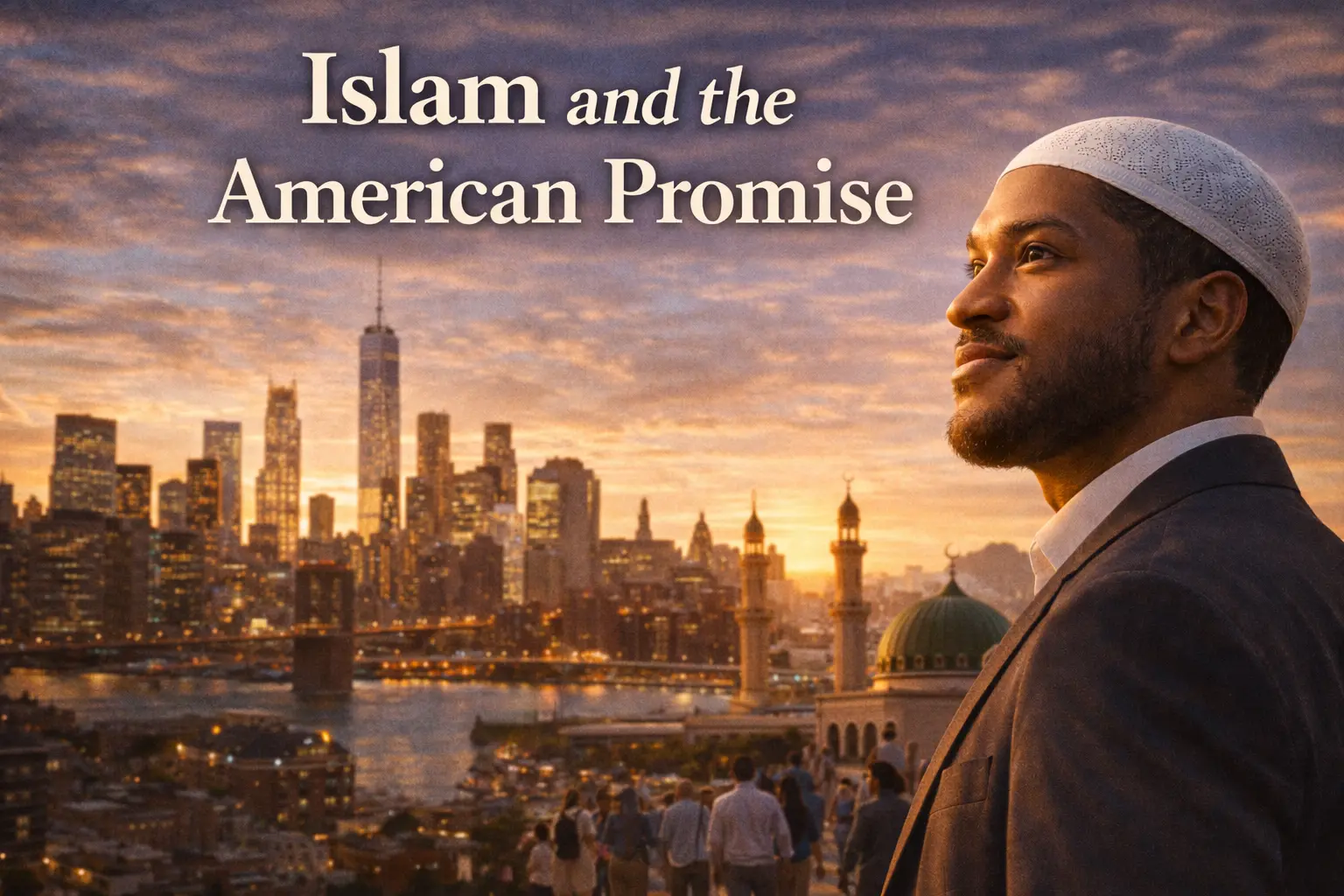
The truth is that Islam and America share far more common ground than most Americans realize. Both traditions value justice, dignity, personal responsibility, community care, and the protection of the vulnerable. Both recognize the importance of balancing individual freedom with collective obligation. Both grapple with the gap between high ideals and imperfect realization. Understanding these convergences doesn’t erase differences or pretend that tensions don’t exist. But it does challenge the narrative of fundamental incompatibility and opens space for Muslims to claim their full belonging in American civic life.
Justice as Foundational Principle
Justice, or ‘adl, stands at the very center of Islamic ethics. The Quran commands believers to “stand firmly for justice” (4:135) and describes Allah Himself as Al-‘Adl, The Just. Islamic law emerged from the pursuit of justice, attempting to protect five essential elements: life, religion, intellect, lineage, and property. The entire Islamic tradition, from the earliest caliphates to contemporary Muslim scholars, grapples with questions of what justice requires and how to achieve it.
Similarly, the American founding elevated justice to first-order priority. The Constitution’s preamble declares that its purpose is to “establish Justice,” placing it before defense, welfare, or liberty. The American experiment rests on the premise that government derives its legitimacy from protecting rights and ensuring equal treatment under law. The nation’s most transformative moments, from the abolition of slavery to the Civil Rights Movement to ongoing struggles for equality, have all been animated by demands that America live up to its promise of justice.
For Muslim Americans, this shared commitment to justice creates natural common cause with broader movements for social change. When they march against police brutality, they’re acting on both Islamic obligation and American promise. When they advocate for living wages and workers’ rights, they’re drawing on both Islamic teachings about economic fairness and American ideals about opportunity. When they defend refugees and immigrants, they’re honoring both Islamic commands to protect the stranger and American identity as a nation of immigrants.
This convergence means that Muslim civic engagement isn’t about importing foreign values but about calling America to its own best principles. When Muslim activists quote both the Quran and the Constitution, they’re not playing a rhetorical game. They’re demonstrating that justice is justice, that the demand for dignity transcends particular traditions, that the work of building a more equitable society belongs to all who believe in it.
The challenge, of course, is that both Islamic societies and American society have often failed to live up to their own justice commitments. Muslim-majority countries have perpetrated injustices in the name of Islam, just as America has perpetrated injustices while claiming to defend freedom. Muslim Americans must grapple with both histories, neither excusing Islamic societies’ failures nor accepting America’s. The commitment to justice requires constant vigilance and critique of all systems that fall short.
Human Dignity and Individual Worth
Islam teaches that human beings are honored by Allah, created in the best form, and appointed as stewards of the earth. Every human possesses inherent dignity by virtue of being human, not because of their accomplishments, status, or identity. This concept, karamah, means that protecting human dignity isn’t optional charity but fundamental obligation.
The American tradition similarly enshrines the principle of inherent human worth. The Declaration of Independence grounds rights not in government grants or social contract but in creation itself. People possess “unalienable rights” simply by being human. The Bill of Rights protects individuals from state power, asserting that there are boundaries government cannot cross regardless of majority will.
Both traditions thus reject the notion that some humans are worth more than others or that dignity can be earned and lost. A poor person and a rich person, a citizen and a non-citizen, a Muslim and a non-Muslim all possess the same fundamental worth. This shared principle creates space for Muslims to advocate for the dignity of all people, not just fellow Muslims, and to find allies among Americans of all backgrounds who share this commitment.
In practice, this means Muslim Americans working to end homelessness, fighting the death penalty, advocating for disability rights, and defending LGBTQ people from violence, even when Islamic teachings create theological tensions around certain issues. The commitment to human dignity means recognizing that people you disagree with still deserve safety, respect, and the protection of their basic rights.
It also means Muslims defending American ideals when they’re threatened. When politicians propose Muslim registries or bans based on religion, Muslims don’t just defend their own rights but the principle that government cannot discriminate based on faith. When surveillance programs target Muslims, the issue isn’t just that Muslims are being watched but that the constitutional protections meant to apply to all Americans are being violated.
This defense of principles rather than mere self-interest represents a mature civic engagement. Muslim Americans aren’t asking for special treatment but for equal treatment. They’re not claiming that Islam should receive privileged status but that religious freedom should mean something. They’re calling America to be America, to honor its commitments, to live up to its promise.
Freedom and Responsibility
Perhaps no value seems more central to American identity than freedom. Yet freedom in Islamic thought is not absence of constraint but liberation from bondage to anything other than Allah. True freedom means freedom from slavery to desires, to social pressure, to tyranny. It means the freedom to choose righteousness, to fulfill one’s purpose, to live in accordance with truth.
This might sound incompatible with American libertarian freedom, the idea that individuals should be able to do whatever they want as long as they don’t harm others. But in practice, even American freedom has never meant unlimited license. It has always been understood as freedom with responsibility, freedom bounded by duties to others, freedom that exists within community rather than in isolation from it.
The Islamic concept of amana, the trust and responsibility that humans bear as stewards of creation, aligns closely with American civic republicanism. Both traditions recognize that freedom requires virtue, that rights come with responsibilities, that individuals must sometimes sacrifice personal desires for collective good. The Muslim who fasts during Ramadan, giving up immediate gratification for spiritual discipline, understands something similar to the American who pays taxes, accepting individual cost for collective benefit.
This shared recognition that freedom and responsibility are intertwined creates space for Muslims to participate fully in American civic debates. When they advocate for regulations to protect the environment, they’re drawing on Islamic teachings about stewardship and American traditions of conservation. When they support public education funding, they’re connecting Islamic emphasis on seeking knowledge with American belief in equal opportunity. When they volunteer in their communities, they’re living out both sadaqah and civic duty.
The tension arises when American individualism pushes toward atomization, toward a freedom so radical that it breaks all bonds of obligation. Islam’s emphasis on ummah, on community and collective responsibility, offers a necessary corrective. Muslim Americans can model a version of freedom that includes care for neighbors, concern for the common good, and willingness to limit personal autonomy for others’ welfare.
Pluralism and Coexistence
One of the most powerful convergences between Islam and American ideals is the commitment to religious pluralism. The Quran explicitly states “there is no compulsion in religion” (2:256) and recognizes that diversity of belief is part of Allah’s plan: “Had Allah willed, He would have made you one nation, but that He may test you in what He has given you” (5:48).
Similarly, America was founded partly by people fleeing religious persecution, and religious freedom became a cornerstone of American identity. The First Amendment’s protection of religious exercise represents a radical experiment: a government that takes no official position on theological truth and protects the rights of all faiths equally.
Both traditions thus create space for genuine pluralism, for different communities to practice their faiths freely while sharing civic space. This doesn’t mean all beliefs are equally true or that differences don’t matter. It means that coexistence is both possible and valuable, that diversity enriches rather than threatens society.
For Muslim Americans, this creates opportunities for deep interfaith engagement. They work alongside Jews, Christians, Buddhists, Hindus, and people of no faith on shared concerns. They build coalitions that cross religious lines, united by common values rather than theological agreement. They demonstrate that you can be firmly committed to your own faith while respecting others’ right to be equally committed to theirs.
This pluralistic engagement sometimes creates tensions within Muslim communities. Some worry that too much interfaith work will water down Islam or lead to religious syncretism. Others argue that Islam’s truth claims are incompatible with treating all religions as equally valid paths. These are real theological questions that deserve serious engagement.
But the pluralism that Islam and America both support doesn’t require religious relativism. It requires something harder: the ability to hold firm convictions while granting others the same freedom you claim for yourself. It means believing Islam is true while defending the rights of non-Muslims. It means building a society where difference is protected rather than merely tolerated.
The Struggle for Realization
Both Islam and America exist in the tension between ideal and reality. Islamic history is full of rulers who violated Islamic principles while claiming to defend them, of injustices perpetrated in Allah’s name, of the gap between what Islam teaches and how Muslims have lived. American history is similarly marked by the distance between promise and practice, from slavery to segregation to ongoing inequalities.
Muslim Americans are uniquely positioned to see both gaps clearly. They experience America’s failure to live up to its ideals when they face discrimination, surveillance, and violence. They also see Islamic societies’ failures when they look at repression, inequality, and injustice in Muslim-majority countries. This dual perspective could lead to cynicism, to giving up on both traditions as hopelessly compromised.
But it can also lead to something more hopeful: the recognition that the struggle to align reality with ideals is itself the work. Justice isn’t achieved once and preserved forever. It requires constant effort, perpetual vigilance, ongoing correction. The Islamic concept of jihad al-nafs, the struggle against one’s own failings, applies equally to collective efforts to build just societies.
Muslim Americans engaged in this work are simultaneously being good Muslims and good Americans. When they protest Islamophobia, they’re defending American constitutional principles. When they advocate for reforms in Muslim-majority countries, they’re calling those societies to Islamic ideals. When they work for criminal justice reform, immigrant rights, or economic equity, they’re drawing on both traditions.
This synthesis doesn’t erase conflicts or pretend that Islam and American secular liberalism agree on everything. They don’t. There are real tensions around questions of religious law, sexual ethics, gender roles, and the relationship between individual autonomy and communal obligation. Muslim Americans navigate these tensions daily, sometimes painfully.
But the existence of tensions doesn’t negate the convergences. It’s possible to have theological disagreements while sharing ethical commitments. It’s possible to maintain distinct religious identity while participating fully in pluralistic civic life. It’s possible to be both Muslim and American not despite each tradition’s values but because of them.
Claiming the Promise
The American promise has never been fulfilled. The declaration that all are created equal was written by slaveholders. The Constitution that established justice denied rights to women and people of color. America’s highest ideals have coexisted with brutal realities from the beginning.
Muslim Americans understand this because they live it. They are told they belong while being treated as outsiders. They are promised equality while facing systematic discrimination. They are invited to be American while being asked to prove their loyalty in ways others never must.
Yet many Muslim Americans choose to claim the promise anyway. They insist that America’s ideals, however imperfectly realized, are worth fighting for. They point out that those ideals align closely with Islamic values and that working for justice in America is a form of Islamic practice. They refuse to accept that being Muslim makes them less American or that being American requires abandoning Islam.
This is not naive optimism. It’s strategic engagement grounded in both Islamic tradition and American history. Every marginalized group that has gained rights in America has done so by holding the nation accountable to its own stated principles. The abolitionists quoted the Declaration of Independence. The suffragists cited Constitutional equality. The Civil Rights Movement appealed to American ideals even as it exposed American hypocrisy.
Muslim Americans are doing the same. They’re saying: you claim to believe in religious freedom, so protect our mosques. You claim to value justice, so end discriminatory profiling. You claim all people are created equal, so treat us accordingly. This is not asking for special favors. It’s demanding that America be America.
At the same time, Muslims are enriching American civic life by bringing Islamic perspectives to public debates. They’re offering critiques of excessive individualism, models of community care, and frameworks for balancing freedom with responsibility. They’re expanding American pluralism by their very presence, forcing the nation to grapple with religious diversity more seriously.
The convergence between Islamic values and American ideals suggests that Muslims aren’t foreign to America’s story but essential to it. The struggle for justice, the commitment to human dignity, the balancing of freedom with responsibility, the building of pluralistic community, these aren’t Muslim concerns or American concerns. They’re human concerns that both traditions address and that Muslims in America are uniquely positioned to advance.
Islam and America both promise something better than what currently exists. Both call believers to close the gap between ideal and reality. Both require struggle, sacrifice, and hope. For Muslim Americans, living at the intersection of these traditions means inheriting both promises and both struggles. It means being twice obligated and twice capable. It means claiming their full inheritance, Islamic and American, and using both to build something new.
The American promise is incomplete. So is the Islamic promise as lived by human communities. But the work of completion is the same work: justice, dignity, responsibility, pluralism, the struggle to build societies worthy of the ideals that inspired them. Muslim Americans are not outside that work. They are central to it. And the values they bring, drawn from both Islam and America, are exactly what that work requires.