The evolving role of masjids as community, education, and civic centers
On a typical Saturday at the Islamic Center of Greater Cincinnati, the building pulses with activity that has little to do with prayer. In one corner, a dozen teenagers huddle over laptops for a coding workshop. Down the hall, elderly women gather for a health screening, checking blood pressure and discussing diabetes management in Urdu, Arabic, and English. The gym hosts a youth basketball tournament, sneakers squeaking on polished floors while parents cheer from folding chairs. Upstairs, a financial literacy class teaches families about halal investing and retirement planning. The food pantry distributes groceries to anyone who needs them, Muslim or not.
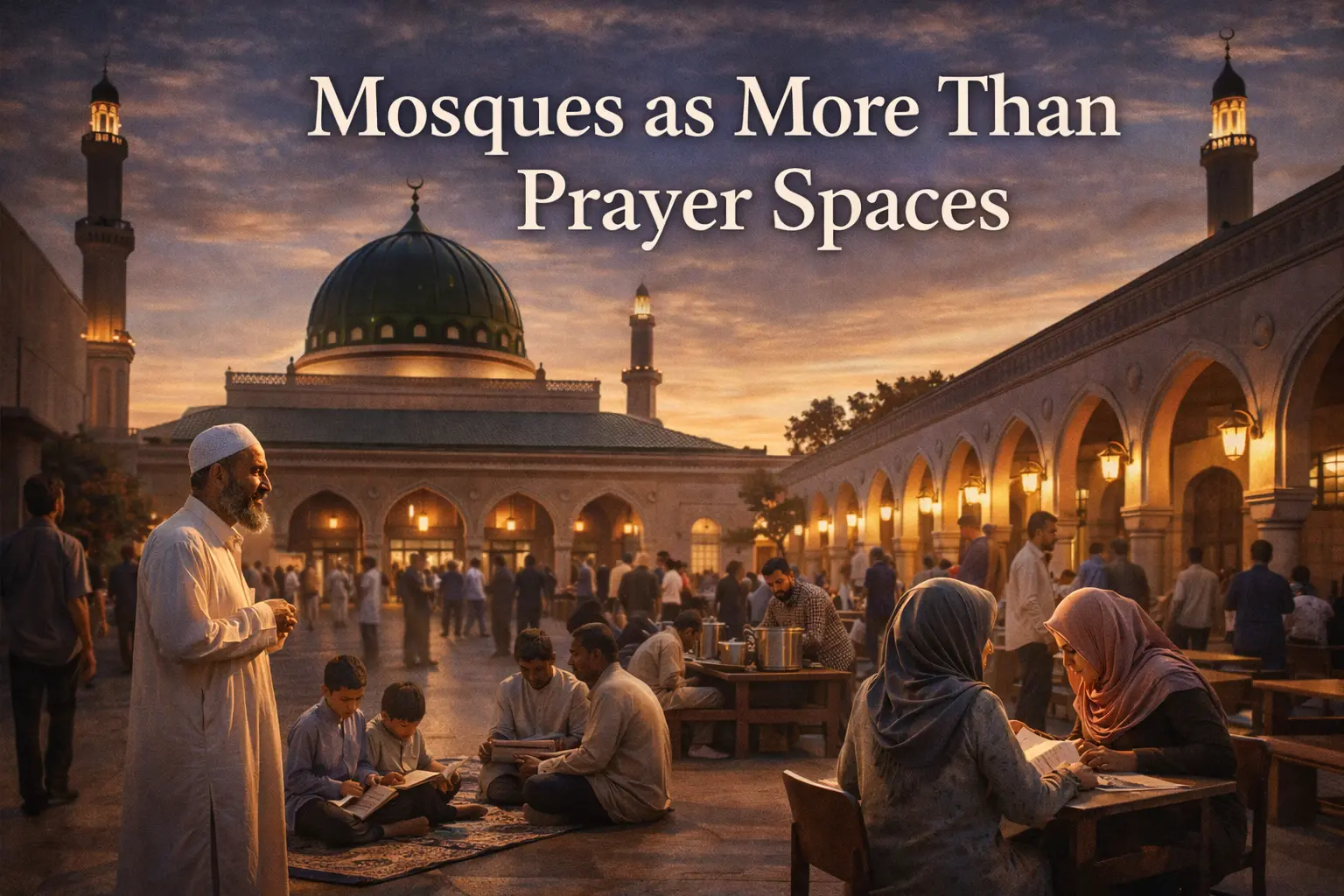
This is what an American mosque looks like in 2026. Yes, five times a day the adhan still calls the faithful to prayer, and on Fridays the main hall fills for Jumu’ah. But increasingly, mosques in America function as comprehensive community centers, serving needs that extend far beyond the spiritual. They are schools and social service agencies, cultural preservation societies and civic organizing hubs, mental health resources and youth development programs. They are where immigrants learn English, where teenagers learn their faith, where families celebrate weddings and mourn losses, where communities mobilize for justice and gather for iftar.
The American mosque has become something distinct from its counterparts elsewhere in the Muslim world, shaped by the particular challenges and opportunities of practicing Islam in a minority context. Understanding this evolution reveals not just how Muslims worship in America, but how they build community, transmit culture, and claim space in a society that often marginalizes them.
From Prayer Room to Institution
The first mosques in America were humble affairs. Immigrant workers in the early 20th century gathered in apartments and storefronts, simply needing a place to pray together. The focus was basic: provide a clean space for salah, ensure proper orientation toward Mecca, accommodate the handful of families who shared their faith and often their language.
As Muslim communities grew and established themselves economically, they built proper mosques. These early structures often mimicked the architecture of the old country, complete with minarets and domes, physical assertions of Islamic identity in an unfamiliar landscape. But the buildings’ functions quickly expanded beyond what their designers might have imagined.
The expansion was driven by necessity. Muslim immigrants needed more than prayer. They needed their children to learn Arabic and understand Islam. They needed halal meat and guidance on American systems they didn’t understand. They needed connection to others who shared their experience of navigating life between cultures. The mosque became the obvious gathering point for all of it.
By the 1970s and 80s, purpose-built Islamic centers were incorporating classrooms, libraries, and multipurpose halls into their designs. The Islamic Society of North America (ISNA) and other national organizations promoted a model of the mosque as comprehensive community center. Board meetings focused as much on curriculum development and youth programming as on prayer schedules and religious programming.
Today, a large American mosque might employ a full-time imam, a youth director, a Sunday school coordinator, a community outreach liaison, and administrative staff. Its annual budget could reach hundreds of thousands or even millions of dollars. Its facility might include a prayer hall, separate women’s section, classrooms, kitchen, gym, library, counseling offices, and outdoor recreational space. It functions less like a traditional masjid and more like a combination of church, community center, and cultural organization.
Weekend School and Identity Formation
Walk into almost any American mosque on a Sunday morning and you’ll find one of its most vital functions: weekend Islamic school. Children who attend public school Monday through Friday come to the mosque to learn what those schools won’t teach them, Arabic language, Quranic recitation, Islamic history, and the practices of their faith.
These Sunday schools serve a purpose beyond religious education. They are where second and third-generation Muslim kids meet other Muslim kids, where they realize they’re not the only ones who can’t eat pepperoni pizza or who leave class during Christmas parties. The friendships formed here often last a lifetime, creating networks of young Muslims who understand each other’s particular experience of American Islam.
The curriculum at these schools reveals the distinctive concerns of American Muslims. Yes, children memorize surahs and learn the pillars of Islam, but they also discuss how to explain their faith to non-Muslim friends, how to handle Islamophobia, and how to maintain Muslim identity in a culture that often contradicts Islamic values. They learn not just what Islam is, but how to be Muslim in America.
For parents, especially immigrants, these programs represent hope that their children will maintain the faith. The fear that kids will drift away from Islam in the face of assimilation pressure is profound and near-universal. The mosque becomes the container for cultural and religious transmission, the place where parents entrust their community to help raise children who are both confidently American and proudly Muslim.
But weekend schools also reveal tensions. How much should curriculum focus on cultural traditions versus universal Islamic principles? Should classes be segregated by gender, and if so, starting at what age? Should Arabic be taught in classical form or in spoken dialects? These debates play out in mosque board meetings and parent committees, reflecting larger questions about what American Islam should look like.
Social Services and Mutual Aid
The mosque food pantry has become a fixture in many communities, serving Muslims and non-Muslims alike. So have emergency assistance funds for families facing eviction or medical crises, job placement services connecting community members with employment, and translation services helping immigrants navigate bureaucracy.
This social service function draws on deep Islamic tradition. Zakat and sadaqah, the mandatory and voluntary charity that are central to Islamic practice, have always meant Muslims caring for the vulnerable among them. But in America, where many Muslim immigrants arrived with little and where Muslim refugees continue to resettle, the mosque often serves as the primary safety net.
Some mosques have formalized this role considerably. They partner with food banks and homeless shelters. They offer mental health counseling, addressing the stigma around therapy in many Muslim cultures by providing culturally competent, faith-informed services. They run domestic violence programs, helping women in difficult marriages navigate options within an Islamic framework. They provide immigration legal services, helping families with paperwork and connecting them with attorneys.
The coronavirus pandemic accelerated this evolution. When COVID-19 hit, mosques mobilized. They distributed masks and food, coordinated mutual aid, hosted vaccine clinics, and checked on isolated elderly members. The infrastructure they had built for community care proved adaptable to crisis response.
This expansion into social services reflects a theological shift as well. American Muslim leaders increasingly emphasize that Islam is not just about individual piety but collective responsibility, that worship means nothing without justice, that true devotion to Allah requires serving His creation. The mosque becomes the vehicle for living out this understanding.
Civic Engagement and Political Organizing
The mosque has also become a site of political consciousness and civic engagement. Voter registration drives happen in mosque parking lots. Candidates for local office speak at community iftars. Know-your-rights workshops teach Muslims how to respond if approached by law enforcement. Immigration lawyers hold clinics after Friday prayer.
This represents a significant evolution. Older generations of Muslim immigrants often avoided politics, focusing on establishing themselves economically and maintaining low profiles. The mosque was meant to be apolitical, a refuge from the complications of American public life.
But events forced a change. Post-9/11 surveillance, hate crimes, immigration bans, and anti-Muslim rhetoric from political leaders made clear that political disengagement was not an option. Young Muslims, especially, pushed their communities toward activism. The mosque became a natural organizing space.
Some mosques now explicitly incorporate civic engagement into their mission. They form political action committees, endorse candidates, mobilize voters, and train community members in advocacy. They join interfaith coalitions working on issues from affordable housing to criminal justice reform. They send delegations to city council meetings and state legislatures.
This politicization makes some members uncomfortable. They worry that partisan politics will divide the community or that tax-exempt status could be jeopardized. They argue the mosque should focus on spirituality, not activism. But others counter that political engagement is religious obligation, that protecting the community and serving justice are Islamic imperatives.
The tension is ongoing and generative. It forces American Muslims to grapple with questions about the relationship between faith and politics, about whether mosques should be sanctuaries from the world or launching pads into it.
Women’s Spaces and Contested Access
The question of women’s access to mosques remains one of the most contentious issues in American Muslim communities. Many mosques still relegate women to cramped basements, back rooms, or separate buildings. Women often cannot see or hear the imam, cannot ask questions during lectures, and are expected to pray at home rather than in the main hall.
But this is changing, slowly and unevenly. Some mosques have created beautiful, spacious women’s sections with clear views of the imam and dedicated entrances. Others have removed physical barriers entirely, allowing men and women to pray in the same space with women in rows behind men. A few have gone further, allowing women to give khutbahs and lead mixed-gender prayers, though this remains controversial.
The push for women’s access comes from multiple directions. Muslim feminists argue that the Prophet’s mosque in Medina welcomed women and that contemporary exclusion contradicts both Islamic tradition and American values of equality. Young women raised in America expect to be included and heard. Converts, particularly white American women, bring expectations shaped by their previous religious experiences or lack thereof.
The resistance is equally multifaceted. Some cite scholarly opinions that women’s prayer at home is superior. Others worry about inappropriate mixing or that women’s presence will distract male worshippers. Still others see women’s demands for access as Western feminism corrupting Islamic tradition.
These debates play out in board elections, community meetings, and occasional public controversies. They reveal differing visions of what an American mosque should be and whose needs it should prioritize. The outcomes vary wildly from community to community, creating a patchwork of practices across American Islam.
Youth Culture and the Third Space
For American Muslim teenagers, the mosque often serves as a crucial third space, neither home nor school but somewhere they can fully be themselves. Youth groups, sports leagues, and social events give young Muslims community with others who share their identity.
Progressive mosques have embraced this function enthusiastically, creating youth lounges with game consoles and basketball hoops, hosting open mic nights where teens perform spoken word poetry, and organizing weekend retreats that combine Islamic education with team-building activities. They hire young, culturally fluent youth directors who can speak to teenagers’ actual concerns rather than lecturing them.
This investment in youth programming reflects recognition that young people are the future of American Islam. If they find the mosque irrelevant or unwelcoming, they’ll leave, and they may not come back. So mosques work hard to make themselves spaces where questions are welcomed, where doubt is not punished, where being Muslim and being American don’t have to conflict.
But youth programming also reveals generational divides. Older community members sometimes view youth activities as frivolous, questioning why donations should fund basketball tournaments rather than religious education. They worry that catering to young people means watering down Islam, that too much accommodation to American culture will erode faith rather than preserve it.
The tension is creative. It forces communities to articulate what’s essential and what’s negotiable, where boundaries should be and where flexibility serves the larger goal of keeping young Muslims connected to their faith and their community.
The Mosque as American Institution
What emerges from all of this is a distinctly American institution. The mosque in America is not quite like the masjid in Cairo or Karachi or Istanbul. It carries more functions, serves more purposes, and operates in a context where Muslims are a minority navigating a secular society.
This American mosque is a hybrid creation, shaped by Islamic tradition but adapted to American realities. It preserves the essential, five daily prayers, Jumu’ah, community gathering for worship, while innovating around the needs that ancient scholars could not have anticipated. It creates space for people to be Muslim in a way that honors both their faith and their citizenship.
The evolution continues. As American Muslim communities mature, as new generations take leadership, as the challenges shift and new needs emerge, the mosque will keep adapting. Some mosques will become more progressive, others more conservative. Some will embrace their role as civic institutions, others will retreat toward purely spiritual functions. The diversity itself is American.
What remains constant is the centrality of the mosque to Muslim American life. It is still where people go to pray, yes. But it is also where they go to belong, to learn, to serve, to organize, to celebrate, to mourn, and to figure out what it means to be Muslim in America.
The mosque has become more than a prayer space. It has become home.