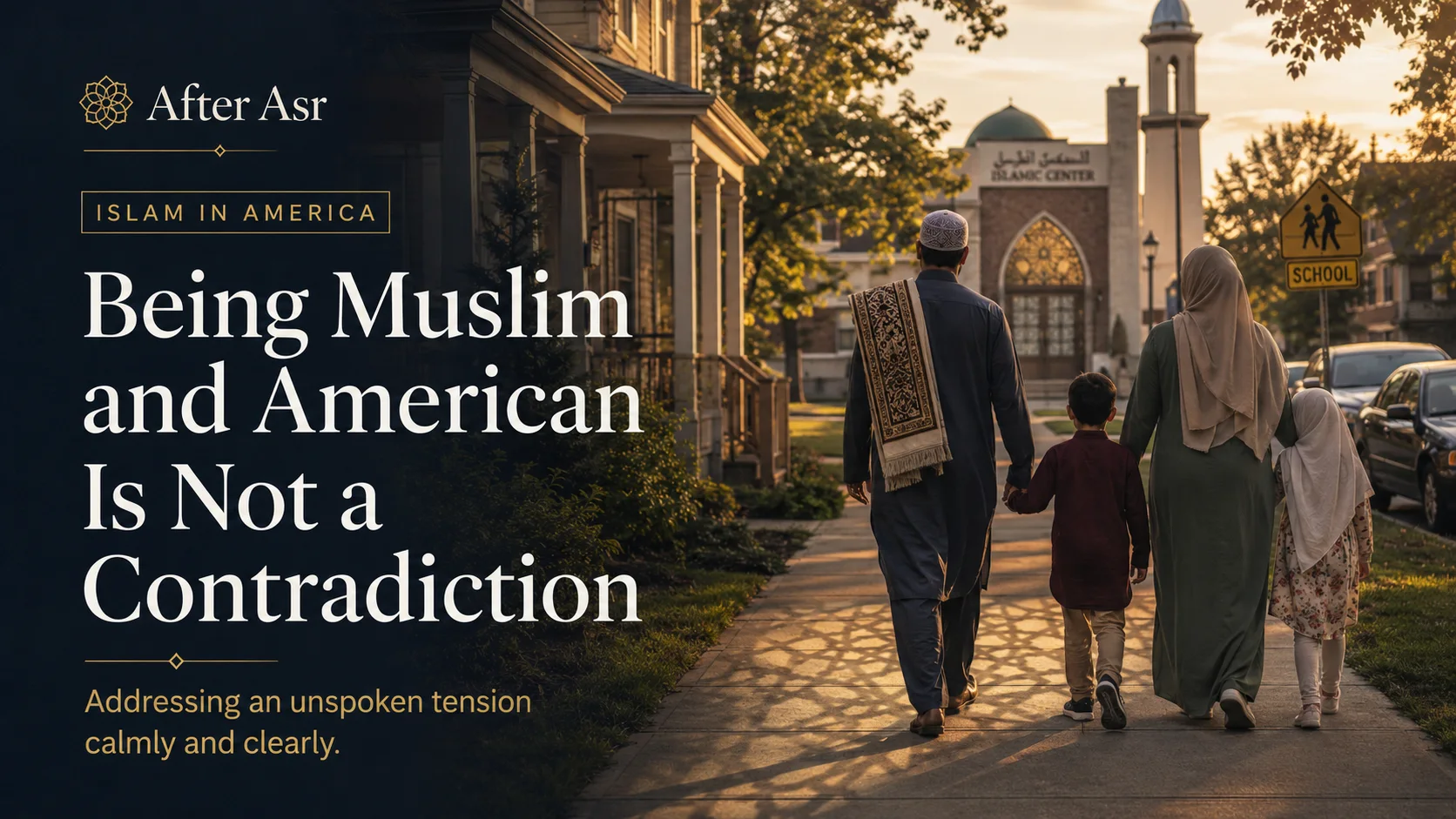
Addressing an unspoken tension calmly and clearly.
There is a question many American Muslims learn to hear even when no one says it aloud.
Can you really be both?
Can you be fully Muslim and fully American? Can you belong to a country whose public rhythms are not built around salah, Ramadan, Eid, halal food, modesty, or the remembrance of Allah? Can you love your neighbors, serve your town, work honestly, vote thoughtfully, attend school meetings, cheer at a child’s graduation, and still refuse to make America the center of your soul? Can you be grateful for the blessings of this country without pretending it is morally innocent? Can you be critical of injustice without being accused of disloyalty? Can you carry a passport and still know that your highest allegiance is to Allah?
The answer is yes, but not because the tension is imaginary.
It is possible to be Muslim and American without contradiction, but only if we understand what each identity means and what each one does not mean. Islam is not a nationality. America is not a religion. Citizenship is not worship. Belonging is not surrender. Gratitude is not blindness. Critique is not betrayal. Faithfulness to Allah does not require hatred of one’s country, and participation in American life does not require dilution of one’s faith.
The confusion often comes from treating American identity as though it must be total. As though to be American means accepting every cultural assumption, every public value, every historical myth, every political mood, and every moral trend. Muslims cannot do that. But no serious religious person can do that. A believer belongs to Allah first, and every earthly belonging is measured beneath that.
This does not make Muslims less American. It makes them people of conscience within America.
America is a place, not a lord
For Muslims, the first clarity is theological.
Allah is Lord. No nation is. No flag is. No constitution is. No party is. No culture is. No public opinion is. No market is. No historical story is. No military power is. No social movement is. The Muslim’s deepest identity is not produced by geography, ancestry, race, language, or citizenship. It is received through submission to Allah.
This does not erase worldly belonging. Islam does not ask human beings to float above place as though families, languages, neighborhoods, and histories do not matter. People are born somewhere, raised somewhere, buried somewhere. They develop accents, memories, tastes, loyalties, and responsibilities. They learn streets and seasons. They care about schools, hospitals, parks, neighbors, local businesses, and the safety of children. They become attached to places because human life is lived in places.
But attachment is not worship.
A Muslim can love a hometown without making it sacred. A Muslim can appreciate the freedoms they have in America without pretending those freedoms are perfect or equally experienced by all. A Muslim can respect civic institutions without believing they are ultimate sources of justice. A Muslim can serve society without treating society as the judge of truth.
This distinction matters because much of modern national identity asks for more than civic responsibility. It asks for emotional submission. It wants people to feel that the nation is the highest family, the final moral horizon, the thing for which all other loyalties must be softened. Muslims cannot accept that. Our highest loyalty is already claimed.
And yet, that loyalty to Allah should make Muslims better neighbors, not worse ones. It should make them more honest, more merciful, more disciplined, more trustworthy, more concerned with justice, and more careful with their obligations.
To say America is not a lord is not to reject living responsibly within America. It is to put responsibility in its proper order.
The difference between belonging and assimilation
Many Muslims in America feel pressure to prove they belong.
Sometimes the pressure is direct. A question, a suspicion, a hostile comment, a demand to condemn, a workplace joke, a classroom stare, a political slogan. Other times it is more subtle. A sense that Muslim practices are tolerated only when they are quiet. A sense that Islam is acceptable as culture, food, fashion, or family tradition, but less acceptable when it becomes law, worship, moral conviction, and public boundary.
In response, some Muslims try to solve the problem through assimilation. They make Islam appear smaller. They avoid religious language. They turn Ramadan into wellness, hijab into personal style only, zakat into charity without worship, and salah into mindfulness with Arabic. They present Muslim life as identical to everyone else’s life, with a few harmless decorations. They hope that if Islam seems familiar enough, the suspicion will fade.
But assimilation is not the same as belonging.
Belonging means living in a place with dignity, responsibility, and relationship. Assimilation means being absorbed until one’s distinctiveness becomes decorative or disappears. Belonging allows Muslims to be known truthfully. Assimilation rewards Muslims for becoming less legible as Muslims.
American Muslims should not have to choose between isolation and erasure. They can belong without dissolving. They can speak English and say Allah. They can participate in public life and keep halal. They can wear a suit, scrubs, work boots, a uniform, a hoodie, a hijab, a kufi, a thobe, jeans, or an abaya, and still be part of the American story. They can attend PTA meetings and pray Maghrib. They can serve in hospitals and fast Ramadan. They can run businesses and close for Jumu’ah. They can live in suburbs, cities, small towns, farms, military bases, college campuses, and apartment complexes, while remaining recognizably Muslim.
The goal is not to appear less Muslim so America can accept us.
The goal is to live as Muslims with such steadiness that belonging no longer requires self-erasure.
Muslims have been here
One reason the supposed contradiction persists is historical forgetfulness.
Many Americans imagine Islam as recently arrived, foreign, imported, or permanently external to the national story. This is not true. Muslims have been present in what became the United States from the beginning, including enslaved African Muslims whose names, prayers, literacy, resistance, and spiritual lives are too often buried beneath simplified histories. Later came communities shaped by immigration, trade, labor, scholarship, prison ministry, military service, civil rights struggle, entrepreneurship, education, and conversion.
The American Muslim story is not one story. It includes Black Muslims whose presence is foundational, immigrant families who built institutions while navigating new languages and systems, converts who found Islam in churches, prisons, universities, books, friendships, marriages, military service, online lectures, and quiet personal searching. It includes Muslims in cities and small towns, doctors and truck drivers, teachers and janitors, scholars and students, refugees and veterans, business owners and farmers, public servants and stay-at-home parents.
To say Muslims are part of America is not a plea for inclusion. It is a statement of fact.
But this history does not need to be used defensively, as though Muslims must prove they have been here long enough to deserve dignity. Human dignity does not depend on arrival date. A newly arrived refugee and a family rooted here for generations both deserve justice. Still, historical memory matters because it corrects the false idea that Islam is somehow incompatible with American soil.
Islam did not arrive yesterday. It has prayed here, suffered here, labored here, taught here, been misrepresented here, served here, and grown here.
The question is not whether Islam can exist in America. It already does.
The better question is whether America is willing to understand the Muslims who are already part of it, and whether Muslims are willing to build with confidence rather than apology.
Citizenship as responsibility, not identity replacement
For Muslims, citizenship can be understood as a form of responsibility.
It involves obeying just laws, honoring contracts, paying what is owed, protecting neighbors, contributing to public good, speaking truthfully, resisting injustice through lawful and ethical means, and caring about the conditions in which people live. A Muslim citizen should not be indifferent to hunger, poverty, racism, violence, schools, housing, prisons, healthcare, corruption, family breakdown, or the loneliness of neighbors. These are not merely political issues. They are human concerns with moral weight.
But citizenship should not replace religious identity.
A Muslim does not become morally serious because the state recognizes them. A Muslim does not become dignified because they are praised as a good citizen. A Muslim does not become trustworthy because they are useful to public institutions. The believer’s moral life begins before and beyond the state. It begins with Allah.
This helps Muslims avoid two mistakes.
The first mistake is withdrawal. Some think that because America is not built upon Islamic foundations, Muslims should disengage from civic life entirely. But withdrawal can become neglect. If Muslims live in a place, their neighbors have rights. Their children attend schools. Their families use roads, hospitals, courts, and public services. Their communities are affected by policy, zoning, policing, education, and social conditions. To live somewhere without caring about its moral condition is not piety. It may be irresponsibility disguised as purity.
The second mistake is absorption. Some become so eager to prove civic belonging that Islam becomes secondary to public approval. They speak only in the language of the dominant culture. They measure Muslim value by whether Muslims are seen as productive, patriotic, moderate, diverse, or useful. But a Muslim’s worth is not determined by civic branding.
Citizenship is real. It matters. It has duties.
But it is not the deepest name of the believer.
Gratitude without mythmaking
Many Muslims are grateful for life in America.
They may be grateful for safety, education, work, religious freedom, economic opportunity, civil rights protections, public libraries, local friendships, professional paths, and the ability to build mosques, schools, businesses, and families. Some came from places marked by war, authoritarianism, corruption, poverty, or instability. Some were born here and feel attached to the landscapes, accents, foods, humor, music, seasons, and local customs of their regions. Some have served in the military. Some have built businesses from very little. Some have found Islam here.
Gratitude is not wrong. In fact, Muslims should be people who recognize blessings.
But gratitude does not require mythmaking.
A Muslim can be grateful for America’s blessings while still telling the truth about slavery, Indigenous dispossession, racism, anti-Blackness, Islamophobia, poverty, unjust wars, incarceration, exploitation, and moral confusion. To name these realities is not ingratitude. It is honesty. Love of place should not require lying about place.
This is especially important for Muslim communities because the experience of America is not the same for everyone. An affluent Muslim professional in a diverse suburb may experience America differently from a Black Muslim family navigating racism, a refugee family navigating trauma, an undocumented Muslim worker fearing exposure, a rural convert living far from community, or a Muslim student facing harassment at school.
There is no single American Muslim feeling about America.
Some feel gratitude. Some feel suspicion. Some feel both. Some feel belonging. Some feel conditional acceptance. Some feel rooted in the country and estranged from its culture. Some feel safer here than anywhere else. Some feel exhausted by being treated as foreign in the only country they have ever known.
A mature Muslim conversation allows this range. It does not demand patriotic performance, and it does not demand permanent bitterness. It allows people to tell the truth about blessings and wounds.
Critique is not betrayal
One of the most damaging assumptions in public life is that critique equals disloyalty.
This assumption has often been used against minorities, religious communities, dissenters, and people who point out injustice. Muslims know this pressure well. If they speak about foreign policy, civil rights, surveillance, discrimination, school bullying, workplace bias, zoning battles, or media misrepresentation, they may be accused of being ungrateful, divisive, or insufficiently American.
But a society that cannot receive critique is not made stronger by silence. It is made weaker.
Muslims have a moral obligation to stand for justice, including when injustice occurs in the place they call home. This obligation should be carried with wisdom, knowledge, and adab, not with reckless anger or partisan reflex. But it cannot be abandoned because people are uncomfortable.
In fact, critique can be a form of responsibility. A parent who criticizes a school policy may be trying to protect children. A mosque that challenges unfair zoning may be defending religious freedom. A Muslim organization that documents discrimination may be asking society to live up to its stated principles. A citizen who opposes harm done in their name may be acting from conscience, not hatred.
The Islamic tradition does not teach blind loyalty to power. It teaches truthfulness, justice, and accountability before Allah. That means Muslims must avoid both shallow nationalism and shallow rebellion. Not every criticism is wise. Not every slogan is true. Not every public cause is righteous. Not every policy disagreement is a spiritual battle. But when something is unjust, Muslims should not be shamed into silence by accusations of disloyalty.
A Muslim can want good for America and still refuse to flatter it.
American culture is not one thing
Another reason Muslims feel tension is that “American culture” is often spoken of as though it were singular.
But America is not one culture. It is many. Southern, Midwestern, Black, Latino, Indigenous, Appalachian, immigrant, suburban, urban, rural, coastal, military, academic, working-class, religious, secular, and countless local cultures overlap and conflict. A Muslim in Myrtle Beach does not live the same American life as a Muslim in Dearborn, Brooklyn, Houston, Minneapolis, Atlanta, Los Angeles, rural Iowa, or a small town in South Carolina. A Black Muslim family with deep American roots may experience “American culture” very differently from a recent immigrant family learning the school system. A white convert may inherit one set of cultural codes and enter another. A Muslim veteran may carry a different relationship to the nation than a Muslim refugee.
This diversity matters because Muslims sometimes speak about “American culture” only as a threat. There are certainly threats: consumerism, sexual permissiveness, individualism, racism, loneliness, addiction, materialism, relativism, and the pressure to make the self sovereign. These are serious. But American life also contains neighborliness, volunteerism, local service, constitutional protections, generosity during disasters, religious freedom, educational opportunity, civic association, and traditions of moral reform.
Muslims should be discerning, not simplistic.
The task is not to accept American culture wholesale or reject it wholesale. The task is to measure what we encounter by Islam. Some things can be embraced. Some can be adapted. Some must be resisted. Some are neutral. Some are harmful in one context and useful in another. Some cultural habits may even help Muslims practice virtues they already value, such as punctuality, transparency, public service, or respect for agreed rules.
Islam gives Muslims a criterion. Without that criterion, Muslims may either absorb everything around them or reject everything out of fear. Both are signs of insecurity. A confident Muslim community can say yes, no, and not like that.
The immigrant child and the inherited question
For many second-generation Muslims, the question of being Muslim and American is not theoretical. It is childhood.
They may grow up with parents who speak another language at home, attend public school in English, eat cultural foods at family gatherings, eat pizza at school events, memorize Qur’an on weekends, watch classmates celebrate Christmas, explain Ramadan annually, translate mail for grandparents, learn to code-switch between elders and peers, and wonder which parts of their family culture are Islam and which parts are simply culture.
They may be told by non-Muslims that they are not really American. They may be told by relatives that they are too American. They may feel they are disappointing both worlds.
This is a heavy inheritance.
Muslim parents often want to protect children from the moral dangers of American society. That concern can be sincere and necessary. But if parents speak of America only with fear or contempt, children may feel that the place they know as home is spiritually suspect. If parents treat every American habit as corruption, children may struggle to distinguish real Islamic boundaries from cultural anxiety. If parents dismiss their children’s American experiences, the children may begin to hide rather than seek guidance.
At the same time, children need to understand that not every desire for belonging is innocent. Peer culture can be cruel. Schools can normalize what Islam does not permit. Media can shape the heart. The wish to fit in can slowly become a willingness to compromise.
The solution is not panic. It is formation.
Children need a Muslim identity strong enough to live in America without being swallowed by it. They need parents, teachers, and mentors who can explain why Islam matters, not only what is forbidden. They need communities where being Muslim feels warm, intelligent, joyful, and serious. They need adults who understand America well enough to guide them through it, not merely warn them about it from a distance.
Converts and the question of home
For converts, the relationship between Islam and American identity can be especially intimate.
They may not be integrating Islam into an immigrant family culture. They may be receiving Islam inside the only culture they have ever known. Their parents, grandparents, childhood churches, school memories, holiday traditions, regional foods, accents, military service, family stories, and hometown attachments may all be deeply American. When they become Muslim, they may wonder what must be left behind and what can be purified, reinterpreted, or kept.
This question requires care.
Some converts are made to feel that becoming Muslim means becoming culturally foreign to themselves. They are told, directly or indirectly, that real Islam looks like someone else’s language, clothing, food, marriage customs, humor, or family structure. They may begin to imitate cultures they do not fully understand because they mistake them for Islam. They may feel that their own American background is spiritually empty or embarrassing.
But Islam is not owned by any ethnicity. A convert does not need to become Arab, South Asian, Somali, Turkish, Bosnian, Malay, West African, or anything else in order to become sincerely Muslim. They need to learn the religion, purify their life, worship Allah, follow the Prophet ﷺ, and join the ummah. Their culture may contain things that must be abandoned, things that can be kept, and things that can be transformed.
American Muslim communities should help converts make these distinctions with wisdom. Do not strip them of every familiar thing and call that piety. Do not leave them alone to decide everything. Teach them Islam clearly. Honor what is good in their family ties, regional manners, work ethic, neighborliness, and personal history. Help them leave what contradicts Islam. Help them build a Muslim life that is faithful without being artificial.
A convert should not have to feel homeless in order to be Muslim.
Black Muslims and the deepest American claim
Black Muslims have always complicated the false idea that Islam and America are opposites.
Their history reveals Islam not as an imported novelty, but as part of America’s deepest moral story: slavery, resistance, literacy, spiritual survival, prison conversion, civil rights struggle, urban institution-building, family discipline, scholarship, international consciousness, and the search for dignity under oppression. To speak of Islam in America without Black Muslims is not only incomplete. It is dishonest.
Black Muslim life also challenges shallow patriotism and shallow foreignness at the same time. It shows that being deeply American does not require accepting America’s myths. It shows that critique can come from people whose roots are older than many who question their belonging. It shows that Islam has offered language, structure, and spiritual power to communities navigating a country that often denied their humanity.
For Black Muslims, the claim to America is not always sentimental. It may be marked by pain, struggle, and refusal. But it is a claim no one can dismiss as foreign. The American Muslim story cannot begin at the airport. It begins also in chains, in plantations, in Arabic manuscripts written by enslaved Muslims, in twentieth-century movements for dignity, in masjids built in Black neighborhoods, in prison prayer circles, in families who made Islam a path of discipline and liberation.
This foundation should humble immigrant Muslims and educate the wider society.
When someone asks whether Muslims can be American, Black Muslim history answers with more force than any public relations campaign could. It says Muslims have been part of this land’s moral reckoning from the beginning, not as guests, but as witnesses.
Patriotism, gratitude, and worship
Muslims often struggle with the word patriotism because it means different things to different people.
For some, it means love of home, gratitude for blessings, service to neighbors, and willingness to contribute to the common good. Understood this way, many Muslims can recognize something natural in it. People often love the places that shaped them. They want their communities to be safe and just. They feel gratitude for protection, opportunity, or belonging.
For others, patriotism means unquestioning loyalty, national superiority, mythmaking, militarized emotion, suspicion of dissent, and a willingness to excuse harm when committed by one’s own country. Muslims cannot accept this. No country is above moral judgment. No nation’s suffering matters more because it is ours. No flag can make injustice pure.
The problem is not love of place. The problem is when love of place becomes worship of place.
A Muslim may feel affection for America, but that affection must remain disciplined by Islam. It cannot override justice. It cannot excuse oppression. It cannot make the Muslim indifferent to suffering elsewhere. It cannot demand that the ummah become less meaningful than national identity. It cannot turn gratitude into silence.
There is also a danger in defining Muslim loyalty only in negative terms. If we only say what we do not worship, do not accept, do not celebrate, and do not endorse, we may fail to explain what we do offer. Muslims should offer honesty, service, mercy, moral seriousness, neighborliness, family stability, care for the poor, respect for worship, and a vision of human dignity rooted in Allah.
A Muslim’s contribution to America is not blind patriotism. It is principled presence.
Public suspicion and private certainty
Even when Muslims know they belong, public suspicion can still hurt.
A person can be born in America, speak only English, pay taxes, serve in the military, teach in public schools, treat patients, coach Little League, volunteer after storms, and still be asked where they are “really” from. A Muslim child can recite the Pledge of Allegiance in the morning and be mocked for fasting at lunch. A Muslim woman can be as American as anyone in the room and still have her hijab treated as a foreign object. A Muslim man can love his hometown and still feel watched at the airport.
These experiences can produce fatigue. They can also produce an understandable desire to prove belonging. But the believer must be careful not to let suspicion define the soul.
Public suspicion is real, but it is not the deepest reality. The deepest reality is that Allah knows who we are. The Muslim’s dignity does not depend on every neighbor understanding them. The community should work against prejudice, teach, build relationships, and defend civil rights. But it should not hand over its inner stability to public misunderstanding.
There is a difference between wanting to be treated justly and needing to be approved. The first is rightful. The second can become a trap.
American Muslims must cultivate private certainty. Certainty that Islam is true. Certainty that dignity comes from Allah. Certainty that being misunderstood does not make one false. Certainty that service is still worthwhile. Certainty that belonging can be lived even when it is questioned by others.
This certainty does not make pain disappear. It gives pain a place to stand.
The mosque as an American institution
The mosque in America is not a foreign embassy. It is an American religious institution rooted in Islam.
This may sound simple, but it matters. The mosque is where Muslims worship Allah, learn religion, gather families, care for converts, teach children, distribute charity, host neighbors, mourn the dead, celebrate Eid, organize volunteers, and build local trust. It is also where American Muslim life becomes visible in brick, carpet, parking lots, zoning meetings, weekend schools, youth basketball, food drives, and community announcements.
Some mosques are purpose-built. Others are converted churches, office suites, houses, storefronts, warehouses, or rented school gyms. Some have domes. Some have no visible Islamic architecture at all. Some serve thousands. Some gather a few dozen. Some are immigrant-led. Some are Black Muslim institutions. Some are multiethnic. Some are rural and fragile. Some are wealthy and expanding. Some are struggling to keep the lights on.
Together, they show that Islam is not only passing through America. It is building.
The mosque’s American context brings challenges: zoning disputes, parking complaints, language differences, security concerns, youth retention, converts’ needs, women’s access, financial transparency, civic relationships, and questions of what kind of English-language religious leadership is needed. But these challenges are not signs that Islam does not belong here. They are signs that a living community is taking root in local soil.
A mosque in a strip mall between a dentist office and a tax preparation service may not look like the romantic image of Islamic civilization. But if Allah is worshipped there, children learn al-Fatihah there, hungry people are fed there, and hearts return to guidance there, it is part of the sacred geography of American Islam.
American Muslim language
Language shapes belonging.
American Muslims are developing ways of speaking about Islam that are neither imported unchanged nor emptied into secular terms. This is not always easy. Some Islamic words should remain: Allah, salah, zakat, taqwa, iman, ihsan, ummah, halal, haram, Sunnah, Qur’an. These words carry meanings that cannot always be replaced without loss. At the same time, Muslims need clear English explanations that allow children, converts, neighbors, and public institutions to understand without confusion.
This is part of the work of being Muslim in America: building a language faithful to revelation and intelligible in context.
Too much translation can dilute. Too little translation can isolate. If Muslims explain salah only as “meditation,” something is lost. If they refuse to explain salah at all, something else is lost. The task is to say, “Salah is the obligatory prayer Muslims perform five times a day, an act of worship, remembrance, submission, and direct accountability before Allah.” That is longer than “meditation,” but it is truer.
The same applies to Ramadan, hijab, zakat, Hajj, marriage, modesty, and Islamic education. American Muslims need language that does not apologize for Islam, but also does not hide behind words people cannot access. This is especially important for children and converts. They need to inherit Islam in a language that carries both depth and clarity.
A community that cannot explain itself clearly may become reactive. A community that explains itself only in borrowed secular language may become thin. The better path is rooted fluency.
Not all tensions must be solved by shrinking Islam
Some tensions between Islam and American life are real.
The school calendar may ignore Eid. Workplace schedules may conflict with Jumu’ah. Dating culture may contradict Islamic boundaries. Financial systems may normalize interest. Entertainment may celebrate what Islam warns against. Family structures may be strained by individualism. Public morality may shift quickly. Gender norms, sexuality, consumption, speech, and freedom may be defined in ways Muslims cannot accept.
These tensions cannot be solved by pretending they do not exist.
Nor should they be solved by shrinking Islam until it fits comfortably into every American expectation. If Islam never conflicts with the surrounding culture, it has likely been edited. Revelation comes to guide human beings, not merely affirm what they already prefer.
At the same time, tension does not equal contradiction. A Muslim can live in a society where not everything aligns with Islam. Muslims have done so in many times and places. The question is how to preserve faith, build community, seek lawful space, teach children, avoid unnecessary hardship, and remain beneficial to others without surrendering principles.
This requires fiqh, wisdom, family strength, institutional planning, and spiritual courage. It requires schools that understand Muslim students. Employers who respect prayer. Mosques that support families. Scholars who understand the local context. Parents who can guide without panic. Youth who can ask honest questions. Communities that do not confuse every cultural discomfort with religious persecution, but also do not normalize genuine compromise.
American Muslim life will always involve negotiation. The goal is not a life without tension. The goal is a life where tension is navigated under the guidance of Allah.
The gift Muslims can offer America
Muslims should be careful with language about what we “offer” America, because Islam is not valuable only if it is useful to national life. Islam is true whether or not America appreciates it. Muslims worship Allah, not public benefit.
Still, sincere Muslim presence can bring real gifts to American society.
Muslims can offer a vision of the human being not reduced to consumption, desire, productivity, race, party, or self-invention. Muslims can offer disciplined prayer in an age of distraction. Fasting in an age of appetite. Almsgiving in an age of accumulation. Modesty in an age of display. Family obligation in an age of radical individualism. Reverence in an age of irony. Moral limits in an age that treats limits as harm. Hospitality in an age of loneliness. Accountability before God in an age that often treats the self as final judge.
These gifts will not always be welcomed. Some will be misunderstood. Some will be mocked. Some Muslims themselves will struggle to live them. But they are still gifts.
The most important contribution Muslims can make to America is not proving that Muslims are just like everyone else. It is showing, humbly and imperfectly, what submission to Allah can produce in human life: mercy, discipline, courage, family, justice, worship, restraint, generosity, repentance, and hope.
America does not need Muslims to become less Muslim.
It needs Muslims to become more faithful, more truthful, more merciful, and more rooted.
A calm answer to an old suspicion
So, is being Muslim and American a contradiction?
No.
But being Muslim does place limits on what American identity can mean. It means America can be home, but not heaven. It can be loved, but not worshipped. It can be served, but not obeyed against Allah. It can be appreciated, but not mythologized. It can be critiqued, but not despised without justice. It can be part of who we are, but not the deepest truth of who we are.
A Muslim in America does not need to live apologetically. Nor does a Muslim need to live angrily. There is another posture: rooted, honest, grateful where gratitude is due, critical where critique is required, loyal first to Allah, responsible toward neighbors, and clear about the difference.
This posture will not satisfy everyone. Some will still see Islam as foreign. Some will accept Muslims only when they are quiet. Some will demand patriotic performance. Some will accuse any boundary of extremism. Some will misunderstand religious conviction as hostility. Some will ask the same questions every generation as though Muslims have not already answered them with their lives.
But Muslims do not need to wait for perfect recognition in order to live faithfully.
They can build homes here. Raise children here. Bury loved ones here. Open businesses here. Teach Qur’an here. Serve neighbors here. Feed the hungry here. Pray in airports here. Fast in schools here. Hold Eid in rented halls here. Speak truth here. Make mistakes here. Seek forgiveness here. Become saints here, if Allah wills.
They can be Muslim and American without contradiction because Islam is large enough to guide every place, and America is not so fragile that it can only contain those who worship it.
The believer belongs first to Allah.
Every other belonging becomes healthier when it remembers that.
About the Author
Mariam Qadir Brooks is the Islam in America Correspondent for After Asr, writing about faith, belonging, community, public life, and the everyday realities of Muslim life in the United States. Her work explores how American Muslims build rooted lives of worship, service, dignity, and responsibility without surrendering the depth of their faith.