
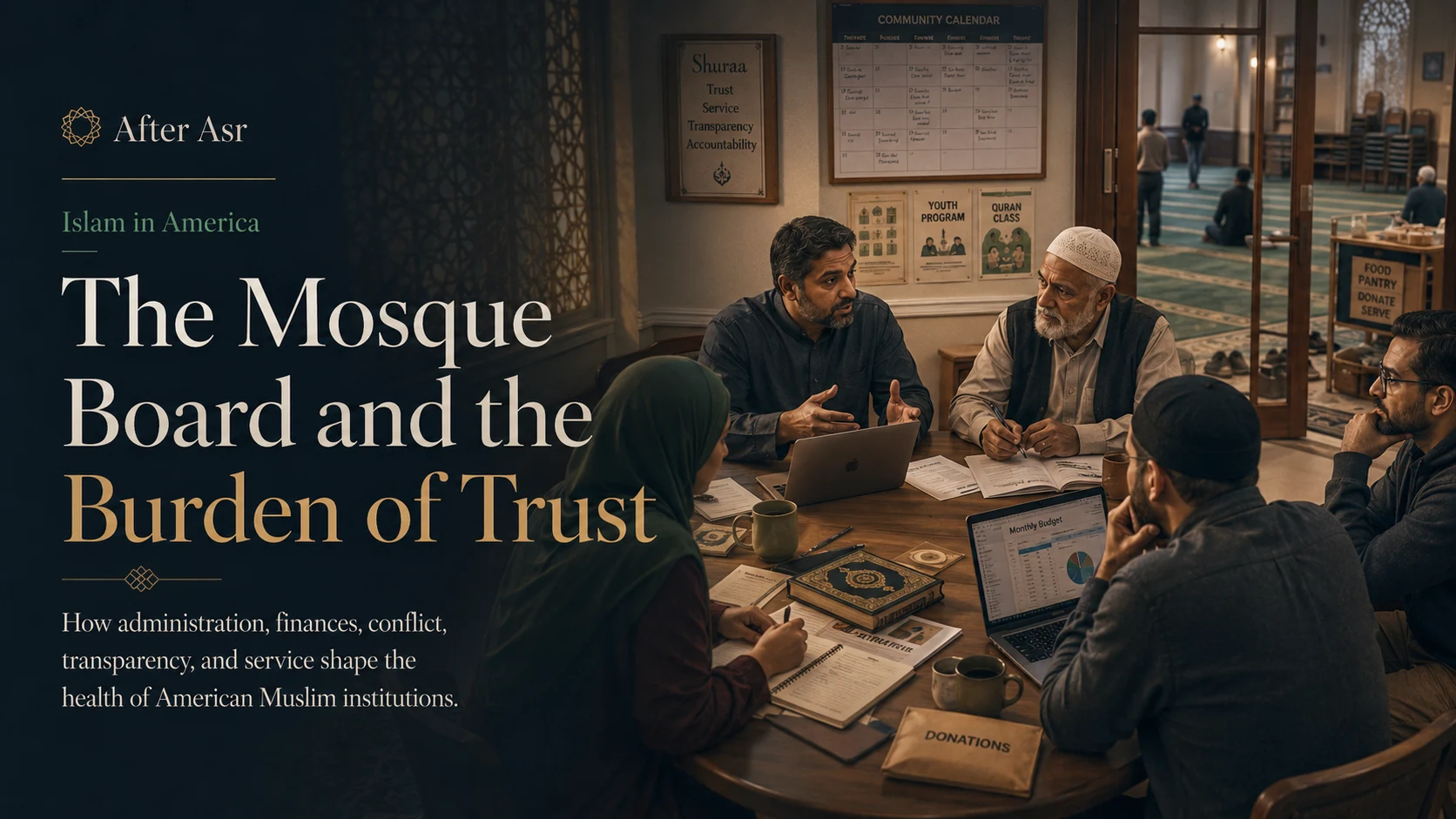
How administration, finances, conflict, transparency, and service shape the health of American Muslim institutions.
Every mosque has a visible life and a hidden life.
The visible life is what most people know. The prayer rows. The khutbah. The Ramadan iftars. The children running through the hallway. The Eid announcements. The Qur’an classes. The janazah prayer. The donation box. The familiar faces after Jumu’ah. The aunties in the kitchen. The uncle who always adjusts the microphone. The youth gathered near the entrance. The shoes lined up, scattered, lost, found, and claimed.
The hidden life is less poetic.
Utility bills. Insurance policies. Building maintenance. Payroll. Bank statements. Zoning issues. Security concerns. Child safety policies. Vendor contracts. Background checks. Cleaning schedules. Teacher stipends. Donor restrictions. Bylaws. Board minutes. Fundraising goals. Conflict complaints. Angry emails. Late-night calls. Leaking roofs. Parking agreements. Imam contracts. Tax filings. Emergency repairs. Community rumors. Decisions no one notices unless they go wrong.
This hidden life is not separate from the spiritual life of the mosque. It shapes it.
A masjid is a house of Allah, but in America it is also usually a nonprofit corporation, property owner, employer, school operator, community center, public-facing institution, and legal entity. Its spiritual mission is carried through administrative structures that can either protect trust or weaken it. A beautiful recitation can happen in a building whose finances are unclear. A crowded Ramadan program can hide exhausted volunteers. A mosque can preach unity while its leadership culture teaches suspicion. A community can speak of amanah, trust, while failing to build systems worthy of that word.
The mosque board is not the heart of the masjid. Worship is. But the board often determines whether worship, learning, service, and belonging can happen with dignity and continuity.
This is why mosque governance matters. Not because administration is glamorous. It is not. Not because board members should be elevated above the community. They should not. It matters because trust is sacred, and institutions can damage souls when trust is mishandled.
Amanah before authority
A mosque board position is not a prize.
It is not a title to display, a social rank to occupy, a family honor to defend, or a way to control the direction of the community. It is an amanah, a trust. That word should make a person tremble before it makes them feel important.
The board member is entrusted with money people gave for Allah’s sake. Entrusted with a building where people pray. Entrusted with decisions that affect children’s learning, women’s access, convert belonging, youth formation, imam stability, employee treatment, donor confidence, and public reputation. Entrusted with complaints that may involve real harm. Entrusted with private information. Entrusted with conflict. Entrusted with the difference between a mosque that feels like mercy and a mosque that feels like politics.
Authority in Islam is not ownership. It is accountability.
A board member who thinks, “This is my mosque,” has already misunderstood the role. The masjid belongs to Allah. Legally, the property may be held by a nonprofit. Operationally, a board may govern it. Financially, donors may sustain it. Socially, families may identify with it. But spiritually, no one owns a masjid as a personal possession.
This distinction matters in American Muslim communities because many mosques were built through the sacrifices of founders. Founders gave money, time, labor, and years of service. Their sacrifices deserve gratitude. But sacrifice does not create permanent personal ownership over a house of Allah. The person who helped build the masjid should be honored, but not allowed to rule without accountability. The donor should be thanked, but not allowed to purchase influence. The board member should be respected, but not treated as beyond correction.
Amanah means the work must be done for Allah, with the community’s rights in view, and with the awareness that every decision will be known fully on a Day when titles will not protect anyone.
The spiritual meaning of administration
Administration can feel dry, but in a mosque it has spiritual meaning.
A clear calendar reduces confusion. A clean budget protects donor trust. A maintained building honors worshippers. A child safety policy protects children. A fair hiring process protects employees. A written conflict process protects the community from favoritism. A functioning sound system helps people hear the khutbah. A well-managed parking plan protects neighbors and elders. A transparent donation report helps people give with confidence.
These are not merely technical matters. They are forms of adab.
A community that runs chaotically may spiritualize disorder. It may say, “We are doing this for Allah,” while repeatedly placing burdens on the same few people, losing records, confusing parents, delaying payments, ignoring maintenance, or making decisions through private conversations rather than agreed processes. Good intention does not excuse preventable harm. Reliance upon Allah does not mean neglecting means.
Mosque administration should be professional without becoming cold. It should be organized without becoming bureaucratic in spirit. The goal is not to turn the masjid into a corporation. The goal is to protect the sacred work from avoidable dysfunction.
This balance is difficult. Some board members come from professional backgrounds and may over-corporatize mosque life, measuring everything by efficiency, branding, metrics, and expansion. Others distrust structure and rely too heavily on informal habits. A healthy masjid needs both order and warmth. Written policies and personal mercy. Budgets and barakah. Spreadsheets and sincerity. Meeting minutes and du’a.
The Prophet’s masjid was a place of worship, learning, consultation, service, and community. It was not chaotic in spirit. It was not cold in spirit. Modern mosque administration should aim for that deeper balance: structure in service of mercy.
Money given for Allah
Mosque finances carry unusual moral weight because people give with religious intention.
A grandmother places cash in a donation box hoping Allah accepts it. A family sponsors iftar in memory of a parent. A worker gives from a modest paycheck. A child puts a few dollars into a box during Ramadan. A business owner funds a classroom. A donor gives quietly for the poor. Someone pays zakat and trusts that it will be handled correctly. Someone gives to a building campaign believing it will become a place of sujood for generations.
This money is not ordinary revenue. It is a trust.
Financial transparency is therefore not a modern obsession imported from nonprofit culture. It is part of amanah. Donors and members should know, in appropriate detail, how funds are collected, restricted, spent, saved, audited, and reported. This does not mean every private matter becomes public. Salaries, assistance cases, legal issues, and donor privacy may require discretion. But discretion is not secrecy, and secrecy is not trust.
A mosque should be able to answer basic financial questions clearly.
What is the annual budget? How much is spent on salaries, utilities, programming, maintenance, education, charity, and debt? Are zakat funds separated and distributed according to proper guidelines? Are restricted donations honored? Who approves expenses? Are financial reports reviewed? Is there an audit or independent review? Are conflicts of interest disclosed? Are board members or their businesses receiving contracts? Are fundraising promises being tracked?
When these questions are treated as disrespectful, suspicion grows.
Transparency protects leaders as much as members. It reduces rumors. It helps donors give confidently. It forces better planning. It prevents one person from carrying too much control. It teaches the community that religious work deserves serious stewardship.
A mosque that asks people to give for Allah must handle that giving as though Allah is watching.
Because He is.
The danger of donor power
Many mosques depend on major donors. This is understandable. Buildings, salaries, schools, repairs, and programs require money. A generous donor can help a community do what would otherwise be impossible. Donors who give sincerely are a blessing.
But donor power can become dangerous.
If a donor’s financial contribution gives them unofficial control over decisions, the masjid’s trust is distorted. If board members fear losing a donor more than they fear Allah, priorities become unstable. If certain families can influence imam hiring, program choices, school policy, women’s access, or conflict outcomes because of money, the community learns that wealth speaks louder than principle.
This is especially harmful in communities with class differences. Working-class members may feel that their voices matter less. Converts may feel invisible. Youth may assume the mosque belongs to wealthy families. Employees may fear confronting donors. Board members may justify compromise as practical necessity.
A mosque must honor donors without being owned by them.
This requires clear governance. Written conflict-of-interest policies. Spending approval processes. Term limits. Independent financial oversight. Transparent decision-making. Diverse leadership. A culture where every donor understands that giving to the masjid is sadaqah, not investment in control.
The donor too should fear Allah. Wealth can be a means of immense reward, but also a test. A person who gives generously and then uses giving to dominate has endangered the sincerity of the gift. A person who gives quietly and accepts accountability has protected the gift.
The masjid should teach both.
Conflict is not failure
Every mosque has conflict.
This should not surprise anyone. Mosques gather human beings: elders, youth, immigrants, converts, Black Muslims, Arab Muslims, South Asian Muslims, African Muslims, Latino Muslims, white Muslims, professionals, laborers, wealthy donors, struggling families, different madhhabs, different politics, different languages, different expectations, different wounds. They gather people for worship, education, marriage, funerals, money, children, leadership, and community identity. Of course there will be conflict.
Conflict is not automatically failure. How conflict is handled reveals the health of the institution.
Unhealthy mosques avoid conflict until it becomes crisis. Leaders ignore complaints, silence criticism, dismiss concerns, or resolve matters privately according to personal relationships. People begin to gossip because formal pathways do not work. Families leave quietly. Volunteers burn out. Employees feel unprotected. Youth learn that adults preach adab but practice power. Women may stop reporting issues because nothing changes. Converts may disappear rather than enter community politics.
Healthy mosques do not eliminate conflict. They create trustworthy ways to address it.
A complaint process. Clear lines of authority. Private counsel before public escalation where appropriate. Documentation. Mediation. Protection for vulnerable people. Timelines. Recusal when conflicts of interest exist. Willingness to apologize. Willingness to discipline misconduct. Willingness to say no to unreasonable demands. Willingness to admit when the board lacks expertise and must seek outside help.
Not every complaint is valid. Not every critic is sincere. Not every rumor deserves institutional response. But communities become sick when leaders use the existence of bad-faith criticism as an excuse to ignore sincere concerns.
A mosque board should not fear conflict more than injustice.
Transparency without exposure
Transparency is necessary, but it must be governed by adab.
A mosque should not hide financial realities, governance processes, or major decisions from the community. It should report clearly, communicate early, and avoid making members feel that everything important happens behind closed doors. But transparency does not mean exposing every private matter.
A family receiving zakat should not become public knowledge. An employee’s private performance issues should not become community gossip. A marital dispute brought to the imam should not become boardroom entertainment. A complaint involving harm should be handled with seriousness, confidentiality, and appropriate reporting, not broadcast loosely. A donor’s private hardship should not be revealed. A convert’s personal struggle should not be discussed casually.
The board must learn the difference between secrecy and confidentiality.
Secrecy protects power.
Confidentiality protects people.
This distinction is morally important. When leaders refuse to answer basic governance questions, they may call it confidentiality when it is actually secrecy. When community members demand details about private cases, they may call it transparency when it is actually curiosity. Both errors damage trust.
A healthy institution explains what can be explained, protects what must be protected, and builds enough credibility that people do not assume every private matter is a cover-up.
Credibility is built over time through consistency.
The imam and the board
The relationship between the imam and the board shapes the spiritual health of many American mosques.
In some communities, the imam is treated as an employee expected to perform religious services without real authority. In others, the imam holds too much unchecked influence. Some boards micromanage khutbah topics, community counseling, teaching priorities, or public statements. Some imams lack administrative support and become responsible for everything: prayer, teaching, counseling, fundraising, youth issues, janazah, marriage, conflict, media, interfaith relations, and emotional emergencies. Some are underpaid, overworked, and criticized from every side.
This is not sustainable.
The imam’s role is sacred and human. He may be a scholar, teacher, spiritual guide, counselor, mediator, public representative, and community anchor. But he is not a machine. He needs a clear contract, fair compensation, time off, boundaries, support staff, professional development, and protection from being used as a tool in board politics.
The board, for its part, has legal and administrative responsibilities. It must manage finances, property, employment, compliance, and institutional strategy. It should not surrender these duties entirely to the imam. Nor should it treat the imam as a hired reciter whose religious guidance can be ignored when inconvenient.
The relationship should be built on consultation, clarity, and mutual respect.
Who supervises whom? What authority does the imam have in religious matters? What authority does the board have in administrative matters? How are conflicts resolved? How are community concerns about the imam handled? How are concerns from the imam about the board handled? How is the imam protected from unreasonable demands? How is the community protected from religious authority being misused?
These questions should not be answered only after crisis. They should be part of institutional design.
A masjid where the imam and board distrust each other will eventually teach that distrust to the community.
Women and governance
A mosque board’s treatment of women reveals much about its understanding of community.
Women often sustain mosques through teaching, food service, fundraising, convert care, children’s programming, counseling, event planning, administrative work, and informal pastoral labor. Yet in many communities, women’s voices are underrepresented in governance. Decisions about women’s prayer spaces, programming, safety, education, childcare, facility design, and family services may be made without serious consultation with women.
This is not only impractical. It is unjust.
A board that governs a community must hear the community. Women are not a special-interest group within the masjid. They are part of the masjid. Their concerns should not be reduced to “sisters’ issues,” as though the spiritual lives of women and girls are secondary to the main work. A girl who grows up feeling unwelcome in the masjid may carry that wound into adulthood. A mother without childcare support may stop attending classes. A convert sister without mentorship may disappear. A woman reporting harassment may lose trust if leaders respond poorly.
Including women in governance does not mean abandoning Islamic adab. It means taking consultation seriously. Communities can develop models appropriate to their understanding of Islamic guidelines while ensuring women have real input, authority, and protection. Advisory councils, board seats where accepted, program leadership, listening sessions, confidential reporting channels, women-led education, and facility planning committees can all matter.
But tokenism is not enough. One woman on a committee without influence does not solve a culture of dismissal. A sisters’ survey ignored after collection is worse than no survey at all. Praising women’s labor while excluding women’s judgment is hypocrisy wrapped in gratitude.
A mosque that wants to raise confident Muslim girls should let them see women treated with dignity in the house of Allah.
Black Muslims, race, and institutional truth
Mosque governance in America cannot be honest without addressing race.
Many American mosques are immigrant-built or ethnically shaped. Many others are Black-led, multiracial, convert-centered, or regionally mixed. In every case, race affects belonging, leadership, trust, marriage, youth experience, educational content, and community memory. A board that says, “We do not see race, we are all Muslim,” may think it is being Islamic. Often, it is avoiding reality.
Black Muslims are foundational to Islam in America. Yet Black Muslim leadership, scholarship, and institutional experience are often underrecognized in broader Muslim spaces. Anti-Blackness can appear in who is trusted with authority, whose concerns are heard, which masjids receive funding, how children are disciplined, which families are considered desirable for marriage, and whose history is taught.
A mosque board has responsibility here.
Does the weekend school teach Black Muslim history as part of American Islam? Are Black Muslims represented in leadership beyond token inclusion? Are relationships built with Black-led masjids? Are anti-Black comments in the community corrected? Are convert and Black Muslim concerns taken seriously? Does the board understand the racial history of the neighborhood where the mosque is located? Are food pantry and outreach programs conducted with dignity, not saviorism?
If a mosque is in America, race is not a side topic. It is part of the moral landscape.
Boards should not wait for a crisis to begin learning. They should seek knowledge, build relationships, diversify leadership, and address prejudice as a matter of taqwa.
Unity built on silence is not unity. It is postponement.
Converts and institutional belonging
A mosque board should ask a simple question: what happens after someone takes shahadah here?
If the answer is unclear, the institution has work to do.
Converts need prayer instruction, beginner education, mentorship, Ramadan support, Eid inclusion, family guidance, marriage protection, and long-term belonging. Too often, convert care depends on whoever happens to be kind. A sister takes responsibility informally. A brother teaches prayer when he can. Someone starts a group, then moves away. A new Muslim receives attention for two weeks, then disappears into the margins.
This is not enough.
Convert care should be institutional, not accidental. Not bureaucratic, but reliable. A mosque can create a convert care team, assign mentors, maintain beginner classes, provide clear resources, protect privacy around shahadah, and ensure converts are invited into ordinary community life. Budgets should reflect this priority. If a mosque can fund decorations, guest speakers, and expansion campaigns, it can fund beginner books, classes, and support systems.
Converts also reveal whether a mosque is truly a house of Allah or mainly a cultural club. If a convert feels they must become Arab, South Asian, Somali, Turkish, Bosnian, or anything else to belong, the mosque has confused culture with Islam. If a white convert is treated as a trophy while Black converts are ignored, the mosque has a race problem. If convert women are vulnerable to unhealthy marriage proposals because they lack advocates, the mosque has a protection problem.
The board must not leave these issues to sentiment.
A shahadah is a beginning. The institution should be ready for what begins.
Youth, safety, and seriousness
Many mosque boards speak about youth because they worry about losing them.
Worry is not a strategy.
Young Muslims need prayer, knowledge, mentorship, recreation, service, safe spaces for questions, and meaningful responsibility. They need adults who understand digital life, school pressure, gender questions, activism, loneliness, and identity confusion. They need more than occasional pizza nights or lectures warning them about the outside world.
Boards must decide whether youth work is a serious institutional priority or a decorative concern.
Serious youth work requires budgets, trained mentors, background checks, child safety policies, transportation planning, mental health referral awareness, gender adab, curriculum, and adult support. It requires listening to youth without surrendering Islamic principles. It requires including youth in service, not only entertaining them. It requires spaces where young people can ask questions without being humiliated.
Safety must also be taken seriously. Any institution serving children and youth should have clear policies around supervision, reporting, boundaries, overnight events, transportation, teacher conduct, and volunteer screening. Communities sometimes avoid these topics because they feel uncomfortable or because “we trust everyone.” Trust is not a child safety policy.
A mosque that neglects safety in the name of family-like closeness may expose children to harm.
Protecting youth is not a legal inconvenience. It is an Islamic duty.
Volunteers and the ethics of labor
Mosques run on volunteers.
The person who opens the door. The one who cleans after iftar. The teacher who comes every Sunday. The sister who organizes meals. The brother who manages the website. The youth who stack chairs. The uncle who repairs the sink. The auntie who coordinates janazah food. The professional who files paperwork. The student who designs flyers. The convert mentor who answers late-night questions.
Volunteer labor is beautiful when it is sincere and shared. It becomes unhealthy when it is assumed, extracted, or romanticized.
Boards must think ethically about labor. Who is doing the work? Are the same people always carrying it? Are women expected to handle food, children, and cleanup while men make decisions? Are youth used as free labor without mentorship? Are skilled professionals expected to donate endless services because “it is for the masjid”? Are teachers unpaid while the community funds less essential expenses? Are volunteers thanked but unsupported? Are burnout signs ignored?
Not every mosque can pay everyone. But every mosque can respect labor. Clear roles, reasonable expectations, scheduling, training, supplies, stipends where possible, rest periods, and appreciation all matter. Sometimes the Islamic thing is to reduce programming rather than crush volunteers beneath it.
A board that depends on hidden labor should make that labor visible enough to protect it.
The masjid is not served by burning out its servants.
The board member’s family
The burden of mosque leadership often reaches the board member’s family.
Meetings run late. Phone calls interrupt dinner. Jumu’ah becomes logistics instead of worship. Ramadan becomes exhaustion. Spouses absorb stress. Children wait while parents handle “one more thing.” Family time becomes community time. Board members may feel they are serving Allah while slowly neglecting people Allah placed closest to them.
This tension should be named.
Serving the mosque is noble, but it does not erase family rights. A board member’s spouse and children should not become unpaid casualties of community work. Some families willingly share the sacrifice, and Allah may reward them. But the community should not presume endless availability.
Boards should build sustainable rhythms. Meeting times should be reasonable. Roles should be distributed. Emergencies should be distinguished from poor planning. Terms should have limits. Leaders should take breaks. Families should be considered when expectations are created.
A person who gives their best patience to the community and their worst fatigue to the home should pause. The masjid needs leaders whose service is not built on neglect.
This is not selfishness. It is balance.
Elections, appointments, and the character question
Mosque board selection is often difficult.
Some boards are elected. Some appointed. Some founder-led. Some family-influenced. Some rotate. Some barely change. Some communities struggle to find qualified people willing to serve. Others struggle because too many people seek authority for the wrong reasons.
Whatever the model, character matters.
A person may be wealthy, educated, professional, eloquent, or socially respected and still be unfit for trust. A board member needs honesty, humility, patience, discretion, ability to listen, willingness to learn, commitment to prayer, freedom from obvious conflicts of interest, and concern for the whole community, not only their circle. They should be able to disagree without cruelty. They should protect confidential information. They should not use board access to settle personal scores. They should not confuse confidence with competence.
Communities often elect or appoint people based on visibility, donor status, family name, professional success, ethnicity, or popularity. These are weak measures. Governance requires skill, but skill without taqwa is dangerous. Taqwa without basic competence can also cause harm if the person refuses to learn.
A healthy board needs a mix: religious seriousness, administrative competence, financial literacy, legal awareness, community representation, gender awareness, youth understanding, racial humility, and the ability to seek expert advice.
Not everyone who loves the mosque should be on the board. Some may serve better as teachers, volunteers, donors, mentors, or advisors. Leadership is not the only form of service.
When board conflict becomes community fitnah
Board conflict can poison a mosque.
People take sides. Private matters leak. WhatsApp groups ignite. Khutbahs become coded messages. Donors threaten to withdraw. Families leave. Volunteers stop serving. Youth watch adults behave worse than the teenagers they correct. The imam is pressured. Old ethnic, family, or political divisions resurface. The mosque becomes emotionally unsafe.
Sometimes conflict is necessary because real harm must be addressed. Avoiding it would be worse. But many board conflicts are intensified by ego, poor communication, unclear bylaws, lack of term limits, donor influence, personality clashes, and refusal to seek mediation early.
A board should treat internal conflict as spiritually dangerous.
Members should ask themselves: Am I seeking Allah’s pleasure or victory? Am I speaking truthfully? Am I protecting confidential information? Am I willing to be wrong? Am I listening? Am I dragging the community into what should be handled through process? Am I using religious language to cover ego? Am I making the masjid a battlefield?
When conflict reaches a certain level, outside mediation may be necessary. Not every dispute can be resolved by the same people who created it. Trusted scholars, professional mediators, nonprofit advisors, or respected community elders from outside may help.
The goal should not be saving face. It should be protecting the masjid, correcting wrongs, and restoring trust where possible.
Fitnah in leadership does not remain in leadership. It travels through the prayer rows.
Professionalization without losing the soul
As American Muslim institutions grow, many mosques need more professional systems.
Clear hiring. Employee handbooks. Financial controls. Child protection policies. Insurance. Facility maintenance plans. Database management. Donor communication. Strategic planning. Program evaluation. Proper bookkeeping. Legal compliance. Training. Conflict resolution. Communication protocols.
This professionalization is necessary.
But it can create another danger: the mosque may begin to feel like a service organization with prayer attached. Members become clients. Worshippers become data. Donors become segments. Ramadan becomes a campaign. Youth become metrics. The imam becomes content. The board becomes a management team. The language of efficiency replaces the language of sincerity.
The mosque needs professionalism, but not corporate soullessness.
A masjid is not a startup. It is not a brand. It is not merely a nonprofit. It is a house of Allah and a community of worshippers. Its success cannot be measured only by attendance, revenue, square footage, social media engagement, or program count. It must be measured by worship, knowledge, character, trust, inclusion, service, and whether people are being helped toward Allah.
Professional systems should serve spiritual aims. They should reduce chaos so hearts can focus. They should protect people from harm. They should allow teachers to teach, imams to guide, volunteers to serve sustainably, and worshippers to trust the institution.
The danger is not having systems. The danger is forgetting why the systems exist.
The poor and the boardroom
Mosque boards often include professionals, donors, business owners, and socially established members. This can bring skills and resources. It can also create blind spots.
Are the poor present in the board’s imagination?
When fees are set for programs, does anyone ask whether struggling families can attend? When fundraising speeches are made, are low-income worshippers made to feel ashamed? When building projects are planned, is zakat distribution strengthened too? When iftars are organized, are hungry people served with dignity? When the mosque expands, does it remain accessible to those without wealth? When community needs are assessed, are service workers, refugees, single parents, unemployed brothers, elderly sisters, and undocumented families considered?
A mosque is not healthy if it is comfortable for donors but intimidating for the poor.
Zakat and sadaqah require seriousness, confidentiality, and proper knowledge. Boards should ensure that assistance is handled with dignity and within Islamic guidelines. They should also understand that poverty is not always visible. Some families dress well but struggle with rent. Some students are hungry. Some converts lack support. Some elders are isolated. Some workers give more generously, proportionally, than wealthy families.
The poor should not be remembered only during Ramadan campaigns. Their rights are part of the masjid’s ongoing amanah.
A board that forgets the poor has misunderstood the house it governs.
Communication as mercy
Many mosque crises are worsened by poor communication.
A program is canceled and people are not told. A construction project begins without explanation. A teacher leaves and rumors fill the gap. A policy changes but only insiders know. Financial concerns circulate because reports are unclear. Women’s space is moved without consultation. Youth events are announced last minute. Eid plans are confusing. Ramadan schedules change repeatedly. Community members feel ignored, then become suspicious.
Clear communication is a mercy.
It respects people’s time. It reduces rumors. It helps families plan. It makes newcomers feel included. It protects leaders from unnecessary criticism. It teaches that the community is worthy of being informed.
Boards should communicate regularly and plainly. Not every message needs polished branding. People need accurate prayer times, program details, financial updates, construction notices, policy explanations, and points of contact. They need to know how to raise concerns. They need to know what decisions have been made and why, within appropriate limits.
Communication should also be spiritually shaped. Do not speak to the community only when asking for money. Do not make every message urgent. Do not hide behind vague language. Do not use announcements to shame people. Communicate gratitude, needs, decisions, and reminders with dignity.
A masjid that communicates well teaches trust through small acts.
The courage to apologize
Mosque leaders will make mistakes.
They will mishandle a complaint. Overlook a group. Miscommunicate a policy. Spend unwisely. Delay a repair. Choose the wrong speaker. Fail to support a teacher. Ignore youth concerns too long. Underestimate women’s needs. Forget converts. Respond poorly to criticism. Trust the wrong person. Speak harshly. Make a decision without consultation.
The question is not whether mistakes will happen. The question is whether leaders can apologize.
Many mosque boards struggle here. Apology feels like weakness. Leaders fear legal exposure, loss of authority, donor backlash, or community criticism. Sometimes these concerns are real. But a culture where leaders never apologize becomes spiritually poisonous. It teaches that authority matters more than truth.
A sincere apology can restore trust. It should be specific, not vague. It should not shift blame. It should include correction where possible. “We made this decision without enough consultation. We apologize. Here is how we will handle this differently.” Or, “We failed to communicate clearly about the funds raised. Here is the report, and here are the steps we are taking.” Or, “We did not provide adequate support for the sisters’ space during Ramadan. We apologize and have formed a team to address it.”
Apology does not solve everything. Some harms require deeper repair. But without apology, repair rarely begins.
Leaders who cannot say “we were wrong” should ask whether they are fit to lead a community built on repentance.
Expansion and the temptation of prestige
Many mosques dream of expansion.
More parking. More classrooms. A larger prayer hall. A gym. A school. A banquet space. A library. A funeral facility. A youth center. These dreams can be sincere and necessary. Communities grow. Children need space. Programs require rooms. A cramped masjid may limit worship and learning.
But expansion can also become prestige.
A community may begin measuring success by size. Fundraising campaigns become emotionally intense. Donors are promised legacy. Leaders speak of vision, but do not address current dysfunction. A mosque may raise millions for a building while teachers remain unsupported, converts remain lonely, youth remain unmentored, women’s concerns remain unresolved, and the poor remain underfunded.
A larger building can amplify existing problems.
Before expansion, a board should ask: Are our finances transparent? Is our current building maintained? Do we have governance capacity for growth? Are women included in design? Are youth needs understood? Are converts considered? Are accessibility and disability needs included? Are we planning for operations, not only construction? Can we afford staff? Will debt burden the community? Does this project serve worship and education, or does it serve image?
Building for Allah is noble. Building for status is dangerous.
The masjid does not become more beloved to Allah because it is larger. It becomes beloved through sincerity, worship, knowledge, justice, and service. A small storefront filled with taqwa may be spiritually greater than a grand building filled with ego.
Expansion should be undertaken with trembling, not vanity.
Serving the whole community
A mosque board must resist serving only the loudest, wealthiest, oldest, most organized, or most familiar segments of the community.
The whole community includes children, youth, single adults, married couples, divorced people, widows, elders, converts, Black Muslims, immigrant families, refugees, working-class members, professionals, women, men, disabled worshippers, those struggling with faith, those returning after distance, and those who attend quietly without social connections.
No board can satisfy everyone. But it must remember everyone.
This requires intentional listening. Surveys can help, but only if read seriously. Listening sessions can help, but only if people feel safe speaking. Informal conversations can help, but they must include people outside leadership circles. Data can help, but not everything meaningful is measurable.
Boards should ask who is missing. Who stopped coming? Who never attends programs? Who feels unwelcome? Who benefits from current structures? Who carries hidden labor? Who is affected by decisions but absent from the room where decisions are made?
Serving the whole community does not mean flattening Islamic principles to please everyone. It means applying those principles with awareness of real people.
The mosque is not a private club for those who built it first or fund it most.
It is a trust for those Allah brings to it.
Board service as worship
For all its difficulty, mosque board service can be worship.
The late meeting can be worship. The budget review can be worship. The uncomfortable apology can be worship. The decision to recuse oneself from a conflict can be worship. The protection of confidential information can be worship. The correction of financial errors can be worship. The refusal of donor pressure can be worship. The repair of women’s space can be worship. The creation of a convert care program can be worship. The child safety policy can be worship. The janazah planning can be worship. The quiet effort to reduce fitnah can be worship.
But only if done for Allah, within His limits, with humility.
Board service can also become spiritually dangerous. The ego may enjoy influence. A person may become attached to being needed. A family may treat the masjid as its domain. Leaders may resent criticism. Good work may become self-importance. Sacrifice may become a reason to control. Public service may hide private spiritual decline.
Board members need their own spiritual care. They need prayer, Qur’an, classes, companionship, and reminders of death. They should not let meetings replace worship. They should not let administration consume the heart. They should have people who can advise them honestly. They should make istighfar often.
The masjid is not only a place they govern.
It is a place where they too must be purified.
A healthier mosque culture
A healthy mosque culture does not depend on perfect leaders. There are no perfect leaders.
It depends on trustworthy systems, sincere hearts, shared responsibility, and a community willing to practice adab. Board members must lead with transparency and humility. Community members must critique with fairness and serve with sincerity. Donors must give without control. Imams must guide with courage and mercy. Volunteers must be supported. Youth must be formed. Women must be heard. Converts must be welcomed. Black Muslim history and leadership must be honored. The poor must be protected. Children must be safe.
This is not idealism. It is the work of institutional taqwa.
A mosque may still have disagreements. It may still make mistakes. It may still struggle financially. It may still disappoint people at times. But if trust is valued, if repentance is possible, if systems are clear, if people are protected, if money is handled carefully, if leaders are accountable, and if worship remains central, then the institution can remain healthy enough to grow.
The masjid does not need to be flawless to be beloved.
It needs to be truthful.
The meeting after Isha
Imagine a mosque board meeting after Isha.
The prayer hall is quiet now. A few worshippers remain making dhikr. Children’s worksheets are stacked in a classroom. The kitchen light is still on. A donation box sits near the entrance. Somewhere, a volunteer is locking a side door. In a small room, board members sit around a table with laptops, tea, budget papers, and tired faces.
They are discussing a roof repair, a teacher stipend, a complaint from a parent, Ramadan expenses, a request from converts for a beginner class, the sisters’ space, a youth event, a donor concern, and whether the masjid can afford to hire help.
None of this looks dramatic.
But the health of the community may depend on how they speak in that room.
Do they remember Allah? Do they tell the truth? Do they listen? Do they protect people’s dignity? Do they spend carefully? Do they admit what they do not know? Do they make decisions for the whole community or only their circle? Do they fear losing status more than failing the trust? Do they leave the room closer to amanah or closer to ego?
Mosque governance is not separate from spirituality.
It is one of the places spirituality is tested.
The board and the budget, the meeting and the minutes, the conflict and the cleaning schedule, the donation and the disclosure, the apology and the policy, all of it can become a means of drawing nearer to Allah if carried with sincerity.
The mosque board does not carry the masjid alone. It should not. The masjid is carried by worshippers, teachers, volunteers, donors, imams, parents, youth, elders, converts, and the mercy of Allah before all else.
But the board carries a particular burden of trust.
If it carries that burden humbly, the community may not notice every good decision. That is fine. Much of good governance is invisible because it prevents harm before harm becomes visible.
Allah sees it.
And for anyone entrusted with a house where believers place their foreheads on the ground, that should be enough to make the work both frightening and noble.