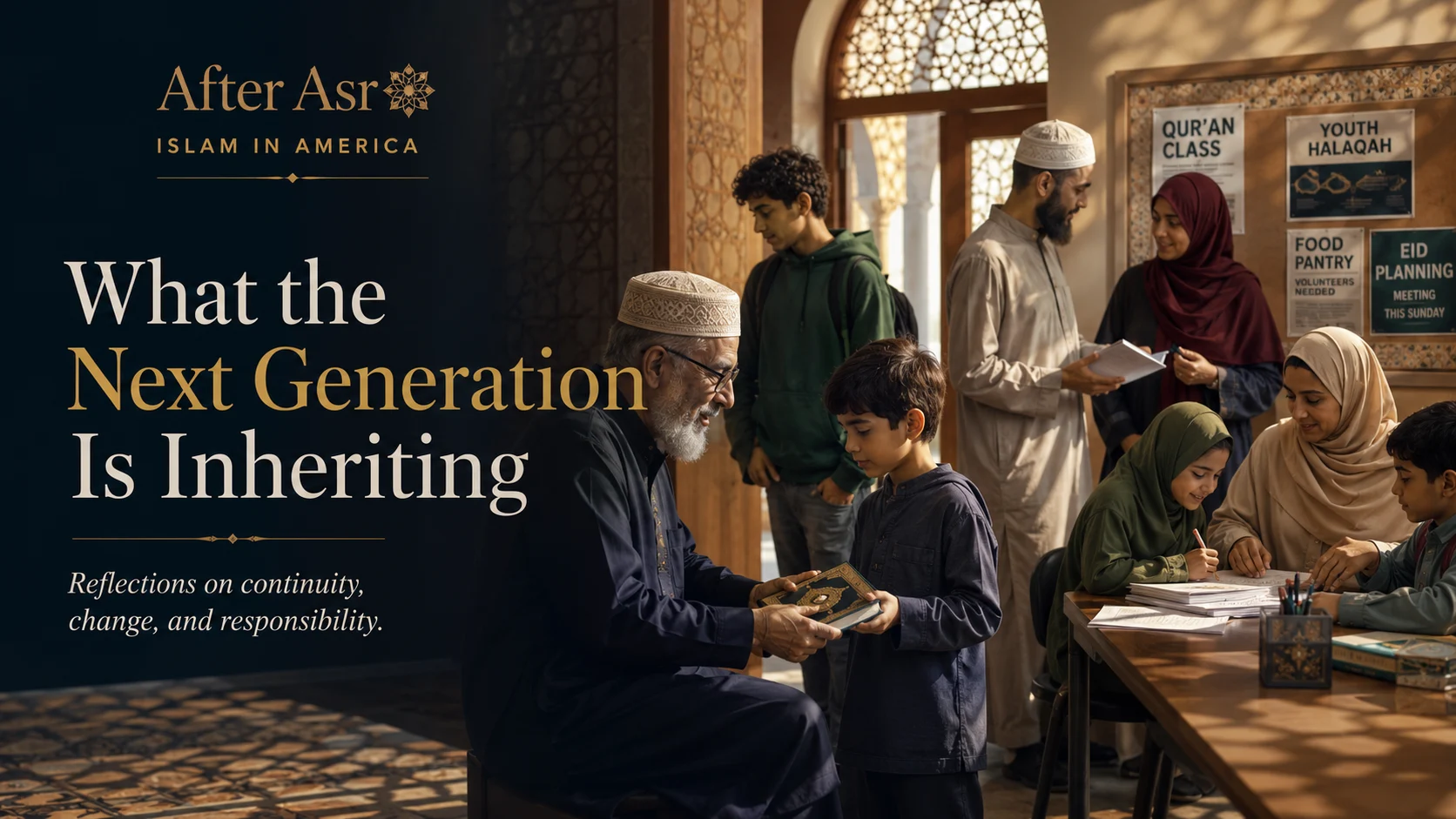
Reflections on continuity, change, and responsibility.
Every generation of Muslims receives something it did not build alone.
A child enters a mosque and assumes it has always been there. A teenager attends Eid prayer in a rented convention hall and does not know who negotiated the contract, who borrowed the sound system, who worried about the bill, or who came early to mark the prayer rows. A young adult grows up with halal restaurants, Muslim student associations, Qur’an teachers, Ramadan calendars, Islamic schools, online lectures, Muslim therapists, Muslim lawyers, Muslim chaplains, and English-language khutbahs, and may not know how recent some of these things are. A convert walks into a masjid and finds prayer rugs, bookshelves, volunteers, classes, and a community that, however imperfect, was built by people who once had far less.
Inheritance can make blessings feel natural.
That is both beautiful and dangerous. Beautiful, because every community hopes to build enough stability that the next generation can stand more easily. Dangerous, because what is inherited but not understood may be neglected. What is received without memory may be treated casually. What is available without sacrifice may be assumed to require no maintenance.
American Muslims are now living through a generational handoff. The community is no longer only asking whether Islam can take root here. It has taken root. Mosques have been built. Schools have opened. Families have grown. Converts have entered. Children have become parents. Immigrant communities have become multigenerational. Black Muslim institutions have continued to carry older foundations. Muslim professionals have entered nearly every field. Muslim public presence is more visible, more complicated, and more contested than before.
The question is no longer only, “Can Islam survive in America?”
The question is, “What kind of Islam in America are we handing forward?”
They are inheriting institutions
The next generation is inheriting institutions that previous generations fought to establish.
Mosques in office parks, converted churches, storefronts, suburban campuses, inner-city neighborhoods, rural roads, and purpose-built Islamic centers. Weekend schools run by volunteers. Full-time Islamic schools built through donor dinners and family sacrifice. Muslim nonprofits, counseling services, civil rights groups, burial societies, food pantries, youth programs, campus associations, chaplaincy networks, media projects, and community endowments.
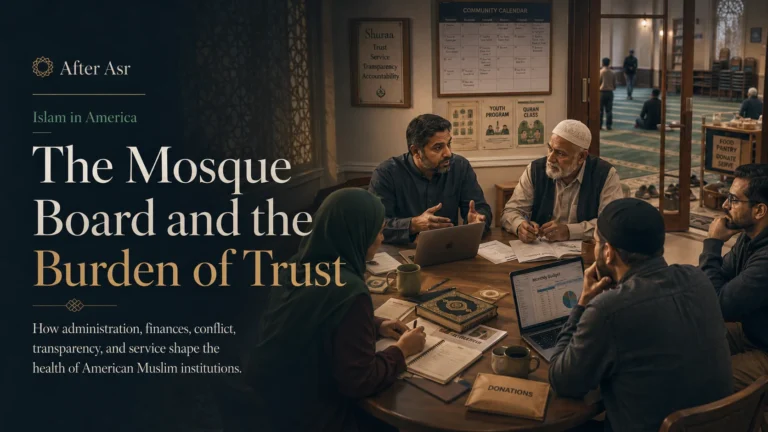
These institutions matter. A community without institutions is fragile. It depends on personalities, memory, and emergency improvisation. Institutions create continuity. They hold property, calendars, records, classrooms, prayer spaces, bank accounts, libraries, and public trust. They allow one generation’s work to outlive individual effort.
But institutions are not automatically healthy because they exist.
The next generation is inheriting buildings, but also governance habits. Prayer spaces, but also gender arrangements. Weekend schools, but also curriculum gaps. Boards, but also conflict patterns. Donation systems, but also questions of transparency. Youth programs, but also memories of whether young people were truly heard. Convert programs, but also the difference between public celebration and private care. Women’s spaces, but also the unresolved question of women’s authority and dignity. Racial diversity, but also the unfinished work of anti-Blackness and ethnic hierarchy.
An institution can be a blessing and a burden at the same time.
The next generation will need gratitude without passivity. They should not despise what elders built because it is imperfect. Much of it was built with limited resources, limited time, limited English, limited professional training, and immense sacrifice. But they also should not preserve every pattern simply because it is inherited. Some things must be honored. Some must be repaired. Some must be retired. Some must be rebuilt with more knowledge and mercy.
The institution is not the goal. It is a vessel. The question is whether the vessel still carries worship, knowledge, justice, mercy, and trust.
They are inheriting memory, and sometimes forgetting it
No community can remain healthy if it forgets how it arrived.
American Muslim memory is not one story. It includes enslaved African Muslims who carried Islam under unimaginable violence. It includes Black Muslim movements that gave spiritual and social language to dignity, discipline, and resistance. It includes immigrant families who prayed in apartments, rented halls, university rooms, and storefronts before building mosques. It includes converts whose entry into Islam reshaped families and local communities. It includes refugees who brought wounds and resilience. It includes Muslim veterans, prisoners, chaplains, teachers, mothers, merchants, laborers, students, scholars, and elders.
The next generation needs this memory, not as nostalgia, but as moral orientation.
Without memory, young Muslims may inherit a shallow story. They may think Islam in America began with their parents’ immigration, or with campus activism, or with online scholars, or with a few famous public figures. They may not know the older roots. They may not know the sacrifices behind local institutions. They may not know which elders cleaned the first masjid with their own hands. They may not know which families mortgaged homes, which women cooked for fundraisers, which teachers worked unpaid for years, which Black Muslim communities preserved faith before many immigrant communities arrived, which converts were lonely before programs existed.
Forgetting makes people careless.
A teenager who does not know what it took to establish Jumu’ah may treat the masjid as a service provider. A board member who does not know earlier struggles may repeat old mistakes. A young professional who does not know Black Muslim history may unconsciously participate in erasure. A community that does not preserve convert stories may keep celebrating shahadah while neglecting the person afterward. Children who do not know their grandparents’ sacrifices may dismiss them as culturally awkward rather than historically significant.
Memory should not be used to silence critique. Elders sometimes say, “You do not know what we sacrificed,” as if sacrifice means no one may ask for improvement. That is not healthy. But youth also should not confuse access with entitlement. They should know that the carpet beneath their feet was paid for by someone’s labor, and the Qur’an class they attend was built by someone’s patience.
A community needs memory with humility on both sides.
They are inheriting confidence, but also anxiety
Many young Muslims in America are more publicly confident than their parents or grandparents may have been.
They have grown up seeing Muslim athletes, politicians, scholars, artists, doctors, lawyers, journalists, comedians, writers, entrepreneurs, teachers, and activists. They may have Muslim friends at school, halal food nearby, youth conferences, online lectures, Islamic apps, modest fashion brands, Muslim therapists, and campus prayer rooms. Some know how to request accommodations. Some are more willing to say “I am Muslim” without shrinking. Some wear hijab, kufi, thobes, abayas, or ordinary American clothing with a clear sense that Islam belongs wherever they go.
This confidence is a blessing.
But it coexists with anxiety. The next generation also inherits public suspicion, digital pressure, political polarization, Islamophobia, racism, surveillance memories, war images, arguments about gender and sexuality, family fragmentation, loneliness, pornography, consumerism, mental health struggles, and the constant performance of identity online. They inherit a society where every belief can be mocked, every desire can be marketed, every private insecurity can be turned into content, and every moral boundary can be made to feel oppressive.
They may appear confident while inwardly uncertain.
Some young Muslims know how to defend Islam publicly, but struggle to pray consistently. Some can explain Islamophobia but not tawheed. Some are proud of Muslim identity but unsure about Islamic belief. Some attend protests but not Jumu’ah. Some love the aesthetics of Ramadan but feel distant from Qur’an. Some reject shallow assimilation but are not yet rooted in knowledge. Some are deeply practicing but afraid to voice their questions. Some feel judged by elders who do not understand the world they are navigating.
The next generation does not need adults who only praise their confidence or panic over their anxiety. They need formation. They need teachers who can distinguish rebellion from confusion, sincerity from performance, and doubt from arrogance. They need parents who can listen without surrendering principles. They need mosques that are intellectually serious and emotionally safe. They need spaces where Islam is not reduced to identity, but also not presented as a list of prohibitions without beauty.
Confidence must be tied to truth, or it becomes fragile.
They are inheriting questions their elders could avoid
Every generation faces questions the previous generation did not answer fully.
Today’s young Muslims are inheriting questions about belief in a secular age, religious authority in an online world, gender and sexuality, race and anti-Blackness, marriage across culture and class, mental health, public school curricula, student debt, professional ethics, artificial intelligence, digital intimacy, climate anxiety, political participation, family estrangement, and the meaning of Islamic community in a society of individual choice.
Some elders did not face these questions in the same way. Others faced them but did not speak openly. Some migrated with the hope of preserving faith through family structure and community boundaries, only to find that children raised in America would encounter a different world. Some Black Muslim communities carried deep experience navigating American moral contradictions, but their wisdom was not always centered in broader Muslim spaces. Some converts asked hard questions from the beginning, but were sometimes treated as exceptions rather than as people revealing gaps in the community’s teaching.
The next generation is not wrong for asking questions.
Questions become dangerous when they are fed only by confusion, ego, or public pressure. But questions can also be signs of seriousness. A young Muslim asking, “Why do we believe this?” may not be rejecting Islam. They may be asking for an inheritance deep enough to live by. A teenager struggling with a moral teaching may not need condemnation first. They may need patient explanation, spiritual grounding, and love that does not lie. A young adult asking about race in the mosque may be calling the community toward justice. A convert asking what is Islam and what is culture may be protecting the religion from confusion.
The danger is not the existence of questions. The danger is a community that has no trustworthy way to answer them.
If the mosque cannot answer, the algorithm will. If parents cannot listen, strangers online will. If scholars are not accessible, influencers will fill the space. If Islamic education remains shallow, every public controversy will feel destabilizing.
The next generation needs more than inherited conclusions. They need the principles, methods, adab, and spiritual grounding by which Muslims seek truth.
They are inheriting diversity, and the responsibility to make it real
American Muslim diversity is often celebrated in public language. It is less often disciplined into actual community life.
The next generation is inheriting a Muslim America that includes Black Muslims, Arab Muslims, South Asian Muslims, African Muslims, Southeast Asian Muslims, Latino Muslims, white Muslims, Turkish Muslims, Bosnian Muslims, Iranian Muslims, Afghan Muslims, Somali Muslims, Sudanese Muslims, Caribbean Muslims, converts, immigrant families, refugees, wealthy professionals, working-class laborers, suburban families, rural Muslims, prisoners, veterans, scholars, artists, and people of many madhhabs, temperaments, and levels of practice.
This diversity can be beautiful. It can also be difficult.
If diversity remains only visual, it becomes a performance. A multicultural iftar does not automatically mean shared authority. A photo with many faces does not mean equal belonging. A mosque may be ethnically diverse but socially segregated. A community may praise Black Muslim history but not follow Black Muslim leadership. A youth group may welcome converts but not understand their family realities. A board may claim to represent everyone while speaking only one cultural language. A school may include students from many backgrounds but teach Islam through one ethnic lens.
The next generation is inheriting the task of making diversity morally real.
This means asking who leads, who teaches, who is heard, who is protected, who feels at home, who is used for public optics, who is invisible, who is expected to adapt, and who is allowed to remain themselves. It means honoring difference without letting difference become division. It means teaching children that the ummah is not a slogan. It is a discipline of love, justice, patience, and humility.
It also means refusing to turn every difference into a crisis. Muslims will disagree. Cultures will differ. People will have different foods, accents, clothing, family habits, and community expectations. Unity does not require sameness. It requires adab, shared worship, and commitment to truth.
The next generation will need to be better than previous generations at crossing lines without erasing them.
They are inheriting wounds
Every generation inherits wounds it did not choose.
Some young Muslims inherit the wounds of migration: parents who left homes, languages, relatives, careers, status, or safety behind. Some inherit the wounds of racism and anti-Blackness, both in broader America and inside Muslim spaces. Some inherit the wounds of war, surveillance, refugee trauma, poverty, prison, broken families, addiction, harsh religious teaching, community conflict, mosque exclusion, or public humiliation. Some inherit the loneliness of being the only Muslim in a school or town. Some inherit the burden of family expectations shaped by fear.
These wounds do not disappear because a community speaks about hope.
A child may inherit a parent’s anxiety without understanding its source. A young person may inherit silence around trauma and mistake it for coldness. A convert may inherit rejection from family and then encounter community neglect. A Black Muslim may inherit exhaustion from being asked to correct both America and the ummah. A Muslim woman may inherit both public stereotypes and private dismissal. A second-generation child may inherit pressure to redeem a family’s sacrifices.
A responsible community does not make wounds the center of identity, but it also does not deny them.
Healing requires truth. It requires Islamic spiritual care, competent counseling where needed, better teaching, safer institutions, and a willingness to repent for communal harms. It requires elders who can tell stories honestly, not only triumphantly. It requires youth who can hear sacrifice without turning it into accusation. It requires communities that understand that some people are not distant from the masjid because they are careless. They may be distant because they were hurt there.
The next generation should not be handed unresolved pain and told to call it tradition.
They deserve better. And they also carry responsibility not to turn inherited wounds into permanent bitterness. Islam teaches remembrance, repentance, justice, forgiveness where possible, and the hope of transformation. A wound can explain difficulty, but it should not become the only inheritance.
They are inheriting a digital world without walls
Previous generations worried about television, music, friends, dating, and school culture. The next generation carries an entire world in the hand.
The digital world has changed Islamic inheritance. A child can watch Qur’an recitation, lectures, Islamic reminders, and Arabic lessons online. A convert in a small town can learn from teachers across the world. A teenager can find Muslim peers, scholars, and beneficial content. This is a mercy.
But the same device carries pornography, cynicism, atheism, mockery of religion, endless comparison, consumerism, gender confusion, ideological extremism, gossip, spiritual performance, and a constant invitation to live before an audience. The phone does not merely provide information. It trains attention, desire, envy, outrage, and identity.
The next generation is inheriting Muslim life in a world where privacy is weakened and performance is normal.
This affects faith. Worship can become content. Hijab can become branding. Islamic reminders can become aesthetics. Religious disagreement can become entertainment. Young Muslims may know global debates before they know local teachers. They may learn fragments of fiqh from clips and fragments of spirituality from captions. They may feel informed while being unformed.
Parents and educators cannot simply say, “Put the phone away.” They need a deeper approach. Teach digital adab. Teach the rights of the eyes. Teach the value of hidden deeds. Teach how algorithms shape the soul. Teach how to verify knowledge. Teach why not every Islamic speaker online should be followed. Teach children and adults how to be alone with Allah in a world that constantly asks them to be seen.
The next generation will need spiritual privacy as a survival skill.
They are inheriting the labor of women
The next generation is inheriting communities built in large part by women’s labor.
Mothers teaching Qur’an at home. Women organizing food, fundraisers, halaqahs, children’s programs, convert care, marriage support, counseling referrals, Eid logistics, funeral meals, and quiet networks of mercy. Women serving as teachers, scholars, professionals, donors, administrators, board members, writers, chaplains, and spiritual anchors. Women holding families together through migration, poverty, racism, divorce, grief, and the strain of raising Muslim children in a non-Muslim majority society.
Much of this labor has been visible only when needed.
The next generation must decide whether it will continue to benefit from women’s work while limiting women’s voice, or whether it will build communities that honor both contribution and authority. This is not about copying secular frameworks. It is about taqwa. If women teach the children, sustain the families, support the converts, organize the programs, and carry pastoral burdens, then their knowledge, concerns, and leadership must be taken seriously.
Girls should inherit a community where they are spiritually nourished, intellectually respected, physically accommodated, and morally guided without being reduced to symbols. Boys should inherit a community where serving alongside women’s dignity is normal, where masculinity is not built on control, and where women’s labor is not invisible. Men should inherit the responsibility to serve, clean, teach, listen, and carry domestic and communal burdens with humility.
A community that fails its women will fail its future, even if its buildings are full.
They are inheriting parents who are tired
The next generation is not only inheriting from institutions. It is inheriting from parents.
Many Muslim parents in America are tired. Tired from work. Tired from bills. Tired from migration. Tired from discrimination. Tired from explaining Islam. Tired from raising children in a culture that moves faster than they can interpret. Tired from trying to preserve faith while maintaining careers, marriages, homes, elder care, and community obligations. Tired from pretending they are confident when they are afraid.
This tiredness shapes children.
A parent may want to teach Qur’an but fall asleep. Want to answer questions but become impatient. Want to make Ramadan beautiful but feel overwhelmed. Want to guide a teenager but not understand the world the teenager inhabits. Want to model prayer but struggle privately. Want to protect children from harm but become controlling. Want to pass on Islam but mostly pass on anxiety.
Parents need mercy. But mercy does not mean avoiding responsibility.
The next generation deserves parents who keep learning, apologize when wrong, seek help, build home routines, and refuse to outsource faith entirely to weekend school. Parents should not have to do this alone. Communities should support them with classes, counseling resources, mentorship, social support, and practical tools. But parents remain central.
A child may forget many lectures. They will remember whether Islam made the home warmer or colder. Whether Allah’s name came with fear only, or with hope and love. Whether prayer interrupted cruelty, or existed alongside it. Whether parents treated Islam as a living relationship with Allah, or mainly as a list of pressures.
The next generation is inheriting not only what parents teach. It is inheriting how parents live.
They are inheriting the unfinished work of Islamic education
American Muslims have built many educational spaces, but the work remains unfinished.
Weekend schools exist, but often need stronger curriculum, teacher training, parent involvement, and continuity. Islamic schools exist, but not all families can afford them, and not all schools combine academic excellence with spiritual formation. Youth programs exist, but many still struggle to go beyond entertainment or warnings. Adult education exists, but often remains occasional. Convert education exists, but is uneven. Women’s education exists, but access and seriousness vary. Online learning exists, but guidance is inconsistent.
The next generation will inherit both the infrastructure and the gaps.
If they are wise, they will not merely complain about the gaps. They will build. They will become teachers, curriculum writers, chaplains, scholars, mentors, counselors, school administrators, parents who study, board members who prioritize education, donors who fund teacher training, and students who remain humble. They will create educational models that are rooted in tradition and aware of American realities.
The next generation should not have to choose between shallow cultural Islam and disconnected academic Islam. They need education that teaches worship, belief, Qur’an, seerah, adab, fiqh, spirituality, history, contemporary questions, and service. They need education that forms the whole person, not only the public identity.
If Islamic education remains weak, every other inheritance becomes vulnerable.
Buildings can be sold. Programs can fade. Public visibility can shift. But a generation formed by knowledge and worship can rebuild after loss. A generation without knowledge may inherit buildings and still lose the soul.
They are inheriting wealth, opportunity, and moral risk
Many American Muslims are entering new levels of professional and economic stability.
Doctors, engineers, business owners, lawyers, academics, tech workers, real estate investors, entrepreneurs, public servants, and skilled tradespeople have helped build financially stronger communities. This creates opportunities. Mosques can expand. Schools can improve. Scholarships can be funded. Media can be built. Families can support relatives. Muslim businesses can grow. Charitable work can become more strategic.
But wealth carries moral risk.
The next generation may inherit comfort that makes sacrifice feel optional. They may inherit professional success without Islamic financial literacy. They may normalize interest, luxury, status competition, and career worship. They may measure community success by buildings and banquets rather than prayer and character. They may treat Muslim institutions like service providers because they are used to consumer choice. They may support causes when convenient but avoid the discipline of zakat, sadaqah, and simple living.
Wealth is not evil. It can be a tool of immense good. But only if governed by taqwa.
American Muslim education must include money. Halal income, riba, zakat, inheritance, debt, contracts, business ethics, employee rights, consumerism, charity, endowments, and the spiritual diseases of greed and status. Children should see generosity at home. Youth should understand that success is not measured only by salary. Communities should honor teachers, caretakers, laborers, and volunteers, not only high-earning professionals.
The next generation may have resources earlier Muslims did not. The question is whether those resources will build the akhirah, or only more polished versions of worldly ambition.
They are inheriting public presence
The next generation will likely be more publicly visible than previous ones.
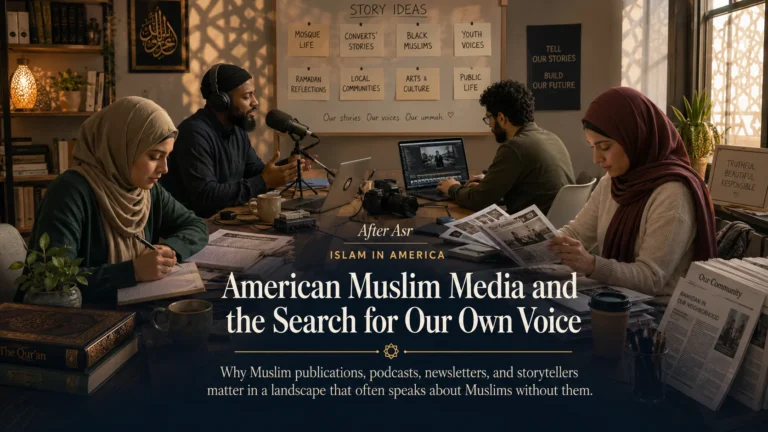
Muslims are in media, politics, academia, sports, arts, medicine, law, education, technology, and local civic life. Mosques hold open houses. Schools learn about Ramadan. Cities issue Eid greetings. Companies recognize Muslim employee groups. Muslim stories appear in film, books, podcasts, newsletters, and social media. Public presence is no longer rare.
This visibility brings opportunity and temptation.
The opportunity is to speak truthfully, serve society, correct misunderstanding, build relationships, and let Muslim children see themselves as part of public life without shame. The temptation is to confuse visibility with health. A community can become more visible while becoming spiritually weaker. It can gain representation while losing knowledge. It can be included in public ceremonies while neglecting prayer. It can be praised by institutions while failing vulnerable members.
The next generation must learn that being seen is not the same as being sound.
Public presence should emerge from private strength. Otherwise it becomes performance. A Muslim on a panel should still be a Muslim in salah. A Muslim organization recognized by city leaders should still care for lonely converts and struggling families. A Muslim influencer should still fear Allah with the tongue. A Muslim professional praised for representation should still guard halal earnings, modesty, honesty, and prayer.
Visibility can serve Islam, but it cannot replace Islam.
They are inheriting responsibility for converts
As Islam grows in America, converts will remain central to the community’s future.
The next generation must inherit a better model of convert care than celebration without continuity. Converts are not seasonal inspiration. They are brothers and sisters whose lives may involve family rupture, loneliness, rapid learning, cultural confusion, spiritual intensity, and the need for real companionship. They may enter Islam through study, marriage, friendship, prison, online lectures, grief, curiosity, or a sudden opening of the heart. Their paths will vary.
The community must be ready.
This means structured beginner education. Mentorship. Clear explanations of prayer. Support during Ramadan and Eid. Guidance on family relationships. Protection from cultural overwhelm. Access to scholars. Social belonging that does not depend on being married into a Muslim family. Patience with uneven progress. Respect for their pre-Islamic family ties where appropriate. Help distinguishing Islam from ethnic habit.
The next generation can build this if it understands that converts are not additions to an immigrant community or exceptions to a born-Muslim norm. They are part of the American Muslim story itself.
A community that receives converts well renews its own faith. Converts remind born Muslims that Islam is guidance, not inheritance alone. But that reminder should lead to responsibility, not consumption of their stories.
They are inheriting the need for local rootedness
A strange feature of modern life is that people can feel connected to Muslims across the world while disconnected from Muslims down the street.
The next generation is inheriting global awareness through social media, news, online scholars, and digital communities. This can deepen the sense of ummah. It can create solidarity with Muslims suffering elsewhere. It can expose young people to knowledge and perspectives beyond their local mosque.
But Islam is also local.
Someone needs to visit the sick in this town. Teach the children in this mosque. Help the convert in this neighborhood. Attend the janazah of this elder. Support the Muslim student in this school. Build halal options in this city. Meet local officials about this zoning issue. Repair this community’s conflict. Clean this prayer space. Feed these families.
Global concern without local responsibility can become emotional consumption. Local service without global concern can become narrow. The next generation needs both.
They should know Palestine, Sudan, Kashmir, Uyghur suffering, Syria, Yemen, and other wounds of the ummah. They should also know the widow at their mosque, the brother who lost his job, the child being bullied at school, the convert who has no Eid plans, the elderly couple needing a ride, and the small-town Muslims trying to organize Jumu’ah.
The ummah is not only an idea. It has addresses.
They are inheriting disagreement
The next generation will inherit Muslim disagreement: differences of madhhab, theology, politics, methodology, culture, strategy, generation, and personality.
They will see debates over moon sighting, prayer times, school curricula, women’s spaces, youth programs, marriage norms, political engagement, interfaith work, public statements, finances, leadership, and religious authority. Some disagreements will be legitimate. Some will be ego. Some will be inherited from other countries. Some will be intensified by social media. Some will be necessary.
The question is not whether Muslims will disagree. They will. The question is whether they will know how.
If the next generation inherits disagreement without adab, it will inherit fragmentation. If it learns that every difference is betrayal, it will become harsh. If it learns that every disagreement is meaningless, it will become careless. If it learns to distinguish principles from preferences, obligations from strategies, knowledge from opinion, and correction from humiliation, it may become stronger than previous generations.
We must teach the adab of disagreement intentionally.
How to ask scholars. How to respect legitimate differences. How to avoid speaking without knowledge. How to give sincere advice. How to apologize. How to leave a matter alone. How to prioritize unity without sacrificing truth. How to recognize ego in religious argument. How to protect community bonds during conflict.
A generation that cannot disagree well cannot build lasting institutions.
They are inheriting hope
Despite everything, the next generation is inheriting hope.
Not naive optimism. Not the assumption that things will automatically improve. Not the belief that every mosque will grow, every child will remain practicing, every institution will become wise, every public misunderstanding will fade, or every wound will heal quickly. Hope in Islam is deeper than optimism. It is tied to Allah’s mercy, the possibility of repentance, and the knowledge that sincere effort is never lost.
There are reasons for hope.
Children are memorizing Qur’an in American cities and small towns. Converts are entering Islam with sincerity. Young Muslims are asking serious questions. Women are teaching, writing, organizing, and seeking knowledge. Black Muslim history is being recovered and honored more widely, though still not enough. Mosques are learning from mistakes. Communities are building schools, clinics, counseling networks, media platforms, and service organizations. Muslim professionals are bringing Islamic ethics into fields where they are needed. Parents are trying again. Youth are returning after distance. Elders are making dua. Teachers are showing up.
The future is not guaranteed, but it is not empty.
The next generation will not preserve Islam in America through fear alone. Fear may alert, but it cannot nourish. They need love of Allah, love of the Prophet ﷺ, love of Qur’an, love of prayer, love of the ummah, love of truth, and love strong enough to correct what must be corrected.
Hope is not passive. It works.
What must be preserved
The next generation must preserve what cannot be replaced.
Tawheed. Salah. Qur’an. Love of the Prophet ﷺ. Reverence for sacred knowledge. Adab. The family as a place of mercy and responsibility. The masjid as a house of worship, not merely a community center. Zakat and sadaqah. Fasting. Modesty. Truthfulness. Respect for parents without enabling harm. Care for neighbors. Concern for the poor. The centrality of the akhirah. The distinction between Islam and culture. The dignity of every Muslim regardless of race, ethnicity, class, or background. The courage to be different where Allah commands difference.
These are not nostalgic items. They are foundations.
If the next generation preserves institutional forms but loses these foundations, it will inherit shells. Beautiful buildings, clever branding, full calendars, and public recognition cannot substitute for hearts attached to Allah.
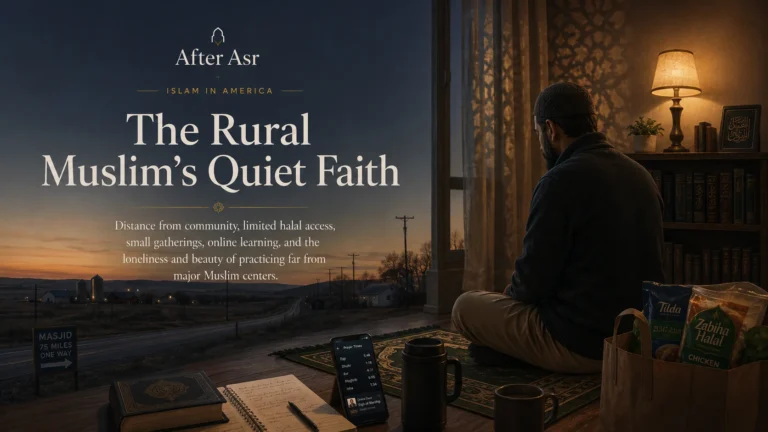
Preservation does not mean freezing every habit of the past. Some forms must change. Language changes. Educational models change. Technology changes. Community needs change. Leadership structures mature. Youth questions shift. Converts require new approaches. Women’s participation must be handled with more seriousness. Anti-Blackness must be addressed more truthfully. Rural Muslims need better support. Online learning must be guided. Institutions must professionalize without losing softness.
But change must serve preservation of the soul, not replace it.
The next generation must learn the difference between renewal and surrender.
What must be repaired
Some inheritances need repair.
Mosque governance that lacks transparency. Cultural arrogance. Anti-Blackness. Neglect of converts. Poor women’s spaces. Youth programs without depth. Weekend schools without teacher support. Fundraising without accountability. Religious teaching without mercy. Community service that burns out the same few volunteers. Public representation that hides internal dysfunction. Families that use religion as control rather than guidance. Silence around abuse. Dismissal of mental health. Class privilege. Ethnic clustering that leaves others at the margins.
These are not reasons to abandon the community. They are reasons to take responsibility.
Repair requires courage because it often disappoints everyone. Elders may feel criticized. Youth may feel change is too slow. Leaders may feel attacked. Marginalized members may feel tired of explaining. Donors may resist accountability. Volunteers may fear more work. But repair is part of amanah.
The next generation should not inherit a habit of either blind loyalty or easy abandonment. Blind loyalty allows harm to continue. Easy abandonment leaves institutions to decay. The better way is principled repair: truthful, patient, organized, spiritually grounded, and willing to build alternatives where necessary.
Repair also requires self-examination. The next generation may rightly critique older patterns, but it will create its own problems if it lacks humility. Social media outrage is not the same as reform. Cynicism is not courage. Public callouts are not always justice. New language does not automatically create better character. Repair must begin with taqwa, or it becomes another form of ego.
What must be built
The next generation will need to build what previous generations could not yet build fully.
Stronger Islamic schools. Better adult education. Serious convert care systems. Youth mentorship that continues beyond high school. Muslim counseling and chaplaincy rooted in Islamic understanding. Professional ethics programs. Endowments to support institutions long-term. Local Muslim media. Archives of community history. Women’s scholarly spaces. Leadership training. Rural Muslim support networks. Disability access. Burial infrastructure. Healthy governance models. Islamic curriculum that speaks to American realities without dilution. Programs for new parents, singles, divorced Muslims, elders, prisoners, veterans, and those returning to practice after distance.
This building will require money, but not only money. It will require knowledge, patience, administration, humility, and spiritual intention. It will require people willing to do unglamorous work. It will require Muslims who can think beyond one event, one fundraiser, one crisis, one personality, or one generation.
The next generation should build with memory and imagination together.
Memory prevents arrogance. Imagination prevents stagnation. Memory says, “Do not forget what was sacrificed.” Imagination says, “Do not assume what exists is all that can exist.” Together, they allow renewal without contempt.
American Muslims should not build merely to be impressive. They should build to worship Allah better, teach children better, serve neighbors better, protect vulnerable people better, and hand forward something more trustworthy than what they received.
The responsibility of elders
If the next generation is inheriting, then elders are also responsible for how they hand things over.
Elders must teach history without weaponizing sacrifice. They must mentor without controlling. They must correct without humiliating. They must allow young people to lead before they themselves are gone. They must document institutional knowledge. They must share authority. They must tell the truth about mistakes. They must make room for converts, women, Black Muslims, youth, and those outside dominant ethnic circles. They must preserve foundations without demanding that every cultural habit remain unchanged.
This is difficult. It is not easy to build something over decades and then watch others question it. It is not easy to see younger Muslims use new language, challenge old structures, or misunderstand earlier struggles. It is not easy to step aside when one still feels responsible.
But handing forward is part of building.
An elder who refuses to train successors has not protected the work. They have endangered it. A founder who cannot let go may turn service into ownership. A parent who only warns but never explains may lose the child’s trust. A teacher who does not prepare new teachers leaves a gap. A board that does not develop younger leadership creates future crisis.
The best elders do not only preserve institutions. They cultivate inheritors.
The responsibility of youth
The next generation also has responsibilities.
They must learn before judging. Serve before demanding authority. Understand history before rewriting it. Respect elders without imitating every mistake. Ask questions without arrogance. Seek knowledge from reliable sources. Protect prayer. Build families with intention. Care for converts. Learn Black Muslim history. Address racism and cultural arrogance. Support women’s learning and dignity. Develop financial ethics. Practice adab online. Stop treating the mosque like a product. Show up when chairs need stacking. Give money, not only opinions. Make dua for those who came before.
Youth are not only critics of inheritance. They are trustees.
This does not mean waiting until older generations approve every change. Some repairs cannot wait forever. But even reform must have manners. The goal is not to defeat elders. The goal is to carry Islam forward more faithfully.
Young Muslims should remember that one day, if Allah gives them life, they too will be the elders. They too will have blind spots. They too will be misunderstood by those who come after. They too will hope that their sacrifices are treated with mercy.
This awareness should soften the heart.
The inheritance beneath all inheritances
Beneath institutions, memory, culture, language, history, and community life, the true inheritance is Islam itself.
Not as a slogan. Not as ethnicity. Not as public identity. Not as family pressure. Not as a reaction to Islamophobia. Not as aesthetics. Not as politics. Not as nostalgia. Islam as submission to Allah. Islam as worship. Islam as guidance. Islam as mercy. Islam as truth.
Every generation must receive Islam again. It cannot be inherited mechanically. A child born into a Muslim family must still come to know Allah. A teenager raised in the masjid must still choose prayer. An adult with Muslim parents must still repent. A community with Islamic institutions must still renew sincerity. Converts remind born Muslims of this reality because they enter consciously, but born Muslims also need conscious return.
The next generation is inheriting more than buildings. It is inheriting the call to worship Allah in a particular time and place.
America will change. The Muslim community will change. Technology will change. Public debates will change. The ethnic composition of mosques will change. The questions of youth will change. The shape of institutions will change. But the need of the human being will not change.
The heart will still need Allah.
The soul will still need prayer.
The community will still need mercy.
The tongue will still need truth.
The poor will still need care.
The child will still need guidance.
The convert will still need belonging.
The elder will still need honor.
The sinner will still need repentance.
The dying will still need hope.
This is the inheritance that matters most.
Handing forward with trembling and hope
The next generation is not inheriting a finished project.
It is inheriting a trust.
A trust built by enslaved Muslims whose faith was not extinguished, by Black Muslim communities who carried dignity through struggle, by immigrants who built mosques from scarcity, by converts who entered Islam with courage, by mothers and fathers who tried, by teachers who showed up, by volunteers who stacked chairs, by imams who carried questions, by donors who gave quietly, by youth who returned, by elders who made dua, by communities that made mistakes and still hoped.
The inheritance is mixed because human beings are mixed. It contains beauty and failure, sacrifice and negligence, wisdom and fear, courage and avoidance. That is why the next generation must receive it with both gratitude and responsibility.
They should not say, “Everything before us was wrong.”
They should not say, “Everything before us must remain.”
They should say, “May Allah reward those who carried this before us. May He forgive them and us. May He show us what to preserve, what to repair, what to build, and what to leave behind.”
This is the posture of trusteeship.
The future of Islam in America will not be secured by panic, nostalgia, branding, anger, or public recognition. It will be secured, by Allah’s permission, through worship, knowledge, character, family, community, justice, mercy, and the patient work of handing forward what is true.
The next generation is watching.
They are watching how we pray, not only how we speak. How we disagree, not only what we claim. How we treat women, converts, Black Muslims, elders, youth, the poor, and those who struggle. How we use money. How we respond to criticism. How we repair harm. How we remember Allah when no one is impressed.
They will inherit what we build.
They will also inherit what we neglect.
So we should build carefully, repent often, teach clearly, listen humbly, and leave behind more than institutions.
We should leave behind a path back to Allah.