
How Muslims maintain confidence amid misrepresentation.
There is a particular discipline required of Muslims in America: to know who you are before the world tells you who it thinks you are.
This is not always easy. Public life is full of images, assumptions, questions, jokes, headlines, scripts, and suspicions that arrive before a Muslim has spoken. Islam is discussed in classrooms by people who may know little about it. It is debated on television by people who may never enter a mosque. Muslim women are analyzed as symbols. Muslim men are feared as types. Muslim children are asked questions they did not create. Converts are treated as puzzles. Black Muslims are too often erased from the story. Immigrant Muslims are treated as permanently foreign. Practicing Muslims are praised when they are useful and questioned when they are firm.
Misrepresentation is not one single event. It is an atmosphere.
It can come loudly through news coverage, political rhetoric, entertainment, and public controversy. It can also come quietly through workplace assumptions, school assignments, neighborly curiosity, airport suspicion, casual jokes, and the way people pause before saying the word Muslim. Some of it is malicious. Some of it is lazy. Some of it is inherited. Some of it is simply the result of a society that has spoken about Muslims more often than it has listened to them.
The danger of this atmosphere is not only that others misunderstand Muslims. The deeper danger is that Muslims may begin to understand themselves through the misunderstanding of others.
A believer needs private certainty.
Not arrogance. Not denial. Not contempt for outsiders. Not the brittle confidence that must always argue, correct, and defend. Private certainty is quieter than that. It is the knowledge, cultivated before Allah, that Islam is true, that dignity comes from Him, that public confusion does not alter revelation, and that a Muslim does not become less whole because others cannot see them clearly.
This certainty must be built. It is not automatic. It is taught in homes, strengthened in prayer, clarified through knowledge, protected by community, and renewed whenever the world becomes loud.
The exhausting task of being explained poorly
Many Muslims know the feeling of hearing Islam explained by someone who does not love it.
A news anchor summarizes a complex issue with careless language. A textbook presents Islamic civilization as a unit in world history, then rushes past living faith. A film uses Muslim aesthetics to suggest danger. A politician speaks of “Muslim communities” as a security problem or demographic tool. A public figure praises “moderate Muslims” in a way that makes ordinary religious practice sound suspicious. A workplace training mentions Ramadan as a diversity fact, but says nothing about prayer, worship, or Allah.
The Muslim listening may feel frustration, sadness, embarrassment, anger, or fatigue. Sometimes they correct the error. Sometimes they cannot. Sometimes they wonder whether correction would change anything. Sometimes they are simply tired of watching Islam reduced to someone else’s need.
Being explained poorly is a spiritual test because it can tempt the heart in several directions.
It can tempt Muslims into constant defensiveness, as though Islam must be saved every day from the latest misstatement. It can tempt them into withdrawal, as though silence is safer than being misread. It can tempt them into dilution, as though the solution is to present Islam in the least challenging form possible. It can tempt them into bitterness, as though everyone outside the community is committed to misunderstanding.
Each temptation carries harm.
Islam does not need panic. It does not need Muslims to become public relations officers for Allah’s religion. It does not need bitterness to protect it. It does not need dilution to survive. What it requires from believers is truthfulness, knowledge, worship, patience, courage, mercy, and trust.
A Muslim may correct what is false. They may build better media. They may write, teach, speak, organize, and clarify. But they must also know when to return the matter to Allah. Not every lie can be answered by one person. Not every careless comment deserves the whole heart. Not every public distortion should be allowed to colonize private worship.
The believer has work to do, but the believer is not the guardian of all public perception.
The difference between being known and being approved
Much of the pain of misrepresentation comes from the human desire to be known.
People do not want to be flattened. They do not want their faith reduced to politics, culture, violence, gender debates, or foreignness. They do not want their children to inherit suspicion. They do not want their neighbors to fear them. They do not want to enter classrooms, hospitals, airports, workplaces, and civic spaces under a cloud of assumptions.
This desire to be known is natural. It is not weakness.
But it can become spiritually dangerous when the desire to be known turns into dependence on being approved. Approval is unstable. It can be granted and withdrawn according to the mood of the age. Muslims may be praised when they serve public narratives and criticized when they refuse them. They may be admired for charity but challenged on moral boundaries. They may be celebrated for diversity but resented for conviction. They may be welcomed as neighbors but questioned as believers.
If Muslims build their confidence on approval, their confidence will rise and fall with every headline.
Private certainty frees the believer from this instability. It allows a Muslim to seek understanding without needing approval as a condition of dignity. It allows a Muslim to say, “I want to be known truthfully, but I do not need everyone’s acceptance to know that I belong to Allah.” It allows the community to engage without begging, explain without shrinking, and serve without performing.
This distinction is especially important for young Muslims. They need to learn that being liked is not the same as being respected, and being respected is not the same as being faithful. They need adults who model calm confidence rather than desperate acceptability. They need to see Muslims who can be gracious in public without constantly asking, “Did we look good enough?”
Islam is not made true by applause. The Muslim is not made dignified by recognition.
The public image and the private prayer
A Muslim’s public image can be distorted. Their prayer cannot be taken from them unless they surrender it.
This is one of the great protections of Islam. No matter what is said about Muslims, the believer still stands before Allah. The adhan still calls. Fajr still enters before dawn. The Qur’an still speaks. Ramadan still comes. Zakat still purifies wealth. Du’a still rises from the heart. The grave still awaits. The Day of Judgment is still real. The mercy of Allah is still greater than public ignorance.
Prayer restores scale.
A headline can feel enormous until the believer says Allahu Akbar. Not as a slogan, but as reality. Allah is greater than the headline. Greater than the insult. Greater than the misrepresentation. Greater than the approval of others. Greater than the fear of being misunderstood. Greater than the nation, the media cycle, the classroom, the workplace, the comment section, and the anxious need to control how every person sees us.
This does not make public harm unreal. Misrepresentation can lead to discrimination, bullying, surveillance, violence, exclusion, and emotional exhaustion. Muslims should not dismiss these harms with simplistic spiritual language. But prayer keeps harm from becoming ultimate. It returns the believer to the One whose knowledge is perfect.
In salah, the Muslim is not a symbol, suspect, ambassador, minority, demographic, or debate topic. The Muslim is an abd, a servant. That is the truest identity.
A community that wants confidence must protect prayer, not only public image. It must teach children to pray before teaching them to answer stereotypes. It must help converts love salah before asking them to explain Islam to others. It must build mosques that are not only event centers, but houses of worship. It must measure success not only by representation, but by whether hearts are turning toward Allah.
Public misunderstanding becomes less powerful when private worship becomes more real.
Knowing Islam well enough not to panic
Certainty requires knowledge.
A Muslim who knows little about Islam may feel shaken every time Islam is criticized. Not because the criticism is strong, but because the Muslim’s foundation is weak. If a person only knows Islam as family culture, inherited identity, or a few moral positions, then public misrepresentation can feel personally destabilizing. A hostile question may expose not Islam’s weakness, but the believer’s lack of preparation.
This is not a reason for shame. It is a reason to learn.
American Muslims need serious, accessible Islamic education, not only for children, but for adults. They need to know tawheed, the Prophet ﷺ, Qur’an, worship, purification, prayer, fasting, zakat, Islamic character, family ethics, basic fiqh, spiritual diseases, repentance, and the broad outlines of Muslim history. They need to understand what is central and what is secondary, what is agreed upon and what has legitimate difference, what is Islam and what is culture, what requires scholarly knowledge and what can be explained simply.
Knowledge gives proportion.
Without knowledge, every public debate feels like an emergency. With knowledge, the believer can say, “This is a serious question,” or “That criticism misunderstands the issue,” or “Muslims have discussed this for centuries,” or “I do not know enough to answer, but I know where to seek guidance.” Knowledge allows the Muslim to avoid both blind defensiveness and unnecessary doubt.
It also protects against overreaction. Not every criticism of Muslim behavior is Islamophobia. Sometimes Muslims are being corrected for real failures. Not every uncomfortable question is an attack. Sometimes people are ignorant but sincere. Not every public conversation requires a full theological response. Sometimes a simple explanation is enough. Knowledge helps Muslims discern.
A community confident in Islam does not panic whenever Islam is discussed. It listens, evaluates, responds where needed, and remains rooted.
Misrepresentation from outside and confusion from inside
Public misunderstanding does not only come from non-Muslims. Sometimes Muslims misrepresent Islam too.
They may do so through harshness, ignorance, cultural arrogance, racism, misogyny, dishonesty, bad character, spiritual shallowness, or public speech without knowledge. They may reduce Islam to identity politics, ethnic custom, anger, aesthetics, online debate, or moral policing. They may speak in the name of Islam while violating its adab. They may make the religion seem narrow, cruel, chaotic, or hypocritical through their conduct.
This is painful because Muslims are often already misrepresented from outside. Internal misrepresentation feels like betrayal.
But private certainty requires honesty here as well. Muslims should not protect every Muslim behavior because outsiders are watching. Islam is not honored by denying community flaws. A Muslim who says, “This behavior is wrong,” is not helping Islamophobia. They may be protecting the integrity of the faith. The key is to distinguish between Islam and Muslim failure.
Islam is true. Muslims may fall short.
This sentence is simple, but it must be deeply understood. If Muslims do not understand it, they will either defend the indefensible or become disillusioned when Muslims disappoint them. Converts especially need this clarity. Young people need it. People hurt by community failures need it. The behavior of Muslims can affect one’s emotional relationship to the community, but it does not determine the truth of revelation.
Private certainty is not blind loyalty to Muslims. It is loyalty to Allah, His Messenger ﷺ, and the truth. That loyalty should make Muslims more willing to correct injustice within the community, not less.
The child who learns the atmosphere
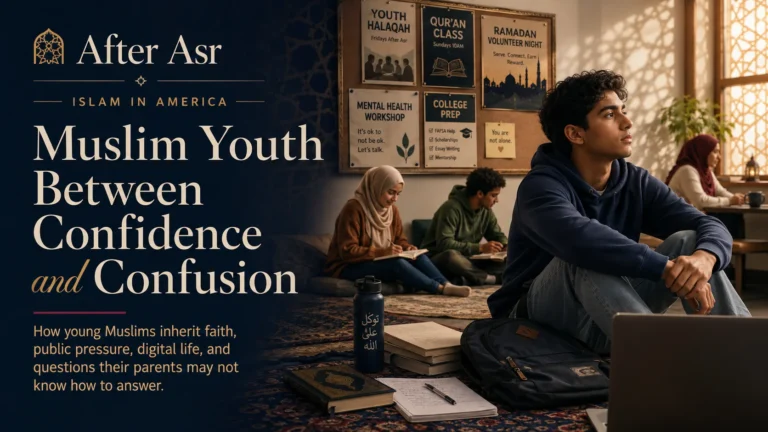
Children learn public misunderstanding before they have language for it.
They notice when adults lower their voices about being Muslim. They notice when a parent becomes tense after a news story. They notice when classmates ask strange questions. They notice when teachers mispronounce names. They notice when Ramadan is treated as exotic. They notice when Eid is ignored. They notice when their mosque has security cameras. They notice when their parents tell them to be careful what they say.
If adults are not careful, children may inherit anxiety as part of religious identity.
A child may begin to feel that being Muslim means being watched, questioned, or explained. They may feel they must behave perfectly so others do not judge Islam. They may become embarrassed by visible practices. Or they may become angry and withdrawn, assuming the outside world will never understand them.
Muslim children need truth, but they also need confidence.
They should be told that some people misunderstand Islam, but Islam is not confusing to Allah. They should be taught how to answer simple questions without feeling responsible for everything. They should know that they can say, “I do not know.” They should see adults correct misinformation calmly. They should see Muslim joy, not only Muslim anxiety. They should experience Ramadan, Eid, prayer, Qur’an, family, and community as blessings before they experience them as explanations.
A child who loves Islam deeply is better prepared to face misunderstanding than a child who only knows Islam as something that must be defended.
This begins in the home. Speak about Islam with warmth. Speak about Allah with love and awe. Tell stories of the Prophet ﷺ. Make Eid beautiful. Make the masjid familiar. Let children see adults pray sincerely. Let them know that Muslim identity is not a public burden first. It is a gift from Allah.
Converts and the shock of being misunderstood
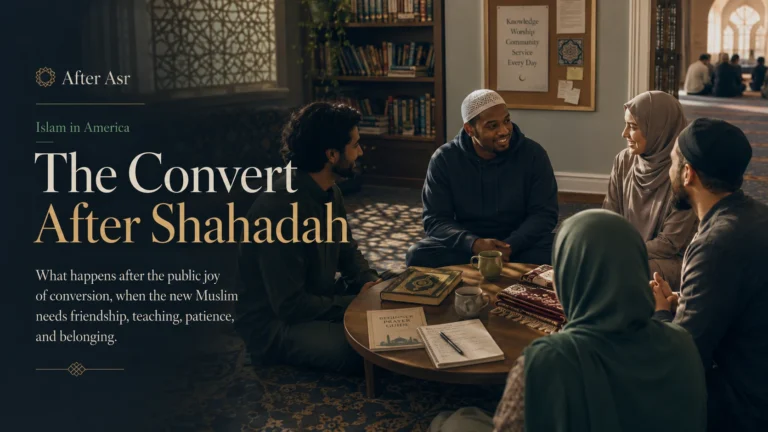
Many converts experience a sudden shift after becoming Muslim. Before Islam, they may have moved through American life without being asked to represent a religion. After Islam, especially if they become visibly Muslim or openly practicing, they may encounter suspicion, confusion, fascination, or grief from family and friends.
Some are asked, “Are you becoming extreme?” Some are told, “You used to be normal.” Some are treated as though they have rejected their family or culture. Some are asked whether they converted for marriage. Some are assumed to have been manipulated. Some are praised by Muslims as inspirational while being questioned by non-Muslims as strange. Some become tired of explaining why they pray, fast, avoid pork, dress differently, or no longer participate in certain rituals.
This can be disorienting.
The convert needs private certainty, but they may still be building it. The first years of Islam can be full of learning, tenderness, mistakes, loneliness, and spiritual intensity. Public misunderstanding during that period can feel especially heavy. A convert may know Islam is true and still feel hurt when loved ones misunderstand them.
Communities should not rush converts into public explanation. Let them learn. Let them grieve. Let them grow. Let them become rooted before asking them to become bridges. Support them when family questions become painful. Teach them how to explain Islam without anger and how to set boundaries without cruelty. Remind them that being misunderstood by people does not mean they are unknown to Allah.
A convert’s certainty should not depend on becoming a perfect representative. It should be nourished through worship, companionship, knowledge, and patience.
Muslim women and the visible argument
Muslim women, especially those who wear hijab or niqab, often carry public misunderstanding on the body.
Before they speak, assumptions may already gather. Oppressed. Radical. Modest. Foreign. Conservative. Brave. Backward. Empowered. Victim. Symbol. Depending on the observer, the same woman may be read through entirely different scripts. She may be praised for choice by some and pitied by others. She may be interrogated by strangers. She may be expected to answer for gender in Islam at work, school, or family gatherings. She may be treated as more religious than she feels, or less free than she is.
This is not only an intellectual burden. It is emotional and physical. To be visibly Muslim is to have less control over when Islam enters the room. The room sees it before the woman decides whether to mention it.
Private certainty for Muslim women must be more than slogans about empowerment. It must be rooted in Allah. It must include knowledge of why one does what one does. It must include community support, not only public admiration. It must include the right to be human, to have bad days, to be funny, intelligent, tired, ambitious, quiet, flawed, and complex without every mood being interpreted as a statement about Islam.
Muslim communities should protect visible Muslim women from being used as symbols, even by Muslims. Do not make them carry every conversation about authenticity, modesty, representation, or oppression. Do not praise them only when they are useful in public. Do not ignore their actual needs in mosques, workplaces, schools, and families.
A woman’s dignity is not in what others project onto her. It is in her servanthood to Allah.
Black Muslims and the burden of historical correction
Black Muslims in America often face a particular kind of misrepresentation: erasure.
The public may imagine Muslims as foreign, Arab, South Asian, immigrant, or newly arrived. Many Muslims themselves may unconsciously repeat this distortion. Black Muslims are then placed in the exhausting position of correcting the American story and the Muslim community’s story at the same time.
They may have to remind others that Islam in America cannot be honestly told without enslaved African Muslims, without Black Muslim movements, without prison Islam, without urban masjids, without families who preserved discipline and dignity under pressure, without scholars and leaders formed in Black Muslim experience. They may have to challenge anti-Blackness in immigrant-dominated spaces while also challenging Islamophobia in broader society.
This is too much weight for one community to carry alone, yet Black Muslims have carried it with immense strength.
Private certainty here may look like refusing erasure. It may look like knowing that public ignorance does not undo historical reality. It may look like building institutions that do not wait for recognition. It may look like teaching children a fuller story than textbooks or mosque programs provide. It may look like insisting, calmly and firmly, that Islam in America is not foreign to Black history and Black life.
Other Muslims should not make Black Muslims repeat this correction forever. The responsibility to tell the truth belongs to the whole community. American Muslim certainty must include historical honesty. A Muslim community that forgets its Black Muslim foundation will remain vulnerable to the lie that Islam belongs elsewhere.
The immigrant Muslim and the suspicion of foreignness
Immigrant Muslims and their children often face the suspicion that Islam is foreign because they are seen as foreign.
An accent becomes evidence. A name becomes a question. A language becomes distance. A mother’s clothing becomes a symbol. A father’s beard becomes a stereotype. A mosque with immigrant leadership becomes, in some eyes, less American. Children who are born here may still be asked where they are really from. Families who have lived in America for decades may still be treated as guests.
This suspicion can shape the inner life of immigrant communities. Some respond by preserving culture tightly, fearing loss. Some push children toward assimilation, fearing rejection. Some become defensive. Some become quiet. Some pour their energy into building mosques, schools, businesses, and professional lives, hoping that stability will answer suspicion.
But no amount of contribution can fully satisfy people committed to seeing Muslims as outsiders.
Private certainty allows immigrant Muslims to honor their histories without apology and participate in American life without inferiority. It allows them to teach children that their family languages, foods, and memories are not obstacles to being Muslim or American. It also allows them to distinguish between Islam and culture, so that children are not burdened with defending cultural habits as though they were revelation.
The immigrant Muslim does not need to erase origin to belong. Nor should origin become an idol. Islam gives a larger home than ethnicity and a deeper dignity than national acceptance.
Rural Muslims and quiet certainty
For Muslims far from large communities, public misunderstanding can feel personal because there may be no crowd to absorb it.
The rural Muslim, the small-town convert, the family in a county with no mosque, the student who is the only Muslim in school, the worker who has never met another Muslim colleague, all may experience Islam as both deeply private and constantly visible. They may not face national media directly, but they face local curiosity. They may become “the Muslim” in every room.
Their certainty must often be cultivated with fewer supports. Online lectures, books, distant teachers, occasional mosque visits, family prayer, small gatherings, and personal discipline may become lifelines. The absence of a large community can be lonely, but it can also produce a profound sincerity. When no one around you is fasting, fasting becomes undeniably for Allah. When no one expects you at the masjid, driving an hour for Jumu’ah becomes an act of love. When no one understands your prayer, prayer becomes private loyalty.
Urban Muslims should not underestimate this. American Islam is not only built in large mosques and crowded iftars. It is also built in quiet homes, truck stops, dorm rooms, military barracks, small apartments, rural roads, and break rooms where one believer chooses Allah without applause.
Private certainty is often strongest where public recognition is weakest.
Media literacy as spiritual protection
Muslims need media literacy not only as a civic skill, but as spiritual protection.
A person who consumes every headline, outrage clip, comment thread, and hostile debate without discipline may begin to feel that the world is nothing but contempt. They may become reactive, anxious, cynical, or addicted to being offended. They may mistake constant exposure for awareness. They may know every insult against Muslims but feel distant from the Qur’an. They may be informed and spiritually depleted.
Not everything deserves the eyes.
A Muslim should know enough to be responsible, but not consume misrepresentation as a daily diet. There is a difference between staying aware and repeatedly injuring the heart. The phone can become a small machine of spiritual agitation if not governed. Public misunderstanding becomes more powerful when Muslims carry it in their pockets and refresh it before Fajr, after salah, during meals, and before sleep.
Media literacy asks: Who is speaking? What do they know? What are they trying to make me feel? Is this verified? Is this worth my attention? Does this require action from me? Am I becoming more useful, or only more angry? Is this helping me serve Allah, or stealing my peace?
Sometimes the most faithful response is to read carefully. Sometimes it is to correct publicly. Sometimes it is to support Muslim media. Sometimes it is to turn the screen off and pray.
Confidence cannot grow in a heart constantly fed by contempt.
Muslim media and telling ourselves truthfully
One response to misrepresentation is not merely demanding better coverage from others. It is building Muslim spaces of truthful speech.
Muslim publications, podcasts, newsletters, documentary projects, children’s books, local histories, oral archives, school curricula, khutbahs, art, fiction, and community storytelling all matter. Not because Muslims need propaganda, but because Muslims need truthful self-understanding. If others constantly tell the story of Islam in America, Muslims may become guests in their own narrative.
But Muslim storytelling must also be honest.
It should not turn Muslims into flawless victims or perfect citizens. It should not hide community problems. It should not reduce Islam to identity. It should not produce shallow inspiration while avoiding hard questions. It should not imitate the same sensational habits Muslims criticize elsewhere. It should tell the truth with adab: the beauty, the failures, the diversity, the worship, the struggle, the humor, the loneliness, the institutions, the histories, the families, the converts, the elders, the children, the dead, the future.
Truthful Muslim media can strengthen private certainty because it gives Muslims language for their own lives. A young Muslim who sees their reality described with care may feel less alone. A convert may find words for experiences they thought were personal failures. An elder may see their sacrifices remembered. A community may recognize its blind spots. Non-Muslims may also benefit, but the first responsibility is not performance. It is truth.
Muslims need to speak in their own voice, not only in response to someone else’s distortion.
When confidence becomes arrogance
Private certainty must be distinguished from arrogance.
A Muslim confident in Islam should not become contemptuous toward non-Muslims. Certainty is not permission to mock, dismiss, or dehumanize others. The Prophet ﷺ did not teach believers to respond to ignorance with cruelty. The Qur’an calls to wisdom, beautiful preaching, justice, patience, and truth. Confidence without mercy becomes harshness. Knowledge without humility becomes disease.
Misrepresentation can tempt Muslims into reverse stereotyping. “They will never understand.” “Americans are all like this.” “Non-Muslims only hate us.” “There is no point explaining.” These statements may arise from pain, but they are not always true. Many people are sincerely ignorant, not malicious. Some are open to learning. Some have been misled. Some have never met a Muslim. Some are neighbors with rights upon us. Some may one day be guided to Islam.
A believer does not let the wrongdoing of some erase the humanity of others.
Private certainty should produce calmness. The confident Muslim does not need to humiliate people to feel safe. They can correct firmly without cruelty. They can decline bad-faith conversations without bitterness. They can answer sincere questions with patience. They can admit Muslim failures without fearing Islam will collapse. They can say, “This is what we believe,” without needing to win every argument.
True certainty bows before Allah. Arrogance bows before the self.
The role of the mosque in forming confidence
The mosque should be one of the places where Muslims are reintroduced to themselves truthfully.
Not as minorities first. Not as victims first. Not as representatives first. Not as a problem to be managed. As believers.
A khutbah can either deepen confidence or feed anxiety. If every sermon is reactive to public events, the community may learn that Islam is always responding to the world. If sermons never address public pressures, the community may feel abandoned. The balance is to root people in Allah, revelation, worship, character, and akhirah, while also helping them interpret the realities they face.
Weekend schools should not only teach children facts. They should help them love being Muslim. Youth programs should not only warn against fitnah. They should build intellectual and spiritual strength. Convert classes should not only teach mechanics. They should offer belonging and worldview. Adult classes should not only be occasional lectures. They should help Muslims answer the age they live in without being consumed by it.
The mosque should be where public misunderstanding is named, but not centered. The center must remain Allah.
If a Muslim leaves the mosque only angrier at the world, something is missing. If they leave only comforted but not strengthened, something is missing. If they leave clearer about Islam, softer in heart, firmer in worship, and more capable of serving others, then the mosque is doing its work.
Private certainty in public service
Private certainty is not withdrawal from society. It is what makes healthy service possible.
A Muslim confident in Allah can serve neighbors without needing to be praised. They can join civic efforts without diluting belief. They can answer questions without becoming defensive. They can work in schools, hospitals, nonprofits, local government, media, law, business, and community organizations while carrying a moral center. They can build relationships with non-Muslims without feeling spiritually threatened by every interaction.
In fact, insecurity often makes public engagement worse. An insecure Muslim may over-explain, overcompensate, avoid hard truths, seek approval, or become combative. A rooted Muslim can be calmer because their identity is not being negotiated in every room.
Private certainty allows Muslims to be generous.
It allows a hijabi doctor to treat patients with excellence without feeling she must constantly explain herself. It allows a Muslim teacher to care for students while maintaining prayer. It allows a business owner to serve customers honestly while keeping halal boundaries. It allows a student to join a class discussion without either hiding or dominating. It allows a mosque to host neighbors without turning the event into apology.
The more secure Muslims are before Allah, the more beneficial they can be among people.
The courage to be ordinary
One way to resist misrepresentation is to tell better stories. Another is to live ordinary Muslim lives without asking permission.
There is quiet courage in this.
A family praying in a rest area during a road trip. A student requesting Eid off without embarrassment. A nurse breaking fast with dates in a hospital hallway. A father taking his child to Qur’an class after work. A convert saying bismillah before eating with relatives who do not understand. A young woman wearing hijab to a job interview. A Muslim business owner closing briefly for Jumu’ah. A teenager explaining to friends that they do not date. A neighbor inviting another family to iftar.
These acts do not make the news, but they form the texture of confident Muslim life.
Public misunderstanding often makes Muslims feel they must do something grand to correct it. Sometimes grand work is needed. But much of the correction happens through ordinary consistency. People who know Muslims personally may slowly become less vulnerable to stereotypes. Children who see their parents live Islam calmly may become less shaken by public noise. Converts who find ordinary Muslim companionship may become less lonely. Communities that practice Islam steadily become harder to reduce.
Ordinary faith is not passive. It is a form of witness.
When the world never fully understands
There is a mercy in accepting that the world may never fully understand.
This does not mean giving up on teaching, correcting, or building relationships. It means releasing the fantasy of total recognition. No community is perfectly understood. No prophet was fully accepted by his people. Truth has always been resisted, simplified, mocked, or misused by some. The believer should not be surprised that Islam is misrepresented. Saddened, yes. Concerned, yes. Active, yes. But not surprised as though the path to Allah promised universal applause.
There will always be people who misunderstand prayer. People who fear modesty. People who reduce Islam to politics. People who cannot imagine obedience as freedom. People who treat religion as identity but not truth. People who prefer Muslims when they are quiet. People who want Muslims to condemn endlessly. People who will not be satisfied no matter how carefully Muslims speak.
The believer cannot live for these people.
The believer speaks truth, acts with wisdom, serves with sincerity, corrects where useful, protects the vulnerable, and then returns the matter to Allah. This is not defeat. It is spiritual realism.
Private certainty grows when Muslims stop expecting public life to give what only Allah can give: full knowledge, perfect justice, complete recognition, and final judgment.
The center that holds
How do Muslims maintain confidence amid misrepresentation?
They pray. They learn. They build homes where Islam is loved. They teach children before the world teaches them shame. They support converts after the first celebration. They tell the truth about Black Muslim history. They honor immigrant sacrifice without making culture into religion. They strengthen rural Muslims and small-town families. They build mosques that form souls, not only host events. They create media that speaks truthfully. They develop scholars, teachers, writers, chaplains, organizers, and neighbors who can explain Islam without reducing it.
They also rest.
They turn off the noise. They sit with Qur’an. They make dhikr. They eat with family. They visit the sick. They laugh after prayer. They serve quietly. They remember death. They remember Jannah. They remember that Allah is not confused by what confuses people.
Public misunderstanding is loud, but it is not sovereign.
A Muslim’s certainty does not come from controlling every image of Islam in the world. It comes from knowing Allah, worshipping Him, trusting His revelation, and living among people with dignity and mercy. It comes from being corrected by the Qur’an more deeply than by the comment section. It comes from belonging to the ummah more deeply than to a media category. It comes from knowing that the Prophet ﷺ was misrepresented too, and that truth remained truth.
The world may call Muslims many things.
But in the quiet before Fajr, in the pause before sujood, in the hunger before iftar, in the whisper of du’a, in the child learning al-Fatihah, in the convert saying shahadah, in the elder turning prayer beads with worn fingers, in the small-town Muslim driving an hour to Jumu’ah, in the mother teaching her child to say Allah with love, the believer remembers the name that matters most.
Servant of Allah.
If that certainty is alive, then public misunderstanding may wound, but it will not define.