Faith formation, schooling choices, and home life
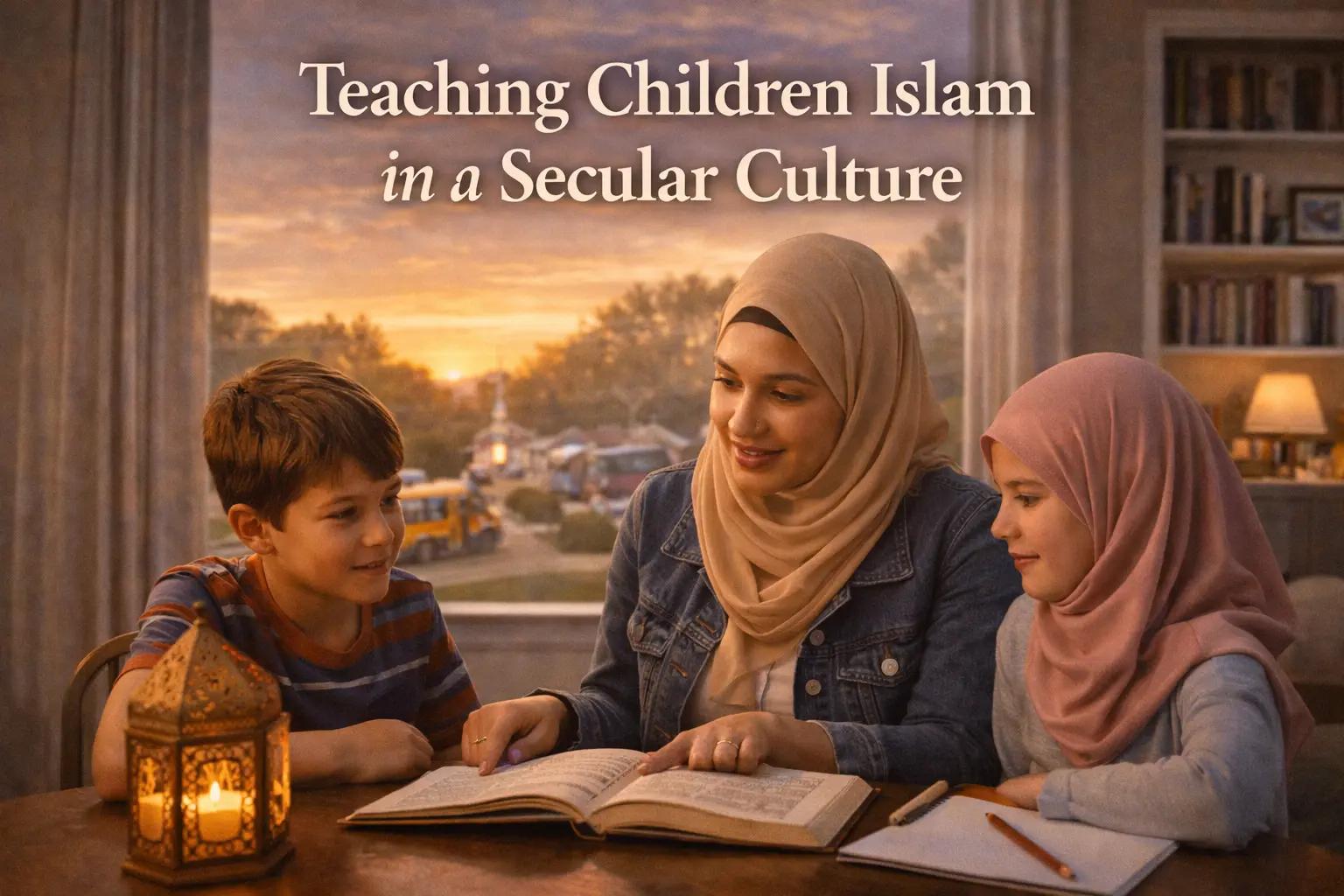
Nadia’s seven-year-old comes home from school with questions. Why do we pray five times a day when nobody else does? Why can’t I eat the birthday cake at school? Why does Allah care if I wear shorts? The questions are innocent, but they reveal the central challenge of raising Muslim children in America: how do you teach them to value what their entire surrounding culture tells them doesn’t matter?
Every Muslim parent in America becomes a religious educator by necessity. You cannot outsource your children’s Islamic formation to the broader culture the way parents in Muslim-majority countries might. School won’t teach them. Television won’t reinforce it. Their friends’ families won’t share it. If your children are going to be Muslim, you have to actively make them Muslim, day after day, choice after choice, conversation after conversation.
This reality transforms Muslim home life in America. Faith cannot be ambient background. It must be intentional foreground. Parents develop strategies, some traditional and some innovated for American contexts, to raise children who are confidently Muslim while fully capable of navigating secular American society. The results are mixed, the anxiety is constant, and the stakes feel impossibly high.
The Daily Practice
For many families, Islamic practice begins with the basics: prayer, Quran, and Islamic manners. Children learn to pray as soon as they can follow instructions, often by age five or six. Parents lead by example, praying at home where children can observe and imitate. The goal is to make prayer normal, not a special occasion but a rhythm that structures the day.
Some families are strict about children’s prayer from a young age, requiring five daily prayers and correcting any mistakes in form. Others are more relaxed, encouraging participation without demanding perfection, hoping that gentle introduction will create positive associations rather than resentment. Both approaches carry risk. Too much rigor might create rebellion. Too much flexibility might communicate that prayer doesn’t really matter.
Quran memorization occupies weekend mornings and summer breaks. Children learn Fatiha first, then short surahs, progressing according to ability and interest. Some parents hire tutors for tajweed lessons. Others use apps and YouTube videos. A few send their children to intensive summer programs where they memorize large portions of Quran in weeks of focused study.
The motivation varies. Some parents want their children to be huffaz, Quran memorizers, for the spiritual merit and discipline it develops. Others simply want their kids to know enough Quran to pray properly and feel connected to Islamic tradition. Still others worry that without memorization, their children will grow up unable to read Arabic or recite the words Muslims worldwide share.
Islamic manners, adab, get taught throughout daily life. Say bismillah before eating. Use your right hand. Greet people with salaam. Respect elders. Be generous. These teachings blend with general good manners, making it sometimes unclear where Islam ends and cultural values begin. But parents see it all as part of raising righteous children, Muslims whose character reflects their faith.
The School Question
No decision causes more anxiety for Muslim parents than education. Islamic school, public school, or homeschool? Each option carries profound implications for children’s Islamic identity, academic preparation, and social development.
Islamic schools offer the obvious benefit of an environment that reinforces rather than contradicts faith. Children pray together, learn Islamic studies alongside academic subjects, and form friendships with other Muslim kids. They’re not the only ones fasting during Ramadan or explaining why they can’t eat pepperoni. Their Muslim identity is normal rather than exceptional.
But Islamic schools vary wildly in quality. Some offer rigorous academics, excellent facilities, and well-trained teachers. Others struggle with limited resources, high turnover, and curricula that lag behind public school standards. Parents who can afford Islamic school tuition, often $10,000 to $20,000 per child per year, must weigh whether the Islamic environment compensates for potentially weaker academics.
There’s also the social concern. Do children in Islamic schools develop the ability to navigate diverse environments? Will they struggle when they eventually enter public universities or workplaces where they’re suddenly the minority? Some parents worry that Islamic school creates a bubble that leaves children unprepared for real-world America.
Public school offers strong academics, diversity, and no tuition. Children learn to function in secular spaces, to explain their faith to curious classmates, to be confidently Muslim while surrounded by non-Muslims. They develop resilience and cultural competence that may serve them well as adults.
But public school also exposes children to everything parents fear: drugs, sexual content, bullying, Islamophobia, peer pressure to abandon Islamic values. Children miss school for Eid and must explain why. They sit awkwardly through Christmas celebrations and Valentine’s Day parties. They navigate crushes and dating culture while their parents forbid boyfriend-girlfriend relationships. The pressure to assimilate is constant and intense.
Homeschooling offers complete control. Parents teach what they want, emphasize Islam as much as they choose, and protect children from negative influences. It allows flexibility for families who travel for Hajj or visit relatives abroad for extended periods. Children can learn at their own pace without the social pressures of institutional schooling.
But homeschooling requires enormous parental investment of time, energy, and often money for curricula and resources. Not all parents are equipped to teach effectively. Socialization becomes a challenge, requiring intentional effort to ensure children develop friendships and social skills. And some homeschooled children struggle when they eventually enter college or careers, having never learned to function in institutional environments.
Many families mix approaches over time. Elementary school at Islamic school, middle and high school public. Homeschool for a few years, then transition to traditional school. The decisions are never permanent and rarely feel completely right.
Creating Islamic Home Culture
Regardless of schooling choice, parents try to create home environments that nurture Islamic identity. Quranic recitation plays in the car. Islamic children’s books fill the shelves. Halal food rules are non-negotiable. Arabic phrases pepper everyday speech, inshallah and alhamdulillah and masha’Allah becoming verbal habits.
Some families are all in on Islamic home culture. They limit media consumption to Islamic content, monitor friendships carefully, and structure free time around mosque programs and Quran study. Their homes feel distinctly Muslim, decorated with calligraphy and prayer rugs, organized around prayer times, saturated with Islamic references.
Others take a lighter touch. They maintain basic Islamic practices but don’t isolate their children from mainstream culture. Kids watch the same TV shows as their classmates, play the same video games, listen to the same music. Parents pick their battles, prohibiting what seems genuinely harmful while allowing what seems harmless, even if not explicitly Islamic.
The challenge is determining where to draw lines. Is music haram or only certain kinds of music? Can children watch movies with magic, or does that conflict with Islamic theology? What about Halloween, Christmas celebrations at school, birthday parties at trampoline parks? Every family navigates these questions differently, often inconsistently, trying to find balance between Islamic authenticity and American normalcy.
Ramadan becomes especially important for family Islamic culture. Even young children participate, fasting partial days or just avoiding snacks. Families make suhoor together before dawn, breaking fast together at maghrib. They attend tarawih at the mosque, stay up late, and create special Ramadan traditions. For many Muslim children, Ramadan memories, the excitement of iftar, the community feeling of crowded mosques, the sense of shared sacrifice, become foundational to Islamic identity.
Eid provides another anchor. Families make it special with new clothes, gifts, elaborate meals, and gatherings with other Muslims. They’re consciously creating alternatives to Christmas, trying to give their children celebratory moments that are Islamically rooted. The effort is both necessary and exhausting.
The Conversations
Perhaps the most crucial element of teaching children Islam in secular culture is ongoing conversation. Children need explanations, not just rules. Why do we believe in Allah when many people don’t? Why is the Quran true? Why do we dress modestly? Why can’t we date?
The questions get harder as children get older. Teenagers push back. They want to go to prom, to dress like their friends, to not be different. They question whether God really cares about the details parents insist matter. They point out hypocrisy in the community, Muslims who judge others while violating Islamic principles themselves.
Parents respond in different ways. Some double down on authority, because I said so, because it’s haram, because this is what Muslims do. This sometimes works through sheer force of parental will, but it can also backfire, creating resentment and eventual rebellion.
Others engage in genuine dialogue, acknowledging doubts, exploring questions together, showing children that faith can withstand scrutiny. This approach respects children’s intelligence and agency but requires parents to be knowledgeable and thoughtful enough to engage complex questions. Not all parents are.
Many families seek outside help, bringing children to youth programs at mosques, connecting them with young Muslim mentors, sending them to Islamic summer camps. The hope is that someone besides Mom and Dad can reach them, that peer influence and inspiring teachers can do what parental nagging cannot.
The Peer Pressure Problem
Muslim children in America face intense peer pressure to assimilate. They see their classmates dating, drinking, wearing whatever they want, and living with freedoms they don’t have. They feel left out, restricted, and different in ways that adolescence makes unbearable.
Parents try various approaches. Some enforce strict rules, no sleepovers, no social media, no hanging out with non-Muslim friends. This protects children from certain influences but can increase their sense of isolation and make forbidden things more appealing.
Others allow more freedom, trusting that solid Islamic foundation will help children navigate temptation. They permit carefully chosen friendships with non-Muslims, allow participation in school activities with clear boundaries, and try to maintain open communication so children will talk to them rather than hide things.
The Muslim community itself provides some protection. When children have Muslim friends who share their restrictions, being different feels less isolating. Youth groups and Islamic school social circles create alternative peer groups where Islamic values are normal. But these communities aren’t always available, especially for families outside major cities or for children whose personalities don’t fit the local Muslim kid culture.
The Identity Formation
What emerges from all this effort is a generation of Muslim Americans with complex relationships to faith. Some maintain strong Islamic identity, praying regularly, dressing modestly, and staying involved in Muslim community. Others drift away, keeping cultural markers but abandoning religious practice. Most fall somewhere in between, negotiating their own versions of what being Muslim in America means.
Parents cannot control outcomes. They can teach, model, explain, and hope, but ultimately their children will make their own choices. This is terrifying for parents who view their children’s faith as their responsibility and their children’s potential rejection of Islam as their failure.
Yet many children raised with Islam in America develop strong, thoughtful faith precisely because it was never passive. They had to defend it, question it, choose it consciously. They become Muslims who know why they believe, who can articulate their faith to skeptics, who practice Islam as conviction rather than mere inheritance.
The task of teaching children Islam in secular culture is exhausting and never-ending. There’s no curriculum that guarantees success, no strategy that works for every family. Parents muddle through, making imperfect choices, hoping that love, example, and intentional effort will be enough.
What sustains them is both faith in Allah and faith in their children. They trust that the seeds they’re planting will grow, perhaps not exactly as they imagined but into something authentic and rooted. They believe that raising children who are both confidently Muslim and successfully American is possible, even if the path there is unclear.
And they keep trying, day by day, prayer by prayer, conversation by conversation, building Islamic identity in hearts that will carry it into a future they can only imagine.