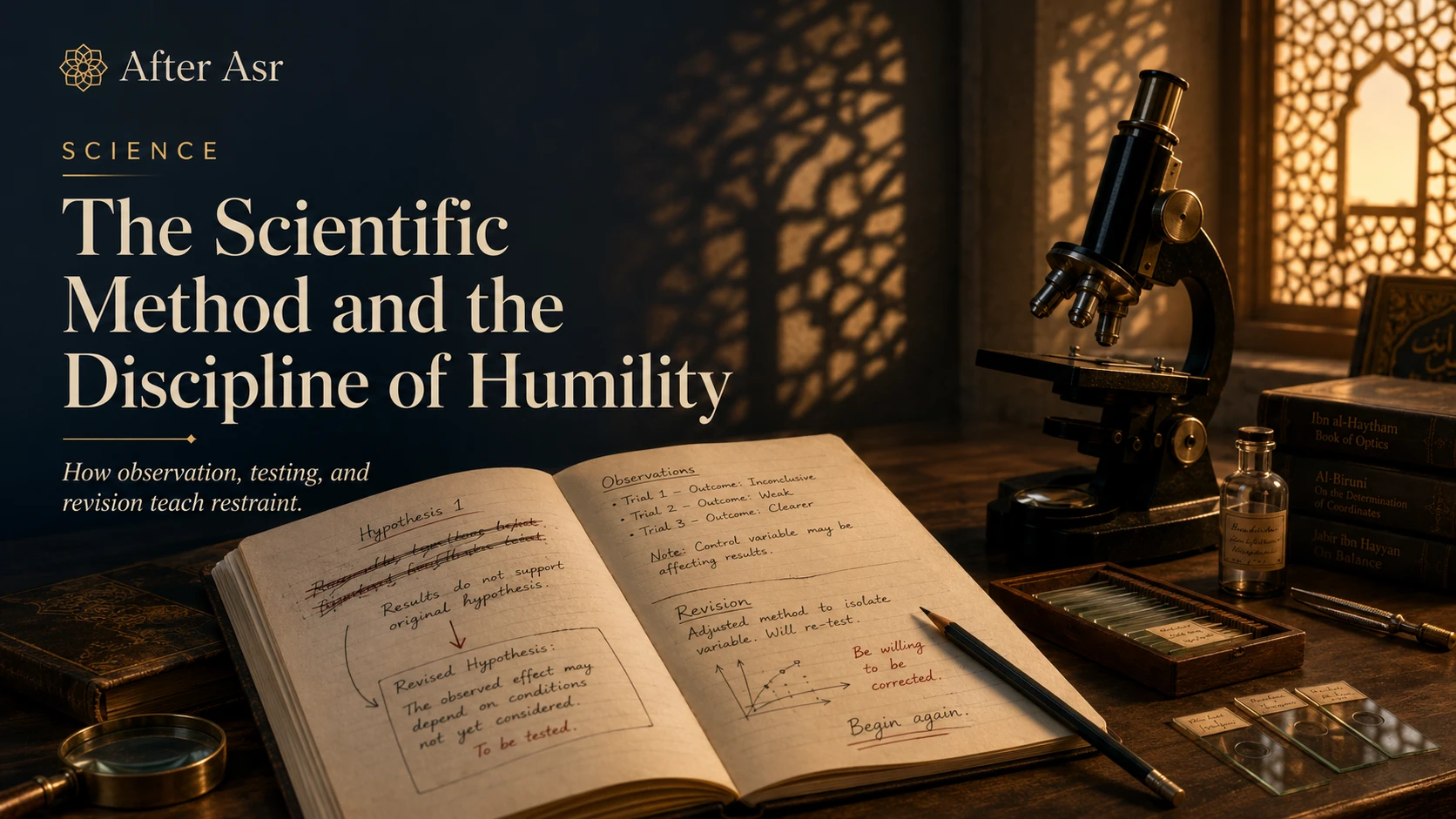
How observation, testing, and revision teach restraint
There is a quiet beauty in being corrected by reality.
A person may begin with confidence. He may believe he understands what is happening. The pattern seems obvious. The explanation feels elegant. The first answer arrives quickly, almost too quickly, and the mind enjoys the satisfaction of certainty.
Then the experiment fails.
The observation does not match the prediction. The patient does not respond as expected. The data refuses to cooperate. The result is not dramatic. Sometimes it is only a small inconsistency, a detail that does not fit, a number slightly out of place. But for the careful observer, that small resistance matters.
Reality has spoken.
This is where the scientific method becomes more than a technical process. It becomes a discipline of humility. It teaches the human being to pause before claiming too much, to test before declaring, to revise before defending, and to accept that truth is not injured by our correction. Only pride is.
The scientific method is often introduced in school as a set of steps: ask a question, form a hypothesis, conduct an experiment, collect data, analyze results, draw a conclusion. This is useful, but incomplete. If we only describe the method mechanically, we miss its moral shape.
At its best, the scientific method trains the soul away from arrogance.
It says:
Look carefully.
Do not assume too quickly.
Let your claim face the world.
Let your explanation be tested.
Let others examine your method.
Let the answer change if the evidence demands it.
This is not merely a method for laboratories. It is a way of resisting the ego’s desire to be right without being truthful.
Observation before conclusion
The scientific method begins with observation.
That may sound simple, but true observation is difficult. Most people do not see the world as clearly as they think they do. We see through expectation, habit, fear, memory, desire, and culture. We notice what confirms us. We overlook what inconveniences us. We simplify what is complex so that we can move on with our day.
Observation asks us to slow down.
Before we explain the thing, we must encounter it. Before we diagnose, we must listen. Before we generalize, we must notice. Before we argue, we must understand what is actually present.
This is why the first discipline of science is attention.
A doctor must attend to the patient’s symptoms, not merely to the category she expects the patient to fit. A botanist must attend to the plant as it grows in real conditions, not only to the diagram in a textbook. An astronomer must attend to faint light across immense distance. A public health researcher must attend to patterns that may be hidden beneath ordinary statistics.
Careless observation produces careless knowledge.
This is true beyond science as well. Families suffer when people stop observing each other carefully. Communities suffer when leaders assume they already know what people need. Religious conversations suffer when people answer questions that were not actually asked. Public debates suffer when everyone reacts to a symbol instead of examining the reality beneath it.
Observation is an act of restraint. It delays the ego’s rush toward conclusion.
To observe well is to say: I will not force reality to fit my impatience.
The hypothesis and the danger of attachment
After observation comes the hypothesis — a possible explanation, a proposed relationship, a testable idea.
The hypothesis is an essential act of imagination. Science requires creativity. Someone must look at a pattern and wonder what may be causing it. Someone must suggest that two things may be related. Someone must imagine a mechanism hidden beneath appearances.
But a hypothesis is not a truth. It is a proposal.
This distinction is one of the great lessons of scientific humility. Human beings easily become attached to their own explanations. Once we have named something, we feel we possess it. Once we have argued for an idea, we begin to defend it as though our dignity depends on it. Once others know what we believe, changing our mind can feel like public defeat.
Science asks us to hold our explanations more lightly.
A hypothesis should be strong enough to test, but not so sacred that it cannot be corrected. It should be clear enough to guide inquiry, but not so beloved that contradictory evidence is ignored.
This balance is hard. Scientists, like all people, can become attached to their theories. Researchers can spend years pursuing an explanation. Careers, reputations, institutions, and funding can gather around certain assumptions. The scientific method does not magically remove ego from the human being.
But it does create a structure that challenges ego.
The hypothesis must face evidence. It must become vulnerable to correction. It cannot remain safely hidden inside the mind, protected by eloquence. It must enter the world of testing.
That vulnerability is part of its honesty.
In ordinary life, many of our “hypotheses” about people and situations never receive this kind of testing. We assume someone is rude, lazy, arrogant, irresponsible, irrational, or hostile. We build entire emotional worlds around explanations we have never examined. We collect evidence selectively. We dismiss anything that complicates our story.
A scientific spirit would ask: What else could explain this? What evidence would change my mind? Have I confused my interpretation with the truth?
This does not mean human relationships should become experiments. It means humility should govern our conclusions.
Testing as submission to reality
Testing is where the claim meets resistance.
A test asks whether the world behaves as our explanation predicts. If our idea is true, certain results should follow. If they do not follow, then something must be reconsidered: the hypothesis, the method, the measurement, the assumptions, or the interpretation.
There is something spiritually instructive in this.
The human ego often wants reality to submit to the self. It wants the world to confirm what the self already believes. Testing reverses this. It asks the self to submit to reality.
The experiment does not care how beautiful the theory is. The data does not care how confident the researcher feels. A treatment does not become effective because we want it to work. A material does not become safe because a company invested in it. A claim does not become true because it is repeated with authority.
Testing protects us from the tyranny of preference.
This is why controlled experiments, replication, measurement, and peer review matter. They are not merely bureaucratic procedures. They are safeguards against human weakness. They acknowledge that we are capable of error, bias, wishful thinking, and self-deception.
A person who resents testing may not be defending truth. He may be defending control.
In public life, this matters deeply. We are surrounded by claims: health claims, political claims, technological claims, moral claims, economic claims. Some are true. Some are partly true. Some are misleading. Some are profitable. Some are emotionally satisfying. Some are designed to spread faster than they can be examined.
The discipline of testing teaches us not to surrender our minds to the first claim that excites us.
It teaches us to ask: How do we know? What was measured? Compared to what? Under what conditions? Has this been repeated? Who benefits if I believe this? What uncertainty remains?
These questions are not signs of cynicism. They are signs of responsibility.
Failure as instruction
In science, failure is not always the opposite of progress. Often, failure is the path by which progress becomes honest.
A failed experiment can reveal that a theory was incomplete. A negative result can prevent harmful assumptions from becoming practice. A result that contradicts expectation can open an entirely new field of inquiry. A mistake can expose a weakness in method that would have distorted future research.
This is one reason science requires patience. It does not always reward speed. It rewards carefulness.
Modern culture struggles with this. We prefer success stories, breakthroughs, dramatic discoveries, and confident announcements. We do not always honor the slow, unglamorous work of being wrong properly.
But there is a difference between being wrong carelessly and being wrong well.
To be wrong carelessly is to ignore evidence, mislead others, or refuse correction.
To be wrong well is to learn, revise, clarify, and become more truthful.
The scientific method depends on the possibility of being wrong well. If error is treated as humiliation, people will hide it. If revision is treated as weakness, people will defend falsehood. If uncertainty is treated as incompetence, people will exaggerate certainty.
A healthier intellectual culture would make room for honest correction.
This does not mean all errors are harmless. Some errors in medicine, engineering, public policy, or environmental management can have serious consequences. Accountability matters. But accountability should not become a culture of performance where no one can admit limits.
Humility allows learning to continue after error.
A scientist who cannot say “I was wrong” is dangerous. A religious teacher who cannot say “I need to check” is dangerous. A policymaker who cannot say “the evidence has changed” is dangerous. A community leader who cannot say “we misunderstood this” is dangerous.
Human beings are not made safer by pretending leaders know everything. They are made safer when leaders are honest about how knowledge is formed, tested, revised, and limited.
Revision as moral courage
Revision is the part of the scientific method that many people admire in theory but resist in practice.
It is easy to say, “I follow the evidence.” It is harder to change when the evidence points away from what we wanted to believe.
Revision requires moral courage because it often costs something. It may cost pride. It may cost status. It may cost simplicity. It may require apologizing, retracting, redesigning, delaying, or beginning again. It may require admitting that a beloved explanation was incomplete.
But revision is not the enemy of truth. It is one of the ways truth is honored.
When science revises, people sometimes mock it: “First they said one thing, now they say another.” Sometimes this criticism is fair, especially when early claims were communicated with too much confidence. But revision itself is not a flaw. A method that cannot revise is not strong. It is brittle.
The question is not whether scientific understanding changes. The question is how responsibly it changes.
Does it change because of better evidence?
Does it change because methods improved?
Does it change because earlier assumptions were exposed?
Does it change transparently, with honesty about what was known and unknown?
If so, revision should increase trust, not destroy it.
The same is true in personal life. A person who can revise his opinion in light of truth is not weak. A person who can reconsider a judgment, soften a harsh conclusion, or abandon a false assumption is practicing humility. The inability to revise is not strength. It is often fear dressed as firmness.
Faith itself requires a kind of revision of the self. Not revision of divine truth, but revision of the human being before truth. Repentance is, among other things, the admission that one’s previous direction was wrong. Growth requires correction. Guidance requires that the servant be willing to move.
A heart that cannot revise cannot be guided.
Restraint in what we claim
The scientific method teaches not only how to discover, but how to speak.
A careful researcher learns to distinguish between what the evidence shows, what it suggests, what remains uncertain, and what has not been studied. This restraint is part of intellectual honesty.
But public communication often strips away restraint.
A study that finds a limited association becomes a headline announcing a sweeping conclusion. A preliminary result becomes “proof.” A small sample becomes universal advice. A complex finding becomes a social media slogan. The public receives not science, but certainty manufactured from fragments.
This damages trust.
When claims are overstated, later correction feels like betrayal. When nuance is removed, disagreement becomes confusion. When uncertainty is hidden, people assume someone was lying when the uncertainty eventually appears.
Scientific humility requires disciplined speech.
It is morally better to say “we do not yet know” than to decorate ignorance with confidence. It is better to say “the evidence is limited” than to pretend the matter is settled. It is better to explain uncertainty honestly than to manipulate people into trust.
This does not mean experts should speak timidly when evidence is strong. False balance can also be harmful. Some matters are well established, and public hesitation can create danger. But even firm conclusions should be communicated with clarity about scope.
Truthful speech has boundaries.
Science teaches us to respect those boundaries by asking us to make claims proportional to evidence. That is a lesson the whole society needs.
Humility is not weakness
Humility is often misunderstood as softness, uncertainty, or lack of confidence. But scientific humility is not the refusal to know. It is the refusal to pretend.
A humble scientist can be very confident when evidence is strong. A humble physician can recommend treatment decisively. A humble engineer can say that a structure is unsafe. A humble public health expert can warn of real danger.
Humility does not mean all claims are equal. It does not mean every opinion deserves the same weight. It does not mean expertise should be ignored. It does not mean a person must remain forever undecided.
Humility means confidence remains accountable to truth.
It means one’s certainty grows from evidence rather than ego. It means conclusions are held with awareness of method, scope, and limitation. It means the expert remembers that expertise in one field does not grant wisdom in all matters. It means the non-expert remembers that suspicion is not the same as understanding.
This balance is difficult but necessary.
Without humility, authority becomes arrogant.
Without confidence, knowledge becomes paralyzed.
Without restraint, discovery becomes reckless.
Without courage, inquiry becomes timid.
The scientific method, properly understood, does not ask us to abandon confidence. It asks us to earn it.
The spiritual danger of being right
There is a particular danger in being right.
When our explanations work, when our predictions succeed, when our knowledge gives us power, we may begin to believe that correctness has purified us. But a person can be right and still be arrogant. A person can understand mechanisms and still lack mercy. A person can possess knowledge and still misuse it.
Science can teach humility through correction, but success can teach pride if the soul is not careful.
A society that becomes scientifically advanced may begin to mistake ability for worthiness. Because it can build, it assumes it may build. Because it can intervene, it assumes it should intervene. Because it can measure, it assumes what cannot be measured is less real. Because it can explain certain processes, it assumes meaning has been exhausted.
This is not science itself. It is the spiritual misuse of scientific power.
The scientific method can tell us whether something works. It cannot, by itself, tell us whether our desire for it is pure. It can help us predict consequences. It cannot guarantee that we will care about those consequences. It can reveal complexity. It cannot force us to become reverent.
That is why humility must be more than methodological. It must become moral and spiritual.
We need the humility to be corrected by evidence.
We also need the humility to be accountable before God.
A method for the laboratory, a lesson for the soul
The scientific method is not a religion. It is not revelation. It is not a complete philosophy of life. It is a disciplined way of investigating the natural world.
But within that discipline are lessons the soul badly needs.
Observe before judging.
Test before declaring.
Revise when corrected.
Speak only according to what you know.
Do not confuse your interpretation with reality.
Do not let pride make you loyal to error.
Do not fear truth because it inconveniences you.
These are scientific habits, but they are also human virtues.
Imagine if public debate carried more of this spirit. Imagine if people paused before repeating claims. Imagine if leaders admitted uncertainty without being punished for honesty. Imagine if communities asked better questions before assigning blame. Imagine if students were taught that changing one’s mind for the sake of truth is not embarrassment, but maturity.
Imagine if believers approached the created world with this kind of disciplined wonder: not careless, not insecure, not arrogant, but attentive and grateful.
The world would not become free of disagreement. Science itself contains disagreement. But disagreement would become less theatrical and more sincere. Inquiry would become less about performance and more about truth.
The restraint of the careful mind
There is a kind of restraint that looks like silence, but is actually wisdom.
It is the restraint of the researcher who does not overstate the result.
The doctor who says, “We need more tests.”
The teacher who says, “That is a good question; let me verify.”
The student who says, “I do not understand yet.”
The believer who says, “Allah knows best,” not as an escape from thinking, but as protection against false certainty.
This restraint is not laziness. It is discipline.
The scientific method teaches that knowledge should be approached with care because reality is worthy of care. The body is worthy of care. The earth is worthy of care. The mind is worthy of care. The vulnerable people affected by our conclusions are worthy of care.
To be reckless with knowledge is to be reckless with trust.
The careful mind does not refuse to act. It acts with proportion. It does not refuse to speak. It speaks with honesty. It does not refuse to conclude. It concludes with awareness of what the conclusion can and cannot bear.
In an age that rewards speed, restraint may feel almost rebellious.
But restraint is often where humility becomes visible.
Beginning again
One of the most beautiful things about the scientific method is that it allows beginning again.
A failed hypothesis does not end inquiry. It refines it. A corrected conclusion does not destroy knowledge. It strengthens it. A new observation does not humiliate the careful seeker. It invites him deeper.
There is mercy in a process that allows correction.
Human beings need that mercy. We are not born knowing. We misunderstand. We overstate. We assume. We defend ideas that later prove incomplete. We mistake fragments for wholes.
But we can learn.
The scientific method, when practiced with integrity, teaches us how to learn without making ignorance our home and without making certainty our idol. It teaches us to walk a middle path between arrogance and despair.
Look closely.
Ask carefully.
Test honestly.
Revise humbly.
Speak truthfully.
Begin again.
This is not only how good science grows. It is how a human being becomes more faithful to reality.
And for the believer, reality is not empty. It is created. It is ordered. It is filled with signs, patterns, limits, and lessons. To study it well is not to conquer it, but to receive it with attention.
The scientific method does not remove wonder from the world. It teaches us that wonder deserves discipline.
And discipline, when joined to humility, becomes a form of reverence.