How the Quran teaches courage when belief becomes costly.
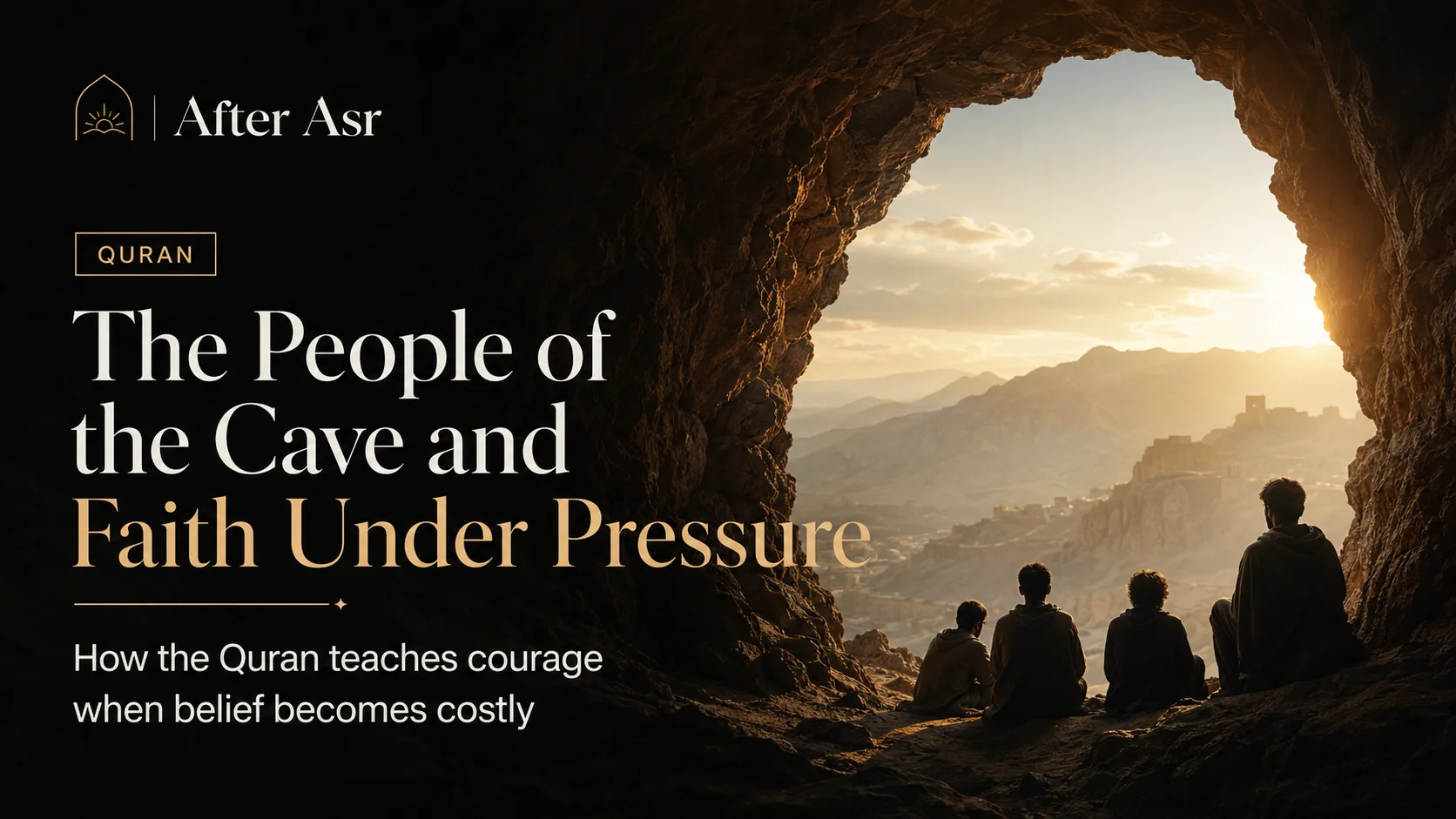
The story of the People of the Cave is one of the Quran’s most powerful accounts of faith under pressure. It is not a story of public victory, military strength, political authority, or immediate social reform. It is the story of a small group of young believers who recognize truth in an environment hostile to it, refuse to surrender their faith to the demands of their society, and seek refuge when remaining openly within that society would threaten their religion.
This makes the story especially relevant. Many believers will never face a ruler demanding explicit disbelief, but almost every believer will face pressure of some kind. Pressure to conform. Pressure to remain silent. Pressure to dilute belief until it becomes socially acceptable. Pressure to treat faith as private sentiment rather than public truth. Pressure to laugh at what should be honored, normalize what should be resisted, or feel ashamed of what Allah has dignified.
The People of the Cave teach that faith is not only tested by violence. It is also tested by the atmosphere around us. A society can pressure the believer through ridicule, isolation, career risk, family expectation, intellectual fashion, political fear, and the simple desire to belong. In such a world, courage may not always look dramatic. Sometimes courage looks like refusing to let the heart bow, even when the body must withdraw.
A Story of Young Believers
The Quran describes the People of the Cave as young men who believed in their Lord, and Allah increased them in guidance. This detail matters. Youth is often associated with instability, imitation, and social hunger. Young people are frequently pulled by the need to belong, to be accepted, to avoid standing out, and to be recognized by the dominant culture around them. Yet the Quran presents these young believers as people of courage, clarity, and moral seriousness.
Their youth does not make their faith shallow. It makes their faith more striking. They are not portrayed as elders removed from social pressure after long lives of spiritual training. They are young people facing a world that likely offered them safety if they conformed and danger if they remained faithful. They chose faith anyway.
This gives the story special weight for every generation. Young Muslims often carry intense pressure to appear normal according to standards that may not be spiritually healthy. They may be told to keep religion small, flexible, embarrassed, or hidden. They may be made to feel that seriousness about Allah is excessive, strange, backward, or socially inconvenient. The People of the Cave show that youth can be a season of deep faith, not merely a season of excuses.
Allah does not dismiss young believers as immature. He honors them in revelation.
Faith Begins With Recognition
The People of the Cave did not merely inherit a label. They recognized the truth of their Lord in a society organized around falsehood. This recognition is central. Faith under pressure cannot survive as culture alone. It must become conviction.
A person may carry religious identity because of family, community, ethnicity, or habit. These can be meaningful starting points, but pressure exposes whether faith has entered the heart. When belief becomes costly, inherited identity may not be enough. The person must know, at some level, why they stand where they stand.
The young believers in the cave understood that their Lord was the Lord of the heavens and the earth. This gave them a scale larger than their society. The people around them may have possessed numbers, power, custom, and public approval, but they did not possess ultimate truth. The believers’ clarity about Allah made the demands of falsehood smaller.
This is one of the great protections of Tawheed. When Allah is known as Lord, society loses its claim to absolute authority. The crowd may pressure, but the crowd did not create. The ruler may threaten, but the ruler does not own the Hereafter. The culture may mock, but the culture cannot define truth. Faith begins to withstand pressure when the believer’s sense of reality is anchored above the approval of people.
The Pressure to Conform
The story implies a social world in which belief was not treated as harmless difference. The young believers faced a people whose expectations threatened their faith. This pressure to conform is one of the most common tests of religious life. It is rarely presented as a demand to betray Allah outright. More often, it arrives in softer language.
Be realistic.
Do not make things awkward.
Everyone does this.
Do not be extreme.
Keep that private.
You can still believe, just do not let it affect anything visible.
Why do you have to be different?
Such pressure can be powerful because human beings are social creatures. We do not like being rejected. We want family acceptance, peer belonging, professional opportunity, and public respect. The nafs can easily begin negotiating with truth in order to preserve comfort.
The Quran does not deny the difficulty of this. The People of the Cave were not asked to pretend that pressure was imaginary. They faced it honestly. Their response was not to dissolve into society’s expectations, but to preserve their relationship with Allah. In doing so, they teach that the believer cannot allow belonging to creation to require betrayal of the Creator.
When Withdrawal Becomes Worship
One of the most misunderstood parts of the story is their retreat to the cave. The People of the Cave withdraw, but their withdrawal is not cowardice. It is not laziness, escapism, or hatred of society. It is a deliberate act to preserve faith when remaining in the open would expose them to spiritual or physical danger.
This teaches an important principle: not every situation is solved by staying visible. Sometimes the believer must speak. Sometimes the believer must remain patient within society. Sometimes the believer must build, teach, serve, and endure. But there are also moments when withdrawal becomes necessary, not because faith has failed, but because faith must be protected.
The cave is not a symbol of defeat. It becomes a place of divine care. They enter it with vulnerability, but Allah turns it into shelter. What appears small and hidden becomes honored in revelation. What appears like disappearance becomes preservation.
For Muslims today, this does not mean abandoning society at every difficulty. It means recognizing that the soul needs protected spaces. A believer may need distance from environments that constantly feed sin, mock faith, inflame desire, normalize arrogance, or weaken remembrance. Sometimes protecting faith requires choosing better company, reducing exposure to spiritual harm, leaving a corrupt environment, or creating spaces where obedience becomes possible.
Withdrawal for Allah is not escape from responsibility. It is responsibility toward the soul.
The Cave and the Mercy of Allah
The young believers ask Allah for mercy and right guidance in their affair. Their dua reveals their dependence. They do not enter the cave relying on their own bravery. They seek Allah’s mercy because courage alone cannot preserve the servant. Social pressure, fear, uncertainty, and isolation are heavy. Without Allah’s mercy, even strong believers can weaken.
This is an important part of the story. The People of the Cave are courageous, but they are not self-sufficient. Their courage is joined to dua. They act, then rely. They leave what threatens their faith, then ask Allah to arrange their matter rightly. This is the balance of tawakkul: effort without arrogance, reliance without passivity.
The cave itself becomes a sign of mercy. Allah protects them in a way they could not have planned. Their sleep, their bodies, the movement of the sun, the fear placed around them, and their eventual awakening are all governed by Allah. The story teaches that when servants sincerely choose Allah under pressure, Allah can open forms of protection beyond ordinary calculation.
The believer may not always receive protection in the same visible form, but the principle remains: no one who chooses Allah is unseen by Him.
Time Belongs to Allah
The People of the Cave sleep for years beyond their own perception. When they awaken, they do not fully understand how much time has passed. This is one of the story’s most striking features. It reminds the reader that human beings experience time from within extreme limitation. What feels long to us may be brief in Allah’s scale. What feels delayed may be precisely measured. What we think is the end of a story may be only a hidden interval.
This has spiritual significance. Believers under pressure often struggle with time. How long will this last? When will relief come? When will truth be recognized? When will the hostile environment change? When will the believer’s patience make sense?
The story of the cave teaches that time is not empty when Allah is protecting the servant. Years may pass, but Allah is not absent from the passing. The young believers sleep while Allah preserves them, and they awaken into a world changed by a decree they did not control. Their task was not to manage the centuries. Their task was to be faithful in the moment Allah placed before them.
This is a deep lesson in reliance. The believer is responsible for obedience in the present. Allah owns the timeline.
Faith May Be Hidden Before It Is Honored
When the People of the Cave first withdraw, they are not publicly celebrated. They are hidden. Their act of faith is not validated by society at the time. They disappear from the public world. Yet the Quran later preserves their story as guidance for the world.
This teaches that public recognition is not the measure of spiritual worth. Some of the most important acts of faith may occur in hidden places: a private refusal, a quiet escape from sin, a decision not to join falsehood, a prayer made in fear, a group of believers supporting one another away from public attention. People may not notice. History may not record it. Allah knows.
The modern world often trains people to value visibility. If something is not seen, posted, praised, or documented, it feels less real. The Quran reverses this. The cave is hidden from the people, but not from Allah. The hidden act becomes eternally meaningful because Allah gives it meaning.
A believer should never underestimate private faithfulness. The moment no one sees may be the moment that defines the soul.
Companionship Under Pressure
The People of the Cave are not alone. They are a group. This matters because faith under pressure is easier to preserve with righteous companionship. A believer standing alone may still be strong by Allah’s help, but good companions can protect one another from fear, doubt, isolation, and compromise.
Companionship is not only social comfort. It is spiritual infrastructure. The right companions remind you who you are when the world tries to rename you. They help normalize obedience in an environment that normalizes disobedience. They give courage when public opinion becomes heavy. They make withdrawal from falsehood less lonely.
This is especially important for young believers. The desire to belong is powerful, and if righteous belonging is absent, harmful belonging becomes more attractive. Communities must understand this. It is not enough to tell young Muslims to resist pressure while leaving them socially isolated. They need circles of faith, friendship, learning, beauty, purpose, and belonging that make obedience livable.
The People of the Cave show that sometimes survival of faith depends on finding others who are also willing to choose Allah.
The Dog at the Threshold
The Quran mentions their dog, stretched at the entrance of the cave. This detail has moved readers for generations. While the central honor belongs to the believing youths, even the animal associated with them is preserved in the story. Without exaggerating beyond what is revealed, the mention itself suggests the dignity of companionship with the righteous.
The dog is at the threshold, connected to people who chose Allah under pressure. Its place in the story reminds us that nearness to the people of faith matters. The company one keeps is not spiritually neutral. To be attached to those who remember Allah, defend faith, and seek protection from falsehood is better than being comfortably surrounded by those who pull the heart away from Him.
This should make the believer ask serious questions about belonging. Who stands at the entrance of my life? Who guards my habits? Who shapes my speech, humor, desires, fears, and ambitions? Who makes faith easier, and who makes it feel embarrassing? The story of the cave honors righteous companionship even in its smallest surrounding details.
Allah Can Make the Hidden a Sign
The People of the Cave eventually become known, and their story becomes a sign. What began as a retreat from pressure becomes evidence of Allah’s power, especially His power over life, death, sleep, awakening, and resurrection. Their preserved bodies and awakening after a long period point beyond their own story to the greater truth of the Hereafter.
This is how Quranic stories often work. They begin with human struggle, then open into theological meaning. The People of the Cave are not only examples of courage. They are also signs of Allah’s ability to resurrect and bring forth what seems impossible. Their sleep is a small sign pointing toward a greater awakening.
This means their story teaches both ethics and belief. Ethically, it teaches courage, companionship, withdrawal for faith, and reliance. Theologically, it teaches that Allah controls time, life, death, and resurrection. A believer who reads the story should not only admire the youths. They should also increase in certainty that the One who preserved them in the cave can bring all creation back after death.
Disputes Over Details
The Quran mentions that people disputed over the number of the sleepers. This is a significant part of the story because it shows how easily human beings become distracted by details that do not benefit them. Instead of focusing on the moral and theological lessons, people may become consumed by speculation.
This remains a danger in religious reading. A person may become obsessed with names, numbers, locations, and historical curiosities while avoiding the demands of the story. The Quran gives what is needed for guidance and disciplines curiosity that does not lead to obedience.
The lesson is not that details never matter. Islamic scholarship takes knowledge seriously. But not every unknown detail is spiritually important. Sometimes the more important question is not “How many were they?” but “Would I have stood with them?” Not “Where exactly was the cave?” but “What falsehood do I need to withdraw from?” Not “How did their bodies remain preserved?” but “Do I believe Allah has power over life, death, and resurrection?”
The Quran redirects the reader from speculative curiosity to transformative reflection.
Faith Under Pressure Does Not Require Hatred of People
The People of the Cave separated from their society’s falsehood, but the story should not be read as a license for contempt toward everyone outside one’s group. Their separation was about preserving faith from coercion and corruption. It was not about developing arrogance, paranoia, or hatred.
This distinction matters. A believer under pressure may be tempted to respond with bitterness toward society as a whole. Sometimes anger is understandable, especially when faith is mocked or believers are harmed. But the Quranic path is not built on hatred for its own sake. It is built on loyalty to Allah, truthfulness, wisdom, and moral clarity.
Withdrawal from harm should not make the heart arrogant. It should make the heart more dependent on Allah. The believers in the cave are not portrayed as self-righteous rebels seeking identity through opposition. They are servants seeking mercy and right guidance.
The believer must resist falsehood without letting falsehood deform their character.
The Cave as a Symbol for Every Age
Every age has its caves. Not always literal caves, but places of refuge where faith can breathe. A mosque can be a cave from a world of distraction. A righteous friendship can be a cave. A family committed to prayer can be a cave. A study circle can be a cave. A quiet moment with the Quran can be a cave. A decision to step away from harmful media, corrupt company, or a sinful environment can be a cave.
The point is not to romanticize isolation. The Muslim is not meant to abandon the world entirely. Islam calls believers to worship, serve, work, teach, build, marry, trade, give, and stand for justice. But engagement without refuge can exhaust the soul. A person constantly exposed to pressure without spaces of remembrance may slowly begin to bend.
The cave represents protected faith. Every believer needs some form of it. Not as a permanent hiding place from responsibility, but as a mercy that preserves the heart for responsibility.
The Test of Being Different
The People of the Cave were willing to be different. This is one of the hardest parts of faith under pressure. Many people can believe quietly if belief costs nothing socially. The test comes when faith requires visible difference: different worship, different limits, different speech, different modesty, different entertainment choices, different moral commitments, different loyalties, different definitions of success.
Being different can be lonely. It can make a person feel strange even among their own people. It can create tension in families, schools, workplaces, and friendships. The nafs may begin asking whether the difference is worth it.
The Quran answers through stories like this one. Difference for the sake of Allah is not disgrace. It may be honor. The People of the Cave were not honored because they blended perfectly into their society. They were honored because they refused to surrender truth to society.
A believer should not seek strangeness for ego or performance. But when obedience to Allah makes one different, that difference should not be treated as shame.
Trust When the Future Is Unknown
The young believers did not know exactly what would happen when they entered the cave. They asked Allah for mercy and guidance in their affair. This is the posture of believers who act without owning the outcome. They know what obedience requires now, but they do not know what Allah will unfold later.
Much of life works this way. A believer leaves a sin without knowing what will replace it. They choose honesty without knowing whether it will cost them. They protect their faith without knowing whether others will understand. They make hijrah from a harmful environment, literal or spiritual, without seeing the whole map ahead. They choose Allah, then trust Allah with the unseen consequences.
This is not recklessness. It is obedience joined to reliance. The People of the Cave teach that the believer does not need to know the entire future in order to be faithful in the present. Allah knows the future. The servant knows the obligation of the moment.
Conclusion
The People of the Cave and faith under pressure remain one of the Quran’s great lessons for believers living in difficult environments. Their story teaches that faith may require courage, companionship, withdrawal, patience, and trust in Allah’s unseen care. It teaches that young believers can possess extraordinary seriousness, that social pressure does not define truth, that hidden faithfulness is not lost, and that Allah can turn a place of fear into a place of mercy.
Their cave was not a symbol of defeat. It was a refuge chosen for Allah. In that refuge, Allah preserved them, made their story a sign, and taught generations that the believer is never truly alone when seeking protection through Him.
The story also disciplines the reader. It warns us not to become lost in unhelpful speculation while ignoring the real question: what pressures are trying to claim our faith, and what must we do to protect it?
Every age asks believers to conform to something.
The People of the Cave remind us that the servant of Allah must know when to stand, when to withdraw, when to seek righteous companionship, and when to trust that Allah can preserve what the world tries to erase.
Faith under pressure is not easy.
But the cave teaches that when a believer chooses Allah, even hidden places can become filled with light.