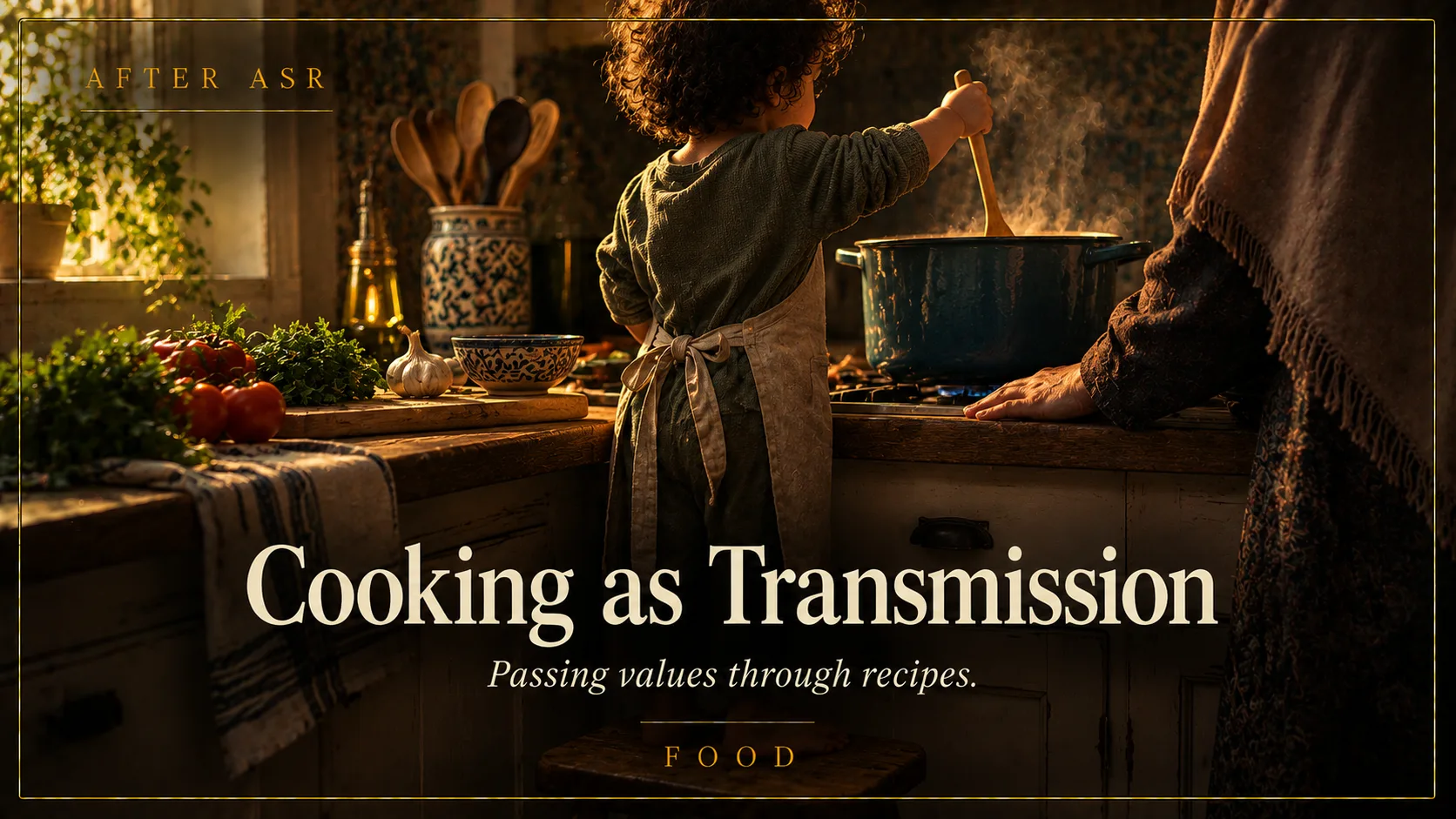
The first thing my mother handed me in a kitchen was not food. It was a job.
Stand here, she said, and stir this, and do not let it catch. I was seven. The spoon was too big for my hand, and the instruction was bigger than the pot.
I know that now. I did not know it then. That is how the kitchen teaches.
The School That Never Announces Itself
No family calls the kitchen a classroom, which is precisely why it works. Children flee anything labeled educational. They wander freely into rooms that smell like dinner.
Yet more values change hands over a cutting board than over most lecterns. Patience, generosity, cleanliness, gratitude, the treatment of guests, the treatment of leftovers. Each arrives disguised as a cooking instruction, which is the only disguise a child will let a value wear.
The curriculum is never posted. There are no grades, no diploma, no parent-teacher conference. There is only a small person on a stool, absorbing how the adults of her family behave when they feed people.
By the time she is grown, she will cook like them in ways she cannot list. More quietly, she will give like them, host like them, and stretch a pot for a stranger like them. The recipes came with riders attached.
Every kitchen is transmitting something. The only question is what.
A Recipe Is One Tenth Ingredients
Write out any beloved family recipe and look at what the paper actually holds. Quantities, times, an oven setting. Perhaps a note about which brand of butter.
Now list what the paper cannot hold. When to double it because a neighbor is struggling. Which cousin gets it without onions and never has to ask. Why it appears at every funeral within six hours, unbidden, like a first responder.
The ingredients are the smallest part of the inheritance. The rest is protocol, and protocol is just values wearing an apron. A recipe, fully transmitted, includes its occasions, its exceptions, and its obligations.
Ask an old cook for a recipe and notice that she answers with a story. The dish arrives wrapped in the occasion it was invented for, the person it was invented by, and the rule about who must never be charged for it. She is not being charming. She is being accurate about what the recipe contains.
This is why a dish learned from a website is not the same possession as a dish learned from a grandmother, even when the two taste identical. The website version comes with instructions. The grandmother version comes with instructions and orders.
Stand Here and Stir
Values transfer by apprenticeship, not by announcement. The mechanism is old and specific. The child is given a real task, slightly too hard, inside the adult’s supervision.
Stand here and stir. Watch that it does not catch. Tell me when it smells different. The task is small, but it is real, and the child can feel the difference. Dinner will actually depend, in some tiny way, on her spoon.
Responsibility taught this way needs no speech about responsibility. The pot supplies the stakes. The parent supplies the calm. The child supplies the attention, and attention, repeated, becomes competence, and competence becomes the quiet confidence that she can be trusted with things that matter.
Notice what the stool by the counter really is. It is a door held open. Children remember for the rest of their lives which adults let them into the work, and which ones sent them away so it could be done properly.
Yes, the eggs will be cracked badly and the flour will reach the floor. Efficiency is the enemy of apprenticeship, and every teacher at a stove chooses nightly between a clean kitchen and a taught child. Choose the child. Floors mop.
Send them away often enough and they stop coming. Then the transmission ends, not with a refusal to learn, but with a refusal to teach.
Patience Is Taught at Low Heat
Certain lessons can only be learned at the speed of food. The onions cannot be hurried past their sweetness. The dough must rest, and no argument shortens the rest. The stew is ready when it is ready, and the cook serves the stew, not the clock.
A child raised near these facts absorbs a rhythm the culture no longer teaches anywhere else. Almost everything in her world responds instantly. The pot does not. The pot has terms, and the terms are non-negotiable, and dinner arrives through submission to them.
This is patience taught honestly, through the wrists and the waiting, rather than through a poster with a sunset on it.
The tradition prized this temperament and called it forbearance. The kitchen builds it one simmer at a time. Nobody who has properly caramelized onions remains entirely convinced that speed is a virtue.
Ramadan supplies the advanced course. To cook an entire iftar while fasting, tasting nothing, correcting by smell and memory alone, is restraint practiced at a level no seminar could invent. The children watch a hungry adult season food for others with a steady hand. That image outlasts a hundred sermons on self-control.
Slow food makes slow tempers. Both are undervalued.
Bismillah Before the Knife
In a Muslim kitchen, the divine name is a working tool. It is said over the knife, over the pot, over the first taste. The child hears it long before understanding it, the way children hear their own names.
This is theology delivered at the correct altitude for a seven-year-old. God is not confined to the prayer rug in this house. He is mentioned over rice. Provision is from Him, the food is a trust from Him, and the correct posture toward dinner is gratitude with sleeves rolled up.
Halal awareness arrives the same sideways way. The child watches which packages are turned over and read, which aisle is skipped, which questions are asked at the butcher counter. No lecture required. The family’s care is visible, and care is contagious.
The meal is bracketed at its far end too. Alhamdulillah, said with the last bite, closes the loop the Bismillah opened. A child raised inside those bookends learns that eating is an event with a beginning and an end, addressed in both directions to the One who provided it.
Years later, in a dorm kitchen far from home, that child will murmur Bismillah over a sad little pot of instant noodles. The word will land like a hand on the shoulder. Some inheritances are two syllables long and indestructible.
Waste Is a Value Question
Watch a grandmother close out a meal. The rice is scraped to the last spoonful and assigned a future. The bones are bound for stock. The bread, grown stale, becomes something better than it was, because throwing bread away is simply not done in her country, which is to say, in her character.
The Prophet, peace be upon him, taught that the last of the food should not be abandoned, for no one knows in which portion of the meal the blessing lies. A fallen morsel was to be cleaned and eaten, not surrendered. The instruction is tender toward food in a way our landfills cannot comprehend.
Behind the grandmother’s thrift there is often a history the child only learns later. She lived through a year when bread was arithmetic. Her refusal to waste is not stinginess and never was. It is respect, paid forward from a hunger she hopes the child will never be able to imagine.
A child who watches leftovers being honored learns a doctrine about the world. Provision is not garbage in waiting. It is a trust, finite and dignified, to be used to its edges.
The lesson scales up silently. The adult who cannot throw away rice grows into the citizen who cannot ignore waste anywhere. Frugality learned at the pot becomes stewardship everywhere else.
Generosity Is Measured in Extra Portions
In some households, the pot is always slightly too big for the family. Ask why, and the cook shrugs. You never know, she says, and the sentence needs no ending.
The child absorbs the math without being taught it. We cook for ourselves plus a margin, and the margin belongs to whoever appears. The knock at dusk is not a problem to be solved. It is the reason the pot was built with a suburb.
This is generosity installed at the level of habit, below decision, which is where the strongest values live. The adult who grew up with the margin will cook the margin forever, in whatever country, at whatever income.
Her children will ask why the pot is always too big. She will shrug. You never know.
Three generations of that shrug, and a family develops a reputation. People in trouble learn which doors to knock on. The pot decided that, decades ago.
The Sons Belong at the Stove Too
Aisha, may Allah be pleased with her, was asked what the Prophet did at home. Her answer embarrasses centuries of excuses. He was in the service of his family, she said. He mended, he helped, he did the work of the house.
So the sunnah has an opinion about who belongs in the kitchen, and the opinion is everyone. A household that trains its daughters to feed people and its sons only to be fed is running half a transmission and calling it tradition.
Put the boys on the stool. Hand them the too-big spoon at seven, the knife at eleven, the whole Friday dinner at sixteen. They will absorb the same patience, the same margins, the same Bismillah over the blade.
Nobody should pretend this is exotic. Half the legendary cooks of the Muslim world are men, from the kabob masters of Istanbul to the uncle who commandeers every Eid grill in America. The only kitchen men have historically avoided is the unpaid one at home. That is the one the sunnah walked into.
And something else, quietly. A man who can feed people never has to be waited on to feel respected. He learned at the stove that service is strength. His future household will be the calmer for it, and his mother will hear about it, with thanks, for years.
Seasoning Is Judgment in Miniature
Taste it, the elders command, holding out the spoon. What does it need?
The question looks culinary. It is actually an examination in judgment. The child must consult her senses, form an opinion, and defend it. More salt is a thesis. The elders will test it against their own palates, and sometimes the child is right, and the whole kitchen adjusts.
This is how discernment is built, one spoonful at a time. Not the rule-following kind, but the kind that assesses a live situation and commits to a call. Recipes hand down the framework. Tasting hands down the judgment, and judgment is the part that cannot be written.
Notice also how correction works at a good stove. Too much chili is met with laughter and yogurt, not shame. The dish is fixable, the cook is learning, and everyone still eats. Children who are corrected this way learn to correct this way.
The kitchen may be the last place a child can be wrong safely. Guard that.
What the Child Overhears While the Pot Simmers
Half of what the kitchen transmits is never addressed to the child at all. It is overheard.
The aunties talk while their hands work, and the talk is the family’s real archive. Who helped whom in the bad year. What was done when the business failed, and who showed up with rent money and never mentioned it again. Which behavior earned quiet contempt, and which earned decades of loyalty.
The child at the counter appears busy with the peas. She is transcribing everything. Values are caught mostly in this eavesdropped form, as verdicts delivered sideways while the onions brown.
This is worth remembering as the adults in the room. The kitchen has excellent acoustics and a long memory sitting on the stool. What we honor aloud over the simmer is what they will honor.
Speak generously about people while you cook. The stool is listening. It seasons more than the pot.
Failure Is Part of the Syllabus
Every cook’s education includes its ruins. The first roti comes out shaped like a country in a civil war. The rice burns the week you are finally trusted with it alone.
What matters, permanently, is what the adults do next.
In one kitchen, the failure is met with a sigh and the child is relieved of duty. Lesson learned: do not attempt, do not risk, wait to be old before you try things. In another kitchen, the burnt pot becomes a story before it is even soaked. Everyone eats the salvageable half. The child cooks again Thursday.
Only one of these kitchens is teaching cooking. Both are teaching how failure will be treated in this family, and the child files the answer somewhere deep and consults it for the rest of her life, in matters far from rice.
Mercy at the stove is transmission too. Perhaps the most important line in the whole recipe.
The Recipe Card Is a Small Will
At some point, the transmission should touch paper. Not because paper is sufficient, but because paper survives bad years and long distances.
Write the family dishes down for your children, and write them in your own voice, margins included. Add the riders that make the recipe yours. Double this for funerals. Your father proposed the night I first made this. Never sell this, only give it.
A card like that is a small will, disbursing property no court recognizes. It bequeaths obligations along with techniques, and the obligations are the estate.
Someday a granddaughter will stand in a kitchen you never saw, holding that card, and your handwriting will tell her who her people were and how they behaved with a full pot. She will feed someone because the margin told her to.
That is inheritance working exactly as designed.
When the Transmission Skips a Generation
Be gentle here, because many readers are the skipped generation. The decades of double shifts and drive-thru dinners broke many chains. Some mothers were too exhausted to teach. Some children were too scheduled to learn. Nobody sinned. The economy simply ate the apprenticeship hours.
The good news is that transmission has no expiration date. A forty-year-old can call her mother and ask to learn, and the asking itself repairs something that predates the recipe.
The internet can supply the techniques, and honestly, it supplies them well. What it cannot supply is the riders. No video will tell you which dish your family owes to grieving neighbors, or why the pot runs large. For that, you need your people, or their stories, or their margins.
And if you are the first Muslim in your family, you are not a skipped generation at all. You are a founding one. The dishes you gather now, from friends and potlucks and your own experiments, become the ancestral cuisine of people who do not exist yet. Write your riders early. Someone will inherit them.
Start where the chain is still warm. One elder, one dish, one standing appointment. The generation that almost lost the thread is exactly the one that decides whether it was almost or actually.
Teach One Dish Like a Trust
Here is the practice, then, in its smallest complete form. Choose one dish that carries your family in it. Teach it to one younger person, entirely.
Entirely means the whole rider. The shopping and the shortcuts. The Bismillah and the margin. Who this dish gets cooked for, on which occasions, and the story of the hands you learned it from. Say the values out loud once, so the child can check her eavesdropping against the official record.
Then do the hard part. Step back and let her cook it for people while you sit at the table and receive it. Transmission is complete only when the student has fed someone and watched the face change.
The student does not have to share your blood. A niece, a neighbor’s teenager, the young convert who lingers after class asking about your thermos. Chosen apprentices carry recipes as faithfully as descendants, sometimes more so, because they know the gift was optional.
One dish, fully handed over, outweighs thirty recipes bookmarked. Depth is the format the kitchen respects.
The Spoon Passes
Every cook you love was once seven, on a stool, holding a spoon too big for her hand.
Someone stood behind her and did not take the spoon back.
That patience fed you, years later. It is your turn to stand there now.
Find the small hands in your kitchen.
Say stand here, and stir.
Then stay.
The pot teaches. The staying is the lesson.