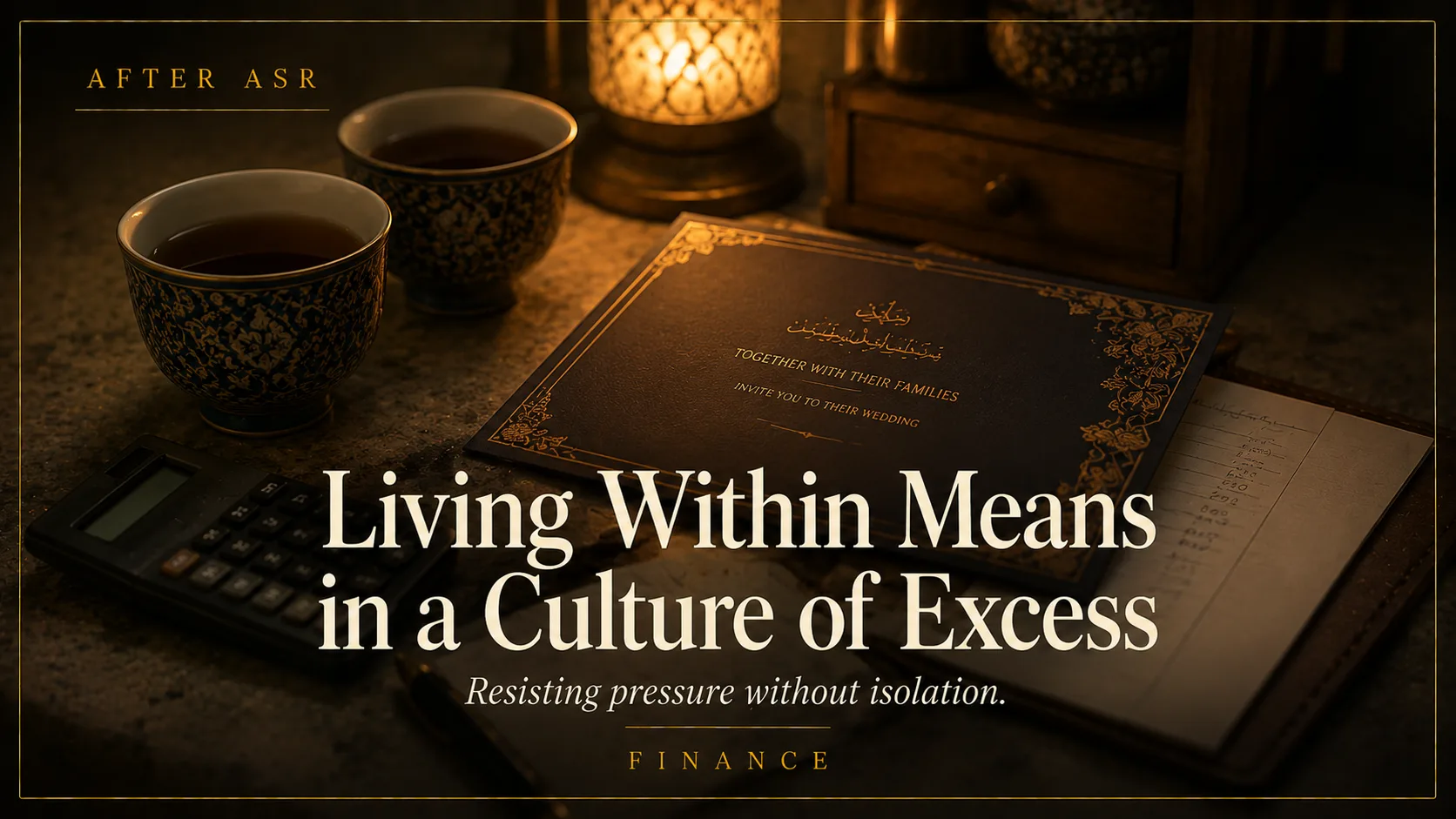
The invitation arrives in gold lettering, and the arithmetic starts before the envelope is fully open.
The outfit, the gift, the travel, the hotel block reserved under the family name. A couple stands at their kitchen counter doing silent math over a piece of beautiful cardstock. They will go, of course. They love these people.
But somewhere in the silence, both of them are wondering the same thing. When did belonging get this expensive.
This essay is about living within your means in a culture that treats restraint as failure. The hard part is not the spreadsheet. The hard part is doing it without drifting to the edge of your own community, and that is the part worth writing about.
The Price of Belonging Keeps Rising
Every community charges dues, and none of them appear on a statement.
The wedding season that costs a month’s rent. The group dinner where the bill splits evenly regardless of who ordered water. The Eid expectations that inflate a little every year, quietly, the way all unexamined traditions do.
None of this is malicious. Each expense, taken alone, is an act of love or at least of loyalty. The trouble is the sum. Social life has become a subscription with annual price increases, and canceling feels like canceling the friendships themselves.
So people pay. They pay with credit more often than anyone admits at the dinners they are paying for. The smiling table conceals half a dozen private ledgers, each one strained, each one convinced it is the only one.
The strangest part is that nobody at the table actually set the price. Everyone is obeying a standard that everyone else assumes someone else established. Ask around and no one claims it.
Excess Is the Air, Not the Exception
It helps to name the environment honestly. We are not people with a spending problem living in a neutral world. We are ordinary people living inside the most sophisticated persuasion machine ever assembled.
Billions of dollars move annually for a single purpose: to make sufficiency feel like deprivation. The phone in your pocket delivers that message more times per day than any generation before us heard it per month.
The upgrade cycle is the machine’s masterpiece. Nothing you own is allowed to stay finished. The kitchen is dated, the phone is slow, the car is due, and the definitions of dated, slow, and due are set by the sellers.
Advertising once interrupted your evening from a billboard. Now it studies your searches, learns your weak hours, and knocks precisely when resolve runs thinnest. Calling this a fair fight flatters the fight.
Recognizing the machine does not defeat it. But it relocates the shame. A person straining against engineered appetite is not weak. He is outnumbered, which is a different problem with different solutions.
What the Quran Calls Israf
The tradition has a name for excess, and it does not treat the matter gently.
Israf, extravagance, wastefulness beyond need. Surah Al-A’raf gives the baseline instruction: eat and drink, but do not be excessive, for God does not love the excessive. Permission and limit arrive in the same breath.
Surah Al-Isra goes further and colder. The wasteful, it says, are the brothers of the devils. That is strong language for a shopping pattern, which suggests the Quran sees something in waste that we have trained ourselves not to see.
What it sees, I think, is ingratitude wearing a festive costume. Waste treats provision as disposable, and treating a gift as disposable says something about your view of the Giver. The overflowing cart is not just a budget event. It is a theological statement, made in aisle nine.
Note that the limit is tied to need and gratitude, never to a dollar figure. What counts as excess in one household is baseline in another. The Quran regulates the relationship to provision, not the price tag on it.
The Middle Seat Between Miser and Spendthrift
The Quran does not answer excess with austerity. It answers with balance, described precisely.
Surah Al-Furqan praises those who, when they spend, are neither extravagant nor tightfisted, but hold to a just middle. Both ditches get named. The man who buys everything and the man who buys nothing are both, in the Quran’s accounting, off the road.
This matters because frugality has its own disease, and Muslims are not immune. There is a stinginess that dresses as discipline, a hoarding that quotes verses. The tradition never blesses it. Wealth withheld from every good use is not stewardship. It is constipation of the hand.
Notice also where the verse sits. Spending conduct appears in Surah Al-Furqan inside the portrait of the servants of the Merciful, in the same passage as their prayer and their humility. The wallet was never outside the religion.
Living within means is therefore not a minimalist aesthetic or a vow of grimness. It is a lane. Wide enough for comfort, marked on both sides, with the markings drawn by revelation rather than by the neighbors.
Lifestyle Inflation Is a Treadmill With Carpet
Here is the pattern that defeats more households than any recession: the raise arrives, and the life silently rises to absorb it.
Nobody decides this. It happens in increments too small to trigger a family meeting. A slightly better car at the same monthly payment. A slightly bigger apartment, justified twice. Within eighteen months the new income is fully employed, and the family that earns a third more feels exactly as stretched as before.
The treadmill is carpeted, which is why nobody notices they are running. Comfort keeps pace with income, so the sensation of progress never arrives, only the speed.
The escape is boring and effective: decide the life first, then let income exceed it. A household that holds its standard of living steady through two raises builds more margin than most inheritances deliver. The treadmill only works if you match its pace.
The Monthly Payment Is the Anesthetic
Excess rarely asks for the full price anymore. It asks for a manageable monthly number, and the word manageable does the killing.
Financing slices every purchase into painless pieces. The car is no longer a five-figure decision; it is a number that sits politely beside the rent. Even clothing now arrives in four easy payments, each too small to feel on the way down.
The household ends up owned in installments. Payments that were individually reasonable assemble into a life with no slack, where every future dollar already reports to a past decision. The calendar fills with obligations before the month begins.
There are legitimate uses for careful financing, and honest people disagree about where the line runs. But the seller’s enthusiasm for the installment should tell you who the arrangement was designed to serve.
Ask the older question at the register: can we buy this, not can we carry it. If the answer requires slicing, the honest answer was already no. A price you cannot feel is not a price you can afford.
Comparison Now Has a Distribution Network
Envy is old. Its delivery system is new, and the difference matters.
A century ago you compared your household to the ones on your street, most of them roughly your equals. Today you compare your ordinary Tuesday against the highlight reels of several hundred acquaintances, plus a professional class of strangers paid to make consumption look like meaning.
No nervous system was built for that exposure. The feed is a comparison engine wearing the costume of friendship, and it bills you monthly in discontent.
The Prophet, peace be upon him, gave advice that predates the technology and outranks it: look at those below you in worldly matters, not those above you, so that you do not belittle the blessing you hold. That is not a plea for smugness. It is aim correction. Gratitude requires a reference point, and the feed always points the scope the wrong way.
There is a practical corollary. Curating the feed like a diet is not weakness. Unfollowing an account that reliably manufactures wanting is fencing the pasture, and shepherds have always fenced.
The Wedding Test
If you want to see a community’s relationship with excess, attend its weddings.
What was once a meal and a blessing has become, in many of our communities, a production with a six-figure ceiling and rising. Families take on real debt to fund a single evening. The couple begins their shared ledger underwater, toasted by guests who will spend the drive home comparing.
The Prophet, peace be upon him, blessed marriages of famous simplicity. The tradition records weddings where the feast was dates and barley, attended by the best generation this community ever produced. Nobody present recorded feeling cheated.
I am not against joy, and this is not a call for cardboard weddings. It is a call for weddings the marriage can afford. The couple is the point. The evening is packaging, and packaging is the one line item that never appears in the marriage itself.
If you hold influence over a coming wedding, spend it early. The budget conversation before the venue tour is a kindness. The identical conversation after the deposits is a wound.
Hospitality Is Not Display
Here a distinction has to be handled carefully, because generosity is a command and stinginess is a disease.
Islam is lavish about hospitality. Honor the guest, feed people, let the pot be generous. Nothing in this essay argues against the full table. The question is who the table is for.
Hospitality aims at the guest’s comfort. Display aims at the guest’s opinion. The two can serve identical food, and the difference is invisible to everyone except the host and his accountant. One host is feeding people. The other is purchasing a reputation and catering it.
The Prophet, peace be upon him, hosted on little and honored guests greatly, and no record complains about his table. Abundance of welcome and abundance of spending were never the same measurement.
The test is simple to state and uncomfortable to take. Would you serve this meal if no one would ever mention it. Would the smaller spread embarrass you, and if so, in front of whom, exactly. Generosity survives that question. Performance does not.
Debt Is How Excess Sends the Bill
Excess has a settlement mechanism, and it is patient.
The lifestyle that runs ahead of income does not collapse immediately. It borrows. The card carries the gap, quietly, at a rate that compounds while the household sleeps. For a while, sometimes years, the arrangement feels workable.
Then the math arrives all at once: the minimum payments that no longer minimize anything, the balance that survived every resolution made against it.
The tradition took this weight seriously enough that the Prophet, peace be upon him, regularly sought refuge from debt in his prayers. Not because borrowing is sin, but because it is weight, and weight should be picked up deliberately or not at all.
Debt deserves its own essay, and it will get one. For now, one sentence carries the point. Living beyond your means is not a lifestyle. It is a loan, and the lender has not forgotten.
Saying No Without Leaving the Table
Now the hard part, the part the frugality books skip: how to resist the current without drifting out of the community that swims in it.
Isolation is the cheap solution and the wrong one. The man who exits every gathering to protect his budget protects it into loneliness, and the tradition weighs brotherhood too heavily to call that a win. The assignment is both: solvency and belonging, held at once.
Most of it comes down to counteroffers. Decline the restaurant, propose the park. Skip the resort trip, host the backyard night that people mention for years. The refusals land softer when they arrive attached to an invitation, because what people fear in your no is not the missing dinner. It is the missing you.
Keep a few honest sentences ready for the moment of pressure. We are saving hard this year. We would love the cheaper plan. No drama, no details owed, and repetition makes them boring, which is the goal.
And say the quiet part once in a while, to a trusted friend: we are keeping our spending small on purpose. Said plainly, without sermon, it is astonishing how often the answer is relief. Almost everyone at the table was waiting for someone else to say it first.
Raising Children Inside the Current
The pressure lands hardest on parents, because the comparison machine recruits your children as its sales force.
The shoes matter at school in ways adults have forgotten. The phone model is a social document. A child cannot see the family balance sheet, but he can see the gap between his backpack and the one beside it, and he brings the gap home at full volume.
Two mistakes wait here. The first is surrender, funding every request to spare the child discomfort, which teaches him that discomfort is unbearable and money is the cure. The second is the lecture about starving children, deployed weekly until it becomes furniture.
The middle path is transparency scaled to age. We choose not to buy that, because our money has jobs, and here they are. A child who hears choose, rather than cannot, learns that restraint is a decision made by people in control of their lives. That lesson outlasts every sneaker cycle.
Let the children witness the giving as well as the declining. A household that says no to itself and yes to others is teaching the full sentence. Restraint without generosity reads, to a child, as ordinary fear.
A Budget Is a Wall Against the Weather
Living within means eventually requires knowing what the means are, with unfashionable precision.
Most households do not. Income is known, roughly. Spending is discovered afterward, like weather damage. The gap between the two is estimated optimistically and inspected never.
The repair does not require software or seminars. It requires one honest month of watching where the money actually goes, and then a short list of decisions about where it should. Call it a budget or refuse the word entirely. What matters is that outflow becomes a choice rather than a report.
Do the watching together if the household is shared. Money secrets between spouses compound like the debts they usually conceal. One ledger, four eyes.
A household that spends less than it earns, on purpose, in a culture screaming otherwise, has built something real. The wall is invisible from the street. You feel it in the storm, which is the only time walls matter.
Allies Make Restraint Livable
Nobody holds a line alone forever. The culture is a current, and currents defeat swimmers one at a time.
So find the others. They exist in every community: the couple that hosts potlucks without apology, the friend who says the honest sentence about money before you have to. Two families agreeing to simple birthdays can reset the norm for an entire circle of children.
Norms move in small numbers. One person declining the expensive tradition is an eccentric. Three are a movement, and five are a new normal that the next newcomers will assume was always there.
Choose the allies before the pressure, not during it. The month of the wedding is a bad time to renegotiate a culture. The quiet year before it is perfect.
This is how communities change their cost of belonging: not by sermons from the front, but by quiet coalitions at the back, made of people who would rather have each other than impress each other.
What Simplicity Buys
It is worth stating plainly what the restrained household gets in exchange, because the culture only advertises what it gives up.
Margin, first. The gap between earning and spending is where every future good waits: the emergency absorbed without panic, the opportunity taken without borrowing, the generosity offered without checking anything first.
Margin is also what the open hand breathes. Households living at their absolute limit give at their absolute limit, which is to say rarely, and with wincing.
Then sleep, the kind that does not audit. A household with no gap lives permanently at the edge of its own life, and the edge is expensive in ways that never appear as line items.
And finally a strange, unadvertised pleasure: wanting what you already have. The culture calls that settling. The tradition calls it wealth. One of them is selling something, and it is not the tradition.
Enough, Practiced Daily
Contentment is not a personality type. It is a practice, renewed roughly as often as hunger.
The Prophet, peace be upon him, said that whoever wakes secure among his family, healthy in his body, holding the day’s provision, has been given the world entire.
Read that slowly. It is a definition of rich, and most of us met it this morning.
The culture will keep raising the price of enough.
You are allowed to stop bidding.
The table is still yours. So is the seat at everyone else’s.
Enough is not what remains when wanting fails. It is what appears when wanting is finally aimed.