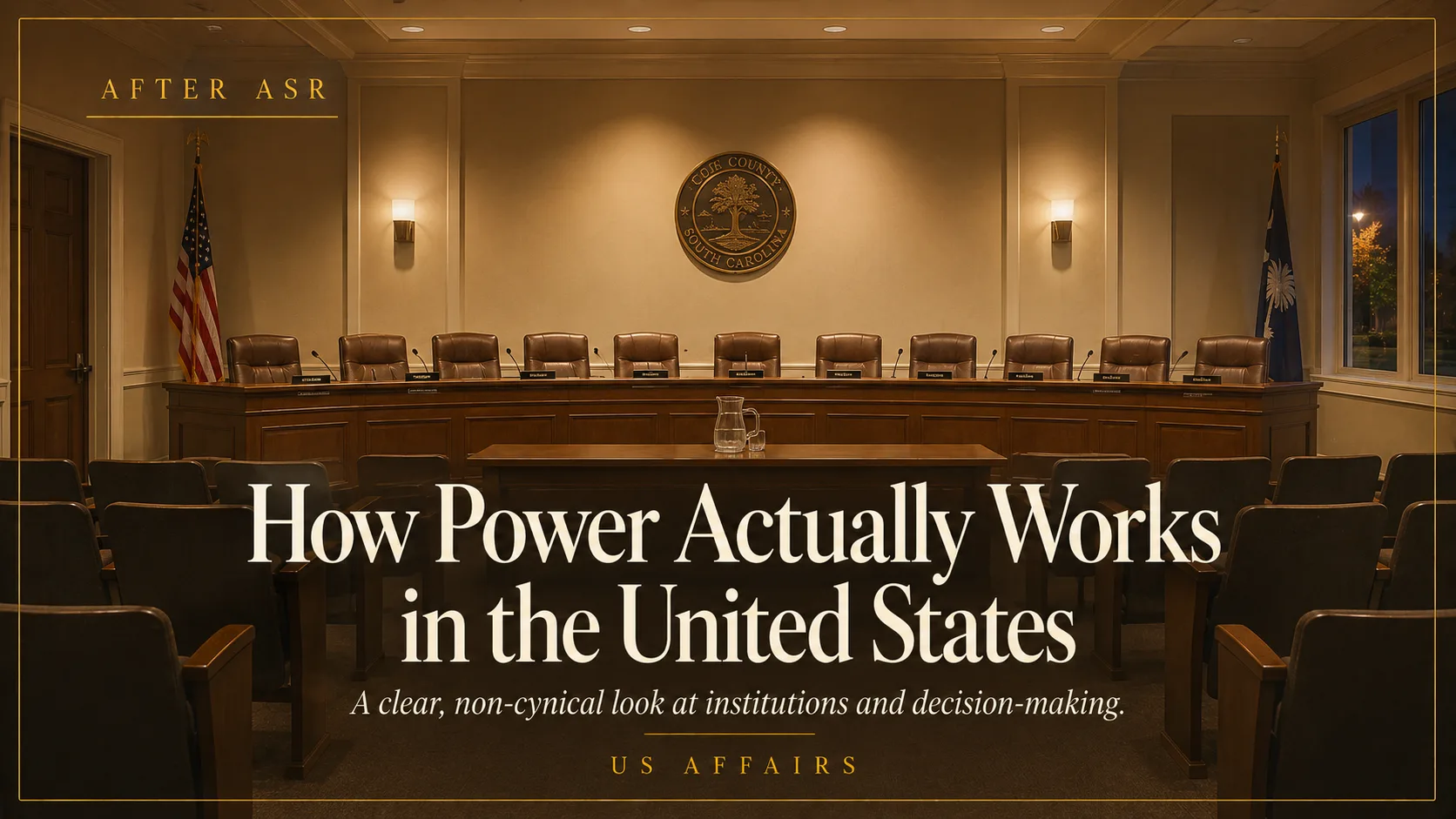
On most Tuesday nights, in a room that seats two hundred and holds nine, a county commission votes on things that will outlast the news cycle.
A road gets funded. A permit gets denied. A budget line moves by a few hundred thousand dollars.
Almost no one is watching. This is where a great deal of American power actually lives, and it is not where most of us are looking.
Power Is Not the Same as the Presidency
When Americans picture power, they picture one desk and one signature. The image is understandable, and it is mostly wrong.
The presidency is real, and its reach is large, but it is one node in a wide grid. A president cannot appropriate money, which is the constitutional work of Congress.
A president cannot interpret a statute for the courts, cannot zone a neighborhood, and cannot set your county’s property tax rate.
Even inside the executive branch, a president governs through agencies staffed by people he did not hire and cannot easily remove.
This is why a president’s frustration in office is often genuine rather than staged. The desk holds less unilateral control than either its admirers or its critics tend to assume.
The office commands attention easily, and attention is often mistaken for reach. What a president can announce and what a president can deliver are two different measures.
Power in this country is not stored in one place, and it was never meant to be. To understand it is to stop hunting for the single lever and start mapping the many.
Attention Is Not the Same as Influence
Most of what we call politics is really attention. We follow the loudest fight, and we mistake the volume for the stakes.
But the decision that changes your week is rarely the one that dominates the feed. Influence is the capacity to change an outcome, and attention is only the capacity to notice one.
They are not the same thing, and confusing them is expensive. A person can spend years furious at a distant office while ignoring the board that sets the local curriculum.
The loudest story is built to hold your eye, not to reflect your leverage. Leverage is quiet, specific, and usually close to home.
News is a market, and it sells intensity, because intensity is what people click. A calmer question, asked steadily, will not trend, and it will still change more.
The measure of influence is not how strongly you feel about a decision. It is how close you stand to the room where the decision is made.
The Country Was Built to Be Slow
The American system was designed by people who feared concentrated power more than they feared delay. So they split it, and then they split the splits.
The framers wanted friction, and they built it into the walls. A single actor moving quickly was the danger they were guarding against.
This is why change here feels slow, and why the slowness is a feature and not a flaw. Frustration with the pace is fair.
Mistaking the pace for a malfunction is not. The machine is doing what it was built to do, which is to make any one hand’s grip hard to close.
Other systems move faster, and they can also turn faster in the wrong direction. The same walls that trap a good reform will trap a reckless one, which is the bargain the founders accepted.
Slow is not the same as broken, though the two feel identical when you are waiting. A system that resists fast capture also resists fast repair, and that is the honest trade.
Federal, State, and Local Are Three Different Countries
We speak of the government as if it were one body. In daily life you are governed by at least three, and they rarely coordinate.
The federal government handles the border, the currency, and the largest programs. Your state decides most of your criminal law, your schools, and your professional licenses.
Your city and county handle the police at your door, the water in your pipes, and the zoning on your street.
Because these layers are separate, your cousin two states away can live under genuinely different rules. Federalism means the same country produces many different daily realities.
This is confusing by design, and the confusion tends to protect whoever prefers you aim elsewhere. Knowing the layers is not trivia; it is the difference between being heard and being redirected.
A decision that matters to you sits at exactly one of these levels, and usually not the highest. Learning which level owns your problem is half the work of solving it.
A Bill Is Not a Law, and a Law Is Not a Rule
The path from an idea to a binding requirement is longer than most people imagine. A bill is a proposal, and most proposals die quietly in committee, unread and unmourned.
A law is a bill that survived both chambers and a signature, which is rare. But even a law is often just an instruction to an agency to write the details.
The rule the agency writes is the thing that finally lands on your business or your mosque. Each of these is a different object, at a different stage, with a different way in.
A proposal can be shaped, a law can be challenged, and a rule can be commented on. The stage determines which door is still open to you.
Advocates who win tend to know exactly where their issue sits in this sequence. They do not push on a door that has already closed, and they do not wait past one still open.
Knowing which stage a thing has reached tells you whether your voice can still touch it.
Agencies Write More Law Than Congress Does
Congress passes a few hundred laws in a session. Federal agencies issue thousands of rules in the same window.
This is not a scandal; it is the design working, because legislators cannot foresee every detail. Congress sets the direction, and agencies fill in the specifics through a process called rulemaking.
That process includes a public comment period, which almost no ordinary citizen uses. A proposed rule is posted, anyone may write in, and agencies must answer substantive objections.
Most comments come from industry, because industry knows the door is there and pays people to watch it. The door is open to you on the same terms, at no cost.
The comment window is short, often measured in weeks, and it is rarely advertised. A community that watches for it can speak before the rule hardens, rather than complaining after.
A comment is not a vote, and it does not guarantee a change. But it is one of the quietest and most underused levers in the system.
The Courts Decide What the Words Mean
A law is only words until someone disagrees about what the words require. When that happens, courts decide, and their reading becomes the operative meaning.
This is why a single ruling can change more than a hundred speeches. Courts do not go looking for issues; they wait for a real dispute between real parties.
That waiting is deliberate, because a court is meant to resolve, not to govern. The line between making law and interpreting it is thin in practice and vital in principle.
A court cannot act on a problem no one has brought to it. This is why the choice to bring a case is itself a form of civic power.
It also means courts move on someone else’s timeline, not the public’s. Justice through litigation is real, and it is slow, and both of those facts are true at once.
When you read that a court struck something down, it usually means the words did not reach as far as one side hoped.
The Budget Is Where Priorities Become Numbers
Every government claims priorities, and every government reveals them in its budget. A budget is a moral document written in arithmetic.
What a body funds is what it actually values, whatever its speeches say. Reading a budget is a slower way to learn a government’s mind, and a more honest one.
A promise is not the same as a line item, and only the line item pays for anything. The gap between the two is where most disappointment lives.
Local budgets are public, and they are among the least-read documents in civic life. The road, the library, and the after-school program all wait inside those pages.
A spending choice can be reversed the following year, which is why budgets are argued over annually. The argument is tedious, and tedium is exactly where consistent people gain ground.
You do not need to master accounting to follow the money. You need only to ask what was funded, and what was merely praised.
Career Staff Outlast Every Administration
Beneath the officials who come and go sits a permanent workforce that does not. Millions of civil servants process the claims, inspect the plants, and answer the phones.
They are hired for competence, not loyalty, and most stay through many administrations. An election changes the people at the top, and it barely touches the people in the middle.
This continuity is why the government keeps working during a transition. It is also why sweeping promises meet a patient, procedural reality.
The clerk who reviews your file is not your adversary and not your ally. He is a person doing a defined job under rules he did not write.
Respect and pressure are not the same thing, and both have their place with a public servant. You can be firm about your case while remaining decent to the person handling it.
The person who actually decides your immigration case is not on any ballot. Treating that person with the seriousness the role deserves is simple wisdom.
Money Buys Access, Not Outcomes
Money matters in American politics, and pretending otherwise is naive. But its power is usually more modest and more specific than the cynical story claims.
Money mostly buys access, which is a returned phone call and a seat at the table. Access is not the same as a guaranteed outcome, and the two are often confused.
A well-funded interest can get its case heard and still lose to a better-organized public. Attention and persistence are forms of capital that money cannot fully replace.
The system rewards those who show up repeatedly, and money mostly buys a reliable way to show up. That is a real advantage, and it is not the same as ownership.
Organized attention is the one currency ordinary people can print for themselves. It is slow to earn and hard to fake, and it competes with money more often than we admit.
Believing that money controls everything is its own kind of surrender. It excuses you from the work that money was only trying to outpace.
Oversight Works Quietly, After the Fact
Power is not only exercised; it is also watched. Inspectors general, auditors, and courts review what was done after it is done.
Oversight rarely stops a decision in the moment, and that disappoints people who want a rescue. It works on a delay, correcting the record and setting limits for next time.
A public records request is a tool of oversight available to any resident. The right to ask what a government did is itself a quiet form of power.
Accountability is slower than outrage, and it is more durable. Outrage fades in a week, while a finding sits in the file for years.
The remedy after the fact will not undo the harm you already felt. It will, on a good day, keep the next person from feeling the same one.
The watchers are imperfect, and they miss things. But a system that watches itself, however unevenly, is not the same as one that does not.
The Local Room Is the Emptiest and the Nearest
The higher an office sits, the more crowded the fight to influence it. The lower it sits, the emptier the room and the larger your relative weight.
A city council hears from a handful of residents on most nights. A school board can be moved by a dozen organized parents.
These bodies decide things that touch your children and your street directly. Yet the seats reserved for the public are usually empty, because attention flows upward.
The nearest power is the most neglected, which is a strange and useful fact. Distance makes a decision feel important, and proximity makes it feel small.
The officials in that emptier room often come to recognize the regulars by name. Familiarity is a form of standing, and it is earned by returning, not by shouting.
The opposite of the common assumption is closer to the truth. Where the crowd is thin, one steady voice carries.
A Vote Is One Lever Among Several
Voting is the lever everyone knows, and it is genuinely important. But treating it as the only lever leaves most of your power unused.
Between elections, the same official can be reached by letter, by testimony, and by simply showing up. A vote is a single, occasional signal, and governing happens every day in between.
People who shape outcomes tend to work the days between elections, not just the election itself. The ballot decides who holds the office; the steady pressure decides what they do with it.
A vote chooses a person, and the days after choose a direction. Both matter, and only one of them arrives on a schedule.
Some of the most decisive civic acts happen in ordinary months no one remembers. A hearing on a Tuesday can shape a decade more than an election that made the news.
Confusing the two leaves you loud every few years and silent the rest of the time.
Coalitions Move What Individuals Cannot
One person writing alone is easy to file and forget. The same person as part of a hundred is a constituency, which officials count.
Power in this country answers to organized numbers more than to individual intensity. A coalition does not require agreement on everything, only alignment on one thing.
Communities that learn to align narrowly and briefly can move decisions well above their size. The mosque that partners with a neighborhood group has more reach than either alone.
Alliance is not the same as merger, and a good coalition keeps its members distinct. You can stand beside people you disagree with on much, for the one thing you agree on.
The temptation is to demand full agreement before working together, and it is a quiet trap. A narrow, honest alliance outlasts a broad and resentful one every time.
Organization is the multiplier, and it is available to anyone patient enough to build it. Isolation is not humility; it is only unused strength.
Knowing Where the Decision Lives
Most wasted political energy comes from aiming at the wrong level. People write to a senator about a problem their city council owns.
They rage at a president over a rule an agency quietly wrote. The first question worth asking is not how you feel, but where the decision actually lives.
Once you locate the room, the path to it is usually shorter than you feared. Diagnosis comes before treatment, in civic life as in medicine.
A precise request aimed at the right office beats a loud one aimed at the sky. Accuracy is a form of respect for your own effort.
Anger aimed everywhere is easy, and it accomplishes almost nothing. Effort aimed at one correct office is harder, and it is the only kind that tends to land.
The map is not the whole of power, but without it your effort scatters. Learning the map is the least glamorous and most useful civic skill there is.
What a Muslim Reader Can Carry
You do not have to love this system to understand it. Understanding is not endorsement, and clarity is not surrender.
A Muslim reader can hold this country at a steady arm’s length, neither consumed by it nor blind to it.
Learn where your decision lives. Stand in the room that is nearest and emptiest.
Bring a few others with you when you go.
Power here is not one hand to be feared. It is a grid to be read.
And a grid that can be read can be reached.