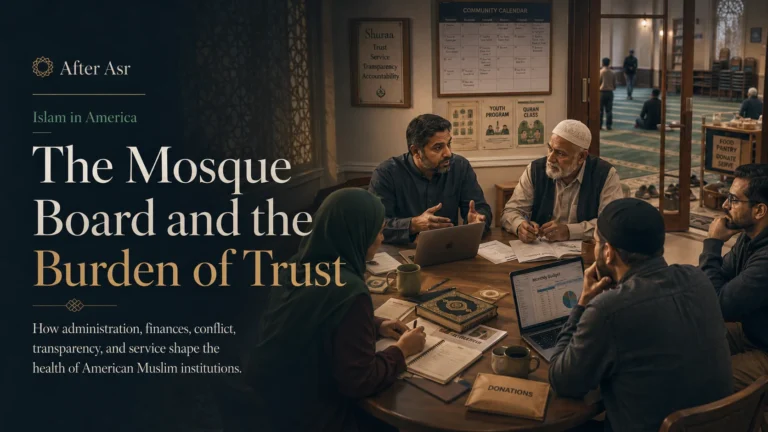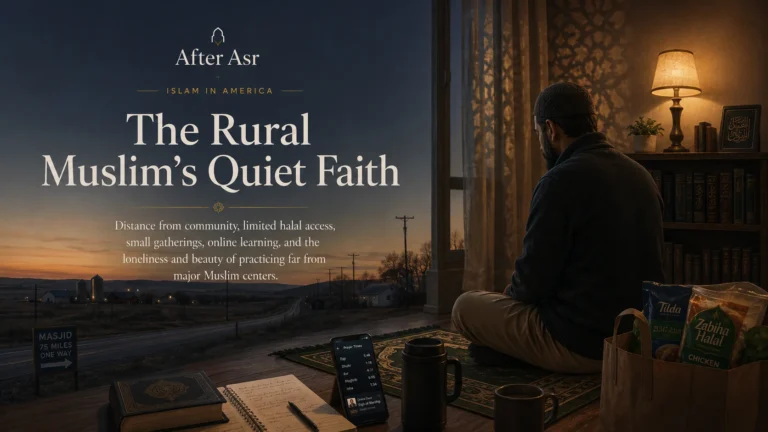
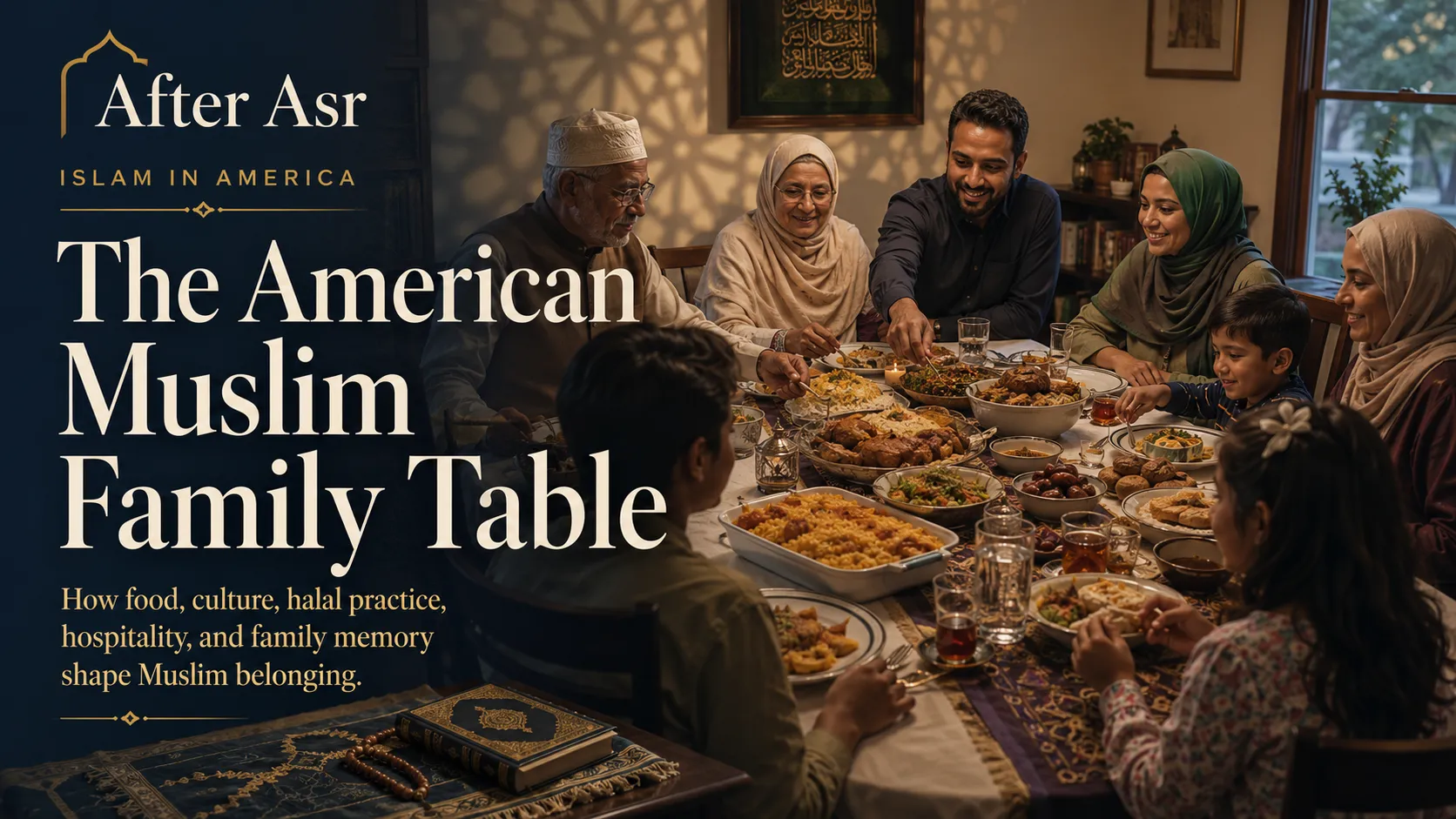
How food, culture, halal practice, hospitality, and family memory shape Muslim belonging.
The Muslim family table in America is rarely only a table.
It is a place of memory, negotiation, worship, culture, longing, discipline, and belonging. It may hold biryani beside macaroni and cheese, dates beside pizza, lentil soup beside fried chicken, sambusas beside salad, tacos beside qahwa, halal burgers beside homemade chutney, cornbread beside kabsa, store-bought cookies beside baklava. It may be a dining room table, a folding table at the masjid, a picnic blanket at Eid, a dorm room desk during Ramadan, a kitchen counter where someone breaks fast alone, or a plastic plate balanced on one hand after Jumu’ah.
At this table, Islam becomes visible in ordinary ways.
Someone says bismillah before eating. Someone checks whether the meat is halal. Someone reminds a child to use the right hand. Someone sends food to a neighbor. Someone saves a plate for a guest. Someone asks whether the gelatin is permissible. Someone explains to a non-Muslim relative why pork is not on the menu. Someone eats dates at sunset with tears in their eyes because Ramadan has returned. Someone tells a story about how food tasted “back home.” Someone else, born here, knows that story by heart but has never seen the place being described.
Food is not the center of Islam. Worship is. Revelation is. Submission to Allah is. But food is one of the ways faith enters daily life. It teaches boundaries, gratitude, hospitality, memory, restraint, generosity, and community. It shows children that Islam is not only believed in the mind, but practiced in the body. It gathers people who may not know how to speak about difficult things, but can still pass a plate with love.
In America, where Muslims live across race, ethnicity, class, immigration history, region, and level of practice, the family table becomes one of the places where belonging is both built and tested.
Halal as obedience, not branding
For Muslims, halal food is not simply a lifestyle label.
It is obedience. It is part of living under Allah’s command in the details of the body. What enters the mouth is not spiritually neutral. Food is tied to worship, gratitude, restraint, animal welfare, lawful earnings, family habits, and moral discipline. To eat halal is not merely to consume a different category of products. It is to accept that appetite has limits and that even ordinary hunger is accountable before Allah.
In America, halal practice takes effort.
Some families live near halal grocery stores, restaurants, butchers, and Muslim-owned markets. Others drive long distances, order meat in bulk, rely on vegetarian options, or ask careful questions at restaurants. Students search dining halls. Workers pack lunches. Parents read labels in grocery aisles. Converts learn which ingredients to check. Families traveling through small towns plan meals around what is available. Children ask why they cannot eat the pepperoni pizza at school. Adults decide whether to attend work events where food options are uncertain.
These moments are not small. They teach Muslims what it means to live with boundaries in a society where convenience is often treated as a right.
Halal also reveals differences within the community. Some families are strict about certification. Some accept broader standards. Some grew up in places where halal meat was assumed and must now learn to ask. Some converts are stricter than born Muslims because they entered Islam through conscious study. Some Muslims struggle financially and cannot always access ideal options. Some young people feel embarrassed asking about ingredients. Some parents worry that their children will associate Islam with always being unable to eat what others eat.
A mature community teaches halal with seriousness and mercy. It does not make light of Allah’s commands. It also does not turn food practice into a tool of humiliation. The goal is not to produce anxiety at every table. The goal is to produce taqwa, gratitude, and obedience.
Halal should remind the believer that the body belongs to Allah.
The table as family memory
Food carries memory more faithfully than many speeches.
A mother prepares a dish the way her mother did, adjusting ingredients to what can be found in an American grocery store. A father insists that Eid breakfast must taste a certain way because that is how it tasted in childhood. A grandmother teaches a child how to fold dough, season rice, roll grape leaves, fry plantains, prepare soup, stir sauce, or make tea strong enough to carry conversation. A family recipe becomes a map back to places children may know only through stories.
For immigrant families, food often becomes one of the last forms of unbroken continuity. Language may weaken. Children may answer in English. Clothing may change. Neighborhoods may shift. Family structures may adapt. But a dish can carry a home across oceans.
This can be beautiful. It can also become complicated.
Children born or raised in America may love these foods and still feel caught between worlds. They may eat cultural dishes at home and cafeteria food at school. They may feel proud of family meals in private and embarrassed by unfamiliar smells in public. They may later regret that embarrassment. They may grow into adults who try to recreate the dishes they once took for granted, calling a parent for instructions that were never written down.
At the Muslim family table, memory is often served before it is explained.
But memory should not become a cage. Not every child will love every inherited food. Not every spouse will come from the same culture. Not every convert will know what is being served. Not every American Muslim table will look like the table of an immigrant family. Food can carry memory, but Islam is larger than any cuisine.
The task is to let food preserve love without turning culture into a test of authenticity.
Black Muslim food traditions and overlooked inheritance
No honest reflection on the American Muslim table can ignore Black Muslim food traditions.
Black Muslims have shaped Islamic food culture in America in profound ways, often through discipline, health consciousness, communal eating, prison food negotiations, bean pies, fish dinners, halal soul food, neighborhood restaurants, family kitchens, and the effort to distinguish Islamic eating from the food systems imposed by poverty, racism, and historical dispossession. Food became part of religious reform, self-respect, bodily discipline, and community building.
In many Black Muslim communities, the table has carried both survival and dignity.
It has held the memory of Southern kitchens, urban neighborhoods, family gatherings, mosque fundraisers, school lunches, prison commissary improvisations, and the effort to make halal practice possible when mainstream halal markets were not easily accessible. It has also carried conversations about health, self-control, economic independence, and the moral meaning of what one consumes.
Too often, broader American Muslim food conversations center immigrant cuisines while overlooking Black Muslim culinary history. Halal is imagined through Arab, South Asian, Turkish, Somali, or other immigrant foodways, while Black Muslim food culture is treated as secondary or local. This is a mistake.
Black Muslim food traditions are not an add-on to American Islam. They are part of its foundation.
A Muslim child learning about halal in America should know about more than imported flavors. They should know how Black Muslims built halal food systems, restaurants, community meals, and dietary discipline under conditions where resources were limited and respect was not guaranteed. They should know that the American Muslim table includes bean pies and biryani, fried fish and falafel, collard greens and kabsa, halal barbecue and sambusas, and that no single cuisine owns Muslim belonging.
The table becomes more truthful when it remembers all who helped set it.
Converts and the first Muslim meal
For converts, food can be one of the earliest and most emotional parts of entering Islam.
The first Ramadan iftar. The first Eid meal. The first time someone says, “Come eat with us.” The first time they decline pork at a family gathering. The first time they read labels in a grocery store. The first time they are invited to a Muslim home and do not know the etiquette. The first time they are served food from a culture they have never encountered. The first time they feel both welcomed and overwhelmed.
Food can make Islam feel like family. It can also make the convert feel like an outsider.
A convert may be praised for choosing Islam, then left alone to figure out halal practice. They may be invited to large iftars but not small family dinners. They may be expected to enjoy unfamiliar foods without explanation. They may feel embarrassed asking what something is. They may not know whether to bring a dish, sit on the floor, eat with hands, accept second servings, or decline politely when full. They may feel that becoming Muslim requires entering someone else’s ethnic household, not only the religion of Allah.
Communities should be gentle here.
Invite converts clearly. Explain what is being served. Ask about allergies and comfort. Do not make them feel strange for not knowing. Do not use their first iftar as a stage for their story unless they offer it. Do not assume they have Eid plans. Do not overwhelm them with advice about every ingredient before they have learned the basics of prayer. Help them build halal habits step by step.
Converts also bring their own food memories. Their family recipes, regional foods, holiday dishes, and childhood meals do not vanish the moment they become Muslim. Some foods may need to be left because they are not halal. Others can be adapted. A convert may make halal versions of Southern food, Puerto Rican food, Appalachian food, Mexican food, Midwestern casseroles, barbecue, seafood dishes, or family desserts. This is not lesser Islam. It is Islam entering a life and purifying what can be purified.
The Muslim table should have room for the convert’s memory too.
Hospitality as worship
Hospitality is one of the great spiritual possibilities of the Muslim table.
To feed someone for Allah’s sake is not merely social kindness. It is worship. A guest at the table brings opportunity: to honor, to serve, to give without humiliating, to welcome without calculation, to make room in one’s home and heart. The Prophet ﷺ taught a way of life in which guests, neighbors, the poor, travelers, and family ties carry moral weight.
American Muslim hospitality often shows itself in generous abundance. Too much rice. Too many trays. Tea offered before the guest has fully sat down. A plate sent home. Someone insisting, “Eat more,” with the seriousness of a legal ruling. Iftar invitations that somehow multiply. Eid tables that seem to expand beyond the size of the room.
This generosity is beautiful when it is sincere.
But hospitality also needs wisdom. A culture of abundance can become pressure, especially for families with limited means. Some people avoid hosting because they feel they cannot produce an impressive meal. Some women carry most of the labor while men receive the guests. Some hosts exhaust themselves trying to meet cultural expectations. Some guests are invited because of status, while lonely people remain uninvited. Some tables are full, but the same outsiders stay outside.
Islamic hospitality should not be confused with performance.
A simple meal can carry more barakah than a lavish spread prepared with resentment. A bowl of soup offered sincerely may be more beloved than a banquet arranged for reputation. Hospitality is not about proving family status. It is about honoring the rights of others and seeking Allah’s pleasure.
The American Muslim table needs a culture where inviting someone over does not require perfection. Where students, converts, single adults, elders, widows, divorced parents, and new families are remembered. Where men share hosting labor. Where takeout can still be hospitality. Where the guest leaves feeling honored, not impressed.
The mosque meal
The mosque meal is its own institution.
Iftar in a multipurpose hall. Jumu’ah lunch fundraiser. Eid breakfast. Janazah meal. Youth night pizza. Sunday school snacks. Community potluck. Food pantry packing day. Marriage celebration. Open house dinner. A table of dates and water after Maghrib. A tray of leftovers sent home with whoever needs them.
Mosque meals build community because they allow people to linger. Prayer gathers bodies in rows. Food often gathers stories. People who might leave immediately after salah stay to talk. Children make friends. Elders are greeted. Newcomers are noticed, if the community is attentive. Converts learn names. Families exchange numbers. Volunteers become friends while washing dishes.
But mosque meals also reveal community habits.
Who serves? Who eats first? Who cleans? Are women trapped in the kitchen while men attend the lecture? Are converts invited to sit with someone? Are Black Muslims and Muslims from outside the dominant ethnic group socially included? Are food allergies and dietary needs considered? Is the poor person served with dignity or made to feel visible? Are youth helping or only consuming? Is there waste? Are volunteers thanked? Is the meal accessible to people who cannot sit on the floor? Are elders given care? Are single people included among family groups?
The mosque meal can be a school of adab if handled well. It can teach children to serve elders, reduce waste, share, clean, and greet guests. It can teach adults humility. It can make the masjid feel like home. But if handled poorly, it can reproduce class, gender, racial, and social divisions under the cover of community.
A meal after prayer should not contradict what the prayer taught.
Halal restaurants and the marketplace of belonging
Halal restaurants have become important social spaces for many American Muslims.
They are where families eat after Eid shopping, students gather after halaqah, friends meet after Jumu’ah, converts experience Muslim public life beyond the mosque, and non-Muslim neighbors encounter halal food for the first time. In some cities, halal food trucks, burger shops, Middle Eastern grills, fried chicken spots, Pakistani restaurants, Somali cafes, Turkish bakeries, African restaurants, halal Mexican fusion, and upscale Muslim-owned eateries have made halal visible in the American marketplace.
This visibility matters. It gives Muslim families options. It allows children to order freely for once. It supports Muslim entrepreneurs. It makes halal practice feel livable rather than restrictive. It creates public Muslim spaces that are social, economic, and cultural.
But the halal marketplace also raises questions.
What does halal mean beyond meat? Are business practices ethical? Are workers treated well? Is certification trustworthy? Is marketing using Islam responsibly? Are Muslim consumers supporting local businesses fairly? Are restaurants accessible to working-class families, or is halal dining becoming another status marker? Are we building food economies that reflect Islamic ethics, or simply Muslim-branded versions of the same consumer culture?
Halal food should not become only a logo.
A restaurant can serve halal meat and still mistreat employees. A business can use Islamic aesthetics and still operate dishonestly. A consumer can eat halal while wasting food, showing off, or ignoring the poor. The marketplace needs Islamic ethics as much as Islamic labeling.
Still, halal restaurants are part of the American Muslim story. They show that Muslims are building public life, not only private accommodation. They show that halal can be rooted in neighborhoods, suburbs, campuses, downtowns, and small towns. They show that food can become a bridge, but also that the bridge must be built with integrity.
Class and the table
Food reveals class more quickly than many conversations do.
Some Muslim families can host large iftars, buy organic halal meat, eat out often, and travel to Muslim food festivals. Others stretch grocery budgets, rely on food pantries, share bulk meat, skip restaurant invitations, or quietly decline potlucks because they cannot bring enough. Some children attend Eid gatherings with expensive outfits and full tables. Others feel the gap between their family’s means and the community’s expectations.
In Muslim communities, class differences are often hidden beneath religious language. Everyone says “brother” and “sister,” but not everyone has the same access to food, hosting, transportation, or social life. A family may be too proud to say they need help. A student may fast because of Ramadan one month and because of money another. A refugee family may be invited once for charity, then forgotten. A convert may be assumed to be fine because they smile.
The table can either expose these differences cruelly or soften them with mercy.
Zakat and sadaqah should not remain abstract. Food distribution, grocery support, community fridges, Ramadan baskets, Eid meals, and discreet help with necessities all matter. But dignity matters too. The poor should not be made into projects. They should be guests, neighbors, members, and contributors. The family receiving a food box may also be the family that teaches your child patience, shares a recipe, makes du’a for the community, or serves in ways no one sees.
Hospitality should flow across class lines. Wealthier families should invite without showing off. Communities should host simple meals where everyone feels comfortable. Children should be taught not to measure people by what they bring to the table. Mosques should avoid making every gathering costly.
A Muslim table is most beautiful when no one is humiliated by hunger and no one is honored because of wealth.
Children and the taste of belonging
Children remember faith through the senses.
The taste of dates after fasting. The smell of soup before Maghrib. The sound of a blender before suhoor. The feel of sitting on the floor at the masjid. The sight of an Eid table. The warmth of someone placing food on their plate. The repetition of “say bismillah.” The instruction to thank Allah. The first time they are allowed to help serve. The first time they fast half a day and everyone celebrates.
These memories shape religious belonging.
A child who experiences Muslim meals as warm, generous, and spiritually meaningful may carry that love into adulthood. A child who experiences food only as restriction, scolding, or cultural pressure may carry a different feeling. Parents do not control every outcome, but they do shape atmosphere.
Food can teach gratitude. “Alhamdulillah” after eating should not be mechanical. It should help children understand that food is a gift, that not everyone has enough, that waste is ugly, that sharing is worship, that the body is an amanah, that halal matters because Allah matters. A child can learn Islamic theology through a meal before they know the word theology.
Children also learn who belongs by watching the table. Are guests welcomed? Are converts included? Are elders served? Are women left to clean alone? Are fathers involved? Are poor families treated differently? Are non-Muslim relatives received with kindness within Islamic boundaries? Are different cultures respected? Is food wasted? Is prayer delayed because dinner is elaborate?
The family table teaches before anyone gives a lecture.
Non-Muslim relatives at the Muslim table
Many American Muslims have non-Muslim relatives, especially converts, mixed families, and those with extended family outside Islam.
Food often becomes the place where these relationships are negotiated. A Muslim may invite parents to iftar. A convert may attend Thanksgiving and bring halal food. A Muslim spouse may explain why alcohol will not be served at home. A family may create Eid meals that include non-Muslim grandparents. A child may learn that loving relatives does not mean adopting every practice.
These moments require wisdom.
The Muslim table can become a form of gentle da’wah, not through pressure, but through warmth and clarity. A non-Muslim parent who sees their child break fast with gratitude may understand Islam differently. A neighbor invited to Eid may feel respected. A relative who first worried that Islam would make someone cold may see more patience, discipline, and generosity.
But Muslims also need boundaries. Hospitality does not require serving haram. Family love does not require participating in religious rituals that contradict Islam. A Muslim home can be welcoming and clear at the same time. “We would love to have you for dinner, but we do not serve pork or alcohol.” “We are fasting until sunset, but please join us for iftar.” “We cannot join that part, but we are grateful to spend time with you.”
Food can soften conversations that abstract debate would harden. It allows people to encounter Islam through care, not argument. But the care must remain truthful.
The best Muslim hospitality does not hide belief. It makes belief beautiful through conduct.
Marriage, in-laws, and merging tables
Marriage often brings two food worlds together.
A Pakistani family and an Arab family. A Somali family and a Black American family. A Turkish family and a white convert. A Bengali family and a Latino Muslim. Two families from the same country but different regions. A born Muslim and a convert whose parents are not Muslim. A couple where one spouse grew up with elaborate meals and the other grew up with simplicity. A household negotiating halal practice after marriage.
Food can become a place of affection or conflict.
Whose Eid breakfast becomes tradition? Which dishes do children learn? How often do families eat out? What counts as proper hospitality? Does the daughter-in-law feel judged by another culture’s cooking expectations? Does the son-in-law feel welcomed at meals? Are converts expected to absorb another family’s food culture without bringing their own? Are women expected to cook by default? Do men know how to host, serve, and clean? Does halal practice become stricter, looser, or more conscious after marriage?
These questions may seem domestic, but they matter because marriage is lived in ordinary habits.
A healthy Muslim marriage does not require one family table to erase the other. It creates a new table with mercy. It honors both backgrounds where possible. It leaves what is not Islamic. It keeps what is good. It avoids making food a battlefield for control. It teaches children that Islam can hold many flavors without losing its center.
In-laws can help by being generous, not possessive. A family recipe is a gift, not a weapon. A daughter-in-law is not less worthy if she cooks differently. A convert spouse should not be treated as culturally empty. A husband should not make food expectations another burden on his wife while calling it tradition. A wife should not be made to prove belonging through kitchen performance.
The sunnah at the table is not domination. It is gratitude, simplicity, generosity, and mercy.
Ramadan and the table of mercy
Ramadan changes the Muslim table more than any other season.
The timing changes. The mood changes. The body changes. A date and water become more precious than a feast. Families gather around sunset. Mosques fill with trays. Students break fast in classrooms. Workers eat in cars. Converts experience the sweetness and ache of the month. Children count minutes. Elders remember Ramadans long gone.
Iftar is often where Muslims feel community most strongly. But Ramadan also reveals who is alone.
A family with relatives nearby may have invitations every week. A single student may eat alone. A convert may not know where to go. A widow may not want to ask. A divorced parent may experience some nights without children as especially painful. A rural Muslim may break fast far from any mosque. An elderly person may be unable to attend iftars because of transportation. A family in financial difficulty may feel embarrassed by what they cannot provide.
The Ramadan table must become wider.
Mosques should organize with intention, not only abundance. Families should invite beyond their usual circles. Youth should be taught to serve. Converts should be checked on before the month begins. Elders should receive meals. Working Muslims should be remembered. Food waste should be reduced. Fundraising should not overshadow worship. The poor should be fed with dignity.
Ramadan teaches hunger so that hearts become softer. If our tables become fuller while our awareness remains narrow, we have misunderstood something.
The most beautiful iftar is not always the largest. It may be the one where someone who expected to be forgotten finds a place set for them.
Eid and the taste of joy
Eid has its own table.
For some families, it begins with sweets before prayer. For others, savory breakfasts. New clothes. Guests. Children’s plates. Envelopes of money. Trays of food carried between homes. Restaurant reservations. Community picnics. Leftovers that last for days. Phone calls to relatives abroad. Photos taken before someone spills something.
In America, Eid can be both joyful and fragile.
The country does not stop. Some parents work. Some children return to school after prayer. Some students have exams. Some converts have no family celebration. Some families create Eid from scratch in homes where no one else understands its importance. Some communities hold Eid on different days. Some people feel the ache of relatives far away or deceased. Some families are divided by divorce, immigration, conflict, or distance.
The Eid table becomes a way of insisting that joy still belongs to Muslims.
This matters for children. Eid should not feel like an afterthought squeezed between American obligations. It does not need to be extravagant, but it should be marked. A special breakfast. A decorated table. A favorite dessert. A visit. A gift. A dua. A family story. A community meal. Children should feel that sacred joy is part of their inheritance.
But Eid should also be protected from consumerism. The goal is not to compete with other holidays through spending. The goal is to celebrate what Allah has given. Food helps, but food is not the whole meaning. The table should point toward gratitude, family ties, forgiveness, generosity, and worship.
A good Eid meal leaves the heart saying alhamdulillah.
Eating with neighbors
The American Muslim table does not only gather Muslims.
Neighbors are invited to iftar. Coworkers taste dates. Teachers receive Eid sweets. Churches, synagogues, and civic groups attend mosque dinners. Non-Muslim relatives join halal meals. A Muslim family sends food across the street. A community food pantry serves anyone in need. A halal restaurant becomes a neighborhood favorite.
Food can build trust where arguments cannot.
A neighbor who has eaten in a Muslim home may find it harder to believe dehumanizing stories. A teacher who has attended iftar may understand Ramadan accommodations differently. A coworker who tastes a dish made for Eid may see Muslim joy more clearly. A non-Muslim relative who sits at a halal table may feel that Islam has not taken their loved one away, but changed the terms of love.
This does not mean food solves prejudice. Some people will eat from Muslim hands and still misunderstand Muslims. Hospitality is not magic. But it is a prophetic kind of moral practice. It does not force understanding. It opens a door.
Muslims should also be careful not to turn every meal with non-Muslims into public relations. Invite people because hospitality is good, not because Muslims must constantly prove humanity. Feed neighbors because neighbors have rights. Explain Islam when asked. Let the table carry warmth without becoming a stage.
The best da’wah at the table may be sincerity.
Food, health, and spiritual discipline
The Muslim table also raises questions of health.
Many communities have inherited rich food traditions, some nourishing, some heavy, some shaped by celebration, scarcity, or labor-intensive domestic life. In America, these traditions meet processed food, fast food, sugar, sedentary lifestyles, busy schedules, and restaurant culture. Ramadan itself can become a month of overeating at night after fasting by day. Eid can become excess. Community meals can be delicious but physically taxing.
Islam teaches gratitude for food, but also moderation. The body is an amanah. Health is not a vanity project when approached properly. It is part of stewardship.
American Muslims need a healthier conversation about food that does not shame bodies or cultures. The goal is not to abandon beloved dishes, mock elders, or turn the table into a place of anxiety. The goal is balance: smaller portions, less waste, more movement, healthier preparation, care for diabetics and elders, thoughtful Ramadan eating, and recognition that halal does not automatically mean healthy.
Food can comfort, but it can also become emotional escape. It can express love, but it can also pressure people to overeat. It can preserve memory, but it can also carry habits that need adjustment. Communities should be able to speak about health with mercy, especially in relation to chronic illness, poverty, stress, and access to quality food.
The sunnah offers simplicity. The modern table often offers excess. Muslims need to remember that blessing is not measured by how much is served, but by how gratefully and lawfully it is received.
Waste and accountability
Few things expose the moral contradiction of abundance like wasted food.
Many Muslim events end with trays of leftovers, half-empty plates, spilled drinks, untouched rice, and trash bags heavy with what could have fed others. This happens in a world where people are hungry, including people within our own communities.
Waste is not a small etiquette issue. It is spiritual ugliness.
The Qur’an warns against wastefulness. The Prophet ﷺ taught gratitude, moderation, and care. A community that raises funds for the poor while throwing away food after events should pause. Not with shame alone, but with reform.
Plan better. Serve smaller portions first. Encourage people to take only what they will eat. Pack leftovers safely. Coordinate with shelters where possible. Send food to students, elders, families in need, and workers. Teach children to respect food. Make cleanup part of Islamic education. Do not let abundance become carelessness.
Waste also includes the unseen labor wasted when meals are poorly planned. Women cooking excessive amounts because expectations demand it. Volunteers cleaning unnecessary mess. Donors paying for food that becomes trash. These are moral and practical failures.
A blessed table is not necessarily a full table. It is a table governed by gratitude.
The family table after loss
Food often appears when words fail.
After a death, people bring meals. After childbirth, meals arrive. After illness, a pot of soup appears. After surgery, someone organizes a meal train. After divorce, a friend invites someone over. After a family crisis, an auntie sends food without asking too many questions. After a tragedy, the community gathers around dishes that cannot heal grief but can keep the grieving from being alone.
In Muslim life, this is part of mercy.
The family table after loss is different. People eat because the body must continue. Guests speak softly. Children ask questions. Someone remembers the deceased’s favorite dish. Someone says, “Make dua.” Someone sends plates home. Food becomes a way of saying, “You are not carrying this alone.”
American Muslim communities should preserve this practice with care. Support grieving families without overwhelming them. Feed them without turning their home into a social event. Remember them after the first week. Include widows, widowers, orphans, and elders in future meals. Do not let the table disappear when the public grief ends.
Hospitality after loss is one of the quietest forms of community love.
The table as a place of teaching
Every Muslim table teaches something.
It teaches whether Allah is remembered before eating. Whether elders are served. Whether children are corrected gently. Whether guests are honored. Whether women sit or only serve. Whether men help. Whether food is wasted. Whether halal is taken seriously. Whether non-Muslim relatives are treated with kindness. Whether converts are included. Whether the poor are seen. Whether different cultures are respected. Whether health is considered. Whether gratitude is spoken.
Parents may think teaching happens in formal lessons, but children are studying at dinner.
They see if their father thanks their mother. They see if their mother is allowed to sit before the food is cold. They see if guests are chosen by status. They see if their family gives leftovers generously or hoards them. They see if grandparents are honored. They see if the family talks about absent people cruelly while eating. They see if dua is made for those suffering elsewhere. They see if the table becomes a place of mercy or tension.
No family table is perfect. Some are marked by conflict, exhaustion, financial stress, picky children, busy schedules, and old wounds. But even imperfect tables can become places of return. A family can begin with bismillah. Put phones away for a few minutes. Ask about prayer. Share one gratitude. Invite someone lonely. Waste less. Let the person who cooked sit first. Teach children to clear plates. Send food to a neighbor. Speak of Allah naturally.
Small habits become inheritance.
Belonging without one cuisine
As American Islam matures, the Muslim table will continue to change.
Intercultural marriages will create new food traditions. Converts will adapt family recipes into halal forms. Black Muslim culinary traditions will be studied and honored more seriously, if the community is truthful. Latino Muslim foodways will become more visible. Children of immigrants will cook simplified versions of dishes they once watched elders make with instinct. Halal American food will grow. Vegan, vegetarian, health-conscious, and allergy-aware Muslim tables will become more common. Some families will eat on the floor. Others at dining tables. Some will serve tea. Others coffee. Some will order takeout and still make a blessed gathering.
This diversity should be welcomed.
There is no single Muslim cuisine. The ummah has always eaten through the lands, climates, histories, and cultures where Muslims lived. What unites the table is not identical food, but obedience, gratitude, hospitality, and remembrance of Allah.
A Muslim child should not grow up thinking Islam tastes like only one region. They should know the breadth of the ummah and the particular beauty of their own family’s table. They should know that halal tacos, bean pies, biryani, sambusas, kabsa, jollof, curry, soup, barbecue, lentils, dates, bread, rice, and simple cereal before Fajr can all belong to Muslim life when governed by halal and gratitude.
The table should teach breadth without losing boundaries.
The blessing we keep setting down
The American Muslim family table is not perfect.
It carries love and pressure. Memory and exclusion. Hospitality and performance. Halal discipline and consumer branding. Women’s labor and women’s wisdom. Class difference and generosity. Cultural beauty and cultural confusion. Convert welcome and convert loneliness. Black Muslim foundations and the need to remember them fully. Immigrant longing and American-born adaptation. Children’s joy and parental exhaustion.
But it also carries immense possibility.
A table can become a place where Islam is loved before it is argued. Where a child learns bismillah. Where a guest finds dignity. Where a convert finds family. Where an elder’s memory is honored. Where a non-Muslim relative sees faith made gentle. Where cultures meet without erasing one another. Where hunger teaches gratitude. Where abundance is restrained by accountability. Where family stories become religious inheritance. Where the lonely are remembered. Where the poor are fed. Where a meal becomes worship.
The table will not save the community by itself. Only Allah guides and preserves. But the table is one of the ordinary places where guidance is made livable.
So we should set it carefully.
With halal food, as much as we are able.
With gratitude before appetite.
With room for guests.
With memory, but not arrogance.
With culture, but not confusion.
With generosity, but not waste.
With joy, but not excess.
With reverence for the One who provides every bite.
In America, where Muslims are often asked to explain themselves in public, the family table offers another kind of testimony. Not loud. Not defensive. Not polished for approval. A quieter witness: people gathered, saying the name of Allah, feeding one another, remembering where they came from, making space for who has arrived, and teaching the next generation that belonging is sometimes learned through a plate placed before you with love.
The table is not only where Muslims eat.
It is where many first learn what it feels like to be part of a people who begin with bismillah and end with alhamdulillah.