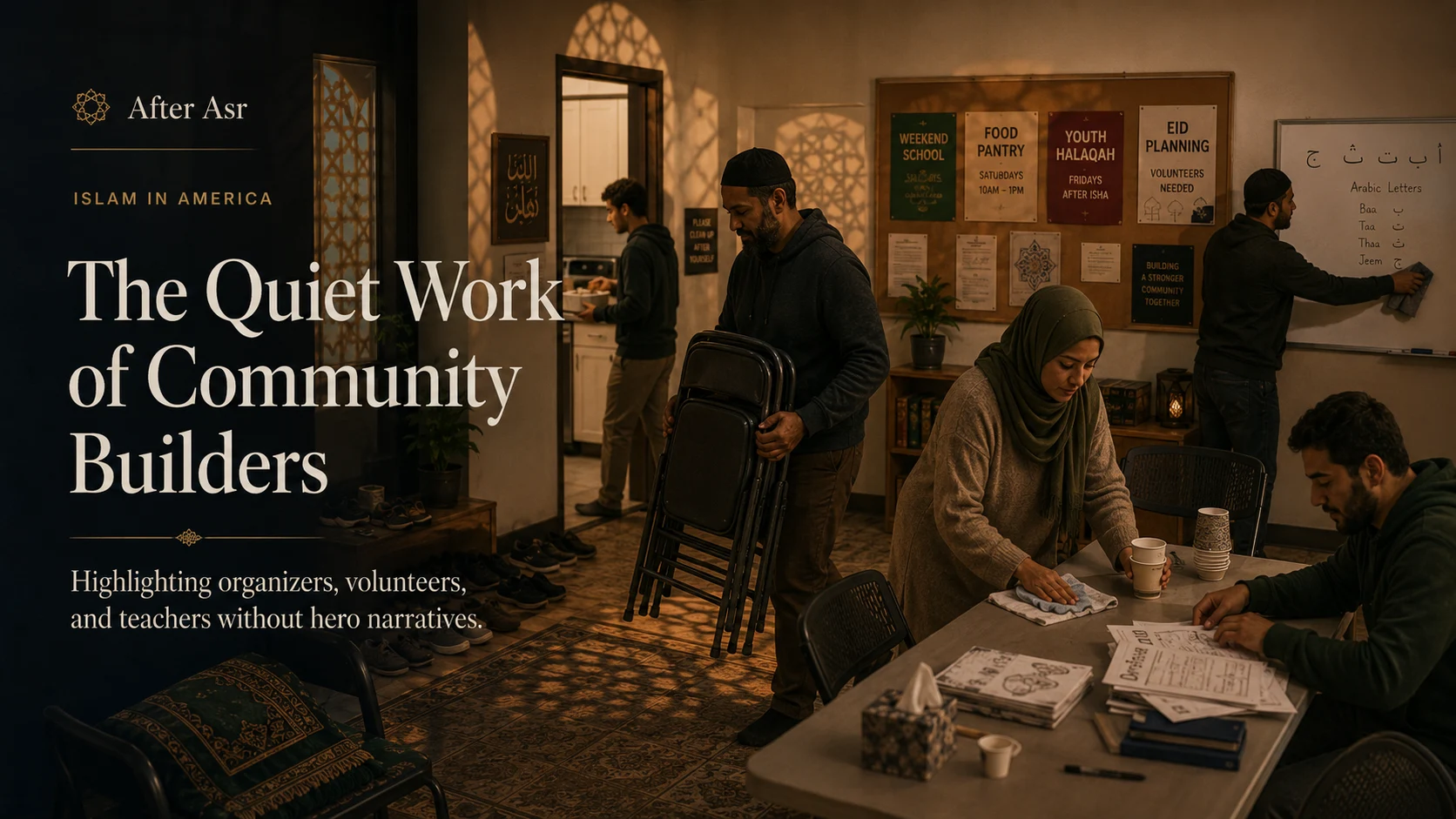
Highlighting organizers, volunteers, and teachers without hero narratives.
Every Muslim community has people whose names are rarely printed on flyers.
They arrive early and leave late. They know where the extension cords are kept. They remember which child has a food allergy, which elder needs a chair, which convert gets nervous walking into a crowded room, which family is quietly struggling, which door sticks in winter, and which microphone only works if the cable is turned a certain way. They stack chairs after everyone else has gone home. They refill water coolers. They clean spills. They answer the same questions every Ramadan. They teach children how to make wudu. They update spreadsheets. They make reminder calls. They open the building. They lock it at night.
Their work is not always beautiful to watch. Much of it is repetitive, logistical, and physically tiring. It does not always come with spiritual language wrapped around it. It may look like carrying trash bags, checking attendance, setting up tables, calming a parent, reminding teenagers to come inside, printing worksheets, counting donations, directing parking, or making sure the women’s restroom has paper towels.
But this is how communities are built.
Not only through grand speeches, major donors, public campaigns, or visionary plans, though those may matter. Communities are built through the quiet repetition of responsibility. They are built by people who keep showing up after the excitement fades. They are built by those who notice what will go wrong before anyone else notices what went right.
American Muslim life depends on these people more than it often admits.
The work beneath the visible community
When people speak about a thriving mosque, school, halaqah, youth group, food pantry, convert program, or Ramadan calendar, they often describe what is visible. A full prayer hall. A successful iftar. A beautiful Eid gathering. A children’s program. A community fundraiser. A lecture series. A clean facility. A welcoming open house. A well-run weekend school.
What is less visible is the labor beneath it.
Someone ordered the food. Someone compared prices. Someone called the vendor twice. Someone borrowed serving spoons from home. Someone created the registration form. Someone translated the announcement for elders who do not read English comfortably. Someone stayed after Maghrib to move the tables. Someone taught volunteers how to sign people in. Someone found a substitute teacher when the regular one had a sick child. Someone answered an angry text at midnight. Someone made sure the new Muslim knew where to sit.
The public experience of community rests on hidden systems of care.
This is not only true in large cities with established institutions. It may be even more true in small American Muslim communities, where one person may serve as teacher, event planner, janitor, youth mentor, website updater, donor coordinator, and emergency contact. In rural areas and small towns, the entire community may depend on a handful of people whose absence would be felt immediately, even if their presence is taken for granted.
We often call these people volunteers, but that word can make the work sound casual. Many are not casually helping. They are carrying pieces of the community’s life.
Without hero narratives
It is tempting to turn community builders into heroes.
The tireless volunteer. The selfless teacher. The uncle who does everything. The sister who never says no. The imam who carries everyone. The mother who runs the weekend school. The brother who fixes every problem. The youth leader who is always available. The board member who sacrifices family time. The organizer who can turn chaos into a schedule.
There is gratitude in these descriptions, but also danger.
Hero narratives can become a way of praising people while continuing to overuse them. They can make exhaustion look noble. They can turn burnout into a badge of sincerity. They can teach communities that if someone truly serves Allah, they should not need rest, boundaries, compensation, training, help, or appreciation beyond occasional applause. They can hide the fact that many “heroes” are simply people who stepped forward when no one else did, then were never allowed to step back.
Islam honors service, but it does not require exploitation. Sincerity does not mean endless availability. Sacrifice does not mean poor planning. Humility does not mean invisibility. Gratitude does not mean placing one person under a weight the community should carry together.
To honor community builders properly, we must see them as human beings, not symbols.
They have families. They get tired. They make mistakes. They can become frustrated, impatient, discouraged, or hurt. They may love the work and resent parts of it at the same time. They may serve sincerely and still need a break. They may be strong and still need someone to ask how they are.
The goal is not to make them legendary. The goal is to make the work shared, sustainable, and spiritually sound.
The organizer as a keeper of trust
The organizer’s work often begins before people know there is anything to attend.
They look at calendars. They negotiate times. They think about school schedules, prayer times, work shifts, weather, childcare, parking, security, food, sound systems, gender arrangements, cleaning, registration, budgets, and whether the masjid has enough chairs. They anticipate conflict. They prepare for no-shows. They create backup plans. They remind people kindly, then remind them again. They try to make the event feel effortless for others, precisely because it was not effortless for them.
Organizing is not merely administration. In Muslim community life, it is a form of amanah, a trust.
A poorly organized event can still have barakah, but good organization can make mercy easier to receive. A clear schedule respects people’s time. A clean space respects people’s dignity. Accessible seating respects elders and disabled community members. Thoughtful food planning respects families. Good communication respects newcomers. A safe check-in process respects children. Transparent fundraising respects donors. A prepared teacher respects students.
Organization can be an act of adab.
This matters because Muslim communities sometimes spiritualize disorder. We say “inshaAllah” when we mean “we did not plan.” We say “the community will figure it out” when one or two people will actually figure it out. We say “for the sake of Allah” when we are asking someone to absorb preventable chaos.
A mature community does not confuse reliance upon Allah with neglecting means. Tawakkul is not disorganization. Barakah does not require avoidable confusion. Good planning is not a lack of spirituality. It can be one of the ways spirituality becomes livable for others.
The organizer may not give the lecture, lead the prayer, or appear in the photographs. But they often create the conditions in which others can benefit.
The volunteer after everyone goes home
The most revealing hour of many community events is the hour after the program ends.
The room is no longer full. The speaker has left. The children are tired. The floor is sticky. The trash is overflowing. Someone’s jacket is still on a chair. Half the food trays are empty, half are awkwardly full, and no one knows who owns the serving utensils. The microphone is missing. The bathroom needs attention. Someone asks whether there are take-home plates. A few volunteers remain.
This is where much of community life becomes real.
The volunteer who stays after the event is doing work that most people benefit from but few people remember. They return the mosque to readiness. They protect the next prayer, the next class, the next gathering. They make sure no one walks into a mess left by someone else’s joy.
This work is humble, but it is not small.
A community that cannot clean up after itself has not fully learned how to gather. A community that depends on the same few people to clean every time is teaching selfishness, even if unintentionally. A community that treats cleanup as beneath certain people has imported a disease of status into a space that should purify the heart.
There is spiritual meaning in picking up cups. There is spiritual meaning in folding tables. There is spiritual meaning in sweeping crumbs from the prayer hall entrance. Not because the task is glamorous, but because service often takes the form of lowering oneself for the comfort of others.
Still, the lesson should not be that the humble few must always do it. The lesson should be that everyone should learn humility.
Teachers who build more than lessons
In many American Muslim communities, teachers carry the future quietly.
Weekend school teachers. Qur’an teachers. Arabic teachers. Youth halaqah leaders. Converts’ class instructors. Mothers teaching at kitchen tables. Fathers reviewing surahs in the car. Elders correcting recitation after prayer. College students teaching younger children because no one else is available. Imams answering basic questions between obligations. Volunteers building curriculum late at night.
Teaching Islam in America is not only about delivering information. It is about forming souls in a society where Islam is often misunderstood, privatized, politicized, or reduced to identity. A good teacher does more than explain facts. They help students love Allah. They make the Prophet ﷺ feel near. They teach adab. They answer questions without panic. They correct gently. They show children that Islam is not an ethnic inheritance only, but a living path. They help converts move from enthusiasm to rooted practice. They help teenagers see that faith can survive adulthood.
This teaching is often under-supported.
Many teachers are unpaid or underpaid. Some teach after full workweeks. Some create materials from scratch. Some manage classrooms without training. Some deal with parents who are anxious, absent, demanding, or inconsistent. Some teach children whose home practice varies widely. Some teach in cramped rooms with limited supplies. Some are expected to produce Islamic confidence in two hours a week while the rest of the child’s life is shaped elsewhere.
Communities praise teachers in general terms, but do not always support them in practical terms. A teacher needs supplies, training, curriculum, planning time, reasonable class sizes, clear expectations, and parental cooperation. They need appreciation before they are exhausted. They need protection from being treated as babysitters. They need spiritual renewal themselves.
If teaching is truly noble, communities should treat it as noble before the teacher burns out.
The women who carry the invisible architecture
In many Muslim communities, women carry much of the invisible architecture.
They organize meals, teach children, welcome new sisters, maintain group chats, remember births and illnesses, arrange support after death, plan Eid details, prepare decorations, clean kitchens, mediate family tensions, mentor younger women, answer convert questions, manage childcare, and quietly identify who is struggling. They may not always hold official titles, but they often hold the community together.
Some of this work is done with love. Some is done because women are expected to do it. Often, it is both.
American Muslim communities need to be honest about this. The labor of women should not be romanticized in a way that excuses inequity. Praising sisters as “the backbone of the community” can become another form of taking them for granted if it is not accompanied by respect, resources, decision-making power, and relief.
If women organize the children’s programs, they should have a real voice in educational planning. If women prepare food, they should not be automatically excluded from the lecture. If women manage convert care, they should be supported with training and budget. If women notice pastoral needs, leaders should listen. If women clean up after events, men and youth should be taught to clean too.
There is no honor in depending on women’s labor while minimizing women’s authority.
This is not about importing slogans. It is about justice and adab. If a community benefits from the work of Muslim women, it should protect their dignity, include their wisdom, and avoid hiding their contributions behind generic language about volunteers.
The invisible architecture should not remain invisible because people refuse to see it.
Youth as builders, not only participants
Muslim youth are often discussed as people the community must serve, protect, teach, or worry about. All of that may be true. But youth are also builders.
They run registration tables. They lift boxes. They design flyers. They manage livestreams. They organize MSA events. They help younger children. They distribute food. They lead service projects. They clean after iftars. They create spreadsheets, slides, websites, and social media posts. They translate between elders and technology. They notice which programs feel welcoming and which feel forced.
When youth are trusted with real responsibility, they often become more attached to the community. Not because they were entertained, but because they were needed.
This does not mean burdening teenagers with adult dysfunction. It does not mean using youth labor without mentorship. It does not mean giving them tasks but no voice. It means inviting them into meaningful service with guidance, respect, and room to learn.
A young person who helps set up an Eid prayer learns that community does not appear magically. A student who teaches younger children learns patience. A teenager who helps with a food pantry learns that Islam is not only personal identity. A college student who organizes a halaqah learns the difficulty of consistency. A youth volunteer who sees adults work with sincerity may carry that example into adulthood.
But if youth are only criticized, they will withdraw. If they are only entertained, they may remain consumers. If they are only used for labor, they may resent the community. They need belonging with responsibility, and responsibility with mercy.
The next generation will not inherit institutions well if they are never taught how institutions are carried.
The convert care worker
Among the quietest and most necessary community builders are those who care for converts after shahadah.
The public moment of conversion is often emotional. People gather. Someone records a video. Hugs are given. Tears are shed. Takbir fills the room. For a moment, the community remembers the beauty of guidance.
Then the harder work begins.
Who will teach this person how to pray? Who will explain purification without overwhelming them? Who will invite them to iftar? Who will help them navigate non-Muslim family relationships? Who will answer basic questions without making them feel foolish? Who will remind them that learning Islam is a path, not an instant transformation? Who will notice if they stop coming?
Convert care requires patience, consistency, and emotional intelligence. It is not enough to love the idea of converts. Communities must love actual converts, with all their questions, needs, histories, mistakes, loneliness, and uneven progress.
The convert care worker often operates quietly. They send texts. They meet for coffee. They share beginner resources. They sit beside someone in prayer. They explain mosque etiquette. They protect new Muslims from being overwhelmed by cultural expectations. They help them distinguish Islam from ethnic habit. They tell born Muslims to slow down. They tell converts that Allah is merciful.
This work rarely receives the attention it deserves because it is not always visible. But it may be among the most important work in American Islam. Converts are not symbols. They are members of the family. A community’s treatment of them reveals whether its hospitality is real.
Building across race, language, and class
Community building in America requires more than enthusiasm. It requires navigating difference.
A single mosque may include Black American Muslims, Arab immigrants, South Asian families, African immigrants, white converts, Latino Muslims, Southeast Asian Muslims, Bosnian Muslims, Turkish Muslims, students, professionals, working-class families, refugees, elders, youth, wealthy donors, people living paycheck to paycheck, people fluent in Islamic vocabulary, and people just learning the basics. They may not share language, culture, food habits, political instincts, educational background, or assumptions about authority.
Someone has to build across this.
The quiet community builder learns that unity does not happen by saying “we are all Muslim” and ignoring everything else. Faith is the deepest bond, but people still arrive with histories. Anti-Blackness must be addressed. Language barriers must be considered. Class differences must be handled with sensitivity. Converts must not be treated as permanent guests. Immigrant elders must not be mocked for accents. Youth must not be dismissed as lost. Women must not be expected to carry labor without voice. Poor families must not be made to feel exposed. Wealthy families must not be treated only as donors.
This work is slow because trust is slow.
A community builder may arrange translation, diversify speakers, invite different families to host, create mixed seating, ensure halal food reflects multiple needs, ask who is not coming, and pay attention to who feels at home and who merely attends. They may challenge subtle exclusions. They may absorb criticism from people who prefer the old patterns. They may make mistakes and have to apologize.
This is not glamorous work. It is the work of making the ummah believable in a local place.
The administrator nobody thanks
Some of the most important Muslim community work happens in email inboxes.
Forms, calendars, budgets, donation receipts, event permits, insurance documents, background checks, child safety policies, facility reservations, tax filings, school records, volunteer lists, emergency contacts, security plans, vendor contracts, website updates, and meeting minutes. These are not the things people usually associate with spiritual life, but without them many programs collapse.
Administration can feel far from worship, especially when it is tedious. But in a community setting, administration protects trust.
A donation receipt tells a donor their contribution was handled responsibly. A clean attendance sheet helps keep children safe. A budget prevents confusion. A maintained website helps newcomers find prayer times. A clear sign-up form reduces chaos. A background check policy protects children. A meeting record preserves institutional memory. A written process prevents favoritism. A reliable calendar helps families plan their lives around the masjid.
American Muslim institutions are still young in many places. Some were built through heroic improvisation, but they cannot remain healthy on improvisation alone. As communities grow, informal habits must become accountable systems. This transition is not always easy. People may resist structure because they associate it with bureaucracy. But the absence of structure can produce harm, confusion, and mistrust.
The administrator may not look like a spiritual leader, but their work can protect the spiritual life of the community from avoidable disorder.
They should be thanked more often.
Burnout in the name of Allah
One of the most painful realities in Muslim community work is burnout wrapped in religious language.
A person begins serving with sincerity. They love the mosque. They love teaching. They love helping families. They love seeing children learn. They love Ramadan. They love converts. They love the elderly. They love being useful for Allah’s sake.
Then the work expands. A few tasks become many. Boundaries blur. People call at all hours. Criticism increases. Appreciation becomes rare. Others assume they will handle it. Their family begins to complain. Their worship becomes rushed. Their patience thins. They feel guilty for wanting rest. They wonder whether stepping back means failing Allah.
This is a dangerous place.
Serving the community should bring a person nearer to Allah, not slowly hollow them out. There will always be sacrifice. There will always be difficult seasons. But if service consistently destroys prayer, family rights, health, sincerity, and emotional steadiness, something needs correction.
Communities must stop using “for the sake of Allah” as a way to avoid sharing work. Yes, the work is for Allah. That is precisely why it should be done with justice. The rights of the volunteer’s spouse, children, body, sleep, and worship are also for Allah. The community’s need does not erase the servant’s humanity.
Burnout is not only an individual failure to manage time. It is often a communal failure to distribute responsibility, train replacements, set expectations, and appreciate people before they collapse.
A healthy community asks: who is carrying too much? Who always says yes? Who has not had a break? Who needs help? Who needs permission to step back? Who can be trained to share the load?
Mercy should not only be preached from the mimbar. It should be built into volunteer systems.
The problem of appreciation without support
Many communities know how to thank volunteers publicly.
A bouquet after the program. A certificate at the annual dinner. A round of applause. A social media post. A line in the newsletter. These gestures can be meaningful. People should be thanked. Gratitude is part of faith.
But appreciation without support can feel hollow.
A teacher thanked once a year but given no curriculum is not supported. A volunteer praised for sacrifice but left alone to clean every event is not supported. A youth leader celebrated publicly but given no budget, training, or adult backup is not supported. A sister praised for running programs but excluded from planning meetings is not supported. A convert mentor admired for patience but given no team is not supported. An administrator thanked for professionalism but expected to work without tools is not supported.
Support asks deeper questions. What resources do you need? What would make this sustainable? Who can help you? What should we stop doing? What can be simplified? Are expectations clear? Are roles defined? Are we compensating people where appropriate? Are we training replacements? Are we protecting your family time? Are we listening to your concerns?
Communities should not wait until volunteers are resentful to ask these questions.
True appreciation is practical. It looks like a schedule that does not assume endless labor. It looks like budgets. It looks like childcare for volunteers. It looks like clear roles. It looks like conflict resolution. It looks like cleaning teams. It looks like stipends when work becomes heavy and specialized. It looks like rest.
A community that loves its builders should build around them, not merely praise them.
Teachers, organizers, and the politics of criticism
Community builders are often criticized by people who are not carrying the work.
Some criticism is necessary. Volunteers and leaders can make mistakes. Teachers can be unprepared. Organizers can overlook needs. Boards can lack transparency. Programs can exclude people. Imams can mishandle questions. Women can be ignored. Youth can be misunderstood. Converts can be neglected. Communities need feedback in order to grow.
But criticism has adab.
There is a difference between helping improve the work and standing at a distance throwing stones. There is a difference between saying, “This event was disorganized, how can I help fix the process?” and saying, “These people never know what they’re doing,” while offering nothing. There is a difference between raising a concern privately and humiliating volunteers publicly. There is a difference between accountability and contempt.
Many community builders become weary not because the work is hard, but because the criticism is careless.
A person who has spent ten hours preparing a program may receive one text about what went wrong and no acknowledgment of what went right. A teacher who has taught for months may hear only from parents when there is a complaint. A youth organizer may be criticized for low attendance by adults who never encouraged their own children to come. A board member may be accused of not caring by people who do not know the unpaid hours spent behind the scenes.
This does not mean community builders should be shielded from all critique. It means critique should be truthful, proportionate, and offered with the intention of repair.
The Prophet ﷺ taught us that religion is sincere counsel. Sincere counsel is not venting. It is not ego. It is not humiliation. It seeks good for the one corrected and the community affected.
A community with adab can improve without devouring its servants.
The spiritual danger of being needed
Community builders also face a danger from within: the ego can become attached to being needed.
This is subtle. A person may begin sincerely, then gradually feel ownership over the program, the classroom, the kitchen, the youth group, the convert circle, the fundraising process, or the entire mosque. They may find it hard to delegate because others will not do it exactly their way. They may feel threatened when new volunteers arrive. They may interpret suggestions as disrespect. They may become indispensable partly because they have not allowed others to learn.
Service can purify the ego, but it can also feed it.
Being needed feels meaningful. Being praised feels good. Being the person who knows how everything works can create status. Even exhaustion can become part of identity: “No one does as much as I do.” This feeling may contain truth, but it can also become spiritually dangerous.
The sincere community builder must learn to train others, share authority, document processes, welcome new energy, and step back when needed. The goal is not to be irreplaceable. The goal is for the work to continue in a healthy way, whether one is present or not.
A program built around one personality may look strong, but it is fragile. A community built around shared responsibility is more likely to last.
The servant of Allah should want the good to grow beyond them.
Small towns, small mosques, large burdens
In small Muslim communities, quiet work can feel especially intense.
There may be no full-time imam. No paid administrator. No youth director. No weekend school staff. No professional maintenance. No large donor base. No established committee structure. A rented room becomes the masjid. A converted house becomes the Islamic center. A few families rotate responsibilities. One person updates prayer times. One person teaches children. One person leads when the regular brother is away. One person handles bills. One person stores supplies at home.
The burden is heavy because there are fewer shoulders.
Yet there is also a particular beauty in these communities. People know when someone is missing. Children grow up watching adults build with their hands. Converts may have access to intimate support if the community is attentive. Volunteers see the direct fruit of their work. The masjid may feel less like an institution and more like a household.
But small communities must be careful not to confuse closeness with sustainability. The same few families cannot carry everything forever. Systems still matter. Documentation still matters. Youth still need development. Women still need voice. Converts still need care. Burnout still happens, even if the community is loving.
American Islam is not only shaped by large metropolitan mosques. It is shaped by these small communities where Jumu’ah depends on whether someone can leave work, where Eid prayer may require borrowing a hall, where halal meat may be far away, where the children’s class has six students of different ages, and where one volunteer’s illness can affect the entire month’s programming.
The quiet work there is not less important because it is less visible. It may be among the most precious.
The ethics of paying people
Many Muslim communities rely heavily on unpaid labor. This is sometimes necessary. Budgets are limited. Communities are young. Volunteers are the heart of communal life. Not everything should become transactional.
But there is also an ethical question: when does volunteer work become labor that should be compensated?
If someone teaches every week, creates curriculum, manages parents, and carries educational responsibility, should they be paid? If someone coordinates a major program for months, should there be a stipend? If someone handles administration that would be paid in any other institution, should it be treated as professional work? If the community can pay for catering, decor, guest speakers, and building upgrades, why can it not support those doing essential ongoing labor?
These questions require honesty.
Payment does not remove sincerity. A teacher can be paid and still teach for Allah. An imam can receive a salary and still serve sincerely. An administrator can be compensated and still hold the work as amanah. The idea that unpaid labor is always more sincere can be spiritually manipulative, especially when applied selectively.
Of course, not every community can pay everyone. But communities can be transparent about capacity, avoid overpromising, offer stipends where possible, rotate duties, reduce unnecessary programming, and at minimum treat unpaid workers with respect equal to the value of their labor.
Sometimes the most Islamic thing is not asking someone to sacrifice more. It is budgeting properly.
Institution-building without losing softness
As communities grow, they need systems. Policies, committees, calendars, budgets, child safety protocols, training, governance, and professional standards are necessary. Without them, communities become vulnerable to confusion, favoritism, burnout, and harm.
But institution-building has its own danger. The community can become efficient but cold. Programs can become polished but spiritually thin. Volunteers can become functionaries. Members can become data points. The mosque can feel more like an organization than a place of mercy.
The quiet community builder helps hold both needs together: structure and softness.
A sign-in table can be organized and warm. A policy can be clear and compassionate. A budget can be responsible and spiritually oriented. A classroom can be structured and loving. A board meeting can be professional and still begin with remembrance of Allah. A volunteer system can have expectations and still make room for human difficulty.
The goal is not bureaucracy. The goal is trust. Structure should serve mercy, not replace it.
American Muslim communities are still learning this balance. Some remain too informal, depending on personalities and last-minute effort. Others become so institutional that people feel managed rather than known. The best communities will build systems that protect people while preserving the warmth that made people come in the first place.
The heart of the masjid cannot be automated. But it can be protected by good systems.
Remembering intention in repetitive work
One of the spiritual challenges of quiet service is repetition.
The first time someone volunteers, the work may feel meaningful. The tenth time, it may feel normal. The fiftieth time, it may feel invisible. The hundredth time, it may feel like obligation without sweetness.
This is why intention must be renewed.
The same task can be heavy or luminous depending on the heart. Setting up chairs can be a chore, or it can be preparing a place where someone may hear a reminder that changes their life. Printing worksheets can be tedious, or it can be helping a child learn the words of the Prophet ﷺ. Cleaning after iftar can be annoying, or it can be honoring the house of Allah. Updating a spreadsheet can feel dry, or it can be protecting trust. Sending reminder texts can feel repetitive, or it can be keeping people connected to goodness.
This does not mean pretending the work is always joyful. Sometimes it is simply hard. Sometimes a person needs rest more than a better intention. But remembrance can rescue repetitive service from becoming mechanical.
Communities can help by making spiritual meaning visible. Begin volunteer meetings with a sincere reminder, not a long lecture. Thank people specifically. Share stories of impact. Rotate people so they do not become numb. Encourage volunteers to pray for those they serve. Remind teachers that students may remember their kindness more than their lesson plan.
Quiet work needs quiet renewal.
The community builder and the family at home
One of the least discussed tensions in Muslim service is the effect on the family of the person serving.
A volunteer who is always at the masjid may leave a spouse carrying the home. A teacher preparing lessons may have less time for their own children. An organizer answering community messages late at night may be emotionally absent at dinner. An imam or board member may absorb everyone’s problems, then return home depleted. A sister coordinating programs may be praised publicly while privately exhausted. A brother serving the community may neglect the very family Allah placed under his care.
This tension requires honesty, not shame.
Community service is noble, but family rights are also sacred. A person should not sacrifice the people closest to them in order to be admired by people farther away. Nor should communities assume that a volunteer’s household will silently absorb the cost of their service.
Sometimes families willingly share in the sacrifice, and Allah may reward them immensely. But willingness should not be presumed. The spouse who watches children during every meeting is also contributing. The children who spend long nights at the masjid because a parent is volunteering are also affected. The household behind the community builder deserves recognition and protection.
Leaders and volunteers should regularly ask: Is this service harming my obligations at home? Have I consulted my family? Am I giving my best patience to the public and my leftovers to those closest to me? Can this work be shared? Can I step back for a season?
A community that wants sustainable builders must care about their homes.
The hidden reward
Much of the quiet work of community building will never be fully known in this life.
No one will remember who set up the chairs for a lecture twenty years ago. No one will know who cleaned the bathroom before Jumu’ah. No one will know how many texts a convert mentor sent. No one will know which teacher stayed up late preparing a lesson that only one child seemed to hear. No one will know who paid for supplies quietly. No one will know who noticed a lonely student and invited them to sit. No one will know who prevented a conflict through patient mediation. No one will know who prayed for the community in the dark.
But Allah knows.
This is the consolation at the heart of quiet service. The work may be unseen by people, but it is not unseen. The thank-you may not come. The certificate may not be printed. The community may forget. But nothing sincere is lost with Allah.
This truth should not be used to excuse neglecting volunteers. Communities should still thank, support, compensate, and share burdens. But for the servant, the hidden reward matters because people are inconsistent. They may praise today and criticize tomorrow. They may benefit and forget. They may misunderstand the work entirely.
Allah does not misunderstand.
The believer who serves quietly is not working for the room. They are working for the Lord of the room, the people in it, and the unseen record that will be opened when every forgotten act is brought forward.
A different way to honor them
If we want to honor community builders, we should begin by making their work less lonely.
Not by calling them heroes, but by joining them.
Not by praising their sacrifice while walking past the mess, but by picking up a broom.
Not by saying the teacher is amazing while ignoring their needs, but by asking what would help the classroom.
Not by telling the organizer, “You always do such a great job,” but by learning the system so they can rest.
Not by applauding women’s labor while excluding women from decisions, but by sharing authority and responsibility.
Not by celebrating youth energy while giving them no mentorship, but by forming them as future trustees of the community.
Not by admiring convert care stories, but by becoming the kind of person who invites a new Muslim to dinner and follows up next week.
A community is not built by admiration. It is built by responsibility.
The quiet builders among us are not asking to become legends. Most of them would probably be uncomfortable with that. They want the program to go well. They want children to learn. They want the masjid to be clean. They want people to feel welcome. They want the work to continue. They want others to care.
The best way to honor them is to help carry what they carry.
The sacred ordinary
The future of Islam in America will not be shaped only by famous speakers, national organizations, major court cases, public debates, viral videos, or large institutions. It will also be shaped by the sacred ordinary.
By Sunday school teachers with tired voices.
By aunties labeling food trays.
By uncles fixing broken doors.
By teenagers stacking chairs.
By mothers teaching al-Fatihah.
By fathers driving children to the masjid after long shifts.
By converts showing up even when they feel awkward.
By administrators sending unglamorous emails.
By board members trying to make hard decisions with limited resources.
By volunteers cleaning after everyone leaves.
By people who do not see themselves as leaders, but whose absence would reveal how much they were holding.
This is not a hero narrative. It is a community truth.
The quiet work is not always pure. It has ego in it sometimes. It has frustration. It has mistakes. It has conflict, tiredness, uneven quality, and human limitation. But it also has sincerity, mercy, patience, and immense hidden reward.
American Muslim communities should learn to see this work clearly. Not to romanticize it. Not to exploit it. Not to bury it under public gratitude once a year. But to structure around it, share it, sustain it, and protect the people who do it.
Because after the lecture ends, after the iftar is eaten, after Eid prayer empties into the parking lot, after the children go home, after the donors leave, after the speeches fade, someone remains with the chairs.
And if that person is doing the work for Allah, then the room is not empty at all.