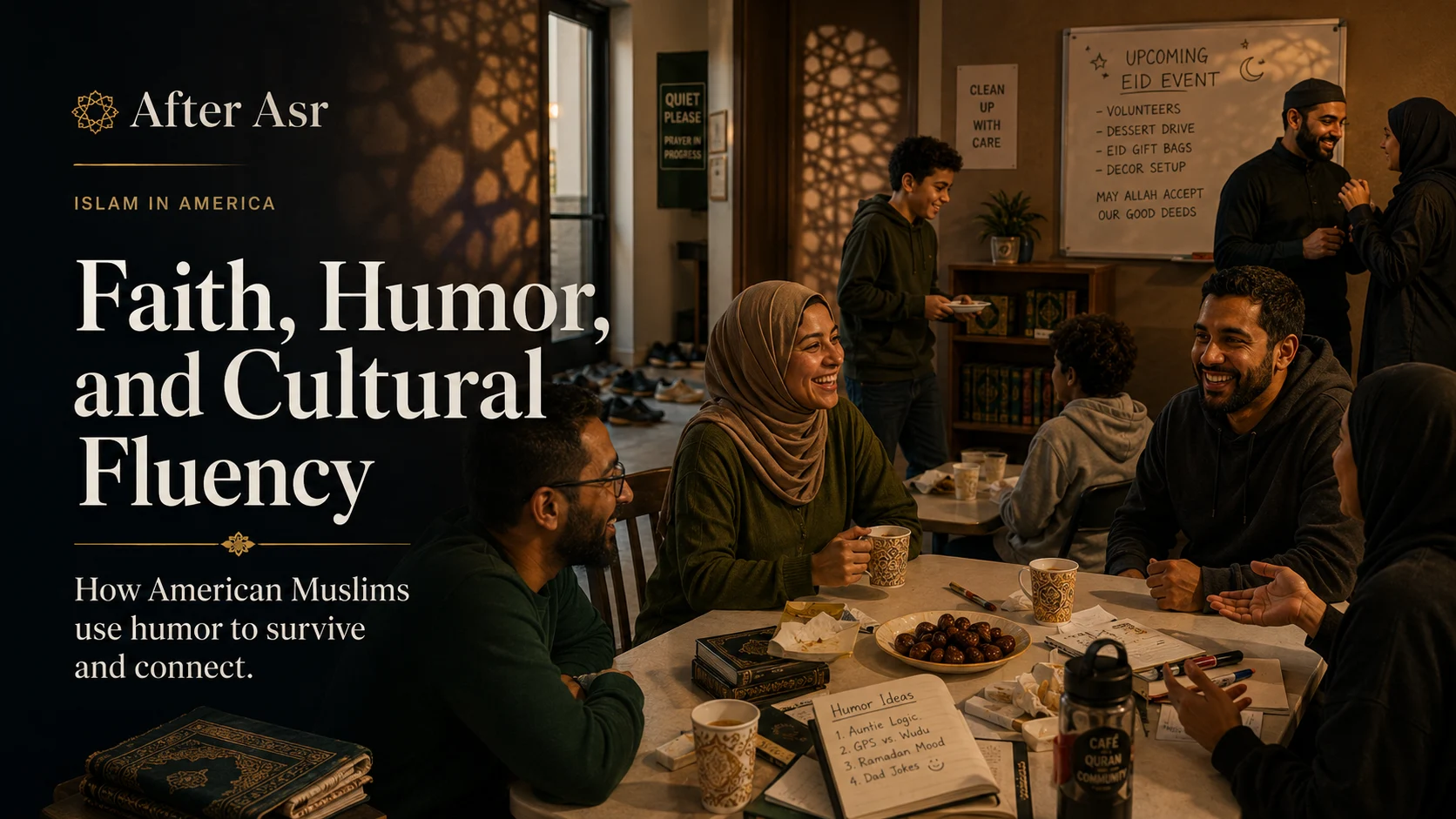
How American Muslims use humor to survive and connect.
There is a kind of laughter that happens in Muslim spaces that is difficult to explain from the outside.
It may happen in the mosque kitchen when the rice is running out and someone says, with absolute seriousness, that this is the real test of sabr. It may happen when a child proudly announces they are fasting, then asks if gum counts as food. It may happen when an uncle gives a khutbah-length answer to a simple parking question. It may happen when a convert realizes that every Muslim family has a different opinion about the correct way to pronounce their name. It may happen when a college student opens their backpack and finds dates, prayer beads, a laptop charger, and a half-finished assignment due at midnight. It may happen when someone says, “I’m just making wudu,” and disappears long enough for everyone to wonder whether they also completed a minor renovation of the bathroom.
The laughter is not always loud. It is often knowing. It comes from people who understand the pressure of living between worlds, from people who carry sacred obligations inside ordinary American schedules, from people who have learned to explain themselves without letting explanation consume them. It is a laughter shaped by inconvenience, memory, affection, fatigue, and faith.
American Muslim humor is rarely only about being funny. At its best, it is cultural fluency. It is a way of recognizing one another across differences. It is how Muslims soften the awkwardness of being misunderstood. It is how converts survive the intensity of learning a new religious world. It is how immigrant parents and American-born children negotiate translation. It is how youth turn public pressure into shared language. It is how communities make room for joy without pretending everything is easy.
Humor does not make faith less serious. Sometimes it is one of the ways seriousness becomes bearable.
Laughter in a life of obligations
Islam is a faith of weight and mercy. It has commands, limits, discipline, worship, accountability, and awe. It also has warmth, beauty, companionship, tenderness, and room for human ease. A Muslim life is not meant to be grim. The Prophet ﷺ was the most serious of people in truth, yet he was not harsh, cold, or joyless. The spiritual path is not made more authentic by making the face permanently heavy.
In American Muslim life, this matters because many Muslims already carry enough tension. They are navigating prayer at work, halal food in public schools, Ramadan schedules in non-Muslim households, family expectations, mosque politics, social misunderstanding, marriage questions, identity pressure, and the constant need to explain what should not always require explanation. Without some lightness, communities become brittle.
Humor can release pressure without denying reality. It allows people to say, “This is hard,” without turning every hardship into despair. It allows a mother to joke about the chaos of getting children ready for Eid prayer while still loving the day. It allows a student to laugh about searching for an empty stairwell to pray in while still recognizing the seriousness of prayer. It allows a convert to smile at their early mistakes without feeling humiliated by them. It allows a community to survive the small absurdities of institution-building, from broken microphones to disappearing extension cords to the eternal question of who moved the chairs.
Laughter, in these moments, is not escape from faith. It is part of living faith inside human limitation.
The believer knows that the world is not a comedy. Death is real. Accountability is real. Injustice is real. But the believer also knows that mercy is real, friendship is real, and small joys can be gifts from Allah. A community that never laughs may not be more pious. It may simply be tired, afraid, or emotionally unsafe.
The humor of being misunderstood
Many American Muslims develop a humor shaped by repeated misunderstanding.
Every Ramadan, someone asks, “Not even water?” Every Eid, someone says, “Is that like Muslim Christmas?” Every Muslim student has heard a teacher mispronounce their name with the confidence of a person entering unknown terrain. Every hijabi woman has fielded questions that began with curiosity and somehow ended in anthropology. Every bearded Muslim man has learned the strange art of looking non-threatening while buying groceries. Every convert has been asked, “But why would you do that?” by someone who assumes Islam is something people are born into, not something one might choose.
Humor becomes a way to manage the repetition.
A Muslim could become angry every time. Sometimes anger is justified. Ignorance can be exhausting, and not every question is innocent. But if the heart reacts to every clumsy comment as though it were a full attack, daily life becomes unbearable. Humor can create a little space between the person and the pressure.
There is a difference between laughing with wisdom and laughing away pain. Muslims should not use humor to excuse disrespect, racism, Islamophobia, or cruelty. But not every awkward question belongs in the same category. Some people are genuinely uninformed. Some are trying. Some are clumsy but reachable. A gentle joke can turn an uncomfortable moment into a conversation.
“No, not even water. Yes, we survive. No, coffee does not have a special exemption, sadly.”
That kind of answer carries more than information. It says, “I am not ashamed. I am not fragile. I am not here to be your spectacle, but I can meet your curiosity with grace.”
This is cultural fluency. It is the ability to read the room without losing oneself. To know when to explain, when to joke, when to correct, and when to walk away. American Muslims often learn this fluency not from books, but from life.
The shared language of Muslim inside jokes
Every community has its inside jokes. Muslim communities have many.
There are jokes about the brother who starts every comment with “Just a quick reminder,” then speaks for twenty minutes. Jokes about iftar officially beginning with one date and unofficially becoming a full athletic event. Jokes about mosque announcements that happen immediately after everyone thinks prayer is over. Jokes about children treating the prayer hall like an indoor track. Jokes about the one auntie who knows every family’s marriage prospects. Jokes about the parking lot being the true test of character. Jokes about people saying “inshaAllah” when they mean yes, no, maybe, probably not, or please stop asking.
These jokes create belonging because they are built from recognition.
A Muslim from New Jersey, Texas, Michigan, South Carolina, California, or Minnesota may enter a mosque and recognize the same patterns. The accents differ. The food differs. The architecture differs. The ethnic composition differs. But somehow, certain things repeat. The shoe area is always a moral lesson. The children are always faster than the adults. The microphone always fails at least once. Someone always brings too much rice, then somehow not enough rice. Someone always says the event starts at six, and everyone knows what that means.
Inside jokes are not trivial. They help create a sense of “we.” They allow a community to laugh at its own habits without hating itself. They make the mosque feel less like an institution and more like a living household. They let newcomers learn the culture gently. They remind people that community is made of people, not ideals.
But inside humor also requires care. A joke that builds belonging for some can exclude others. Ethnic jokes, convert jokes, racial jokes, gendered jokes, or jokes about accents can easily cross from affection into harm. The fact that something makes one group laugh does not mean it is harmless. Communities should be able to laugh at shared experiences without turning vulnerable people into targets.
Good humor says, “We recognize ourselves.”
Bad humor says, “We have found someone to reduce.”
Converts and the comedy of learning
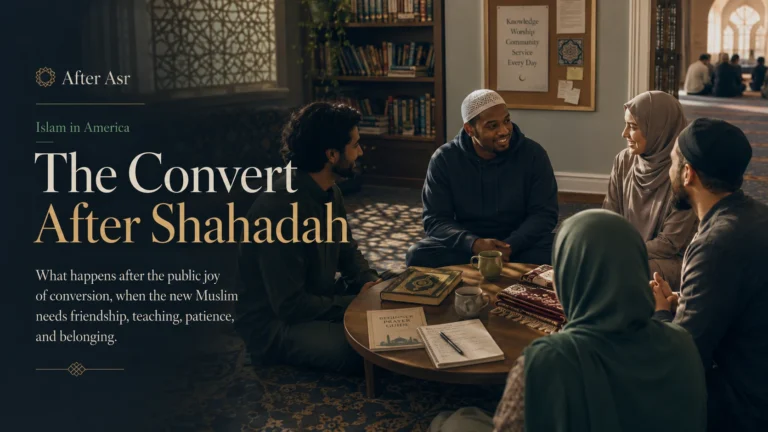
Converts often experience Muslim humor from the edge at first.
They are learning the prayers, the greetings, the food customs, the rhythms of the mosque, the social expectations, the difference between Islam and culture, and the many ways Muslims can disagree while still calling each other brother and sister. They may not understand why everyone laughs when someone says “moon sighting committee.” They may not know why Eid planning seems to involve astronomy, WhatsApp, and emotional endurance. They may hear “inshaAllah” used in so many ways that it feels like a language within a language.
The early convert journey includes moments that can become funny later, but may feel vulnerable while happening. Mispronouncing Arabic words. Standing up at the wrong time in prayer. Breaking fast too early by accident. Not knowing whether to shake hands. Getting invited to five iftars in one week and none the next. Being offered seven plates of food by people who insist they are “just small portions.” Discovering that “brother, just come to the masjid” can mean anything from a brief prayer to a four-hour community event.
A merciful community lets converts laugh without making them feel laughed at.
This distinction matters. Humor can help converts relax. It can make the learning process less intimidating. It can tell them, “You are not the first to stumble. You are family.” But if the humor turns their ignorance into entertainment, it becomes a wound.
Born Muslims should remember that many cultural habits they treat as obvious are not obvious at all. The convert is not foolish for not knowing. They are new to a world others inherited. When converts eventually laugh at their own early mistakes, it should be because they feel safe, not because they were publicly embarrassed.
A beautiful community knows how to say, “We have all learned,” even if some learned earlier than others.
The immigrant parent, the American child, and the joke in between
In many Muslim families, humor lives in the space between immigrant parents and American-born children.
A mother uses an English phrase slightly wrong, and the whole family adopts it forever. A father gives a dramatic warning about leaving the house without a jacket, as if mild weather were a spiritual threat. A child translates a school email into family strategy. Parents mix Arabic, Urdu, Bengali, Somali, Turkish, Bosnian, Farsi, Malay, or another language with English in sentences that only the household understands. Children imitate their parents’ sayings with affection. Parents tease children for needing GPS to drive five minutes away.
This humor can be tender because it carries love across difference.
Immigrant parents often built Muslim life in America with sacrifice their children do not always fully understand. American-born children often navigate schools, social codes, and public expectations their parents did not grow up with. Humor becomes one way to bridge the gap. It allows families to name differences without turning every difference into conflict.
But this humor can also become painful if it hardens into mockery. Children may laugh at parents’ accents in ways that echo the contempt of outsiders. Parents may joke about children being “too American” in ways that dismiss real struggles. Generational humor is healthy when it preserves dignity. It becomes unhealthy when it turns family difference into humiliation.
The best family humor is full of mercy. It says, “We are not the same, but we belong to each other.” It allows immigrant parents to remain honored and American-born children to remain understood. It turns translation into affection rather than shame.
This is one of the quiet arts of Muslim life in America: laughing across generations without breaking the chain of respect.
Muslim youth and the language of memes
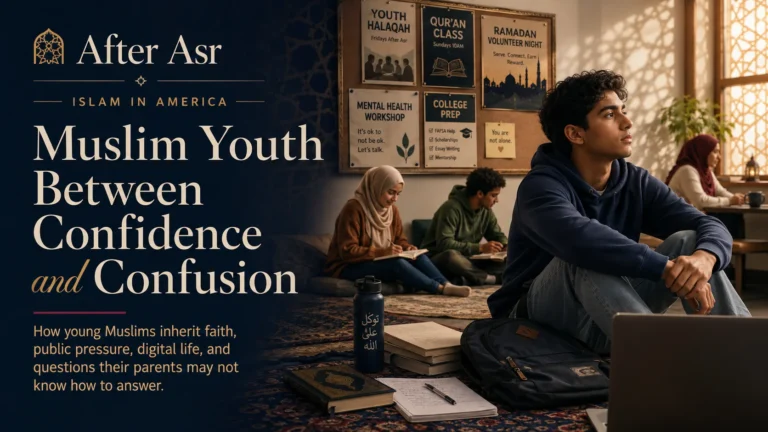
For many young Muslims, humor now travels through memes, short videos, group chats, captions, and shared references.
There are Ramadan memes, Eid memes, halal dating memes, MSA memes, Muslim parent memes, “trying to pray at school” memes, “when the imam says one more announcement” memes, “when someone says inshaAllah but you know they mean no” memes. Some are clever and harmless. Some are sharp with truth. Some are lazy. Some are spiritually corrosive.
This digital humor matters because it shapes how young Muslims talk about faith.
A good joke can make a young Muslim feel seen. It can name the awkwardness of making wudu in a public restroom, the difficulty of fasting during exams, the strange social world of Muslim marriage events, or the tension of being religious in secular spaces. It can help youth realize they are not alone. It can create a bridge between faith and the language of their generation.
But meme culture also has dangers. It can make everything ironic. It can turn worship into content. It can normalize disrespect toward parents, scholars, marriage, hijab, prayer, or the mosque. It can reward cynicism because cynicism is easier to share than reverence. It can make young Muslims feel clever while slowly making sacred things feel ordinary.
Muslim youth do not need humorless policing. They need spiritual taste.
They need to know the difference between laughing at human situations and laughing at worship itself. Between joking about the difficulty of waking for suhoor and mocking the fast. Between teasing the chaos of community life and humiliating elders. Between pointing out real problems and becoming contemptuous. Between using humor to survive and using humor to avoid sincerity.
The internet makes jokes travel faster than wisdom. Muslim communities should not respond only with scolding. They should help young people develop adab in humor, because humor is now one of the languages through which they process identity.
Humor as code-switching
American Muslims often become fluent in multiple social languages.
There is the way one speaks at the masjid. The way one speaks at work. The way one speaks with non-Muslim relatives. The way one speaks in an MSA group chat. The way one speaks with elders. The way one speaks with children. The way one explains Ramadan to a supervisor versus a curious neighbor versus a new convert versus a Muslim friend who already understands the entire situation from one look.
Humor helps with this code-switching.
A Muslim can make a joke at work that gently explains fasting without sounding like a formal presentation. A Muslim student can use humor to answer classmates without seeming embarrassed. A Muslim parent can explain Eid to a teacher with warmth instead of frustration. A Muslim woman can respond to an awkward hijab comment with enough lightness to keep dignity intact, when she chooses to. A Muslim man can disarm suspicion without becoming a clown for other people’s comfort.
This skill is not simple. It requires emotional intelligence, cultural awareness, and self-possession. It is not the same as trying to please everyone. The goal is not to become whatever the room wants. The goal is to communicate truthfully in a way the room can receive, without shrinking the truth.
Humor becomes a bridge. But bridges need foundations. Without faith, humor becomes performance. Without boundaries, humor becomes self-erasure. Without dignity, humor becomes the Muslim making themselves small so others can feel comfortable.
The most graceful American Muslim humor carries confidence. It does not beg to be accepted. It simply knows how to move.
The line between relief and cynicism
Humor helps communities survive, but cynicism can make them sick.
A joke about mosque parking can be harmless. Constant contempt for the mosque is not. A joke about aunties matchmaking can be affectionate. Cruelty toward older women is not. A joke about youth being loud can be funny. Treating young people as problems rather than souls is not. A joke about community fundraising can release tension. Assuming every leader is corrupt without evidence is not. A joke about Muslim marriage meetings can name awkwardness. Turning the search for marriage into bitterness and gender hostility is not.
Cynicism often disguises itself as humor. It says, “I’m just joking,” while spreading despair. It turns every institution into a punchline, every leader into a suspect, every family into a stereotype, every religious effort into hypocrisy. People laugh, but the laughter leaves them colder.
Muslims should be careful with this. The tongue can wound even when smiling. A community can lose trust through jokes repeated over time. Young people can absorb contempt before they have seen enough goodness to balance it. Converts can hear Muslims mock their own community and wonder whether belonging is even possible.
This does not mean we should avoid honest humor about real problems. Sometimes humor tells the truth more gently than confrontation. Communities do have dysfunction. Mosques do make mistakes. Families can be unreasonable. Cultural habits can be absurd. But the believer’s humor should leave room for repair.
A good test is this: after the joke, do we love the community more truthfully, or do we despise it more easily?
Laughing without mocking the sacred
Islam gives humor a place, but not an unlimited one.
The sacred should not be treated carelessly. Allah, the Qur’an, the Prophet ﷺ, prayer, fasting, the unseen, and the obligations of religion are not material for cheap jokes. There is a difference between joking about one’s own struggle to wake for Fajr and mocking Fajr itself. There is a difference between laughing about the chaos of children at taraweeh and treating the prayer as a nuisance. There is a difference between teasing the human habits around Ramadan and making the month itself seem silly.
Adab protects joy from becoming disrespect.
This is especially important in a culture where comedy often proves itself by crossing lines. Modern humor frequently rewards irreverence. Nothing is supposed to be too sacred to joke about. The more shocking the joke, the more “honest” it is assumed to be. Muslims do not need to accept that standard. We can be funny without being crude. We can be honest without being spiritually reckless. We can laugh without training the heart to lose awe.
The believer should ask: does this joke increase affection, humility, and recognition? Or does it make worship feel small? Does it relieve pressure, or does it weaken reverence? Does it bring people closer, or does it make someone an object of contempt? Does it tell a truth, or does it only seek a reaction?
A community that protects sacred things does not become joyless. It becomes safe. People know that laughter will not come at the expense of Allah’s commands, the Prophet’s honor, or the dignity of believers.
That kind of safety allows better humor, not less.
Women, humor, and being allowed complexity
Muslim women often carry their own forms of humor, much of it sharp, observant, and deeply communal.
There is the humor of getting children dressed for Eid while everyone else asks why the family is late. The humor of being told the women’s section is “just upstairs,” when upstairs appears to mean behind three doors and a folding partition. The humor of auntie group chats that can organize a meal train faster than most institutions can schedule a meeting. The humor of hijab pins appearing in every purse, car, couch cushion, and emergency drawer. The humor of being asked whether one showers with hijab on, and having to decide whether the question deserves mercy or silence.
For Muslim women, humor can be a way of naming burdens without always turning them into public grievances. It can build sisterhood. It can expose absurdity. It can make space for honesty about marriage, motherhood, work, mosque access, modesty, expectations, loneliness, and leadership.
But communities should listen carefully. Sometimes what is said as a joke contains a real complaint. When women laugh about inadequate prayer spaces, they may also be telling the truth. When mothers joke about burnout, they may be asking for help. When single women joke about marriage pressure, they may be naming exhaustion. When women joke about always being assigned food service, decoration, childcare, and cleanup, they may be identifying a pattern.
Do not dismiss everything as “just jokes.” Humor is often the language people use when direct speech has not been welcomed.
A mature community can laugh and then ask, “Is there something here we need to fix?”
Black Muslim humor and historical intelligence
Black Muslim communities in America have long carried forms of humor shaped by survival, faith, linguistic brilliance, and historical intelligence. This humor can be warm, precise, and deeply observant. It often names contradiction with a clarity that others avoid. It may carry the memory of being both central to American Islam and repeatedly erased from its public story. It may speak through family, masjid life, prison outreach, neighborhood resilience, Sunday dinners, Eid gatherings, and the long work of building institutions under pressure.
For Black Muslims, humor can be a shield, a mirror, and a form of cultural continuity. It can expose anti-Blackness in Muslim spaces without surrendering love for the ummah. It can name the awkwardness of being discovered by immigrant communities only when American Muslim history is being discussed. It can carry pain without making pain the whole story.
Other Muslims should approach this humor with respect. Not everything is theirs to repeat. Not every joke travels across communities without context. Cultural fluency includes knowing when to listen, when to laugh with others, and when not to borrow language one has not earned.
American Muslim humor is not one thing. It is shaped by Black Muslim histories, immigrant memories, convert experiences, regional cultures, class differences, languages, and local communities. To flatten it into generic Muslim comedy would miss the point. The best humor arises from particular lives.
When Muslims learn to appreciate these differences, humor becomes more than entertainment. It becomes a way of honoring the complexity of the ummah.
The mosque as a place where joy should be allowed
Some Muslims grow up experiencing the mosque as a place of seriousness, correction, and rules, but not always joy. Children are told to be quiet. Youth are told to behave. Women are told where they can and cannot go. Converts are told what they need to learn. Men are told to volunteer. Announcements are made. Funds are raised. Problems are addressed. The mosque becomes necessary, but not always warm.
Humor can help restore the mosque as a human place.
This does not mean turning worship into entertainment. The prayer hall has adab. The Qur’an is not background noise. The masjid should not become chaotic or careless. But a mosque without warmth can become emotionally distant from the people it is meant to form.
There should be laughter in the hallways after prayer. Children should associate the mosque with affection as well as discipline. Youth should know that elders can smile. Converts should feel that mistakes will be met with mercy. Volunteers should be able to laugh together while stacking chairs. Families should feel that the mosque is not only a place they are corrected, but a place where they are known.
Joy is not the enemy of reverence. When properly held, it can deepen belonging.
A child who hears laughter at the masjid may grow up feeling that Islam is alive, not merely imposed. A young person who sees religious adults with humor may understand that piety does not require emotional stiffness. A convert who is gently teased like family, without being humiliated, may feel included. An elder whose stories bring laughter may feel remembered.
The mosque should teach awe, but also affection.
Humor after hardship
Some of the deepest Muslim humor comes after difficulty.
After a fundraiser that nearly failed but somehow succeeded. After a Ramadan program where everything went wrong except the worship. After a family crisis that ended with everyone eating together. After a long immigration process. After illness. After a community conflict. After a frightening public event. After years of being misunderstood. People laugh, not because the hardship was small, but because Allah carried them through it.
This kind of humor has gratitude inside it.
It is different from mockery. It does not deny pain. It looks back and says, “SubhanAllah, we survived that.” It allows people to breathe again. It can become part of communal memory. The story is retold, the details grow slightly more dramatic, and everyone laughs because they know the mercy beneath the absurdity.
American Muslims need this. Communities that endure pressure need ways to remember hardship without being defined by it. Humor can keep memory from becoming only trauma. It can allow people to tell stories of struggle with dignity, warmth, and perspective.
But timing matters. Do not joke too quickly about someone else’s pain. Do not rush people toward laughter because grief makes the room uncomfortable. Humor after hardship should emerge from those who carried it, not be imposed upon them. When it comes naturally, it can be healing. When forced, it can feel like dismissal.
The difference is mercy.
The public Muslim comedian and the private Muslim community
In recent years, Muslim comedians, writers, actors, and online creators have become more visible in American culture. Some have brought needed humor to experiences long misunderstood. They joke about parents, prayer, airport security, halal food, Ramadan, marriage, awkward questions, and growing up Muslim in America. Their work can make Muslims feel seen and help non-Muslims recognize familiar humanity.
This visibility matters. Public humor can challenge stereotypes more effectively than argument because laughter lowers defenses. A well-crafted joke can reveal the absurdity of suspicion. It can show that Muslims are not flat characters from someone else’s news segment. It can give young Muslims a sense that their lives belong in the cultural imagination.
But public Muslim humor also carries responsibility.
There is pressure to make Muslim life palatable to broad audiences. There is pressure to mock one’s own community for laughs. There is pressure to present religious seriousness as backward, parents as ridiculous, scholars as out of touch, and practicing Muslims as socially awkward. There is pressure to earn applause by confirming what the dominant culture already thinks.
The best Muslim humorists resist this. They can critique without betraying. They can be honest without contempt. They can make Muslims laugh at themselves without making Islam the joke. They can translate community life without flattening it. They can trust that Muslim audiences deserve complexity and that non-Muslim audiences can handle more than stereotypes.
Comedy is not fiqh, but it is still speech. And speech is accountable.
Humor as da’wah, but not as a gimmick
Humor can open hearts, but Muslims should be careful not to turn da’wah into charm alone.
A funny Muslim may make Islam feel less foreign to others. A warm joke can reduce fear. A light answer can invite deeper questions. A neighbor who laughs with Muslims at iftar may become more willing to learn. A coworker who sees a fasting Muslim remain cheerful may rethink assumptions. Humor can make the first door easier to open.
But humor cannot replace truth. It cannot carry the whole message. Islam is not validated by Muslims being likable. The Prophet ﷺ was beautiful in character, but he did not reduce revelation to social ease. Da’wah requires sincerity, knowledge, patience, and dependence on Allah. Humor may serve it, but it should not become its foundation.
There is also a risk of Muslims feeling they must be funny to be acceptable. The “friendly Muslim” becomes the safe Muslim, the harmless Muslim, the Muslim who can make others comfortable. This can become another performance. Not every Muslim is funny. Not every Muslim should have to soften a room. Some are quiet, serious, shy, grieving, scholarly, practical, or simply not in the mood.
Muslims should not be required to entertain people out of prejudice.
Humor is a gift when it flows from confidence. It is a burden when demanded as proof of humanity.
What humor reveals about belonging
The jokes a community tells reveal what it loves, what it fears, what it avoids, and who feels safe inside it.
If the humor always targets converts, the community has a convert problem. If it always targets women, the community has a gender problem. If it always targets youth, the community has an age problem. If it always targets certain ethnic groups, the community has a racism problem. If it always mocks religious seriousness, the community has a reverence problem. If no one can laugh at anything, the community may have a fear problem.
Humor is diagnostic.
It shows whether people trust each other. It shows whether correction can happen without humiliation. It shows whether elders and youth can share space. It shows whether the mosque feels like family or bureaucracy. It shows whether people are laughing from affection or from resentment.
A spiritually healthy community does not need to make rules for every joke. It cultivates hearts that know the difference. It teaches adab, humility, and mercy. It allows joy, but does not allow cruelty to hide behind laughter. It allows critique, but does not allow cynicism to become identity. It allows personality, but not ego without accountability.
The best humor leaves people feeling more human, not less.
A Muslim way of laughing
Perhaps the question is not whether American Muslims use humor. They do, constantly. The question is what kind of humor we want to cultivate.
A Muslim way of laughing would be honest, but not cruel. Warm, but not careless. Sharp enough to tell the truth, but not so sharp that it cuts the vulnerable. Rooted enough to protect the sacred, but relaxed enough to enjoy the ordinary. Capable of self-recognition, but not self-hatred. Capable of social critique, but not despair. Capable of cultural fluency, but not dilution.
It would let the convert laugh while learning. It would let the child associate Islam with joy. It would let the immigrant elder remain honored. It would let the American-born Muslim breathe between worlds. It would let women name burdens without being dismissed. It would let Black Muslims speak with the fullness of their own cultural intelligence. It would let youth use the language of their age without losing reverence. It would let communities notice their flaws without giving up on themselves.
This kind of humor is not trivial. It is part of the emotional architecture of Muslim life in America.
The community that can laugh with mercy can often survive pressure with more grace. It can correct itself without collapsing. It can welcome newcomers without making them afraid. It can carry sacred obligations without making religion feel lifeless. It can meet misunderstanding without becoming permanently defensive. It can remember that believers are servants of Allah, and servants of Allah are still human beings who spill tea, lose shoes, misread schedules, forget announcements, overcook rice, mispronounce names, and sometimes laugh until the room feels lighter.
Faith does not need humor in order to be true.
But human beings often need mercy in order to carry truth well.
And sometimes, by Allah’s kindness, that mercy arrives as laughter shared after prayer, over paper plates, in a mosque hallway, under fluorescent lights, among people still learning how to belong to one another.