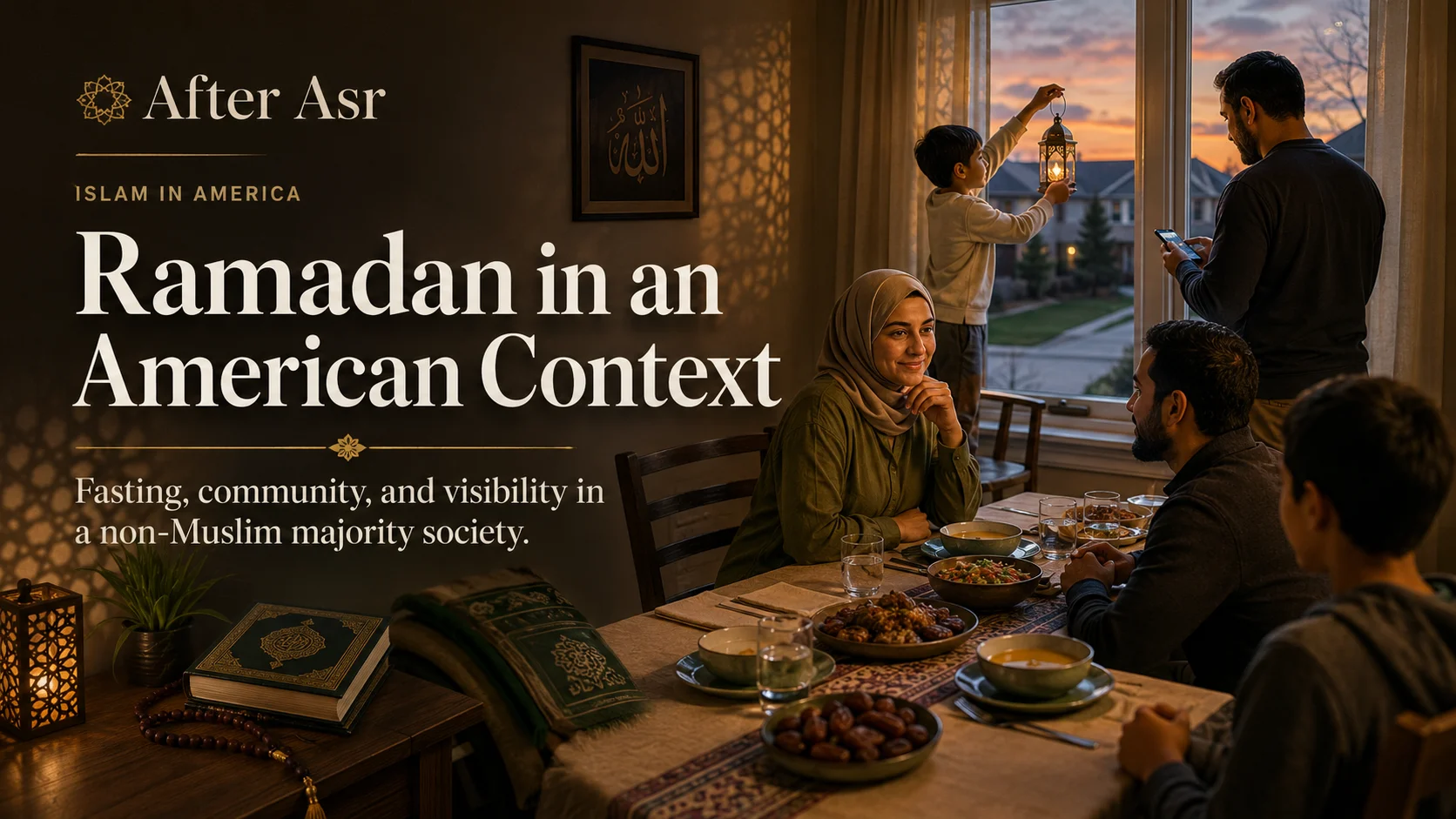
Fasting, community, and visibility in a non-Muslim majority society.
Ramadan arrives in America quietly, even when Muslim hearts feel it loudly.
The grocery stores do not change their music. Office calendars do not soften. School cafeterias remain open. Traffic moves as usual. Morning shows do not count the days until Eid. Most neighbors do not know that an entire month has entered with mercy, discipline, hunger, night prayer, Qur’an, family memory, repentance, and longing. The world outside continues at its normal speed, while Muslim life begins to rearrange itself around a different clock.
This is part of the beauty and difficulty of Ramadan in a non-Muslim majority society. The month is immense for Muslims, but the society around them does not stop. The believer fasts while emails continue, while meetings run through lunch, while children sit beside classmates eating pizza, while nurses work twelve-hour shifts, while delivery drivers carry food they cannot taste, while students take exams, while parents prepare suhoor in houses where others are still asleep. Ramadan becomes a private revolution inside a public routine.
For American Muslims, the month is not only about abstaining from food and drink. It is about carrying sacred time through a society that often does not recognize it. It is about worshipping with seriousness while remaining responsible to work, school, neighbors, relatives, and public life. It is about being visible without performing, explaining without becoming exhausted, gathering without losing sincerity, and fasting not as a cultural marker, but as obedience to Allah.
Ramadan in America teaches a particular kind of spiritual steadiness. The believer learns that sacredness does not need the whole country to announce it in order to be real.
A month that changes the house before it changes the street
In many Muslim homes, Ramadan begins before anyone outside notices.
A mother clears space in the pantry. A father checks the prayer calendar. Children ask whether this is the year they can try fasting. Someone buys dates, lentils, tea, yogurt, frozen samosas, rice, soup ingredients, or whatever foods carry the memory of their family’s Ramadan. Converts search online for suhoor ideas and wonder how much water is enough. College students calculate whether they can attend taraweeh and still finish assignments. Night shift workers ask scholars how to manage fasting when sleep comes at strange hours. Families message one another, “Ramadan Mubarak,” sometimes across oceans, sometimes across town.
The house begins to shift.
The kitchen becomes more intentional. The dining table becomes a place of waiting. The living room may become a place of Qur’an recitation after Fajr. Children learn that sunset has meaning. The refrigerator holds foods reserved for a particular hour. The alarm before dawn becomes part of the family soundscape. Even the quiet feels different.
This domestic transformation matters because Ramadan is often romanticized as a public community month, full of crowded iftars, decorated mosques, and long rows of worshippers. Those scenes are real and beautiful, but much of Ramadan is built in private spaces. A sink full of dishes after iftar. A sleepy teenager eating cereal for suhoor. A convert praying alone from a YouTube guide. A father whispering du’a before leaving for work. A mother reading one page of Qur’an between chores because that is what the day allows. A child asking why Muslims fast and receiving an answer that may remain in the heart for years.
The first Ramadan institution is not the banquet hall. It is the home.
In America, where public life does not naturally organize around Islamic time, the home becomes even more important. It is where Ramadan is made visible to children. It is where ordinary routines are given sacred meaning. It is where the month enters through small acts repeated with love.
Fasting in workplaces that do not pause
The American workplace can be one of the most revealing places to fast.
There is the morning meeting when the coffee is passed around. The lunch break when coworkers ask whether water is allowed. The afternoon fatigue that arrives while deadlines remain unmoved. The long shift when the body grows heavy and the tongue must still remain disciplined. The break room with microwaved meals, birthday cake, and casual questions. The awkward moment when someone says, “I could never do that,” and the fasting Muslim must decide whether to smile, explain, or preserve energy.
For many Muslims, Ramadan at work is a lesson in quiet resilience. The fast is not hidden, but it is not always announced. Some coworkers know. Some forget every year. Some ask kindly. Some make jokes. Some become unexpectedly thoughtful, moving lunch meetings or offering a conference room for prayer. Others treat fasting as an inconvenience, a curiosity, or a productivity concern.
The workplace also exposes class differences within American Muslim life. It is one thing to fast while working remotely with control over one’s schedule. It is another to fast while driving routes, cleaning hotel rooms, stocking shelves, serving food, working in a warehouse, caring for patients, standing all day, or taking back-to-back customer calls. Many Muslims do not have flexible supervisors, private prayer spaces, or the ability to leave early for iftar. Their Ramadan is no less spiritual because it is less comfortable. In many cases, it may be more demanding.
The dignity of these Muslims deserves more attention. The brother cooking food all day in a restaurant while fasting. The sister in healthcare who breaks her fast with water between patients. The security guard eating dates in a parking lot. The rideshare driver praying Maghrib at a gas station. The factory worker who cannot attend taraweeh because the night shift begins. Their Ramadan may not appear in glossy community photos, but it is deeply real.
American Muslims often speak about religious accommodation, and rightly so. Prayer, fasting, Eid, and iftar needs should be respected in workplaces. But beyond formal accommodation, there is a deeper spiritual reality: Ramadan tests whether we can remain servants of Allah in systems not designed around worship.
This does not mean accepting injustice silently. It means recognizing that even when the workplace does not pause, the believer can still carry Ramadan into it with intention, patience, and dignity.
The question everyone asks: not even water?
Every Ramadan, millions of Muslims in America answer the same question.
“Not even water?”
It is often asked with genuine surprise. Sometimes with admiration. Sometimes with disbelief. Sometimes with the tone of someone discovering, for the first time, that religious discipline can still exist in modern life. The question can become tiring, especially for Muslims who have answered it since childhood. Yet it also reveals something important. Fasting interrupts assumptions.
In a society organized around consumption, constant hydration, convenience, snacking, coffee, and personal comfort, the Muslim fast is startling. It says the body has needs, but the body is not the master. It says hunger can teach. It says restraint is not harm when done in obedience and with proper limits. It says worship can enter the stomach, the throat, the schedule, the mood, and the marketplace. It says spiritual life is not only belief inside the mind, but discipline carried by the body.
Muslims should not be annoyed every time someone asks. Curiosity is not always ignorance in the cruel sense. Sometimes it is simply a sign that Islam is more serious than people expected. The question gives Muslims a chance to explain, briefly and beautifully, that fasting is for Allah, that it teaches taqwa, that it joins the body and soul in worship, that it reminds us of need, gratitude, patience, self-control, and mercy.
But Muslims should also not feel obligated to turn every question into a lecture. A simple answer may be enough. “Yes, from dawn to sunset, not even water. It is an act of worship, and Muslims around the world do it during Ramadan.” That sentence can carry more dignity than an exhausted explanation.
The goal is not to make fasting seem easy. The goal is to make its meaning clear.
Children fasting in schools that keep serving lunch
For Muslim children, Ramadan in America is often learned at school.
They sit in cafeterias while others eat. They explain why they are not drinking from the water fountain. They try to focus during afternoon classes. Some are proud. Some are embarrassed. Some are too young to fast but want to try because older siblings do. Some are fasting half-days. Some are fasting secretly because their parents told them they are not ready. Some are not fasting because they are exempt or still learning, and they worry other Muslims will judge them.
The school environment can either make Ramadan dignified or unnecessarily difficult.
A thoughtful teacher can make a difference by allowing a fasting student to spend lunch in the library, avoid strenuous activity during physical education, or make up a test if fatigue becomes significant. A careless teacher can embarrass a child by questioning them publicly. A supportive school can mark Eid absences respectfully. An uninformed school can treat them as unexplained or inconvenient. A classmate can ask with kindness, or mock what they do not understand.
Parents carry a delicate responsibility. They want their children to love Ramadan, not merely endure it. They want them to feel proud without becoming self-righteous. They want them to fast when appropriate without harming themselves. They want them to understand that Islam has mercy and rules, not only social pressure. They want them to know that fasting is not a performance for other Muslims, but worship for Allah.
American Muslim communities can help by giving families language for schools. A simple note explaining Ramadan, fasting, prayer, and Eid can prevent confusion. Mosques can prepare parents before the month begins. Youth groups can talk openly about fasting at school, peer pressure, sports, exams, and how to answer questions. Children need to know both the spiritual beauty and the practical wisdom of Ramadan.
The cafeteria may not stop for them, but their community can help them stand gently inside it.
The convert’s first Ramadan
The first Ramadan after shahadah can be one of the most beautiful and lonely experiences of a convert’s life.
There is the wonder of joining a global act of worship. The first suhoor. The first iftar. The first time thirst becomes a form of remembrance. The first taraweeh, when the Qur’an is recited for long stretches and the convert may understand very little, yet feel that something holy is happening. The first Eid, with its unfamiliar joy and, sometimes, unexpected ache.
There is also the confusion. What exactly breaks the fast? What time does fasting begin? What is suhoor? What is taraweeh? What should one say before eating? How does one manage family members who do not understand? What if they are invited to dinner before sunset? What if they work evenings? What if the mosque feels socially overwhelming? What if they break their fast alone night after night?
Muslim communities often celebrate converts when they enter Islam, but Ramadan reveals whether they have been brought into family. A convert should not have to spend their first Ramadan piecing together religious life from search results and occasional invitations. They need more than a welcome packet. They need people.
Someone should invite them for iftar before the month begins. Someone should explain the mosque schedule without assuming prior knowledge. Someone should sit with them during taraweeh if they are nervous. Someone should tell them that not understanding Arabic does not make their prayer empty. Someone should help them navigate family tension with mercy and boundaries. Someone should check on them after Eid, when the community excitement fades.
The convert’s Ramadan is not a public inspiration story for born Muslims to admire from a distance. It is a trust. If Allah has guided someone into Islam, the community should not leave them alone at the first major doorway of Muslim communal life.
Iftar as memory and mercy
Iftar is more than a meal.
It is the moment when the body receives what it withheld for Allah. It is the glass of water that tastes like mercy. It is the date lifted with gratitude. It is the brief silence before eating. It is the du’a that rises from hunger. It is the family table, the mosque line, the paper plate, the soup steam, the child watching the clock, the elder who has broken more fasts than anyone in the room can count.
In America, iftar carries many cultures at once. A mosque table may hold biryani, lentil soup, pizza, sambusas, dates, fried chicken, rice, pasta, salad, tacos, qahwa, chai, and store-bought cookies. The variety can be chaotic and beautiful. It tells the story of American Muslim life better than many formal speeches. Immigrant memory, convert improvisation, Black Muslim tradition, college student budget meals, suburban potlucks, restaurant donations, auntie networks, and youth volunteers all meet at sunset.
But iftar also reveals community inequalities.
Some families host often. Some cannot afford to. Some people are invited every week. Others eat alone. Some mosques have abundant food. Others struggle to organize enough. Some iftars are welcoming. Others are socially divided by ethnicity, language, class, gender, or familiarity. Some converts, single adults, students, widows, elderly people, and new families discover in Ramadan that community is not automatic.
A spiritually serious Ramadan requires noticing who is missing.
Hospitality is not only feeding those we already know. It is making room for the person standing alone. It is sending a plate to the elderly neighbor. It is inviting the convert without making them feel like a project. It is asking the student far from home where they will break fast. It is remembering the single brother, the divorced sister, the refugee family, the quiet teenager, the person who attends but is never included.
The Prophet’s teaching on feeding the fasting person should not become only a catering project. It should become a culture of mercy.
Taraweeh and the American night
Taraweeh gives Ramadan its night rhythm.
In Muslim-majority societies, streets may stay awake late. Families may adjust. Businesses may shift. The soundscape of the month may change. In America, taraweeh often happens after a full workday, after homework, after dishes, after bedtime negotiations, after long commutes, after explaining to a supervisor why mornings feel harder.
The masjid fills with people who are tired but drawn. Children fall asleep on prayer rugs. Volunteers direct parking. Shoes pile near entrances. Teenagers gather in corners until someone tells them to quiet down. Mothers negotiate strollers, snacks, and salah. Fathers carry sleeping children to the car. Reciters pace themselves through the Qur’an. Elders sit in chairs along the back. People who rarely attend the mosque during the year come night after night because Ramadan has opened something in them.
There is beauty in this effort. American Muslims do not attend taraweeh because the society makes it easy. They attend because the month calls them. The commute itself becomes devotion. The tiredness becomes part of the offering.
But communities should also hold mercy in how they speak about night worship. Not everyone can attend every night. Some work night shifts. Some are caring for infants. Some are chronically ill. Some have disabilities. Some live far away. Some women may lack safe transportation or childcare. Some converts may feel overwhelmed. Some families may need to pray at home to preserve health and sanity. The mosque should invite without shaming.
Ramadan is not a competition in public endurance. Taraweeh is a gift. Communities should make it accessible, dignified, and spiritually nourishing, not another measure by which people feel they have failed.
Visibility without spectacle
Ramadan makes Muslims more visible.
The fasting coworker. The student skipping lunch. The athlete adjusting practice. The employee requesting prayer space. The neighbor receiving an iftar invitation. The city official attending a mosque dinner. The social media posts. The school announcements. The local news story about Ramadan. The crescent decorations at home. The dates kept in a desk drawer.
Visibility can be good. It can normalize Muslim life. It can reduce ignorance. It can help children feel less alone. It can create opportunities for da’wah, neighborliness, and civic recognition. It can remind America that Muslims are not an abstraction, but part of its classrooms, hospitals, fire departments, offices, universities, small businesses, farms, airports, and neighborhoods.
But visibility can also become spectacle.
Ramadan can be turned into a cultural showcase stripped of worship. Iftar can become a networking event with prayer as an accessory. Muslims can feel pressured to make the month legible to outsiders in ways that soften its seriousness. Corporations may post Ramadan greetings while ignoring actual Muslim needs. Schools may celebrate diversity while failing to accommodate Eid. Politicians may attend iftars without listening to Muslim communities. Media may frame fasting as discipline, wellness, or empathy, while avoiding its central purpose: obedience to Allah.
Muslims should welcome sincere recognition, but not depend on it.
Ramadan does not become valuable because a city hall issues a proclamation. It does not become meaningful because a company posts a crescent graphic. It does not become American because a newspaper covers it. Ramadan is sacred because Allah made it sacred. Public recognition may be helpful, but it is not the source of dignity.
The challenge is to be visible without turning worship into performance. To explain Ramadan without reducing it. To invite neighbors without making iftar a stage. To accept civic kindness without letting public approval become the measure of the month.
The loneliness hidden inside the blessed month
Ramadan is often described as communal, but for many Muslims in America, it can reveal loneliness.
Single adults may break fast alone after work. Converts may watch others leave the mosque with families while they drive home to an empty apartment. International students may miss parents across the world. Elderly Muslims may remember fuller tables from earlier years. Divorced parents may spend some nights without their children. Rural Muslims may live hours from the nearest masjid. Muslims with social anxiety may want community but feel unable to enter it. Those struggling spiritually may feel that everyone else is glowing while they are barely holding on.
The month can intensify what is already present. A connected person feels more connected. A lonely person may feel more lonely. A family with warmth feels Ramadan as a blessing. A family with conflict may feel the conflict sharpened by hunger and exhaustion. A person strong in worship may feel lifted. A person distant from worship may feel ashamed.
Communities should speak about this gently.
Ramadan is a month of mercy, but mercy must be made socially visible. A mosque can organize smaller iftars, not only large ones. Families can invite one extra person. Youth groups can include those who hover at the edges. Convert programs can continue through the entire month. Women’s groups, men’s circles, and elder check-ins can make sure no one disappears. Imams can remind people that struggling in Ramadan does not mean Allah has rejected them.
The lonely Muslim should also know that their Ramadan is not lesser because it is quiet. Some of the most sincere du’a may rise from a small apartment with one plate, one glass of water, and no audience. Allah is not closer to the crowded table than to the solitary believer. The community should do better, but the lonely person is not unseen by Allah.
Ramadan and non-Muslim family members
Many American Muslims, especially converts and those in mixed family settings, experience Ramadan with non-Muslim relatives.
A mother may worry that her Muslim child is not eating. A father may feel hurt that his adult child no longer joins family meals during the day. A spouse may not understand the exhaustion. A sibling may make jokes. A grandparent may lovingly offer food again and again. Some families are supportive, setting aside dinner for sunset or asking thoughtful questions. Others are confused, offended, or fearful.
This can make Ramadan emotionally complicated.
The Muslim wants to worship Allah, but also wants to maintain family ties. They may need to explain fasting repeatedly without sounding annoyed. They may need to decline food without rejecting love. They may need to attend family gatherings while not eating. They may need to ask for respect around prayer and iftar. They may need to endure comments with patience while still holding boundaries.
Here, Ramadan becomes a training in adab. Not passive tolerance, but beautiful conduct. A Muslim can say, “Thank you, I am fasting until sunset, but I would love to take some home.” A convert can invite parents to iftar, not as a performance, but as a way of letting them see the beauty of the month. A Muslim can explain that fasting is not self-harm, but worship with rules and exemptions. A person can be firm without becoming cold.
Muslim communities should remember that many believers leave the mosque and return to homes where Islam is not understood. They may need guidance, not judgment. Their Ramadan may require emotional labor invisible to those surrounded by Muslim relatives.
To fast while being misunderstood by family can be painful. It can also be a path of patience, mercy, and quiet da’wah.
Eid in a country that keeps moving
Ramadan ends with Eid, but in America, Eid often arrives on an ordinary weekday.
The school bus still comes. Meetings remain scheduled. Exams are not automatically moved. Coworkers may not understand why Eid cannot simply be celebrated after work. Parents negotiate absences. Students decide whether missing class is worth falling behind. Some employers are supportive. Others are confused. Some Muslims take the day off. Others cannot afford to. Some children attend Eid prayer in new clothes, then return to school because their parents have no childcare.
Eid reveals what it means to celebrate a sacred day in a country that does not stop for it.
There is beauty in the effort. Muslims wake early, bathe, dress well, say takbeer, gather in rented halls, mosques, convention centers, school gyms, parks, and community spaces. There are hugs, photos, sweets, envelopes of money, children running, elders smiling, converts experiencing their first communal joy, and volunteers trying to manage parking with heroic patience. The joy is real, even when squeezed between American obligations.
But Eid also deserves more structural recognition. Muslim communities should advocate for school calendar awareness, excused absences, workplace accommodations, and public understanding. This is not asking for special treatment. It is asking for fair space within a society that already recognizes many religious and cultural rhythms. Muslim children should not have to choose between religious joy and academic penalty. Muslim workers should not feel guilty for requesting leave. Muslim families should not have to explain every year from the beginning.
At the same time, Muslims must remember that Eid is not made sacred by public recognition. It is sacred because Allah gave it to us. Whether in a grand hall or a small apartment, whether fully celebrated or quietly observed, Eid remains Eid.
The American mosque in Ramadan
Ramadan reveals the strengths and weaknesses of the American masjid.
Attendance increases. Donations rise. Volunteers multiply. Qur’an fills the prayer hall. Families return. Youth gather. Converts appear. Neighbors visit. The mosque becomes visibly alive.
But pressure also rises. Parking becomes difficult. Cleanliness becomes harder to maintain. Women’s spaces may become overcrowded. Children may be scolded without compassion, or left unmanaged without responsibility. Ethnic divisions may become visible around food and seating. Fundraising may become excessive if handled without spiritual care. Converts may be welcomed publicly but not personally. Security concerns may increase. Volunteers may burn out. Imams may carry enormous emotional and physical weight.
Ramadan is a stress test for institutions.
A wise mosque prepares not only for programs, but for people. It thinks about accessibility, childcare, women’s prayer space, convert support, youth engagement, elder seating, parking, safety, food distribution, cleaning, and communication. It trains volunteers in adab. It explains schedules clearly. It remembers that newcomers may not know where to go. It makes room for those who do not speak the dominant community language. It does not treat Ramadan as only a fundraising season, though financial support is necessary.
The masjid should be a place where the fasting person feels helped toward Allah, not managed like a crowd.
This does not mean expecting perfection. Most mosques are carried by tired volunteers doing their best. But communities should take Ramadan’s lessons seriously. If the same problems appear every year, the month is teaching something. If women cannot pray comfortably, if converts leave unnoticed, if youth only gather in hallways, if the poor are fed but not known, if volunteers collapse from exhaustion, then the community has work to do after Eid.
Ramadan fills the mosque. The question is whether the mosque learns from who came.
Fasting as resistance to the age
Ramadan in America is not only a religious observance. It is a quiet resistance to the spiritual habits of the age.
The age says consume. Ramadan says withhold.
The age says satisfy every appetite. Ramadan says discipline desire.
The age says the self is sovereign. Ramadan says Allah is Lord.
The age says convenience is the measure of goodness. Ramadan says obedience may be difficult and still beautiful.
The age says identity is declared. Ramadan says faith is practiced.
The age says time belongs to productivity. Ramadan says time belongs first to Allah.
This resistance does not need slogans. It is carried in the body of the fasting person. Every hour of hunger says that the human being is more than appetite. Every withheld sip says that unseen obedience matters. Every pre-dawn meal says that worship can rearrange sleep. Every iftar du’a says that gratitude is learned through need. Every night of Qur’an says that guidance is more precious than entertainment.
In this way, Ramadan critiques American life without requiring Muslims to hate America. It reveals the limits of a culture built around consumption, speed, individual comfort, and constant availability. It also offers a mercy to Muslims living inside that culture: for one month, we are pulled back toward what is real.
The believer still works, studies, shops, drives, pays bills, answers emails, and lives among neighbors. But beneath all of that, another order has taken hold. Dawn and sunset become spiritual boundaries. Hunger becomes remembrance. Time becomes sacred again.
The public beauty of private obedience
One of the paradoxes of Ramadan in America is that fasting becomes visible precisely because it is private obedience.
No one can see intention. No one can see the fast itself. A person can appear normal while carrying hunger for Allah. Yet the effects of fasting become public. The skipped lunch, the tired eyes, the prayer break, the date at sunset, the refusal of coffee, the absence from school on Eid. Private worship leaves public traces.
This is why Ramadan can become a gentle form of da’wah. Not because Muslims are performing, but because obedience has a shape. People notice. They ask. They wonder why someone would choose difficulty for God. In a society where religion is often treated as preference or heritage, fasting shows that Islam is lived with the body.
But Muslims should be careful to preserve the privacy within the visibility. The fast is for Allah. It should not become a badge of superiority. It should not make the fasting person impatient with those who do not fast, whether non-Muslims, children, the ill, travelers, menstruating women, pregnant women, nursing mothers, elderly people, or Muslims struggling in ways others cannot see. A fasting tongue that shames others has missed something of the month.
Ramadan visibility should produce humility, not pride.
The fasting person knows their own weakness by midafternoon. They know how quickly hunger can sharpen irritation. They know how hard it is to control the tongue. They know that without Allah’s help, even one day of worship can become polluted by ego. This knowledge should soften them.
The public beauty of Ramadan is not only that Muslims fast. It is that fasting teaches Muslims their need.
What Ramadan teaches America, and what America teaches Ramadan
Ramadan in America teaches non-Muslim neighbors something about Muslims, if they are willing to notice. It teaches that Islam is disciplined, communal, embodied, generous, and deeply attached to worship. It teaches that Muslims are not seasonal symbols in the news, but people whose lives are ordered by prayer and sacred time. It teaches that religious seriousness still exists in ordinary American places.
But America also teaches Muslims something about Ramadan.
It teaches them that sacred time must sometimes be protected deliberately. It teaches them that community cannot be assumed. It teaches them to explain without diluting. It teaches them to build institutions where none were handed to them. It teaches them to help children carry Islam with confidence. It teaches them to make homes into places of worship. It teaches them to find one another across distance, ethnicity, language, and background. It teaches them that fasting for Allah does not require social ease.
This does not make American Ramadan better or worse than Ramadan elsewhere. It makes it particular.
Every land has its tests. In America, one of the tests is living a deeply communal, sacred month inside a society that often treats faith as private lifestyle. Another test is preserving worship while navigating visibility. Another is building Muslim belonging without making Islam dependent on public recognition. Another is ensuring that those at the margins of the community are not left alone during the month that should gather them in.
Ramadan exposes what American Muslim life has built, and what it still must build.
After the last fast
The final nights of Ramadan often carry a tenderness that is difficult to explain.
The body is tired. The mosque feels familiar. The Qur’an recitation nears completion. People begin to speak about Eid plans. Donation boxes fill. Children grow restless. Adults feel the ache of a month leaving before they were ready. Some are relieved. Some are ashamed they did not do more. Some are transformed. Some fear returning to old patterns. Some wonder whether they will still pray at the mosque after the crowds disappear.
In America, the end of Ramadan can feel especially abrupt. One day the believer is inside the sacred rhythm. The next day, the country is exactly as it was before. Work resumes. School resumes. Lunch resumes. Coffee returns. The stores never knew what ended. The streets do not mark the departure.
But the heart knows.
Ramadan leaves traces. A child remembers their first full fast. A convert remembers their first iftar invitation. A family remembers a night of du’a. A mosque remembers who came back after years away. A lonely person remembers who noticed them. A worker remembers breaking fast quietly and feeling Allah near. A student remembers praying in an empty classroom. A mother remembers asking Allah for help while washing dishes at midnight. A community remembers, if it is wise, what the month revealed.
The work after Ramadan is to honor those traces.
Not by pretending the whole year can feel like Ramadan. It cannot. But by carrying something forward: a prayer protected, a page of Qur’an kept, a relationship repaired, a habit restrained, a person included, a masjid improved, a child encouraged, a convert supported, a heart softened.
Ramadan in America is not a contradiction. It is a training ground. It teaches Muslims to live sacredly in a society that may not recognize sacred time. It teaches them to fast without applause, gather without guarantee, explain without shrinking, and worship without waiting for the world to make room.
The country may not stop.
But the believer does.
At dawn, at sunset, in hunger, in prayer, in Qur’an, in community, in solitude, in the quiet certainty that Allah sees what the public calendar does not.
That is the dignity of Ramadan here.
It arrives quietly, but it changes everything for those who receive it.