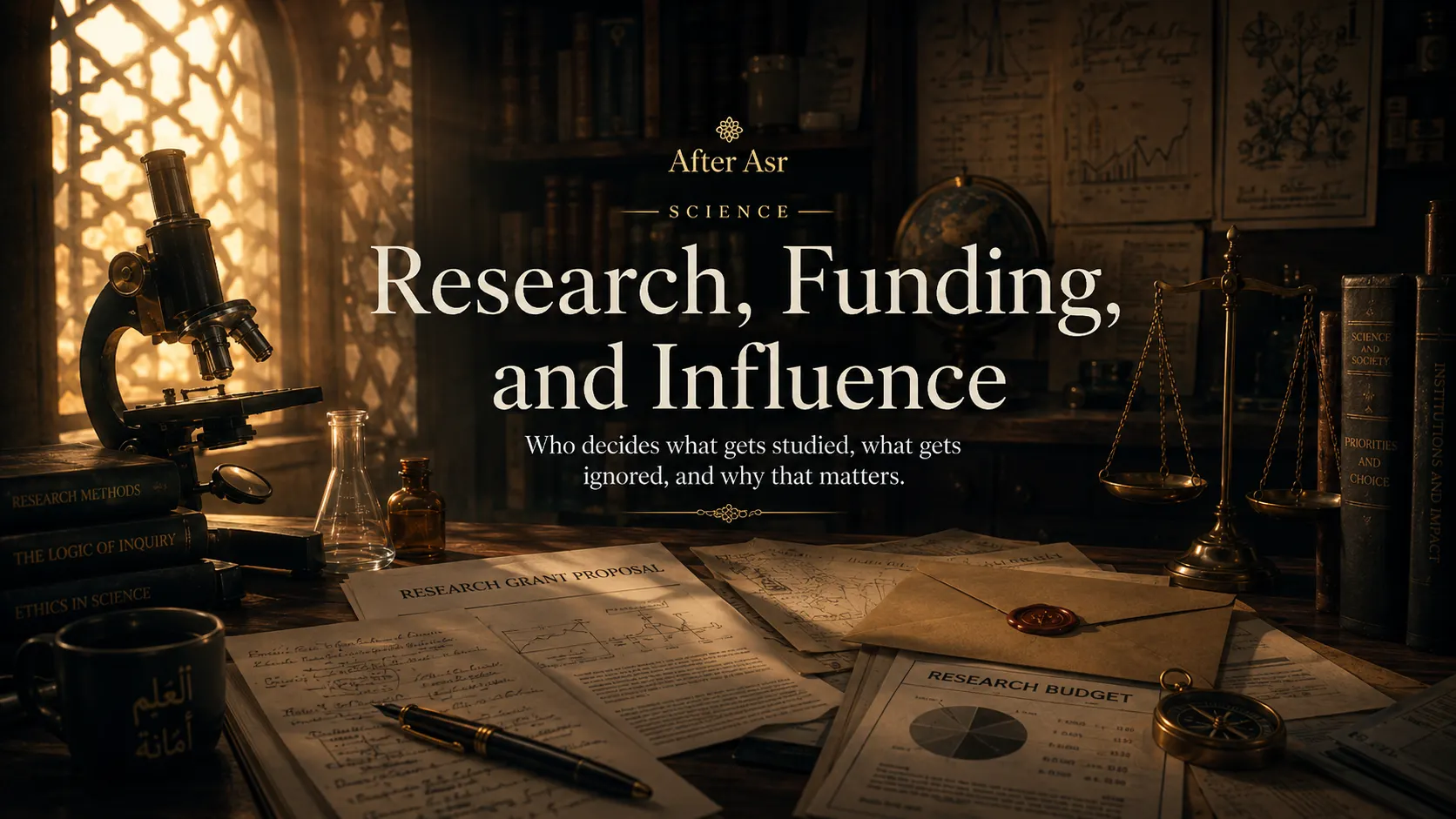
Who decides what gets studied, what gets ignored, and why that matters
Science often begins with a question.
Why does this disease spread?
What makes this material stronger?
How does this ecosystem recover?
Which treatment works best?
What happens when a child grows up near pollution?
Why do some communities suffer more than others?
What is happening inside the brain, the soil, the ocean, the cell, the atmosphere?
But before a question can become a study, something practical must happen.
Someone must fund it.
There must be a laboratory, a field team, equipment, staff, time, training, data access, ethics approval, publication support, institutional backing, and often years of work before an answer emerges. Research is not only curiosity. It is curiosity organized through resources.
This means science does not develop in a vacuum.
What gets studied is shaped by what seems urgent, what seems profitable, what institutions value, what governments fear, what companies can sell, what philanthropists care about, what journals publish, what careers reward, and what societies are willing to notice.
That does not make science fake. It makes science human.
Scientific research can be honest, rigorous, and deeply valuable while still being shaped by systems of funding and influence. The moral question is not whether influence exists. It always does. The question is whether that influence is transparent, accountable, and directed toward the common good.
Who decides what counts as an important question?
That question matters because what we study shapes what we learn, and what we learn shapes what we are able to heal, prevent, protect, repair, and understand.
Curiosity needs resources
It is tempting to imagine science as a pure pursuit of knowledge, guided only by wonder and evidence.
There is truth in that image. Many researchers are driven by sincere curiosity. They endure long hours, failed experiments, uncertain careers, and modest recognition because they want to understand something real. Some are motivated by compassion. Some are motivated by awe. Some are motivated by the hope that their work will reduce suffering.
But even the most sincere scientist lives inside practical limits.
A question that cannot be funded may remain unanswered. A disease that affects people without political or economic power may remain understudied. A long-term environmental problem may receive less attention than a technology that can be commercialized quickly. A basic science question may be neglected because it does not promise immediate results, even though basic research often becomes the foundation for future breakthroughs.
Resources shape possibility.
This does not mean money determines truth. A well-funded study can be wrong. A small study can be insightful. A powerful institution can miss what a careful observer sees. But funding affects which questions receive sustained attention.
A society reveals its moral imagination by what it is willing to investigate.
If we fund weapons more easily than public health, that says something. If we fund cosmetic enhancement more easily than neglected diseases, that says something. If we study consumer behavior more aggressively than loneliness, disability care, or poverty, that says something.
Research priorities are never only technical. They are moral mirrors.
The questions that become visible
Some suffering becomes scientifically visible because someone has the resources to measure it.
Other suffering remains hidden because no one has gathered the data, designed the study, or treated the problem as worthy of serious inquiry.
This is one reason research funding matters so much. A problem can appear small simply because it has not been studied well. A community can appear healthy because no one collected the right information. A harm can appear anecdotal because no institution cared enough to look for a pattern.
In medicine, certain diseases receive enormous attention while others struggle for funding. Some conditions are dismissed for years because they are complex, poorly understood, hard to measure, or affect populations whose pain is not taken seriously. In environmental science, pollution may remain politically invisible until communities organize, researchers investigate, and data makes denial more difficult. In social science, suffering may be renamed as personal failure until research reveals structural causes.
Visibility is not neutral.
To make something visible through research is to say: this matters enough to be known.
But who gets that gift? Whose pain becomes a grant proposal? Whose risk becomes a dataset? Whose environment becomes a study site? Whose disease becomes a priority? Whose questions are considered sophisticated, and whose are treated as complaints?
Science can bring justice when it reveals hidden harm. But injustice can also shape science when some harms are never investigated.
Profit and the direction of discovery
Profit is one of the most powerful forces shaping research.
This is not always bad. Commercial investment can bring useful products into the world. Pharmaceutical research, medical devices, agricultural tools, materials science, software, clean energy, and engineering innovations often require major investment. Companies can move discoveries from laboratory settings into public use.
But profit is not the same as moral priority.
A profitable problem is not necessarily the most urgent problem. A marketable solution is not necessarily the most humane solution. A treatment that can be sold repeatedly may attract more investment than a preventive measure that would reduce long-term need. A condition affecting wealthy consumers may receive more attention than one affecting poor communities.
This is not a conspiracy. It is how incentives work.
If a system rewards financial return above human need, research will often follow the money. That does not mean every researcher inside that system is corrupt. Many are sincere. But sincere people can work within structures that quietly direct attention toward what can be monetized.
The ethical concern is not that profit exists. The concern is that profit can narrow our imagination.
A society must ask: Are we studying what heals, or only what sells? Are we developing technologies that serve human dignity, or technologies that create dependence? Are we treating prevention as less valuable because it is less profitable? Are we neglecting the poor because they are not attractive markets?
Science requires resources. But when resources are governed mostly by profit, the weak may disappear from the research agenda.
Government funding and public priorities
Governments also shape science.
Public funding can support research that markets may ignore: basic science, public health, environmental monitoring, infrastructure safety, disaster preparedness, space exploration, agriculture, disease surveillance, and long-term studies. Government support can make it possible to investigate questions whose benefits are broad, delayed, or difficult to monetize.
This is one of the reasons public research matters.
Not every good question has an immediate customer. Not every necessary study can promise quick profit. Some research serves the public precisely because its benefits are shared across society.
But government funding also carries influence. Political priorities can shape what receives attention. National security concerns can drive research. Public controversy can silence or distort inquiry. Administrations may favor certain fields, neglect others, or pressure agencies in subtle ways. Research can become entangled with ideology, military interests, economic goals, or public relations.
Again, the issue is not whether influence exists. The issue is accountability.
Public funding should serve the public good, not only political advantage. It should support honest inquiry, protect scientific integrity, and ensure that findings are communicated truthfully even when inconvenient.
A society that funds research must also allow research to speak.
If the results are welcome only when they flatter the powerful, then science becomes decoration for policy rather than a guide toward truth.
Philanthropy and the private shaping of public knowledge
Philanthropy can do enormous good in science.
Private donors and foundations can fund neglected fields, support young researchers, build institutions, respond to crises, and take risks that governments or companies avoid. A generous donor may help launch research that saves lives or opens new areas of knowledge.
But philanthropy also raises questions.
When wealthy individuals or foundations fund research, they may shape the agenda according to their own interests, values, or theories of change. Sometimes this is beneficial. Sometimes it can distort priorities. A donor’s passion may elevate one field while others remain ignored. A foundation may prefer measurable interventions over deeper structural questions. A private vision of public good may influence entire research ecosystems.
The problem is not generosity. The problem is unaccountable influence.
Who decides what problems matter? Who evaluates whether a philanthropic agenda reflects community needs? Who is consulted? Who benefits from the prestige of solving problems? Who has the power to define success?
Giving money for research is not morally neutral. It is a form of power.
For believers, this should make us think carefully about sadaqah, waqf, institutional funding, and community investment. Wealth can support knowledge that serves people long after the donor is gone. But wealth can also impose priorities if not guided by humility and consultation.
The best giving does not merely express the donor’s ego. It serves real need.
Academic incentives and the pressure to produce
Research is also shaped by academic careers.
Universities often reward publication, grants, citations, prestige, novelty, and institutional reputation. Researchers may feel pressure to publish often, secure funding, produce impressive findings, and compete for limited positions. Young scholars may avoid risky or unfashionable questions because their careers depend on measurable output.
This can distort science.
A field may reward dramatic findings over careful replication. Researchers may choose questions likely to produce publishable results rather than questions that are slow, necessary, or uncertain. Negative results may be harder to publish, even though they are valuable. Complex work may be simplified for attention. Interdisciplinary work may struggle because it does not fit clean categories.
The result is not that academia is useless. Universities remain vital places of learning and discovery. But academic systems can reward speed, novelty, and visibility in ways that do not always serve truth.
This is a spiritual problem as much as an institutional one.
When reputation becomes too important, the heart becomes vulnerable. A researcher may begin seeking recognition more than understanding. An institution may begin seeking rankings more than service. A journal may seek impact more than carefulness.
Knowledge requires adab. It requires patience, honesty, humility, and a willingness to value work that may not be glamorous.
A healthy research culture must honor not only breakthroughs, but also careful repetition, correction, documentation, teaching, and the quiet work of making knowledge reliable.
What gets ignored
Every research agenda has an unseen shadow: the questions not asked.
What gets ignored may be just as important as what gets studied.
Sometimes questions are ignored because they are difficult. Sometimes because they are not profitable. Sometimes because they are politically inconvenient. Sometimes because the people affected lack influence. Sometimes because the problem crosses disciplines and no institution knows where to place it. Sometimes because acknowledging the problem would require moral change.
For example, a society may study productivity while ignoring exhaustion. It may study consumer preference while ignoring manipulation. It may study disease treatment while ignoring housing conditions that make disease more likely. It may study individual behavior while ignoring environmental exposure. It may study educational outcomes while ignoring hunger, trauma, or disability support.
The ignored question often reveals the protected assumption.
If we only study how to help people tolerate an unhealthy system, we may avoid asking whether the system itself should change. If we only study how to make workers more efficient, we may avoid asking whether work has become dehumanizing. If we only study how to help children focus better, we may avoid asking what kind of world has made attention so difficult.
Research can challenge power. It can also protect power by asking only the questions power is willing to hear.
The language of neutrality
Science is often described as neutral.
In one sense, this is good. Scientific claims should be tested by evidence, not by tribal loyalty. A result should not be accepted simply because it is useful to one group. Methods should be transparent. Data should be examined. Arguments should be accountable.
But neutrality can become misleading when it hides the moral choices surrounding research.
It is not neutral to decide which diseases receive funding. It is not neutral to decide which communities are studied and which are ignored. It is not neutral to define success only by profit, speed, or efficiency. It is not neutral to collect data from people without giving them meaningful benefit. It is not neutral to treat some harms as acceptable because the people harmed have little power.
Science aims for objectivity in method. But research exists inside society, and society is full of values.
The answer is not to abandon objectivity. The answer is to become more honest about the values shaping our questions.
A researcher can be committed to evidence while also caring about justice. A funding agency can support rigorous science while also asking whether neglected communities are being served. A university can pursue knowledge while admitting that its choices reflect priorities.
Neutral methods do not excuse morally empty priorities.
Conflicts of interest
Influence becomes especially concerning when conflicts of interest are hidden.
A conflict of interest does not automatically mean a study is false. A researcher funded by a company may still conduct careful work. A government agency may support useful research. A foundation may fund excellent science.
But conflicts of interest matter because they can shape what is studied, how results are interpreted, what gets published, what gets delayed, and how findings are presented to the public.
Transparency is essential.
People deserve to know who funded research, what role funders played, whether researchers have financial relationships, and whether results were reported fully. Hidden influence damages trust. Even when the science is sound, secrecy creates suspicion.
Trust is not protected by pretending influence does not exist. Trust is protected by disclosure, independent review, replication, open methods where possible, and a culture that values truth more than pleasing funders.
In Islamic moral language, hidden influence resembles a problem of amanah. Knowledge is a trust. To present research as purely independent when it is shaped by undisclosed interests is a betrayal of that trust.
The public does not need perfect researchers. It needs honest ones.
Community voice in research
Research often studies people without listening deeply to them.
A community may be treated as a source of data, but not as a partner in defining the problem. Researchers may arrive, collect information, publish papers, advance careers, and leave. The community may see little benefit. This can deepen distrust, especially among groups with histories of exploitation or neglect.
Ethical research should ask: Who is this for?
If a study concerns a community’s health, environment, education, disability experience, or social conditions, then the people affected should not be treated merely as objects of analysis. Their knowledge matters. Their questions matter. Their concerns may reveal what outside experts miss.
This does not mean community opinion replaces scientific method. It means lived experience can help shape better questions, more respectful methods, and more meaningful applications.
A mother caring for a disabled child may know practical realities that a researcher’s model misses. A farmer may notice soil changes before an institution studies them. A worker may understand risks hidden from management. A patient community may identify symptoms doctors dismissed. A neighborhood may know which environmental harms appear after rain, heat, or industrial activity.
Science becomes stronger when it listens well.
Humility does not weaken research. It improves it.
The role of journals and publication
Research influence does not end when a study is completed.
The publication system shapes what becomes visible. Journals decide what to publish. Editors and reviewers influence standards. Media outlets decide which studies become headlines. Institutions promote some findings and not others.
This matters because publication can determine what enters public conversation.
Dramatic findings may receive attention more easily than careful, modest work. Positive results may be favored over negative results. Studies from prestigious institutions may be treated with more respect. Research in English may travel farther globally. Expensive publication systems may exclude scholars without resources.
The pathway from study to public knowledge is not automatic. It is filtered.
This does not mean published science is untrustworthy. It means publication is part of the ecosystem of influence. To understand research well, we must understand not only what was found, but how certain findings become visible and authoritative.
A responsible reader should not treat every headline as the voice of science. Often, it is the voice of a study filtered through institutional promotion, journal selection, media framing, and public appetite.
Scientific literacy includes knowing how research becomes news.
When research serves the common good
At its best, research funding can become an act of mercy.
A government funds disease surveillance, and outbreaks are caught earlier. A foundation supports neglected tropical disease research, and suffering people gain attention. A university invests in clean water studies, and communities become safer. A donor supports disability technology, and independence becomes possible. Public health researchers study maternal mortality, and preventable deaths are reduced. Environmental scientists document contamination, and families gain evidence for protection.
Research can be service.
It can reveal harm, guide policy, improve treatment, prevent suffering, and help human beings live more responsibly in the world. It can bring hidden realities into public view. It can challenge complacency. It can protect the weak.
This is why cynicism is not enough.
It is easy to say funding influences research and then dismiss everything. But that is intellectually lazy. The goal is not to reject research because influence exists. The goal is to build better structures of influence.
We need funding shaped by justice. We need institutions that value truth. We need transparent conflicts of interest. We need public investment in neglected needs. We need communities involved in questions that affect them. We need researchers formed in humility. We need readers who understand the difference between evidence and marketing.
Research can serve the common good when the common good is actually honored.
Muslim responsibility toward knowledge
Muslim communities should take this topic seriously.
We often speak about seeking knowledge, but we must also ask what kinds of knowledge we support, fund, preserve, and apply. If knowledge is a virtue, then funding knowledge is a responsibility. If beneficial knowledge is a form of ongoing good, then research that serves human dignity may become a profound act of service.
What would it look like for Muslim institutions to fund research responsibly?
It could mean supporting public health studies in underserved communities. It could mean mental health research that understands religious life without reducing it to pathology. It could mean environmental studies around mosques, schools, farms, and vulnerable neighborhoods. It could mean bioethics work rooted in serious Islamic scholarship and scientific understanding. It could mean educational research for Muslim children. It could mean preserving Islamic scientific heritage while also contributing to contemporary inquiry.
But it must be done with excellence.
Good intentions are not enough. Research requires method, ethics, expertise, transparency, and patience. A Muslim approach to research should not become propaganda. It should not begin with conclusions and search for evidence afterward. It should not use religious language to avoid rigor.
Faith should make research more honest, not less.
A believer should fear misusing knowledge, overstating findings, hiding conflicts, or treating people as instruments. The pursuit of beneficial knowledge is noble precisely because it is an amanah.
The reader’s responsibility
Ordinary readers also have a role.
When we encounter research claims, we should ask who funded the study, what question was asked, who was included, whether the conclusion fits the evidence, and whether other studies agree. We should be alert to headlines that turn limited findings into sweeping claims. We should be cautious when research is used mainly to sell a product, win an argument, or shame a group of people.
But we should not become reflexively distrustful.
Suspicion is not wisdom. A person can ask about funding without assuming every funded study is corrupt. A person can recognize bias without believing truth is impossible. A person can critique institutions while still valuing expertise.
The mature reader holds two truths together.
Research is influenced.
Research can still reveal truth.
The task is to become careful enough to tell the difference between evidence, interpretation, marketing, and manipulation.
Funding as moral imagination
In the end, research funding is about moral imagination.
What suffering can we imagine as worthy of attention?
What future can we imagine as worth preparing for?
What communities can we imagine as deserving protection?
What forms of knowledge can we imagine as beneficial even if they are not profitable?
What questions are we brave enough to ask?
A society that funds only convenience will become shallow. A society that funds only power will become dangerous. A society that funds only profit will neglect the poor. A society that funds only urgent crises may fail to prepare for tomorrow. A society that does not fund knowledge at all will become dependent on those who do.
Research does not simply answer questions. It reveals what we cared enough to ask.
This should sober us.
The unanswered question may be a sign of neglect.
The unfunded study may be a sign of misplaced priorities.
The ignored community may be a sign of injustice.
The hidden conflict of interest may be a sign of broken trust.
But the reverse is also true.
The well-funded study of a neglected disease can be a sign of mercy.
The public investment in clean water can be a sign of justice.
The careful research into disability support can be a sign of dignity.
The transparent investigation of harm can be a sign of repentance.
The preservation of knowledge for future generations can be a sign of wisdom.
Knowledge under accountability
Science asks questions about the world. Funding decides, in part, which questions receive enough support to be answered.
That decision is never morally empty.
Behind every research agenda is a vision of what matters. Sometimes that vision is generous. Sometimes it is narrow. Sometimes it is shaped by public need. Sometimes by profit. Sometimes by fear. Sometimes by prestige. Sometimes by genuine compassion. Often, by a mixture.
We should not respond to this with cynicism. We should respond with responsibility.
Researchers must guard their integrity.
Funders must examine their intentions.
Institutions must protect transparency.
Governments must serve the public good.
Communities must have a voice.
Readers must learn to ask better questions.
Believers must remember that knowledge is a trust.
The question is not only whether research is scientifically rigorous. It is also whether our priorities are morally awake.
What we choose to study reveals what we have chosen to see.
And what we refuse to study may reveal what we are willing to leave in darkness.
A faithful society should not be content with that darkness. It should fund light where light is needed most: over the sick, the poor, the vulnerable, the wounded earth, the neglected child, the misunderstood patient, the unsafe worker, the forgotten community, and the future generation waiting silently for the consequences of our choices.
Science can help us know.
But first, someone must decide that the question is worth asking.
About the Author
Dr. Safiyyah Rahman is the Science & Society Essayist for After Asr, writing at the intersection of scientific inquiry, ethics, faith, and human responsibility. Her work explores how knowledge shapes not only what we understand about the world, but how we live within it.