
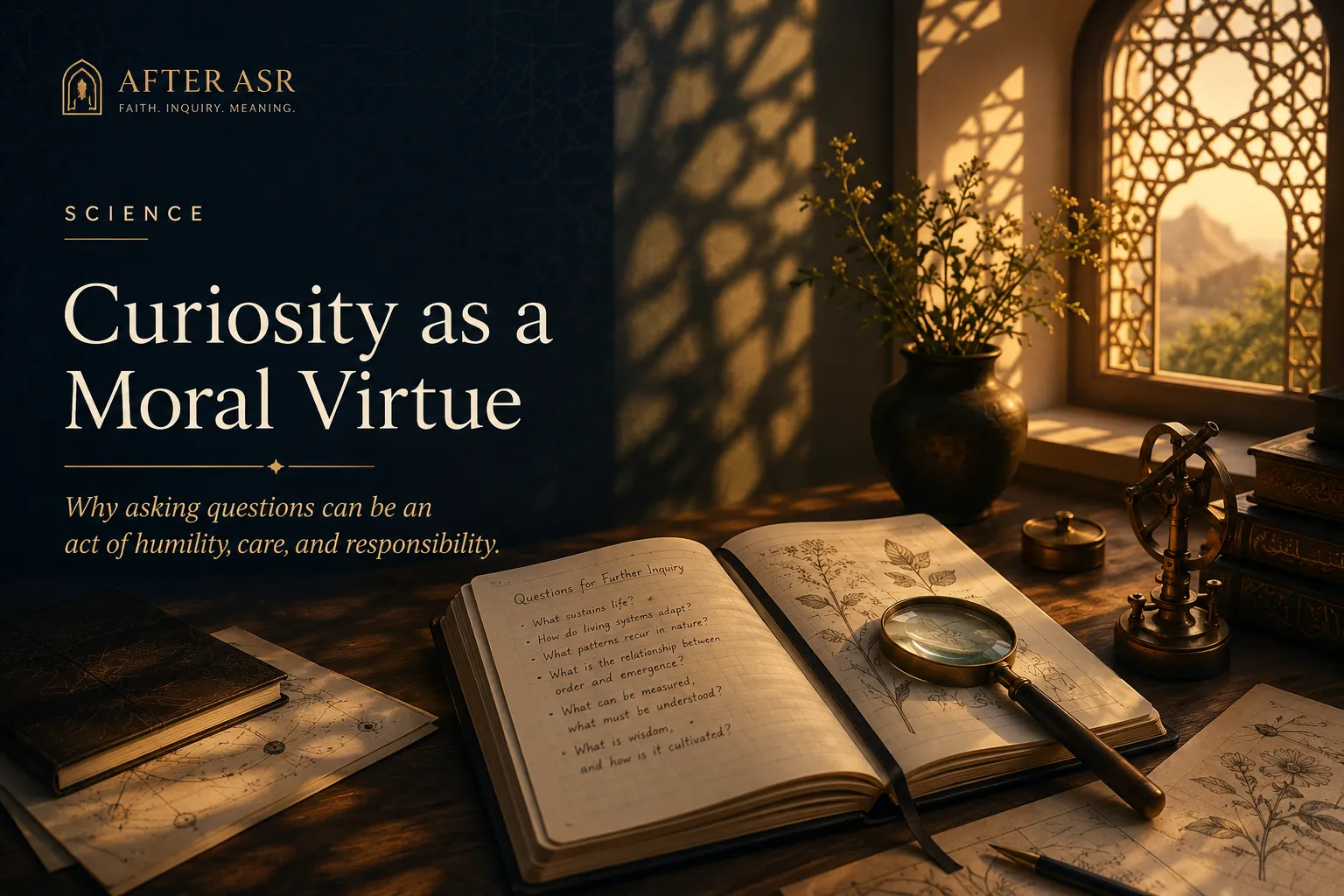
Why asking questions can be an act of humility, care, and responsibility
A question can be an act of arrogance.
It can be used to corner someone, to expose them, to mock what they love, or to perform intelligence in front of an audience. We have all seen this kind of questioning: sharp, impatient, already convinced of itself. It does not really seek an answer. It seeks victory.
But a question can also be something much gentler.
It can be a door opening.
It can be a hand reaching.
It can be the first sign that the heart has not become numb.
A child asking why the moon follows the car is not trying to dominate the sky. A patient asking how a treatment works is not rejecting the doctor. A student asking why a formula matters is not dishonoring the teacher. A believer asking how the world is ordered is not fleeing from faith.
Sometimes, to ask a sincere question is to confess: I do not know everything. I am willing to learn. I am paying attention.
That confession is not weakness. It may be one of the beginning points of wisdom.
In science, curiosity is often treated as an intellectual trait. We imagine curious people as clever, inventive, and observant. They notice what others overlook. They ask what others assume. They test what others repeat. This is true, but it is incomplete.
Curiosity is not only intellectual. At its best, curiosity is moral.
It reveals how a person stands before reality. Does he approach the world as something to exploit, or something to understand? Does she ask questions in order to control, or in order to care? Does the question come from vanity, or from humility? Does it lead to responsibility, or merely to entertainment?
The moral quality of curiosity depends not only on what we ask, but why we ask, how we ask, and what we do with the answer.
The humility of not knowing
Every sincere question begins with a small surrender.
To ask “why?” is to admit that the answer is not already fully possessed. To ask “how?” is to accept that appearances may not be enough. To ask “what am I missing?” is to make room for correction.
This humility is essential to science. A person who believes he already knows has no reason to observe carefully. A person who cannot bear correction has no reason to test his assumptions. A person who treats uncertainty as humiliation will avoid the very process through which knowledge grows.
Scientific inquiry depends on disciplined unknowing.
That does not mean ignorance is praised for its own sake. It means the honest awareness of ignorance becomes the doorway to learning. The scientist does not say, “I know nothing, therefore nothing matters.” The scientist says, “I do not yet know enough, therefore I must look more carefully.”
This is very different from the false confidence that often fills public life. Online, people are rewarded for instant opinions. The fastest voice often sounds like the strongest voice. Complex matters are squeezed into slogans. Doubt is treated as weakness. Changing one’s mind is treated as betrayal.
But reality is not shaped by our need to sound certain.
The natural world does not simplify itself because we are impatient. The body does not become less complex because a headline needs to be short. The climate does not become easier to understand because public debate prefers enemies. Human behavior does not become obvious because we want someone to blame.
Curiosity resists this impatience. It slows the soul down.
It says: Wait. Look again. Ask better. Do not rush to possess what you have barely encountered.
In this sense, curiosity is a discipline against arrogance. It reminds us that the world existed before our opinion of it. It reminds us that our first explanation may not be the truest one. It reminds us that certainty should not be cheap.
Attention as a form of care
Curiosity is not only about wanting information. It is also about giving attention.
And attention is one of the most neglected forms of care.
To be curious about something is to refuse to treat it as invisible. A physician who is curious listens more closely to symptoms. A teacher who is curious asks why a student is struggling instead of labeling him lazy. An environmental scientist who is curious notices small changes in water, soil, insects, and air before disaster becomes obvious. A parent who is curious about a child’s fear may respond with tenderness rather than punishment.
Careless people do not ask enough questions.
They assume. They categorize. They move on. They say, “That is just how it is,” when in reality they have not looked long enough to know what “it” is.
Curiosity, when joined to mercy, interrupts this laziness.
It asks: What is happening beneath the surface? What conditions produced this? Who is affected? What harm is hidden? What pattern have we ignored? What voice has not been heard?
This kind of curiosity is especially important in science because the things that need attention are often small, quiet, or easy to overlook. A slight change in temperature. A mutation in a cell. A pattern in patient outcomes. A correlation in public health data. A species disappearing from a local habitat. A side effect reported by people whose complaints were dismissed.
Much of science is the art of taking small things seriously.
That art has moral consequences. When we fail to pay attention, people suffer. Diseases spread unnoticed. Unsafe products remain in use. Environmental damage accumulates. Medical bias goes unchallenged. Communities become statistics without stories.
Curiosity does not solve every problem, but it often begins the path toward responsibility.
To ask a careful question is to say: This deserves to be understood.
The difference between curiosity and consumption
Not every desire to know is virtuous.
Modern life is full of information hunger that disguises itself as curiosity. We scroll through tragedies, scandals, diagnoses, wars, arguments, personal confessions, and scientific discoveries with the same restless appetite. We want to know, but often not in order to care. We want to know in order to feel stimulated.
This is not curiosity as moral virtue. It is consumption.
There is a difference between studying a disease because you want to heal people and reading about suffering because it is dramatic. There is a difference between learning about another culture with respect and collecting exotic details for your own identity. There is a difference between asking someone about their pain because you love them and asking because their life is interesting to you.
Curiosity becomes morally dangerous when it treats the world as material for the self.
Science has its own version of this danger. The history of research contains examples where human beings were treated as objects rather than persons, where vulnerable communities were studied without proper consent, where the desire to know became detached from the duty to protect.
This is why curiosity must be disciplined by ethics.
The question is not simply: Can this be studied?
It is also: Should it be studied in this way? Who bears the risk? Who benefits from the knowledge? Has consent been honored? Has dignity been protected? Are we seeking truth, or merely power?
A curious mind without moral restraint can become invasive.
A brilliant mind without compassion can become dangerous.
A research program without humility can turn people into instruments.
So curiosity must be purified. It must be connected to adab — to proper conduct, reverence, restraint, and respect for boundaries.
The world is not ours to dissect without responsibility. Human beings are not ours to examine without dignity. Creation is not ours to manipulate without accountability.
Asking better questions
One of the signs of intellectual maturity is learning that not all questions are equal.
Some questions are shallow because they only seek quick answers. Some are narrow because they ignore the larger context. Some are dishonest because they pretend to seek truth while hiding an agenda. Some are cruel because they demand explanation from people who are already wounded.
Better questions require better character.
A better question may be more patient. Instead of asking, “Who is right?” it may ask, “What evidence supports each claim?” Instead of asking, “Why are these people like this?” it may ask, “What conditions shaped this behavior?” Instead of asking, “How can we use this technology?” it may ask, “What kind of life will this technology encourage?”
Science advances through better questions. So does the human soul.
Consider medicine. A narrow question might ask, “Which treatment reduces symptoms fastest?” That may be necessary. But a deeper question might ask, “What produces healing without creating new harm?” A still deeper question might ask, “How do we treat this patient as a whole person, not merely as a malfunctioning body?”
Consider artificial intelligence. A narrow question might ask, “Can this system perform the task?” A deeper question might ask, “What errors does it make, and who will be harmed by them?” A still deeper question might ask, “What human capacities are weakened when we automate this?”
Consider environmental science. A narrow question might ask, “How much can this land produce?” A deeper question might ask, “What can this ecosystem sustain?” A still deeper question might ask, “What does stewardship require from people who will not live long enough to see the full consequences of their choices?”
The quality of the question shapes the quality of the answer.
If we ask only technical questions, we may receive technical answers while missing moral realities. If we ask only economic questions, we may receive profitable answers while damaging the vulnerable. If we ask only personal questions, we may ignore communal consequences.
Curiosity becomes virtuous when it learns to ask in the direction of truth, mercy, and responsibility.
Curiosity and faith
Some believers fear curiosity because they associate questions with doubt.
This fear is understandable. Questions can be destabilizing. They can expose weak foundations. They can lead a person into confusion if they are pursued without guidance, humility, or patience. Not every question should be asked in every setting, and not every questioner is sincere.
But fear of all questioning is not faithfulness. Sometimes it is insecurity.
Faith is not honored by pretending that human beings do not wonder. A person can believe and still ask how. A person can submit to God and still study the means through which things happen. A person can trust revelation and still investigate creation.
The created world is not a distraction from God when approached rightly. It is a sign.
The danger is not curiosity itself. The danger is curiosity severed from reverence. It is the kind of questioning that assumes reality has no meaning unless the human mind can master it. It is the kind of questioning that treats mystery as an enemy rather than a reminder of our limits.
Faith gives curiosity a different posture.
It allows us to ask boldly without becoming arrogant. It allows us to investigate deeply without imagining that measurement is the highest form of knowledge. It allows us to learn from science without expecting science to replace revelation. It allows us to admit uncertainty without despair.
A believer’s curiosity should be marked by wonder. The question “how does this work?” can live beside the question “what does this reveal about wisdom, mercy, order, and dependence?”
When a scientist studies the structure of the eye, the development of the embryo, the behavior of bees, the movement of galaxies, or the healing of tissue, the believer does not have to choose between mechanism and meaning. The mechanism can be part of the meaning. The order itself can deepen gratitude.
To know more about the world should not make the world feel less miraculous. It should make our laziness feel less excusable.
Curiosity as responsibility
Once curiosity leads to knowledge, knowledge creates obligation.
This is where curiosity becomes serious. It is pleasant to ask questions when the answers are beautiful. It is harder when the answers demand change.
If research shows that certain communities are more exposed to pollution, curiosity cannot end with a chart. If medicine reveals that pain is being undertreated in some patients because of bias, curiosity cannot end with a conference presentation. If climate science shows that our habits affect people far away and generations not yet born, curiosity cannot end with admiration for complex models.
To know is to become responsible.
This does not mean every person must become an expert in everything. That is impossible. But it does mean that sincere inquiry should change how we live. Knowledge should make us more careful consumers, more honest communicators, more thoughtful voters, more responsible neighbors, more humble believers.
There is a kind of curiosity that wants answers without consequences. It enjoys learning but resists transformation. It treats knowledge as decoration for the mind.
But moral curiosity asks: Now that I know this, what do I owe?
That question is heavy. It is also necessary.
The purpose of inquiry is not merely to increase information. It is to bring us into a truer relationship with reality. And reality includes other people. It includes the poor. It includes the sick. It includes the land. It includes the animal world. It includes future generations. It includes the Creator before whom knowledge itself becomes testimony.
Preserving the childlike question
Many people become less curious as they grow older.
Not because the world becomes less wondrous, but because they become more defended. They learn to hide ignorance. They learn that asking questions can make them look foolish. They learn to perform certainty. They inherit assumptions and mistake them for conclusions.
Somewhere along the way, the simple question becomes embarrassing.
But the childlike question is precious. Not childish, but childlike: open, attentive, unashamed of wonder.
A child can stare at an ant for ten minutes. An adult walks over entire worlds without noticing. A child asks why the sky changes color. An adult sees sunset only as background. A child asks where the body goes when it dies. An adult avoids the question by staying busy.
Science, at its best, preserves something of that childlike attention while adding discipline to it. It teaches the question to grow up without dying.
Faith does something similar. It teaches wonder to become gratitude. It teaches awe to become worship. It teaches knowledge to become responsibility.
A human being needs both: the courage to ask and the humility to bow.
The adab of inquiry
If curiosity is a moral virtue, then it has manners.
We should ask sincerely, not performatively.
We should ask patiently, not aggressively.
We should ask with respect for the people who may be affected by the answer.
We should ask with willingness to be corrected.
We should ask without treating every mystery as a personal insult.
We should ask without demanding that every answer arrive immediately.
This adab matters in classrooms, laboratories, families, mosques, hospitals, and public debates.
A society that loses the manners of inquiry becomes loud but not wise. People ask questions only to accuse. They gather information only to win arguments. They confuse suspicion with intelligence and certainty with strength. They stop listening because they are busy preparing replies.
A healthier society would teach people how to ask again.
Not merely how to search, but how to wonder.
Not merely how to challenge, but how to listen.
Not merely how to gather facts, but how to become worthy of what the facts reveal.
Curiosity alone is not enough. But curiosity joined with humility, care, and responsibility becomes a path toward wisdom.
The question as a beginning
The world does not owe us simplicity.
It is vast, layered, subtle, and often resistant to our first explanations. The body is more intricate than our diagrams. The earth is more interconnected than our categories. The mind is more mysterious than our metaphors. The heavens are wider than our imagination.
To live well in such a world, we must ask.
But we must ask as servants, not conquerors. We must ask as caretakers, not consumers. We must ask as people who know that the answer, once received, may require something from us.
Curiosity is not just the desire to know. It is the refusal to be careless before reality.
It is the student leaning closer.
The doctor listening longer.
The researcher checking again.
The believer looking at creation and refusing numbness.
The neighbor asking what suffering has been hidden.
The community asking what responsibility knowledge has placed upon it.
A sincere question can be a beginning of humility.
A careful question can be a beginning of mercy.
A courageous question can be a beginning of reform.
A reverent question can be a beginning of worship.
In a distracted age, to wonder carefully is no small thing.
It may be one of the ways the soul remains awake.
About the Author
Dr. Safiyyah Rahman is the Science & Society Essayist for After Asr, writing at the intersection of scientific inquiry, ethics, faith, and human responsibility. Her work explores how knowledge shapes not only what we understand about the world, but how we live within it.