How Muslims talk about Islam in America and why it matters
At the interfaith panel, Yasmin introduces herself carefully. “I’m a Muslim American,” she says, emphasizing the American. She talks about shared values, common ground, how Islam and American ideals align. She quotes the Founding Fathers alongside the Quran. She’s warm, accessible, unthreatening.
Her brother Kareem, watching from the audience, shifts uncomfortably. When he talks about being Muslim, he doesn’t lead with reassurance. He says “American Muslim” instead, putting Muslim first. He talks about justice and resistance, about how Islam challenges American failures rather than affirming American ideals. He doesn’t smile as much. He doesn’t soften the edges.
Same faith, same family, completely different language. And the difference matters.
The words Muslims use to describe themselves, their faith, and their relationship to America are not neutral. Language shapes thought, creates reality, and signals belonging or resistance. How Muslims talk about Islam in America reflects deeper questions about identity, strategy, and what it means to practice faith in a society that often views that faith with suspicion.
These linguistic choices matter internally, shaping how Muslims understand themselves and build community. They matter externally, affecting how non-Muslims perceive Islam and whether they view Muslims as neighbors or threats. And they matter politically, influencing policy debates and social dynamics in concrete ways.
Understanding the language Muslims use requires examining not just what’s said but why certain frames are chosen, what they accomplish, and what they might cost.
Muslim American or American Muslim
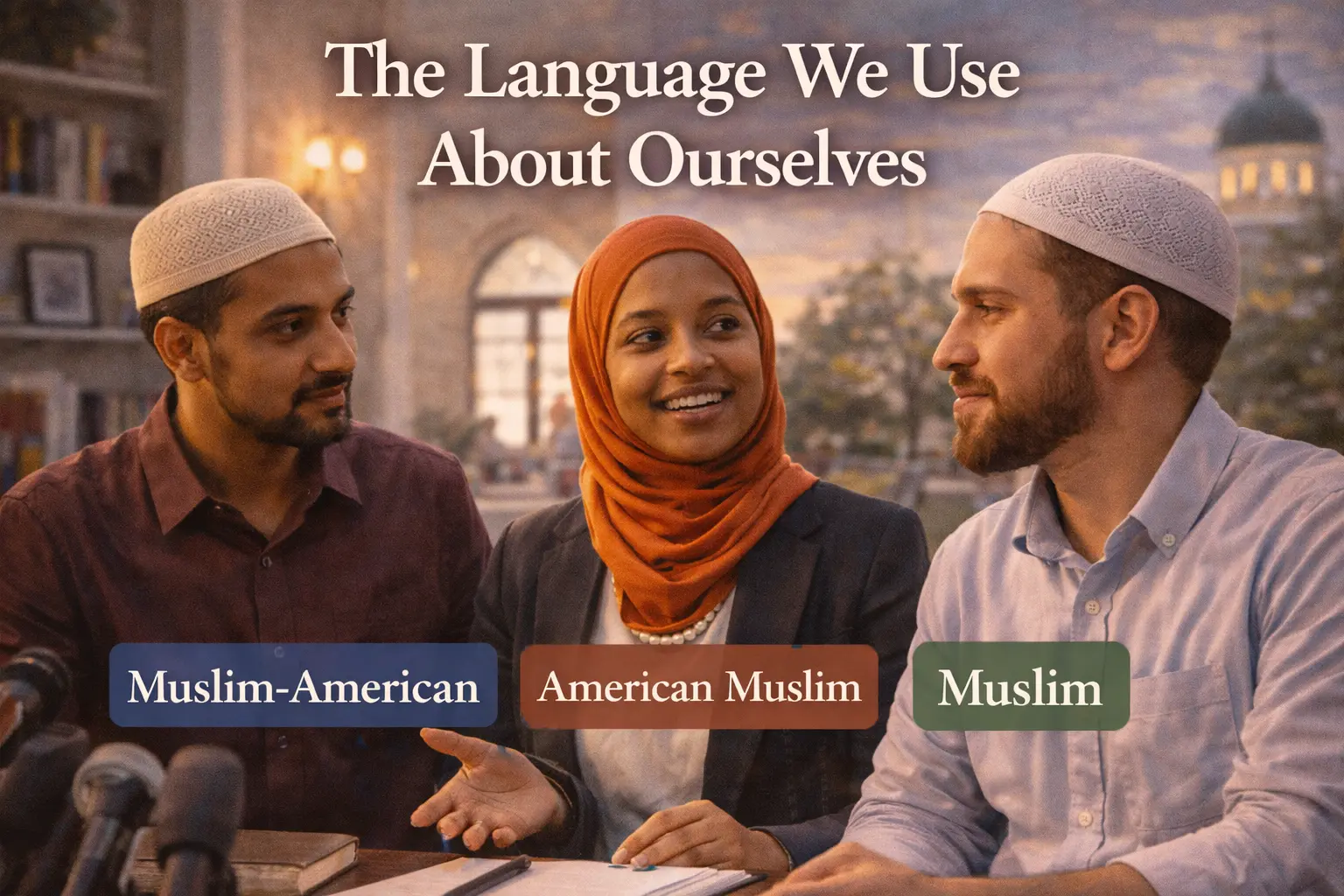
The order of words carries weight. “Muslim American” puts religion second, suggesting that American identity is primary and Muslim identity is modifier. It signals integration, belonging, and compatibility. It says: we are Americans who happen to be Muslim.
“American Muslim” reverses the priority, putting religious identity first. It suggests that being Muslim is the defining characteristic and American is the context. It signals that faith shapes everything else, including how one relates to American identity. It says: we are Muslims living in America.
Some Muslims switch between these formulations situationally, reading audiences and adjusting accordingly. Others consistently use one or the other, making a statement about how they understand themselves. Still others use “Muslim in America” to avoid the possessive entirely, acknowledging presence without claiming ownership or being claimed.
The generational divide is noticeable. Older immigrants often prefer “Muslim American,” emphasizing their successful integration and American identity. Younger Muslims, especially those born here, sometimes prefer “American Muslim,” insisting on being fully both without prioritizing one over the other. The linguistic shift reflects changing relationships to both American identity and Muslim authenticity.
But the choice isn’t just personal. It’s political. When Muslim organizations choose names and branding, when mosques describe themselves, when leaders speak publicly, these linguistic choices signal positioning and strategy.
The Apology Frame
Perhaps the most fraught linguistic pattern is the perpetual apology, the reflexive condemnation of terrorism, the constant reassurance that Islam means peace, the compulsive distancing from any Muslim anywhere who does something wrong.
This language emerges from real pressure. After every act of terrorism committed by someone claiming Islamic motivation, Muslims face demands to condemn, to explain, to prove they’re not secretly sympathetic. The apology frame becomes defensive posture, preemptive strike against anticipated accusation.
“Islam is a religion of peace” has become almost liturgical, repeated so often it’s lost meaning. Muslims say it, non-Muslims expect to hear it, and actual engagement with Islamic theology or Muslim diversity evaporates beneath the slogan.
Some Muslims have rejected this entirely. They refuse to apologize for actions they didn’t commit or to distance themselves from strangers who share their faith. They argue that the demand for condemnation is itself racist, that no one expects all Christians to apologize for Christian terrorism or all white people to condemn white supremacist violence.
Others maintain that strategic condemnation is necessary, that Muslims lack the luxury of refusing to engage. In a society where silence can be read as complicity, they feel obligated to speak clearly against violence, even knowing their words won’t satisfy everyone.
The language of apology creates psychological burden. It positions Muslims as perpetually suspect, always needing to prove innocence. It makes every Muslim conversation with non-Muslims begin from a defensive crouch. It frames Islam as something to justify rather than simply live.
Reclaiming Loaded Terms
Some words carry so much negative association that Muslims debate whether to use them at all. “Jihad” means struggle, including personal spiritual struggle against sin, but in American discourse it’s become synonymous with terrorism. Do Muslims use the word anyway, trying to educate about its actual meaning? Or do they abandon it, refusing to fight linguistic battles they can’t win?
“Sharia” has similarly been weaponized by Islamophobes to mean foreign legal system incompatible with American values. Muslims know Sharia simply means Islamic law and ethics, a framework for living righteously. But explaining this requires constant education, fighting against misinformation that’s deeply embedded in American political discourse.
Some Muslims have embraced reclamation strategy, using loaded terms precisely because they’re controversial. They talk openly about jihad and Sharia, refusing to cede the language to those who distort it. They write articles titled “My Jihad” or “Why I Love Sharia,” forcing readers to grapple with actual meanings rather than caricatures.
Others avoid these words entirely in public contexts, using alternatives that don’t trigger automatic negative reactions. They talk about “Islamic ethics” instead of Sharia, “spiritual struggle” instead of jihad. They meet audiences where they are rather than demanding linguistic education before conversation can happen.
Neither approach is wrong. Both represent different strategic calculations about when to educate, when to accommodate, and what battles are worth fighting.
Unity Language and Its Limits
Muslim organizations and leaders often employ unity language, talking about “the Muslim community” as if it’s monolithic, emphasizing shared identity across vast diversity. This language serves important purposes: it creates solidarity, mobilizes political power, and presents coherent public face.
But it also obscures real differences. The wealthy South Asian doctor and the Somali refugee working at the meatpacking plant are both Muslim, but their experiences of America differ vastly. The conservative Saudi Arabian immigrant and the progressive Black American convert share faith but might disagree on nearly everything else.
Unity language can silence dissent and marginalize those who don’t fit dominant narratives. When leaders speak of what “Muslims believe” or what “the Muslim community wants,” they’re often generalizing from particular subgroups while erasing others. Black Muslims, LGBTQ Muslims, Muslim women, disabled Muslims, all sometimes find their experiences ignored in pursuit of unified messaging.
Some Muslims push back with specificity language, insisting on naming differences. They talk about “Black Muslim experiences” or “immigrant Muslim concerns” or “South Asian Muslim culture,” refusing to let particularity be erased. They argue that honest acknowledgment of diversity strengthens rather than weakens community.
The tension between unity and specificity language reflects deeper questions about how to build coalitions without erasing difference, how to mobilize politically without suppressing internal debate, and how to be both proudly diverse and strategically unified.
Claiming America
How Muslims talk about their relationship to America reveals much about how they understand belonging. Some use ownership language: “our country,” “we Americans,” claiming full belonging without qualification. This language asserts citizenship rights and national identity, refusing to be positioned as perpetual outsiders.
Others use more distanced language: “this country,” “American society,” maintaining separation between themselves and the nation. This language might reflect immigrant identity not yet fully Americanized, or it might signal political alienation from a country that doesn’t fully accept them.
The language shifts in different contexts. A Muslim might say “we Americans” when talking about shared civic responsibilities but “this country” when critiquing American foreign policy. The linguistic code-switching reflects complex relationship to national identity, claiming it in some moments and distancing from it in others.
Some Muslims explicitly reject American identity altogether, seeing themselves as Muslims who happen to live in America rather than American Muslims. They maintain primary loyalty to the ummah, the global Muslim community, and view national identity as secondary or irrelevant. This stance frustrates other Muslims who see it as feeding stereotypes about Muslim loyalties.
Generational Dialects
Language about Islam in America differs markedly across generations. First-generation immigrants often use language that emphasizes gratitude, opportunity, and successful integration. They talk about America as generous host, about building better lives, about the freedom to practice faith.
Their children and grandchildren use different frames. They talk about America as home, not adopted country, and feel entitled to full belonging without gratitude or apology. They’re more likely to critique American failures, to demand rather than request, to center Muslim identity without softening it for non-Muslim audiences.
Converts bring yet another linguistic style, often explaining Islam in terms accessible to other Americans, translating concepts and drawing comparisons to Christianity or secular ethics. They speak both languages fluently and serve as interpreters, though this can also position them as authorities over Muslims who’ve practiced their entire lives.
These generational and conversion status differences create linguistic diversity within Muslim American communities. The words elders use might sound accommodationist to youth. The language young activists employ might seem unnecessarily confrontational to parents. Converts’ explanatory style might strike some immigrants as reductive.
The Private and Public Split
Many Muslims code-switch dramatically between language used within Muslim spaces and language used in public interfaith or cross-cultural contexts. In the mosque, they use Arabic terms, assume shared knowledge, and speak freely about theological concepts. In public, they translate everything, explain basic concepts, and avoid terminology that might confuse or alarm.
This linguistic code-switching is exhausting but often feels necessary. Muslims learn to read audiences and adjust language accordingly, choosing words that will be heard rather than misunderstood, that will open conversations rather than close them.
But the split also creates authenticity questions. When Muslims soften language for non-Muslim audiences, are they being strategic or dishonest? When they emphasize shared values over distinctive Islamic positions, are they building bridges or compromising faith? The line between effective communication and accommodation that betrays principles is not always clear.
Some Muslims maintain that any linguistic adjustment for non-Muslim audiences constitutes unacceptable compromise. They use the same language everywhere, refusing to code-switch. Others see linguistic flexibility as basic communication skill, adapting language to audiences without changing substance.
Words That Wound
The language non-Muslims use about Islam matters too, and Muslims push back against terms they find offensive or inaccurate. “Islamist” has become particularly contested, used by some to distinguish political Islam from religious practice but heard by many Muslims as slur implying extremism.
“Moderate Muslim” is another fraught term. Non-Muslims use it to distinguish peaceful Muslims from extremists, but many Muslims reject it as implying that practicing Islam seriously means being immoderate or that the default Muslim is extremist. They ask: moderate compared to what? Is devout Christianity called moderate?
Muslims also critique language that treats Islam as monolithic. Phrases like “Islam teaches” or “Muslims believe” erase the tremendous diversity of Islamic thought and Muslim practice. They prefer specificity: “some Muslims believe,” “this Islamic tradition holds,” “in this interpretation.”
The fight over language is partly about respect but also about framing. Who gets to define what Islam is? Who decides what counts as authentic Muslim belief? Language that treats Islam as single, knowable thing serves power structures differently than language acknowledging Islam’s diversity and internal debate.
Language as Power
Ultimately, how Muslims talk about Islam in America is about power: who has it, who’s claiming it, and what strategies will acquire it. Language that emphasizes compatibility and shared values might open doors and create opportunities. Language that insists on difference and critiques American failures might mobilize resistance and demand justice.
Neither linguistic strategy is inherently better. Both accomplish different goals and appeal to different audiences. The Muslim lawyer using corporate-friendly language about religious accommodation is doing different work than the Muslim activist using prophetic language about justice. Both are needed.
What matters is consciousness about linguistic choices. Muslims should know what their words accomplish, what they signal, and what they might cost. They should choose language strategically while remaining authentic, adapting to audiences without abandoning truth.
The language Muslims use about themselves shapes not just how others see them but how they see themselves. Words create worlds. The linguistic choices Muslim Americans make are building the reality they’ll inhabit, defining what Islam in America means and what it will become.
Yasmin and Kareem use different language, but both are speaking truth about Muslim American experience. One emphasizes belonging, the other resistance. One builds bridges, the other maintains boundaries. The community needs both voices, both vocabularies, both visions.
The language we use about ourselves matters because it shapes the future we’re creating. Every word is a choice, and every choice builds the world.