
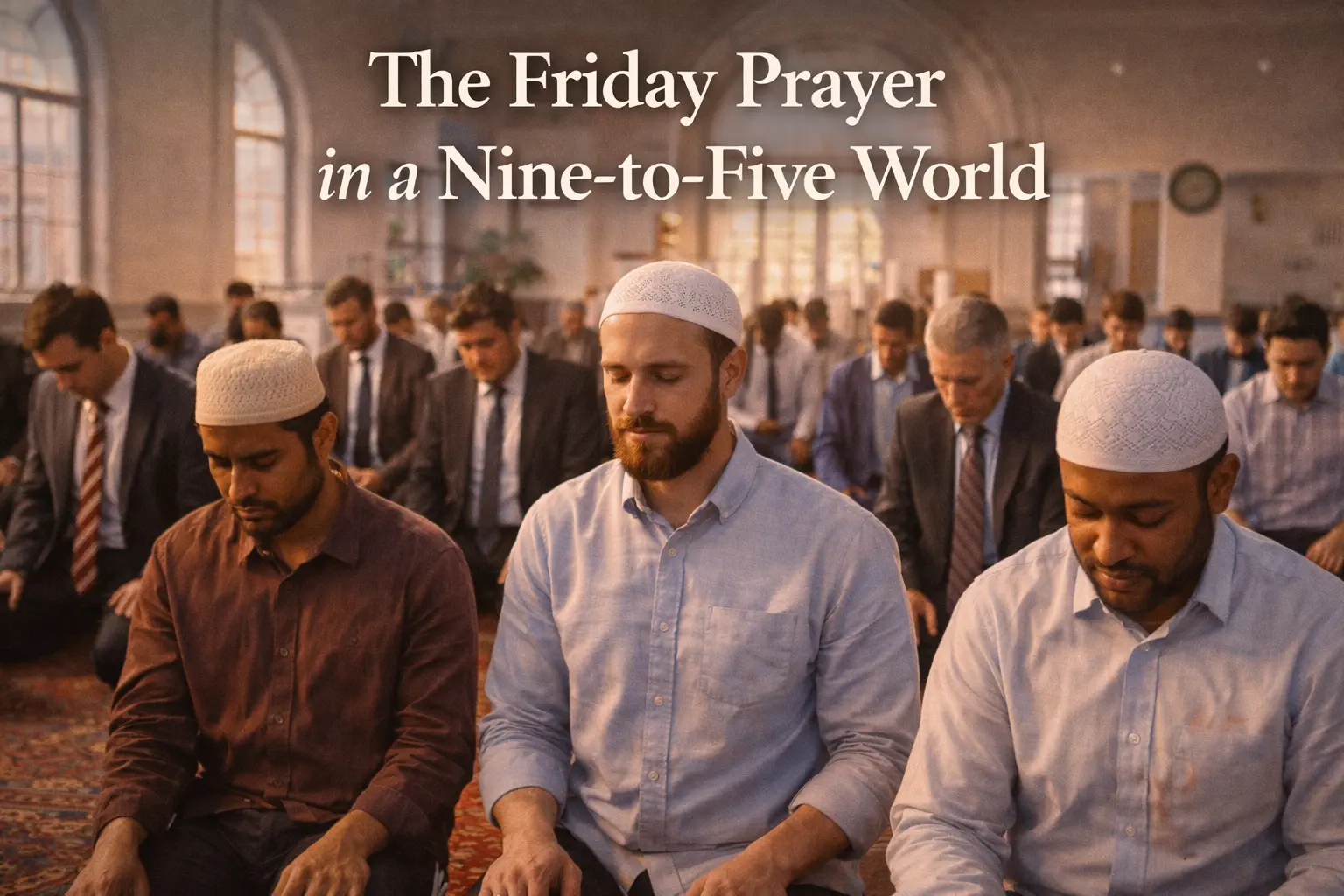
Workplace realities and religious accommodation
Every Thursday night, Omar reviews his Friday calendar with a familiar knot in his stomach. He has a client presentation at 1:00 PM. Jumu’ah at the nearest mosque is at 1:15. The math doesn’t work. It never quite works.
He could ask to reschedule the meeting, but he’s new to the firm and doesn’t want to seem difficult. He could skip the presentation and let his colleague handle it, but that feels like admitting he can’t manage both his faith and his career. He could skip Jumu’ah, telling himself it’s just one week, but he’s already missed the last two Fridays for work conflicts. At what point does occasional necessity become habitual negligence?
Omar settles on a compromise that satisfies no one. He’ll attend the meeting but leave early, catching the tail end of Jumu’ah and missing the khutbah entirely. He’ll pray the two rakats of Jumu’ah quickly in the mosque’s overflow room, then rush back to the office for his 2:30 follow-up. He’ll be distracted during the meeting, anxious during prayer, and guilty about both.
This is the Friday prayer in a nine-to-five world. A weekly collision between religious obligation and professional expectations, between what Islam requires and what America’s work culture allows. For Muslim men, for whom Jumu’ah attendance is generally considered obligatory, and for Muslim women who make attending a priority despite it being optional for them, every Friday becomes a negotiation, a calculation, a small act of resistance or painful compromise.
The Midday Dilemma
The challenge is fundamentally one of timing. Jumu’ah occurs at Dhuhr time, which in most of the United States falls between 12:00 PM and 2:00 PM depending on season and location. This is precisely when American workers are expected to be productive, when meetings get scheduled, when clients expect availability. It’s not early enough to handle before work or late enough to manage after hours. It lands squarely in the middle of the workday.
For Muslims in flexible work environments, this might not be a problem. Remote workers can block off an hour on their calendars, drive to the mosque, and return to their home offices without anyone noticing or caring. Professionals with understanding bosses can take extended lunch breaks on Fridays. Those who work for Muslim-owned businesses might have Fridays built into the company culture.
But many Muslims don’t have that luxury. Hourly workers can’t just leave for an hour without losing pay or facing discipline. Retail and service workers are often scheduled precisely during the times customers are shopping. Teachers can’t leave classrooms unattended. Healthcare workers can’t abandon patients. Lawyers bill by the hour and struggle to justify time away that isn’t billable.
The distance to the nearest mosque compounds the problem. In cities with large Muslim populations, there might be a mosque within fifteen minutes. In smaller cities or suburbs, the drive might be thirty or forty-five minutes each way. Add in the time for the actual khutbah and prayer, and you’re looking at a two-hour absence from work. That’s not a lunch break. That’s a major disruption.
Some mosques have responded by offering multiple Jumu’ah times, 12:30, 1:15, and 2:00, trying to accommodate different work schedules. Others have created express services, shorter khutbahs designed for working Muslims who need to get in and out quickly. These adaptations help, but they can’t solve the fundamental problem that American work culture wasn’t designed to accommodate religious practice in the middle of the day.
The Ask
Many Muslims face a moment when they must ask their employer for accommodation. The conversation is fraught with anxiety. Will this mark them as difficult? Will it limit their advancement? Will it invite questions about their loyalty or commitment? Will it expose them to discrimination they might otherwise avoid?
The legal framework theoretically protects them. Title VII of the Civil Rights Act requires employers to reasonably accommodate religious practices unless doing so creates undue hardship. Friday prayer is clearly religious practice. An hour-long absence once a week is generally considered reasonable. The law is on their side.
But legal protection and workplace reality often diverge. Asking for accommodation requires revealing your religious identity to your employer, which many Muslims prefer to avoid. It invites scrutiny and potential bias. And even when accommodation is granted, informal penalties often follow. You’re not fired or demoted, but you’re passed over for projects, excluded from important meetings, or perceived as less committed than colleagues who don’t require special arrangements.
Some Muslims have positive experiences. They ask, their employers immediately agree, and Friday prayer becomes a routine part of their schedule. Colleagues cover for them, bosses schedule around it, and it becomes normalized. These Muslims often speak gratefully about workplaces that respect their faith.
Others face resistance. Employers question whether the accommodation is really necessary, suggest that the employee could pray at a different time, or express frustration at having to adjust schedules. The accommodation might be technically granted but grudgingly given, poisoning the workplace relationship.
The calculation is especially difficult for Muslims early in their careers or in competitive fields. Young lawyers trying to make partner know that billing fewer hours could cost them advancement. Junior consultants traveling for client work can’t easily explain why they need to leave site visits early on Fridays. Muslim medical students in residency, already working punishing schedules, struggle to ask for additional flexibility.
Many choose not to ask at all. They skip Jumu’ah regularly, telling themselves it’s temporary, that once they’re more established they’ll prioritize it, that Allah understands their situation. The guilt accumulates alongside the justifications.
Strategic Scheduling
Muslims who successfully maintain Jumu’ah attendance often do so through careful strategic scheduling. They frontload their work weeks, getting critical tasks done Monday through Thursday so Friday is less essential. They avoid scheduling important meetings on Friday afternoons. They build buffer time into their calendars. They become masters of efficiency, making every minute count so they can afford the hour away.
Some shift their schedules entirely, coming in early or staying late to make up for Friday absences. They work through lunch other days to bank goodwill. They become the most productive person on their team so no one can question their commitment when they take Friday afternoon for prayer.
Others negotiate formal flexible arrangements, working from home on Fridays or adjusting their hours to start earlier and end earlier. These arrangements require supportive employers and jobs that allow flexibility, but when available, they make Jumu’ah attendance far more manageable.
Muslim entrepreneurs and business owners sometimes build their entire work schedules around Jumu’ah. They block Fridays for administrative work that can be interrupted. They schedule client meetings for other days. They hire staff who can cover during prayer time. This privilege of controlling your own schedule is one reason some Muslims pursue self-employment.
The Proxy Debate
Some Muslims, unable to attend Jumu’ah in person, watch livestreamed khutbahs from their offices or cars, then pray Dhuhr alone. They’re getting the spiritual content of Friday prayer without the communal gathering. Is this sufficient? Does it fulfill the obligation?
Scholars generally say no. Jumu’ah is specifically congregational prayer in the mosque. Watching online doesn’t substitute for physical presence. Praying alone isn’t Jumu’ah, even if you listened to a khutbah first. The virtual experience, however valuable for spiritual nourishment, doesn’t fulfill the requirement.
This creates a theological bind for Muslims who genuinely cannot attend. They want to fulfill their obligation but lack the practical means. Some rationalize that their situation constitutes valid excuse, that financial necessity or fear of discrimination makes their absence permissible. Others carry the guilt as a constant weight, feeling they’re failing a basic Islamic duty.
The question of women adds another layer. Since Jumu’ah is not obligatory for women in most interpretations, Muslim women who work have less theological pressure to attend. But many want to, valuing the community gathering and spiritual renewal. For them, the workplace challenge exists without the guilt of failing an obligation. They negotiate the practical difficulties from a position of choice rather than duty.
The Generational Shift
The relationship to Jumu’ah varies by generation. Older Muslim immigrants, especially those who came as professionals, often accepted that American work life meant missing Friday prayer regularly. They prayed Dhuhr at work and attended the mosque for weekend programs instead. For them, this was the compromise necessary for making it in America.
Younger Muslims, especially those born or raised in the United States, are less willing to accept that compromise. They expect their faith to be accommodated, not hidden. They’re more likely to ask for what they need, to choose employers who will respect their religious practice, or to create work situations that allow them to maintain Jumu’ah attendance.
This generational difference reflects broader shifts in Muslim American identity. The immigrant generation often felt they needed to prove their Americanness by minimizing religious difference. The native-born generation insists on being fully American and fully Muslim without apology. Jumu’ah attendance becomes a line in the sand, a non-negotiable aspect of identity rather than a negotiable convenience.
This shift is enabled by the growing Muslim population and increasing awareness of religious discrimination law. Young Muslims know their rights. They see others successfully negotiating religious accommodation. They refuse to accept that career success requires compromising core religious practices.
The Cost of Compromise
What gets lost when Muslims regularly miss Jumu’ah? More than just the prayer itself. The Friday gathering is meant to unite the community, to provide weekly spiritual renewal, to connect Muslims across class and cultural lines. The khutbah addresses current issues, offers guidance, and reminds listeners of their purpose. The communal prayer reinforces belonging to the ummah.
Muslims who chronically miss Jumu’ah lose these benefits. They become isolated from Muslim community. They miss the spiritual reset that weekly gathered worship provides. They drift from the rhythm of Islamic life, their connection to faith becoming more individual and less communal.
This isolation particularly affects Muslim men who don’t have families pushing them toward the mosque for other reasons. Without Jumu’ah as a weekly anchor, they might not attend the mosque at all. Their Islamic practice becomes private and minimal, maintained enough to technically count as Muslim but without the richness of community engagement.
For children watching their fathers skip Jumu’ah for work, the message is clear: career matters more than prayer, American success requires compromising Islamic practice, Islam is for weekends and evenings but not the real world of work and achievement. This unintended lesson may be the highest cost of all.
Making It Work
Yet many Muslims do make it work. They find mosques close to their offices. They negotiate flexible schedules. They choose careers that allow religious practice. They accept that their path to professional success might be slower or different because they won’t compromise on Friday prayer.
These Muslims often speak of Jumu’ah as a blessing, a weekly reminder of priorities, a forced pause in the chaos of work. The very inconvenience of attending becomes spiritually valuable, a small sacrifice that keeps their focus on what matters beyond career.
They also build communities of working Muslims who support each other. They carpool to Jumu’ah, covering for colleagues who leave early, creating informal networks of accommodation. They normalize religious practice in their workplaces through their consistent example.
The Friday prayer in a nine-to-five world remains a challenge. American work culture shows some signs of adapting, more remote work, more flexibility, more recognition of diverse needs, but it wasn’t built for Jumu’ah and won’t easily accommodate it. Muslims must continue advocating for their needs, educating employers, and sometimes making hard choices between career and faith.
Omar eventually finds a better solution. He switches to a company with a more flexible culture and a concentration of Muslim employees. Friday afternoons become his work-from-home time, scheduled around Jumu’ah at the mosque ten minutes from his house. The anxiety lifts. The guilt fades. He’s found a way, however imperfect, to be both professional and practicing.
Not every Muslim has that option. But every Muslim deserves the chance to try. The Friday prayer is not a luxury or a preference. For millions of Muslims, it’s an obligation, a lifeline, a weekly return to purpose. Making space for it in the nine-to-five world isn’t asking for special treatment. It’s asking for the religious freedom America promises.