Beyond stereotypes, focusing on agency, leadership, and faith
Dr. Amina Khalil runs a emergency department at a major hospital in Houston. She wears hijab in the operating room, scrubs covering her modest clothing, a surgical cap over her headscarf. She makes life-and-death decisions hourly, manages a staff of forty, and publishes research on trauma care. When she leaves work, she picks up her kids from Islamic school, helps with homework, and leads a Quran study circle for women on Wednesday nights.
Nobody asks if she’s oppressed. Her competence speaks too loudly.
The dominant narrative about Muslim women in America revolves around a single question: are they oppressed or liberated? The hijab becomes the only thing people see, a symbol they read as either subjugation or defiance depending on their politics. Muslim women themselves, their actual lives, choices, achievements, and complexities, disappear beneath the projection.
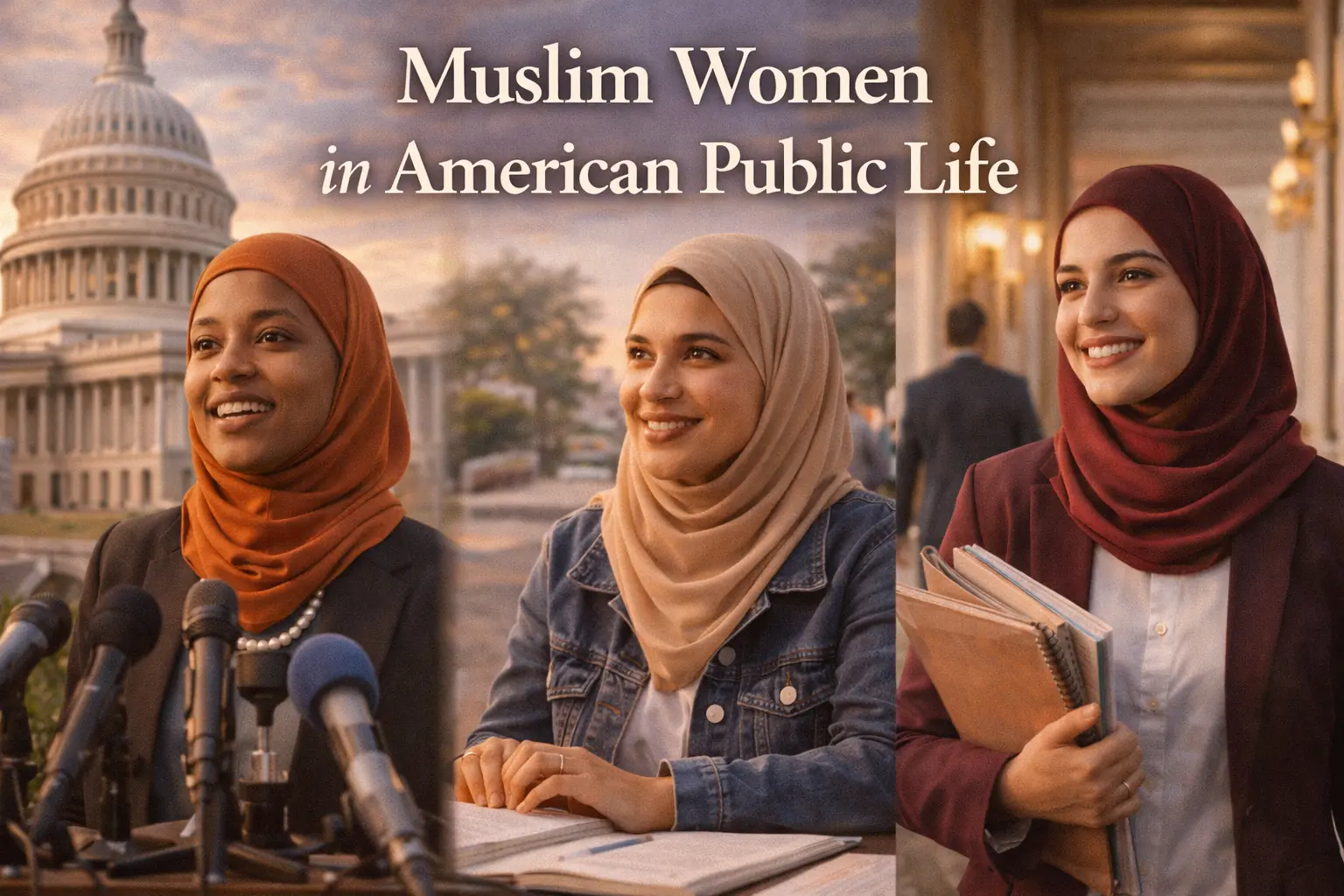
But Muslim women in America refuse to be flattened into symbols. They are doctors and engineers, teachers and entrepreneurs, elected officials and community organizers, mothers and professionals, athletes and artists. They navigate American public life on their own terms, defining what it means to be both Muslim and woman in ways that reject both Islamophobic stereotypes and patriarchal constraints.
Understanding Muslim women in American public life requires setting aside the oppression narrative entirely, not because Muslim women face no challenges, they do, but because that framing misses what’s actually happening. Muslim women are exercising agency, building institutions, claiming space, and redefining what American Muslim identity looks like.
Leadership in Every Field
Muslim women occupy leadership positions across American society. Ilhan Omar and Rashida Tlaib serve in Congress, the first Muslim women elected to that body. Ibtihaj Muhammad competed in the Olympics wearing hijab, becoming an international athletic icon. Dalia Mogahed advises on policy and writes influential analysis. Amani Al-Khatahtbeh founded MuslimGirl.com, creating media by and for Muslim women. Lawyers, doctors, professors, CEOs, the list extends across every profession.
These women didn’t wait for permission. They pursued education, built careers, and claimed positions of influence despite facing both Islamophobia from broader society and sometimes resistance from within Muslim communities. Their presence challenges assumptions about what Muslim women can and cannot do.
In mosques and Islamic organizations, Muslim women increasingly demand and occupy leadership roles. They serve on mosque boards, lead youth programs, give khutbahs in women-only spaces and sometimes mixed gatherings, and organize community services. The model of women as passive recipients of men’s religious leadership is crumbling, replaced by women who study Islamic texts, interpret them for contemporary contexts, and claim religious authority.
This isn’t without controversy. Some Muslim communities resist women’s leadership, citing traditional interpretations of Islamic law. But other communities embrace it, recognizing that women’s perspectives and leadership strengthen rather than threaten Islamic institutions. The debate continues, but the direction is clear: Muslim women are claiming space and building institutions that reflect their values.
Education as Foundation
Muslim women in America are highly educated, often exceeding both Muslim men and American women generally in educational attainment. They pursue advanced degrees, earn professional credentials, and build careers across fields. Education is both personal ambition and religious practice, fulfilling Islam’s emphasis on seeking knowledge.
This commitment to education reflects multiple influences. Immigrant Muslim families often emphasize education as the path to success in America. Islamic tradition honors learning and scholarship. And Muslim women themselves see education as freedom, as pathway to independence and influence that can’t be taken away.
The results are visible. Muslim women lead university departments, publish groundbreaking research, win prestigious fellowships, and mentor the next generation of scholars. They’re mathematicians and historians, chemists and sociologists, contributing to American intellectual life while maintaining Islamic identity.
For many Muslim women, education also enables religious scholarship. They study Arabic, learn Quranic interpretation, master hadith sciences, and earn credentials in Islamic jurisprudence. These female scholars challenge interpretations of Islam that marginalize women, offering readings of texts that center women’s experiences and dignity.
Economic Independence
Muslim women’s participation in the workforce varies widely by background, education, and family situation. Some are primary breadwinners. Others balance careers with family responsibilities. Still others choose to focus on home and children, a choice that deserves respect equal to the choice to work outside the home.
What matters is that these are choices, not impositions. Muslim women in America generally have the freedom to pursue careers, to earn their own money, and to make financial decisions. Islamic law protects women’s right to own property, earn income, and maintain financial independence even within marriage, and American law reinforces these protections.
Muslim women entrepreneurs are building businesses that serve their communities and beyond. They create Islamic fashion lines, halal food companies, modest activewear brands, and consulting firms. They identify market needs and fill them, often while employing other Muslim women and creating economic opportunities.
The tech industry increasingly includes Muslim women who code, design, and lead teams. They navigate male-dominated environments while maintaining their faith identity, proving that hijab and STEM careers are entirely compatible. Their presence challenges both tech culture’s assumptions and stereotypes about Muslim women’s capabilities.
Redefining Modesty
Perhaps no aspect of Muslim women’s public presence generates more attention than clothing choices. The hijab, abaya, niqab, or choice to dress modestly without head covering all become political statements whether women intend them to be or not.
Muslim women navigate this scrutiny with remarkable creativity. They develop modest fashion that’s stylish and professional, proving that covering doesn’t mean frumpy or outdated. Modest fashion influencers showcase how to dress according to Islamic principles while looking contemporary and put-together. Fashion designers create lines specifically for modest dressing, making it easier for Muslim women to find clothing that fits their needs.
Athletes have pushed boundaries, competing in hijab-compatible sports uniforms, swimming in full-coverage suits, and demanding that sports accommodate religious modesty. Their efforts have led to design innovations that benefit all women who prefer more coverage, Muslim or not.
The choice not to wear hijab is equally valid and equally complex. Some Muslim women pray, fast, and practice their faith fully while choosing not to cover their hair. Others cover in some contexts but not others. Still others wore hijab previously but removed it, often facing judgment from Muslims who question their commitment to Islam.
What all these choices share is that they’re choices. Muslim women in America generally have the freedom to dress as they believe Islam requires or allows, without state coercion or family force. This freedom to interpret and practice modesty on their own terms is itself a form of agency often invisible to those fixated on the hijab as symbol.
Motherhood and Family
Muslim women who choose motherhood navigate the same tensions all American women face between career and family, but with additional layers of religious and cultural expectations. Islam honors motherhood, and many Muslim cultures emphasize women’s primary role as mothers. But Islam also permits women to work, to own businesses, and to participate in public life.
Muslim mothers are raising the next generation of American Muslims, making daily decisions about how to transmit faith to children growing up in secular society. They’re teaching Arabic, organizing Islamic education, and modeling how to be Muslim women in America. This work is essential to Muslim American community sustainability even though it’s often invisible in public life.
Many Muslim women resist the false choice between motherhood and public engagement. They do both, sometimes simultaneously, sometimes sequentially. They bring children to community organizing meetings. They build careers around school schedules. They create businesses that allow flexibility for family needs. They refuse to accept that being good Muslims or good mothers requires abandoning professional ambitions or public influence.
Community Building
Muslim women are founding and leading institutions that serve their communities. They establish domestic violence shelters that provide culturally competent, faith-informed services to Muslim women in crisis. They create mental health clinics addressing the stigma around therapy in Muslim communities. They organize youth programs, food pantries, and educational initiatives.
These institutions often emerge because Muslim women identify needs that existing structures don’t address. When mosques fail to provide accessible women’s spaces, women create their own. When mental health services don’t understand Islamic contexts, Muslim women therapists fill the gap. When young Muslim girls need role models, women step forward.
The leadership is often collaborative rather than hierarchical, emphasizing community input and shared decision-making. Muslim women bring different leadership styles to institutions, sometimes challenging patriarchal models with approaches that prioritize relationship-building and collective empowerment.
Faith as Driving Force
For many Muslim women in public life, faith isn’t separate from their professional work or public engagement. It’s the foundation. They pursue justice because Islam demands it. They serve communities because Islamic ethics require caring for neighbors. They advocate for change because they understand their work as worship.
This integration of faith and action challenges secular assumptions that religion must be private. Muslim women bring Islamic perspectives to policy debates, social justice organizing, and professional practice. They speak as Muslims, from Islamic tradition, contributing religious voices to public discourse that often marginalizes or excludes faith perspectives.
Their faith also sustains them through challenges. When facing Islamophobia, discrimination, or the exhaustion of being perpetually visible minorities, Muslim women draw on prayer, Quranic verses, and prophetic examples. Faith provides both motivation for action and resilience for the long haul.
Complexity Over Simplicity
The reality of Muslim women in American public life is far more complex than any single narrative can capture. There’s no monolithic “Muslim woman experience.” There are women from dozens of countries, multiple racial and ethnic backgrounds, different classes, varied theological orientations, and diverse personal circumstances.
Some Muslim women wear niqab and run successful businesses. Others wear no head covering and lead mosques. Some prioritize family over career. Others pursue demanding professional paths. Some are conservative in theology but progressive in politics. Others reverse that pattern. The diversity resists easy categorization.
What unites them is not sameness but shared navigation of being Muslim women in America. They all face assumptions about what they must be like, questions about whether they’re oppressed, scrutiny of their clothing and life choices. They all participate in communities grappling with how to honor Islamic tradition while adapting to American contexts. They all exercise agency in defining what Muslim womanhood means for them.
The Future They’re Building
Muslim women in American public life are not waiting to be liberated by outsiders or seeking permission from patriarchal structures. They’re building the future they want to inhabit, creating institutions, claiming space, and defining Muslim American identity on their own terms.
The next generation of Muslim girls is growing up seeing women like them in positions of influence and leadership. They see Muslim women in hijab on Olympic teams and in Congress. They see female Islamic scholars and entrepreneurs. They see options and possibilities that previous generations couldn’t imagine.
This visibility matters. It expands what Muslim girls believe they can become. It normalizes Muslim women’s public presence. It challenges both external stereotypes and internal limitations.
Dr. Khalil finishes her shift, removes her surgical cap, adjusts her hijab, and heads home. She’ll answer emails about her research, help her daughter with algebra, and prepare for tomorrow’s administrative meeting. She’s not a symbol or a political statement. She’s a Muslim woman living her life, exercising agency, claiming space, and refusing to be anything less than fully herself.
That’s Muslim women in American public life: complex, diverse, faithful, and free. Not in spite of Islam, but because of it. Not waiting for liberation, but living it. Not asking permission, but taking what’s theirs.