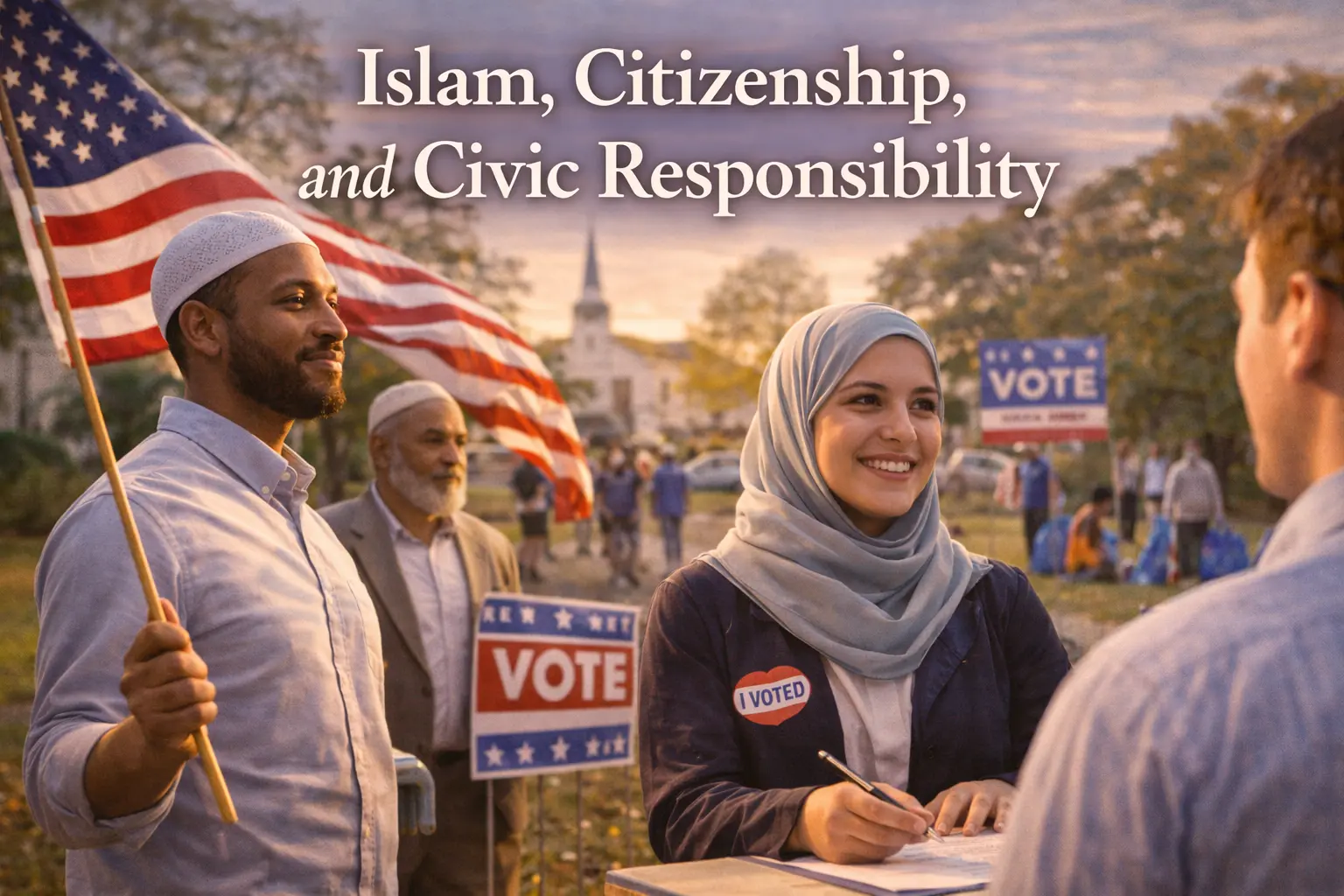
Voting, service, and engagement without partisanship
Imam Hassan sits in his office reviewing a request from a local political campaign. They want to hold a candidate forum at the mosque, inviting both parties to address the Muslim community before the election. It’s a reasonable request. The community needs to hear where candidates stand on issues that affect them. But he knows that whatever he decides, someone will be angry.
If he hosts the forum, some will accuse him of politicizing the mosque. If he declines, others will say he’s failing to engage the community civically. If he invites both parties equally, one side will complain about giving a platform to candidates they view as hostile to Muslims. If he tries to remain neutral, both sides will suspect he secretly supports the other.
This is the tightrope walk of Muslim civic engagement in America. Islam calls believers to pursue justice, serve their communities, and participate in the world around them. American citizenship comes with rights and responsibilities, including the duty to vote and engage in democratic processes. But how do Muslims fulfill these obligations without being consumed by partisan politics, without compromising Islamic principles, and without fracturing communities already under external pressure?
The answer isn’t simple. But it starts with understanding that civic responsibility is Islamic obligation, not optional extra, and that faithful citizenship requires active engagement, not passive withdrawal.
The Theological Foundation
Islamic tradition is clear about the responsibility of Muslims to pursue justice and contribute to the welfare of the societies they inhabit. The Quran commands believers to stand firmly for justice even if it goes against their own interests (4:135). The Prophet Muhammad, peace be upon him, participated actively in civic life even before revelation, joining the Hilf al-Fudul pact to protect the vulnerable in Mecca.
Classical Islamic scholars developed extensive frameworks for Muslim participation in governance and public life. They understood that Islam addresses not just individual piety but collective welfare, that believers have obligations to their neighbors regardless of faith, and that pursuing societal good is worship.
For Muslims in America, these principles translate clearly into civic engagement. Voting is not just a right but a responsibility, a way to advocate for justice and protect community interests. Running for office, serving on school boards and city councils, working in government, these become forms of Islamic service. Community organizing, mutual aid, and advocacy for the vulnerable fulfill religious obligations.
Some Muslims argue for political withdrawal, claiming that involvement in democratic processes compromises Islamic principles or that Muslims should focus solely on spiritual development. But this position misunderstands both Islam and American citizenship. Islam has never separated spiritual devotion from worldly engagement. The Prophet was simultaneously spiritual leader, political head, military commander, and judge. Islamic ethics apply to all of life, including politics.
Similarly, American citizenship is not passive. The founders envisioned active participation in democratic governance, citizens who vote, engage in civil discourse, and hold government accountable. Muslims who withdraw from civic life are failing both their Islamic obligation to pursue justice and their American responsibility as citizens.
Beyond Single-Issue Voting
Muslim civic engagement often gets reduced to single-issue voting. Which candidate is better on Palestine? Who will protect Muslims from discrimination? These questions matter deeply and legitimately shape Muslim political considerations. But reducing citizenship to one or two issues impoverishes both Islamic ethics and democratic participation.
Islam calls believers to care about all forms of justice. Economic justice, racial justice, environmental stewardship, care for the poor and vulnerable, protection of religious freedom for all faiths, these all flow from Islamic principles. Muslim voters should consider the full range of issues that affect their communities and the broader society.
This means grappling with complexity. A candidate might be strong on foreign policy issues important to Muslims but weak on economic policies that hurt working-class communities. Another might protect religious freedom while opposing environmental regulations that Islamic ethics would support. There are rarely perfect choices, only decisions that require weighing competing goods and tolerating compromises.
The goal is not to find candidates who perfectly align with Islamic values, such candidates don’t exist, but to participate thoughtfully in democratic processes that shape society toward greater justice. This requires Muslims to educate themselves on issues, understand policy details, and make informed decisions rather than defaulting to community leaders’ endorsements or single-issue priorities.
It also means recognizing that other Muslims might reach different conclusions. The community includes conservatives and progressives, people whose priorities differ based on their circumstances and understanding. Unity doesn’t require unanimity. Muslims can disagree about candidates and policies while maintaining respect and shared commitment to Islamic principles.
Service Beyond Politics
Civic responsibility extends far beyond voting. Muslims serve their communities through countless non-political forms of engagement that embody Islamic values and fulfill citizenship obligations.
Volunteering at food banks and homeless shelters puts Islamic commands about charity into practice while addressing real community needs. Serving on school boards and parent-teacher organizations helps ensure quality education for all children. Participating in neighborhood associations and community development projects builds strong, cohesive communities. Working as teachers, social workers, public defenders, and civil servants serves the public good while earning a living.
These forms of service are less visible than political activism but equally important. They build relationships across religious and cultural lines. They demonstrate Muslim commitment to the common good. They make abstract Islamic values concrete through daily action.
Some of the most effective Muslim civic engagement happens at local levels. The Muslim doctor who provides free clinics for uninsured patients is practicing both Islamic charity and civic responsibility. The Muslim teacher who stays late to tutor struggling students serves both faith and community. The Muslim neighbor who organizes block parties and watches out for elderly residents embodies Islamic principles of neighborliness.
This grassroots engagement often does more to change perceptions about Muslims than any political campaign or public relations effort. When people know Muslims as the family who volunteers at the community garden, the professional who mentors local youth, or the neighbor who brings meals when someone is sick, stereotypes lose their power.
Navigating Partisanship
The challenge comes when civic engagement intersects with partisan politics. American political culture has become deeply polarized, with each party viewing the other as existential threat. Muslims risk being absorbed into this polarization, becoming pawns in partisan battles rather than agents pursuing Islamic values.
Both major parties court Muslim voters while often failing to truly represent Muslim interests. One party may be stronger on civil rights and immigration but weak on religious liberty and moral issues that concern many Muslims. The other may align with Muslim positions on certain social questions but pursue foreign policies Muslims oppose and tolerate Islamophobia within its ranks.
Muslims respond to this dilemma in various ways. Some align firmly with one party, deciding its overall platform better reflects Islamic values despite disagreements on specific issues. Others remain independent, voting issue-by-issue or candidate-by-candidate rather than along party lines. Still others disengage entirely, frustrated by being forced to choose between imperfect options.
The healthiest approach likely involves strategic engagement without partisan capture. Muslims should work with any party or politician willing to advance justice and protect community interests. They should hold all parties accountable, offering support when deserved and criticism when necessary. They should refuse to be taken for granted by either side.
This means sometimes voting against community consensus, supporting candidates other Muslims oppose, or breaking with ethnic or cultural voting patterns. It means prioritizing principles over party loyalty and being willing to make different choices in different elections as circumstances change.
Most importantly, it means not allowing political disagreements to fracture Muslim community. The mosque should be space that transcends partisan division, where Muslims of different political views pray side by side and work together on shared concerns. Political diversity within the community should be viewed as strength rather than problem to solve.
The Limits of Engagement
While civic engagement is Islamic obligation, it’s not ultimate salvation. Muslims must guard against making politics an idol, investing in electoral outcomes the hope that belongs only to Allah. Elections matter, policies affect real lives, but political power alone will not solve all problems or deliver justice.
This recognition creates healthy boundaries. Muslims should vote, advocate, organize, and participate, but they should also maintain perspective. When elections don’t go their way, they continue working for justice through other means. When political victories occur, they celebrate modestly, knowing that structural change requires sustained effort beyond any single election.
The boundaries also prevent civic engagement from consuming all energy and attention. Muslims still have obligations to family, to spiritual development, to community care that aren’t reducible to politics. The doctor treating patients, the teacher educating children, the parent raising kids, all are engaging in civic responsibility that matters as much as political activism.
There’s also the question of means. Islam permits only ethical forms of engagement. Muslims cannot lie, cheat, or dehumanize opponents in pursuit of political goals. They cannot spread misinformation or participate in corruption. The ends don’t justify the means. How Muslims engage in politics must reflect Islamic ethics, even when that means accepting losses rather than compromising principles.
Building Coalitions
Effective civic engagement requires building coalitions across religious, racial, and cultural lines. Muslims alone lack the numbers to determine most electoral outcomes or drive policy change. But in alliance with others who share specific goals, they can be influential.
This coalition-building is both pragmatic and principled. Pragmatically, it’s necessary for achieving results. Principled, because Islam calls Muslims to work with all people of goodwill toward justice. Muslims can partner with Christians on religious freedom issues, with Jewish communities on combating hate crimes, with secular progressives on civil rights, and with fiscal conservatives on certain economic policies.
These coalitions require Muslims to lead with shared values rather than religious particularity. The argument for refugee resettlement shouldn’t be “Islam requires welcoming strangers” but “our shared commitment to human dignity requires helping displaced people.” The case for environmental policy isn’t “Muslims must be good stewards” but “we all have responsibility to future generations.”
This doesn’t mean hiding Islamic motivations, just translating them into language that resonates across differences. Muslims can be explicitly Muslim while building effective coalitions by finding common ground and respecting partners’ different foundations for shared commitments.
Raising Civic Citizens
Perhaps the most important civic responsibility Muslims have is raising children who understand citizenship as Islamic obligation. This means teaching them that voting matters, that they have responsibility to stay informed, and that participating in democracy is form of worship when done with right intention.
It means taking children to the voting booth, involving them in community service, and talking about current events in ways that connect Islamic values to real-world issues. It means modeling engaged citizenship, showing them that Muslims don’t withdraw from society but actively work to improve it.
It also means teaching nuance, that civic responsibility doesn’t mean blind patriotism, that loving one’s country includes critiquing its failures, and that being good citizens sometimes means challenging the government. American citizenship at its best has always included dissent, advocacy, and pushing the nation toward its stated ideals.
The Long View
Muslim civic engagement in America is still young. The community is learning, experimenting, making mistakes, and developing models that work. Each election cycle brings new lessons. Each local campaign trains new leaders. Each coalition builds new relationships.
The goal is not to win every battle but to build sustained capacity for participation in American democracy while maintaining Islamic integrity. This requires patience, wisdom, and willingness to play the long game.
Imam Hassan eventually decides to host the candidate forum with clear ground rules: both parties invited equally, questions focused on policy not personality, mosque remaining neutral ground where community can gather information and make informed decisions. Some members are unhappy with the decision, but most appreciate the attempt to balance civic responsibility with community cohesion.
The forum happens. Candidates speak. Community members ask thoughtful questions. People leave better informed if not fully satisfied. It’s imperfect, but it’s engagement. And that’s what citizenship requires: showing up, participating, working toward justice even when the path is unclear and the outcomes uncertain.
This is Islam in America. This is civic responsibility. And this is the ongoing work of being both faithful Muslims and active citizens, refusing to choose between the two because both are sacred obligations.