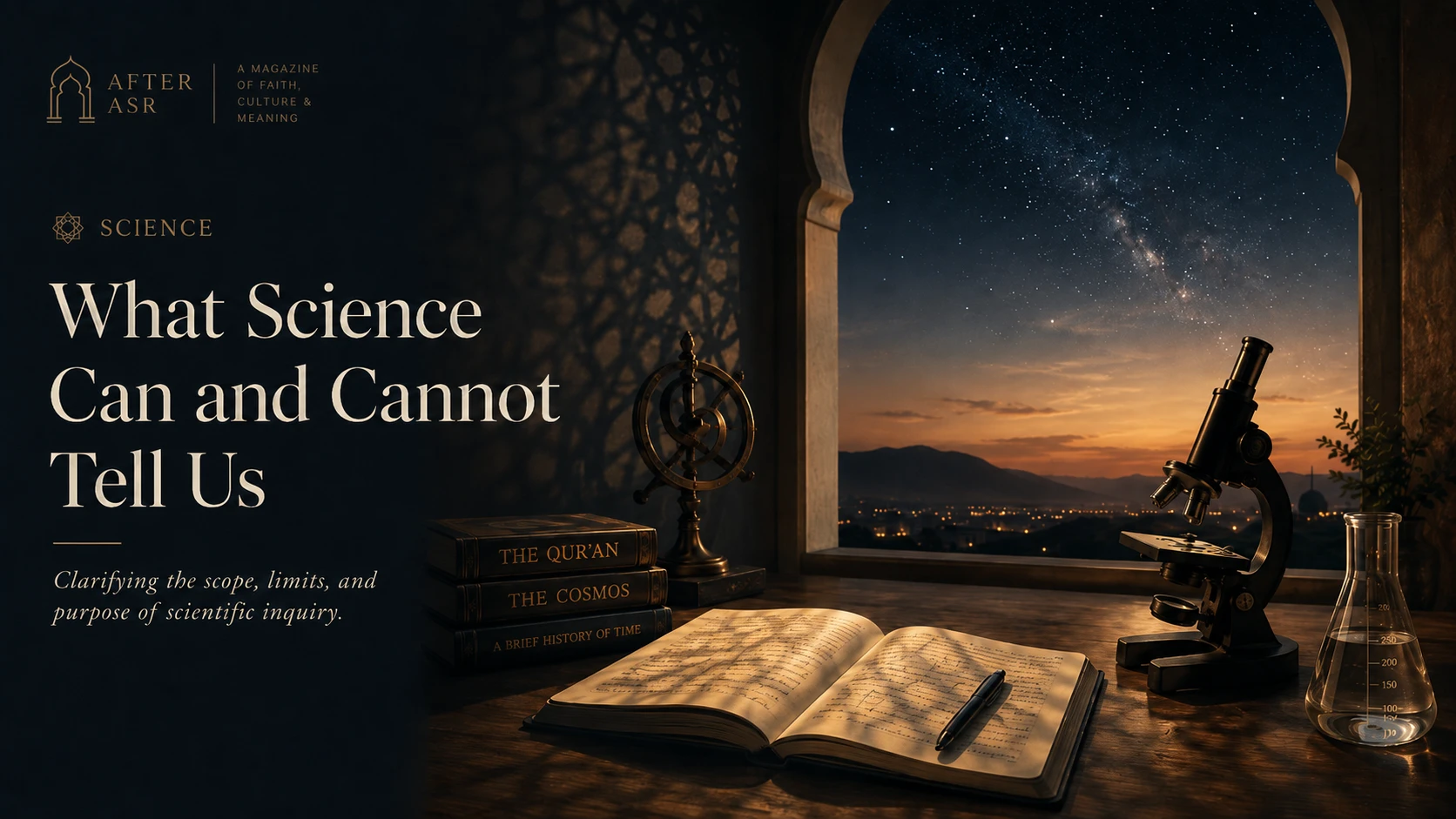
Clarifying the scope, limits, and purpose of scientific inquiry
There is a certain kind of wonder that begins with looking closely.
A child watches rain gather at the edge of a window and asks why drops race each other down the glass. A student sees a diagram of the heart and realizes that the body is not simply alive, but organized, rhythmic, and astonishingly precise. A patient waits for test results and learns, perhaps for the first time, that medicine is both powerful and uncertain. A person looks up at the night sky and feels small, not in a humiliating way, but in a truthful one.
Science often begins here: not in arrogance, but in attention.
Before it becomes a textbook, a laboratory, a grant proposal, or a public debate, science begins with the world refusing to be ignored. Something moves, grows, decays, heals, burns, adapts, or shines. Something happens, and the human being asks: Why? How? What pattern is hidden here?
That question is noble. It deserves respect.
But like every noble human pursuit, science has a scope. It has power, but also boundaries. It can illuminate much, but not everything. It can describe the mechanisms of the world with breathtaking precision, but it cannot by itself tell us what kind of people we should become. It can show us what is possible, but not always what is wise. It can measure, compare, test, and predict, but it cannot carry the whole burden of meaning.
To honor science properly, we must understand both what it can tell us and what it cannot.
Science as a disciplined way of asking
Science is not merely a collection of facts. It is a disciplined way of asking questions about the natural world.
This matters because many people speak of science as if it were a fixed library of final answers. In reality, science is more like a method of disciplined humility. It asks us to observe carefully, form explanations cautiously, test those explanations honestly, and revise them when better evidence appears.
A good scientist does not simply ask, “What do I believe?”
A good scientist asks, “What can be shown? What can be tested? What would prove me wrong? What evidence would require me to change my mind?”
This is one of the quiet moral strengths of scientific inquiry. At its best, science trains the ego to submit to reality. It does not allow a person to merely declare, “This is how I think it should be.” It demands contact with the world as it is.
If a medicine does not work, affection for the theory will not make it heal. If a bridge cannot bear weight, confidence will not keep it standing. If a crop fails under certain soil conditions, optimism will not change the chemistry of the earth. Science disciplines human desire by placing it under observation.
This is why science has given humanity so much practical benefit. Clean water systems, vaccines, anesthesia, weather forecasting, antibiotics, agriculture, aviation, electricity, imaging technology, and countless other developments came through people patiently studying patterns in the created world.
Science can save lives. It can reduce suffering. It can reveal hidden dangers. It can correct assumptions. It can help us steward resources more wisely. It can expose false claims and protect people from superstition, fraud, and preventable harm.
For this, science should not be treated casually. A community that does not respect evidence becomes vulnerable to confusion. A society that rejects disciplined inquiry will eventually pay for that rejection in hospitals, farms, homes, schools, and courts.
But respect is not the same as worship.
What science can tell us
Science is especially powerful when it asks questions about observable processes.
It can tell us how diseases spread. It can help identify what substances are harmful to the body. It can explain how planets move, how cells divide, how ecosystems respond to disruption, and how materials behave under pressure. It can help us understand the relationship between cause and effect in the physical world.
Science can also correct our senses. The earth appears still beneath our feet, yet it moves. The sun appears to rise and set, yet that appearance depends on our position. A person may feel certain that two events are connected, but careful study may show that the connection was coincidence. A treatment may feel effective because someone improved after taking it, but controlled research may show that recovery would have happened anyway.
In this way, science protects us from being ruled only by impressions.
That protection is important because human perception is limited. We notice some things and miss others. We remember selectively. We see patterns that may not exist. We are influenced by fear, loyalty, habit, and hope. We can mistake confidence for truth.
Science does not remove human weakness completely, because scientists are human beings too. But the method of science creates tools to check some of those weaknesses. Peer review, replication, statistical analysis, controlled trials, transparent methods, and debate all exist because one person’s certainty is not enough.
Science says, in effect:
Let the claim be examined. Let the method be shown. Let others test it. Let the evidence be weighed.
This is a deeply valuable habit.
In daily life, this habit can make us more careful people. It teaches us not to forward every dramatic claim we see online. It teaches us not to confuse one story with a general rule. It teaches us to ask whether a headline reflects the study it claims to summarize. It teaches us that “research says” is not a magic phrase. We must still ask: What research? Who conducted it? How was it designed? What did it actually show?
Science can make us better listeners to reality.
What science cannot tell us
The trouble begins when science is asked to answer questions outside its proper scope.
Science can tell us what happens in the brain when a person feels love. It can measure hormones, neural activity, attachment patterns, and behavioral responses. But science cannot fully tell us what love is worth, whom we owe loyalty to, or when sacrifice becomes morally beautiful.
Science can describe the biological development of a human being. It can study genetics, embryology, anatomy, and physiology. But science alone cannot settle every moral question about dignity, responsibility, parenthood, disability, or the sanctity of life.
Science can study the effects of prayer on stress or community on health. But it cannot determine whether a prayer is accepted by God.
Science can describe death as a biological event. It can monitor organs, oxygen, cells, and brain activity. But it cannot, by its instruments, exhaust the meaning of mortality, grief, accountability, or the soul.
Science can help us understand what humans tend to do. It cannot, by itself, tell us what humans ought to do.
That distinction is crucial.
The word “is” and the word “ought” are not the same. Science is very good at studying what is: what happens, what changes, what causes what, what patterns appear. But moral life requires questions of ought: What should we value? What should we protect? What should we refuse? What kind of power should remain unused even if we possess it?
A society can become technologically advanced while morally confused. It can learn how to manipulate attention without asking whether it should. It can learn how to edit genes without agreeing on the boundaries of human dignity. It can build weapons with extraordinary precision while becoming less precise about justice. It can create machines that imitate speech while forgetting how to listen to actual people.
Science expands human ability. It does not automatically purify human intention.
The danger of making science carry too much
In modern public life, science is often placed in an impossible position. People demand from it not only evidence, but identity, certainty, morality, and meaning. Then, when science does what science actually does — revises, qualifies, debates, corrects, and complicates — people feel betrayed.
But the betrayal often comes from expecting science to behave like revelation, ideology, or prophecy.
Science is not revelation. It does not descend complete and protected from error. It is a human process of inquiry into the natural world. Because it is human, it can be influenced by ego, funding, politics, institutional pressure, fashion, and bias. Because it is inquiry, it can change.
This does not make science useless. It means science must be treated honestly.
When science changes its mind, that is not always failure. Sometimes it is the method working properly. New evidence appears. Better tools are developed. Larger studies are conducted. Old assumptions are challenged. A conclusion becomes more precise.
Still, this also means scientific claims should be communicated with humility. Not every early finding deserves a dramatic headline. Not every correlation should become advice. Not every laboratory result should be rushed into public certainty. Not every expert opinion is the same as established knowledge.
If science is exaggerated, public trust weakens. If uncertainty is hidden, people later feel deceived. If disagreement is denied, people search for alternative voices, sometimes less reliable ones. If scientific authority becomes arrogant, skepticism becomes emotionally satisfying.
Science communication, then, is not just about accuracy. It is about character.
Faith does not need science to become smaller
For a believer, the limits of science should not produce fear. They should produce clarity.
Faith does not require us to belittle science. The natural world is not an enemy of belief. To study creation carefully can be a form of gratitude. To understand the body, the stars, the oceans, the climate, and the unseen structures of life can deepen awe rather than diminish it.
But faith also teaches that reality is larger than what can be placed under a microscope.
This does not mean we use faith as an excuse for laziness. It does not mean we reject medicine because healing ultimately belongs to God. It does not mean we ignore environmental damage because the world is temporary. It does not mean we dismiss psychology, biology, or physics because they are “worldly.”
Rather, faith gives science a moral horizon.
It reminds us that knowledge is not neutral in the hands of the human being. Knowledge can heal or exploit. It can serve the vulnerable or empower the arrogant. It can protect life or cheapen it. It can make us humble, or it can become another instrument of pride.
The Qur’anic imagination repeatedly calls human beings to look, observe, reflect, travel, consider, and take lessons from the world. But this looking is not meant to end in vanity. It is meant to awaken recognition, responsibility, and submission to truth.
In that sense, the believer does not fear scientific discovery. The believer fears becoming the kind of person who gains knowledge without wisdom.
Science and the temptation of control
One reason science is so admired is that it gives us control. We can predict storms, treat infections, engineer materials, preserve food, transmit information, and alter environments. These are real achievements.
But control is spiritually dangerous when it convinces us that dependency has been overcome.
The more we can do, the easier it becomes to forget how fragile we remain. A power outage can humble a city. A virus can humble an empire. A drought can humble agriculture. A diagnosis can humble a family. A failed experiment can humble a career.
Science gives human beings tools, but it does not make human beings sovereign.
This matters because modern people are often trained to see limitation as an insult. If something cannot be optimized, extended, automated, modified, or upgraded, we become restless. We begin to treat the body as a machine, attention as a resource to harvest, children as projects, aging as failure, and death as a technical problem waiting for a solution.
Science can help us treat disease. But it cannot make mortality meaningless.
Science can improve communication. But it cannot guarantee understanding.
Science can extend life. But it cannot tell us how to spend it.
Science can reveal complexity. But it cannot force reverence.
The problem is not science. The problem is the human appetite for mastery without accountability.
A healthier relationship with science
A mature society needs neither blind trust nor reckless rejection. It needs a healthier relationship with science.
That relationship begins with gratitude. We should be grateful for the physicians, researchers, engineers, nurses, technicians, teachers, and careful observers whose work reduces suffering. Many of us are alive because someone studied something seriously.
It also requires literacy. People should understand the difference between a strong study and a weak one, between evidence and speculation, between risk and certainty, between expert consensus and individual opinion. Scientific literacy is not only for specialists. In an age of constant information, it is part of responsible citizenship.
It requires humility from experts and non-experts alike. Experts should not confuse specialized knowledge with total wisdom. Non-experts should not confuse suspicion with insight. A person can ask sincere questions without pretending to know more than everyone else. A person can trust expertise without surrendering moral judgment.
It requires moral seriousness. Before asking, “Can we do this?” we should also ask, “Should we do this? Who benefits? Who may be harmed? What assumptions are hidden here? What does this do to the weak, the poor, the unborn, the elderly, the disabled, the forgotten?”
And finally, it requires wonder. Science without wonder becomes machinery. Faith without wonder becomes habit. A human being who loses the ability to marvel becomes poorer, even if he becomes informed.
The proper place of science
Science belongs in a place of honor, but not on the throne.
It should be honored as one of the most disciplined and fruitful ways human beings investigate the natural world. It should be taught carefully, funded responsibly, communicated honestly, and used ethically. It should shape medicine, policy, engineering, agriculture, and environmental stewardship. It should challenge false claims and protect people from preventable harm.
But science should not be forced to become a religion, a morality, a metaphysics, or a substitute for wisdom. When placed on the throne, science becomes distorted. It begins to answer questions it was not designed to answer. It becomes vulnerable to arrogance. It becomes a symbol people either worship or attack.
The better path is more honest and more beautiful.
Let science tell us what it can tell us.
Let it measure what can be measured.
Let it test what can be tested.
Let it correct our assumptions where evidence demands correction.
Let it teach us patience, rigor, and humility before the patterns of the world.
But let us also remember that the human being is more than an observer. We are moral agents. We are accountable for what we do with what we know. We do not merely ask what is true about matter, energy, cells, climate, and stars. We ask what truth requires from us.
Science can show us the intricacy of the body, but it cannot make us grateful.
It can show us the scale of the universe, but it cannot make us humble.
It can show us the fragility of ecosystems, but it cannot make us responsible.
It can show us the mechanisms of life, but it cannot tell us why life should be treated as sacred.
Those are not failures of science. They are reminders that science is part of a larger human calling.
To know is a gift.
To know carefully is a discipline.
To know humbly is a virtue.
And to act rightly upon what we know is a responsibility.
That is where science meets the soul.