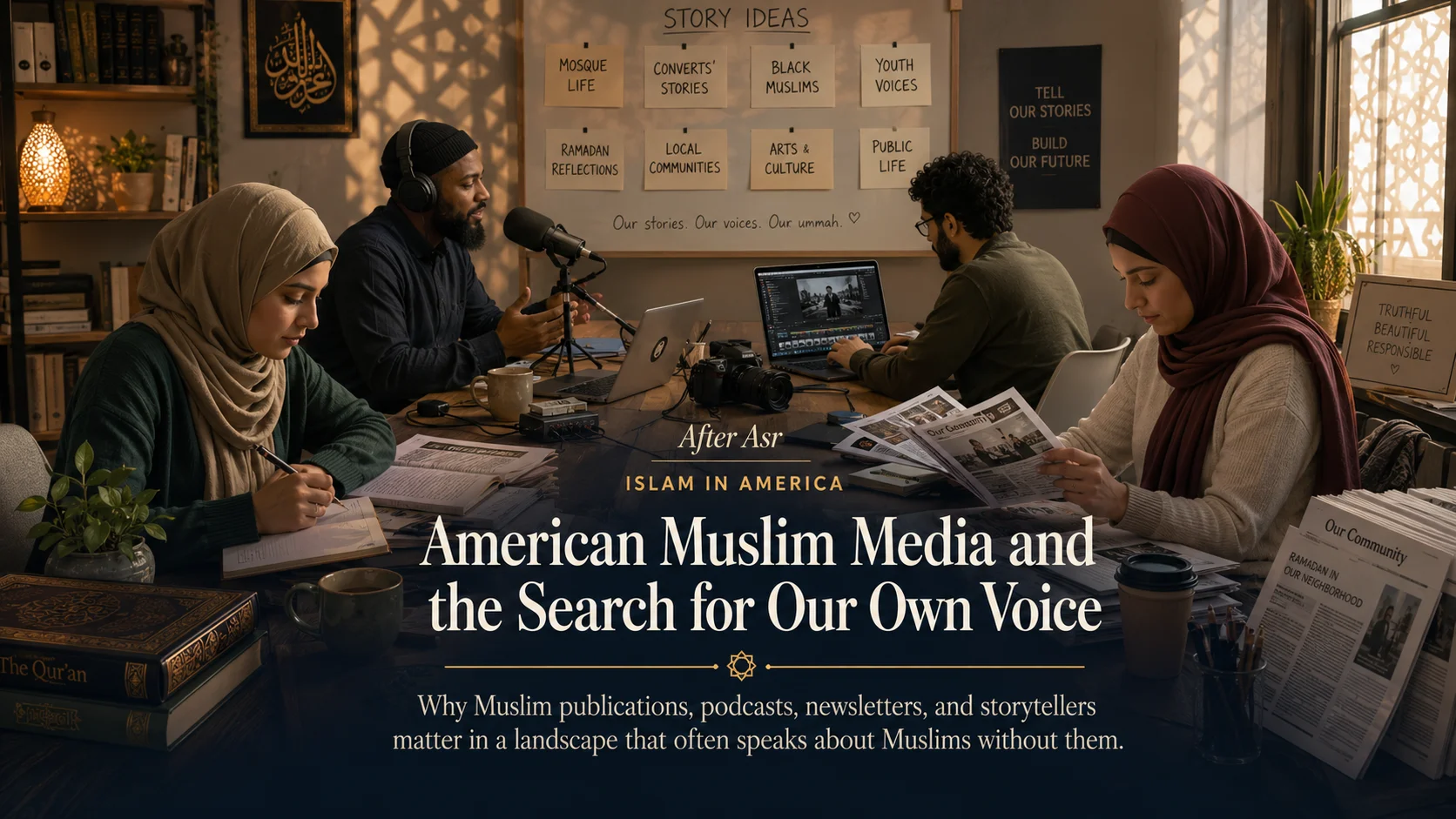
Why Muslim publications, podcasts, newsletters, and storytellers matter in a landscape that often speaks about Muslims without them.
Muslims in America are used to being spoken about.
Spoken about in headlines after crises. Spoken about in political debates. Spoken about in school lessons written without Muslim voices. Spoken about in documentaries shaped by someone else’s questions. Spoken about in security language. Spoken about in diversity language. Spoken about by people who have never sat in a mosque hallway after Isha, never watched a convert navigate their first Eid, never heard aunties organize food after a janazah, never seen Muslim children negotiate cafeteria food, never felt the quiet ache of asking for prayer space at work.
To be spoken about is not always the same as being understood.
Sometimes the coverage is hostile. Sometimes it is sympathetic but shallow. Sometimes it is curious but clumsy. Sometimes it reduces Muslims to victims, threats, symbols, voters, immigrants, activists, women in hijab, grieving families, or success stories. Sometimes it wants Muslims only when there is a tragedy, a controversy, a policy debate, or a cultural moment that makes us useful to someone else’s narrative.
American Muslim media emerges from a simple need: we must be able to speak with our own voice.
Not because outsiders can never report on Muslims. Not because Muslims should retreat into closed conversations. Not because every Muslim story must be flattering. But because no community can remain healthy when its public image, internal memory, moral debates, and ordinary life are mostly narrated by others.
A community needs storytellers who understand its language, silences, wounds, humor, obligations, contradictions, and hopes. It needs publications that can write about Muslims without discovering them anew every time. It needs podcasts where Muslims can think slowly. Newsletters that remember local communities. Magazines that treat Islamic life with beauty. Journalists who know the difference between Islam and Muslim culture. Editors who understand that representation is not enough. Photographers who do not turn Muslims into aesthetic objects. Critics who love the community enough to tell the truth.
American Muslim media matters because voice matters.
But having a voice is not the same as using it well.
Beyond being explained
Much of Muslim public life in America has been shaped by explanation.
We explain Ramadan. Explain hijab. Explain halal. Explain why Muslims pray. Explain that Islam is not violence. Explain that Muslim women are not all oppressed. Explain that Muslims have been in America for centuries. Explain that Islam is not foreign. Explain that Arabs are not all Muslims and Muslims are not all Arabs. Explain that Black Muslims are foundational, though too often ignored. Explain that converts are not exceptions. Explain that mosques are not suspicious. Explain that Eid matters. Explain, explain, explain.
Some explanation is necessary. Neighbors ask sincere questions. Schools need resources. Workplaces need guidance. Public ignorance can harm people if left unaddressed.
But a community cannot live forever in explanation mode.
When Muslims are always explaining themselves, their inner life becomes flattened. Every article becomes introductory. Every conversation begins at the beginning. Every sacred practice is translated for outsiders before it is explored for believers. The community becomes skilled at making itself legible, but not necessarily at making itself deeper.
American Muslim media should do more than explain Muslims to non-Muslims.
It should help Muslims understand ourselves.
Our marriages. Our mosques. Our youth. Our elders. Our converts. Our Black Muslim foundations. Our immigrant institutions. Our rural communities. Our class divisions. Our women’s labor. Our failures of adab. Our spiritual hunger. Our humor. Our food. Our grief. Our contradictions. Our responsibilities. Our future.
There is a difference between writing to prove humanity and writing from the assumption of humanity. Muslims need media that begins from the second place.
We should not always have to enter the page as defendants.
Sometimes we need to enter as servants of Allah thinking carefully about the lives we are building.
The danger of reaction-only media
When a community is frequently misrepresented, it can become reactive.
A bad headline appears, and Muslim media responds. A politician says something harmful, and Muslim media responds. A school district mishandles a Muslim issue, and Muslim media responds. A war intensifies, a hate crime occurs, a public figure insults Islam, a government policy affects Muslims, and again the community responds.
Response is necessary. Silence can be dangerous. Misrepresentation should be corrected. Harmful narratives should be challenged. Muslims should have journalists, editors, legal advocates, scholars, and organizers capable of speaking clearly in moments of crisis.
But reaction cannot be the whole media diet.
If Muslim media only responds to what others say about us, then others still set the agenda. Our stories remain tied to their misunderstandings. Our energy goes toward correction rather than imagination. Our publications become emergency rooms without schools, libraries, kitchens, gardens, or living rooms.
A healthy Muslim media culture must ask: what would we write if we were not always defending ourselves?
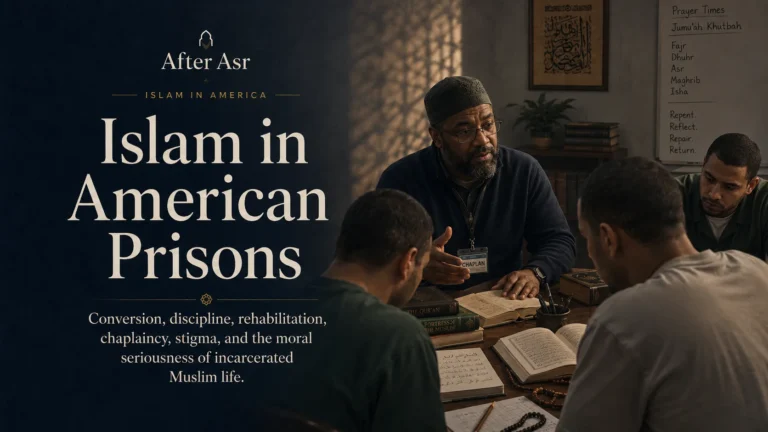
We would write about prayer as lived discipline. About the emotional life of converts after shahadah. About mosque board ethics. About Black Muslim scholarship. About Muslim farmers, nurses, teachers, truck drivers, poets, prison chaplains, veterans, mothers, youth mentors, funeral washers, small-town families, and children learning Qur’an in borrowed classrooms. We would write about Eid logistics, halal economies, spiritual burnout, marriage pressure, Islamic education, neighborhood service, and the ordinary ways Muslims keep faith alive.
Reactive media is sometimes urgent.
Constructive media is necessary for survival.
The community needs both.
Not propaganda, not self-hatred
Muslim media faces pressure from two sides.
On one side is the temptation to produce propaganda: only positive stories, only polished images, only success, only unity, only public relations. This impulse is understandable. Muslims are already misrepresented. Why give outsiders more material? Why air internal problems? Why discuss racism, gender concerns, mosque dysfunction, class arrogance, convert neglect, or spiritual weakness when hostile audiences may exploit those conversations?
On the other side is the temptation toward self-exposure without mercy: constant critique, cynicism, scandal, humiliation, and the performance of bravery through public airing of wounds. This can attract attention. It can feel honest. But it can also become spiritually corrosive, turning the community into content and pain into currency.
Muslim media must reject both propaganda and self-hatred.
Truth is not betrayal. Concealing every problem is not love. A community that refuses self-examination will repeat harm. But critique without adab is not courage. Public discussion without wisdom can damage trust, expose the vulnerable, and train readers to despise the very community they need to repair.
The prophetic path is truthful and merciful. It names wrong without delighting in disgrace. It protects the vulnerable. It distinguishes between public accountability and gossip. It understands that some matters require investigation, some require private counsel, some require institutional reform, and some require public warning.
Muslim media should be brave enough to tell hard truths and disciplined enough not to turn truth into spectacle.
That balance is not easy.
It is the difference between journalism as amanah and journalism as appetite.
The ethics of telling Muslim stories
To tell a Muslim story is to carry a trust.
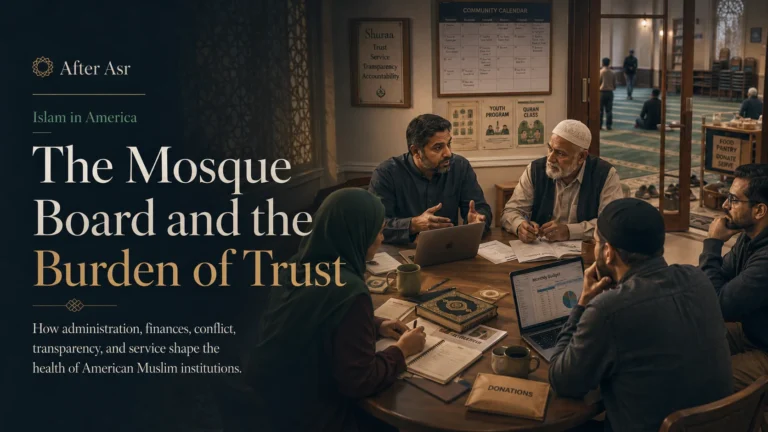
A journalist interviewing a grieving family is carrying trust. A podcaster inviting a convert to speak is carrying trust. A writer describing a mosque conflict is carrying trust. A photographer capturing Ramadan is carrying trust. A newsletter editor summarizing a local controversy is carrying trust. A storyteller writing about prison Islam, Muslim women, youth doubt, or racial wounds is carrying trust.
The question is not only, “Is this story interesting?”
The question is, “What does telling this story do to the people inside it?”
Does it protect dignity? Does it reduce a person to trauma? Does it make a convert perform gratitude? Does it use a Muslim woman’s pain to prove a point? Does it flatten Black Muslim history into symbolism? Does it make poor Muslims visible only as charity cases? Does it present immigrants only through sacrifice and nostalgia? Does it treat youth confusion as failure rather than formation? Does it expose details that should remain private? Does it allow complexity?
Muslim storytellers should be especially careful because they may have access that outsiders do not. A grieving family may trust a Muslim writer. A mosque member may speak more openly to a Muslim journalist. A convert may share vulnerability with someone who knows the language of the community. That access should not be exploited.
Consent matters. Context matters. Accuracy matters. The right not to be turned into content matters.
Islamic ethics should shape Muslim media practice at every level: sourcing, editing, headlines, imagery, privacy, correction, attribution, and tone. The goal is not sterile writing. It is responsible writing.
Our stories deserve beauty.
Our people deserve protection.
Headlines and the moral imagination
Headlines train readers how to feel.
A headline can invite reflection, or it can provoke anger. It can clarify, or it can distort. It can honor complexity, or it can flatten a human being into a clickable object. Muslim media must be careful with the tools of attention.
The broader media economy rewards speed, outrage, fear, conflict, and certainty. Muslim media is not immune to these temptations. A sharp headline spreads faster. A scandal draws traffic. A shocking clip travels. A fight between Muslims can bring more engagement than a thoughtful essay about prayer.
But engagement is not the same as benefit.
If Muslim media imitates the worst habits of the attention economy, it may grow numerically while weakening the community spiritually. Readers become reactive. Listeners become suspicious. Nuance disappears. People learn to consume Muslim pain and conflict as entertainment. Anger becomes the proof of seriousness.
A Muslim publication should ask what kind of reader it is forming.
Is it forming a person who thinks carefully, verifies information, has mercy, seeks knowledge, and cares about reform? Or is it forming a person who scrolls from outrage to outrage, growing sharper in opinion and weaker in worship?
This does not mean avoiding strong headlines or difficult subjects. It means refusing manipulation. It means writing with weight. It means not using the community’s wounds as bait.
The Prophet ﷺ taught that words matter.
Muslim media should believe that.
Podcasts and the return of conversation
Podcasts have become an important part of American Muslim media because they allow conversation to breathe.
A podcast can hold what a headline cannot. Tone, hesitation, memory, disagreement, laughter, grief, and nuance. A scholar can explain slowly. A convert can tell a story without being reduced to one quote. A Muslim woman can discuss community labor with context. A Black Muslim elder can share history in their own cadence. A young Muslim can ask questions that do not fit neatly into an article. A local organizer can explain how a food pantry actually works.
The conversational form can be a mercy.
It can also be careless.
Not every conversation should be recorded. Not every guest is prepared for public exposure. Not every host is qualified to guide theological, legal, political, psychological, or family topics. Long-form speech can create intimacy, but intimacy can become a substitute for knowledge. Listeners may confuse charisma with reliability. A host may become a spiritual authority without training. A guest may speak beyond their expertise because the microphone invites confidence.
Muslim podcasts need editorial discipline too.
Prepare. Research. Clarify when a topic requires scholarship. Avoid turning private pain into entertainment. Protect guests from oversharing. Correct errors. Do not build audiences through constant controversy. Let conversation serve understanding, not ego.
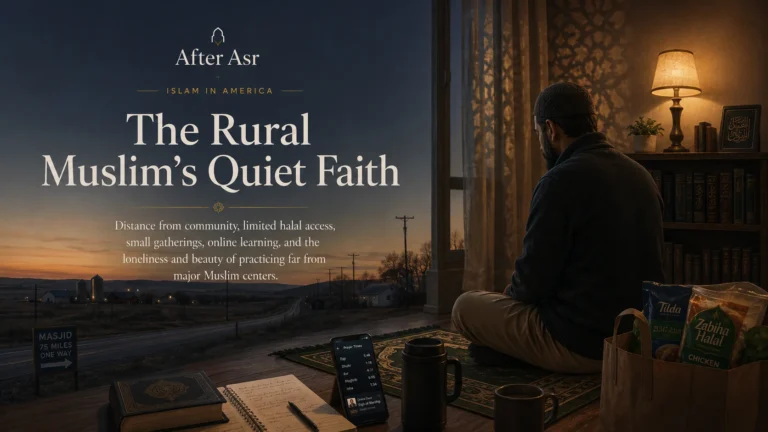
At their best, Muslim podcasts can rebuild oral community in a fragmented age. They can let Muslims hear one another think. They can create companionship for rural Muslims, students, converts, prisoners’ families, exhausted parents, and people far from community.
At their worst, they become another marketplace of opinion.
The difference is amanah.
Newsletters and the local Muslim memory
The humble newsletter may be one of the most important forms of Muslim media.
A newsletter can do what national media often cannot. It can remember the local. The mosque fundraiser. The janazah announcement. The new Qur’an class. The convert support circle. The youth service project. The halal grocery opening. The school board Eid request. The family seeking help after a fire. The imam’s reminder. The community garden. The prison outreach volunteer need. The sisters’ halaqah. The rural family gathering an hour away.
Local memory matters.
If no one records these things, communities forget their own work. The story of Islam in America is not only made by major organizations and national figures. It is made by small efforts repeated over time. A newsletter can become an archive of ordinary faithfulness. Years later, people may look back and see how a community grew, struggled, repaired, and served.
Newsletters can also build trust. They communicate clearly. They reduce rumor. They connect members who cannot attend every event. They invite participation. They make visible the labor of volunteers. They help converts and newcomers know what is happening. They remind the community that the masjid is not only a place one attends, but a body one belongs to.
Muslim newsletters do not need to imitate corporate branding to matter. They need consistency, accuracy, warmth, and usefulness. A well-written local Muslim newsletter can be an act of service.
It says: our community’s life is worth remembering.
Who gets to speak?
Every media community must ask who gets to speak.
In American Muslim media, this question is urgent. Too often, the most visible voices are those with education, language fluency, professional networks, social media comfort, urban access, or institutional connections. These voices may be valuable, but they are not the whole community.
Who speaks for Black Muslims? Who speaks for incarcerated Muslims? Who speaks for rural Muslims? Who speaks for working-class Muslims? Who speaks for converts after the public shahadah moment? Who speaks for Muslim women whose labor keeps institutions alive? Who speaks for elders whose English is limited but whose memory is deep? Who speaks for refugees? Who speaks for disabled Muslims? Who speaks for young people who are not already polished? Who speaks for mosque custodians, teachers, funeral washers, food pantry volunteers, truck drivers, farmers, nurses, and single parents?
Muslim media should not only invite the already articulate.
It should build forms that help more people be heard. Oral histories. Community essays. Interviews. Photo essays. Local reporting. Anonymous reflections when needed. Translated pieces. Youth submissions. Elders’ memories. Chaplaincy stories. Regional features. Editorial mentorship.
This does not mean every voice is equally informed on every topic. Expertise matters. Scholarship matters. Lived experience matters, but it does not automatically answer every question. A mature media culture knows how to honor different kinds of knowledge without confusing them.
The goal is not noise.
The goal is a truer chorus.
Black Muslim media as foundation, not niche
American Muslim media cannot be honest if it treats Black Muslim media as a niche.
Black Muslims have long produced newspapers, speeches, lectures, pamphlets, magazines, radio programs, community communications, prison correspondence, books, sermons, and oral histories that shaped Islam in America. Their media work was often tied to dignity, discipline, racial justice, religious teaching, community building, and the need to speak when mainstream outlets distorted or ignored Black Muslim life.
This is foundational, not peripheral.
Broader Muslim media must learn from Black Muslim media traditions, not merely include Black voices during Black History Month or after racial crises. Black Muslim storytellers have navigated the double burden of being misrepresented as Black and Muslim. They have preserved histories that others neglected. They have addressed prison life, family, community economics, religious reform, education, and self-definition with a seriousness the wider ummah still needs.
If American Muslim media is searching for its own voice, it must understand that part of that voice has been speaking for a long time through Black Muslim communities.
The task is not to absorb or tokenize it.
The task is to honor, study, cite, support, and be changed by it.
Immigrant media and the memory of elsewhere
Immigrant Muslim communities have also built media ecosystems of their own.
Ethnic newspapers, satellite channels, WhatsApp broadcasts, mosque announcements, language-specific podcasts, community radio, YouTube lectures, diaspora magazines, and local newsletters have connected families to homelands, preserved language, announced deaths, raised funds, explained immigration issues, and maintained cultural memory.
This media has served real needs. It helped people remain connected across oceans. It gave elders information in languages they understood. It carried news from countries that American outlets ignored. It preserved religious and cultural life in diaspora.
But immigrant media can also become inward-facing. American-born generations may not understand it. Converts may be excluded by language. Black Muslims and other ethnic groups may feel peripheral. Issues facing youth in America may be filtered through assumptions from elsewhere. Political conflicts from other countries may be imported into local mosque life.
A mature American Muslim media landscape should honor immigrant media while also building shared spaces. Heritage languages matter. Diaspora memory matters. But American Muslim life also needs media that can speak across backgrounds, in the language of the country where younger generations are living, without severing ties to the broader ummah.
The question is not whether Muslims should remember where they came from.
The question is whether we can also speak faithfully about where we are.
Converts and the story after conversion
Mainstream Muslim storytelling often loves conversion moments.
The shahadah. The tears. The before-and-after. The surprising path to Islam. These stories can be powerful. They remind born Muslims that guidance is a gift. They honor the courage of those who enter Islam. They offer da’wah.
But convert stories should not stop at the moment of conversion.
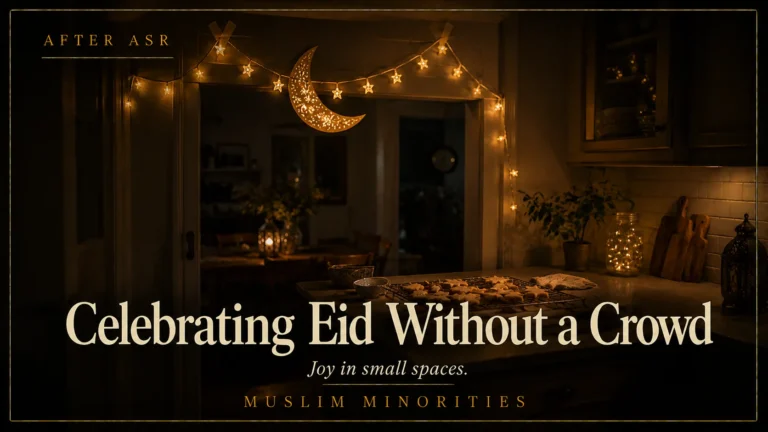
What happens after? How does the convert learn prayer? How do they navigate family holidays? How do they survive their first lonely Eid? How do they find trustworthy knowledge? How do they deal with Muslim cultural expectations? How are they treated in marriage conversations? How do race, class, gender, disability, and geography shape their experience? What does Islam look like ten years after shahadah, when the convert is no longer new but still carries a distinct history?
Muslim media can serve converts by telling these fuller stories.
Not as inspiration content, but as community accountability. A convert’s life reveals whether Muslim institutions know how to welcome, teach, and integrate. It reveals where culture has been mistaken for religion. It reveals how much belonging depends on family networks that converts may not have.
Convert storytelling should be dignified. Ask consent. Avoid spectacle. Do not demand that converts perform gratitude or pain. Let them be ordinary Muslims too. A convert can write about parenting, work, Qur’an, marriage, grief, or local community without always beginning with “how I became Muslim.”
A media culture that only loves the shahadah moment has not yet learned to love converts as full members of the ummah.
Women writing the masjid from the inside
Muslim women’s writing is essential to understanding American Muslim life.
Women know parts of the masjid that men may not see. The women’s prayer space. The convert sister’s first months. The quiet labor behind iftars. The group chats that hold families through illness. The emotional care after divorce. The girls asking questions about faith and body. The mothers managing children during taraweeh. The women teachers shaping weekend schools. The safety concerns that never reach board minutes. The spiritual hunger beneath constant service.
If women do not write, speak, record, and edit, these realities remain partial in public memory.
But women’s media work should not be limited to “women’s issues.” Muslim women should write theology, politics, family, prison, finance, art, history, Qur’an, food, rural life, chaplaincy, and institutional ethics. Their perspective matters not because women are symbolic, but because they are thinkers, believers, scholars, journalists, mothers, daughters, converts, organizers, critics, and witnesses.
Muslim media should also protect women storytellers from the double burden of visibility. Women who write honestly may face backlash, dismissal, harassment, or being labeled divisive. Publications should support them editorially and communally. Readers should engage their work with seriousness, not reduce it to tone.
A community that depends on women’s labor should be willing to read women’s words.
Youth, digital fluency, and depth
Young Muslims are not waiting for permission to make media.
They are already creating videos, podcasts, newsletters, memes, essays, photo projects, spoken word, online reminders, campus publications, and community pages. They understand platforms older institutions barely know how to use. They can speak in the language of their peers. They can make Islam visible in digital spaces where many youth actually spend their time.
This is an opportunity.
It is also a risk.
Digital fluency is not the same as wisdom. A young Muslim may know how to make content spread but not how to verify information, protect privacy, cite sources, avoid religious overclaiming, or understand the spiritual impact of public speech. A meme may be funny but cruel. A reminder may be sincere but inaccurate. A viral critique may expose a real problem but damage people unnecessarily. A youth podcast may create valuable conversation but wander into topics requiring scholars.
Muslim communities should not simply condemn youth media. They should mentor it.
Teach media ethics. Teach adab of disagreement. Teach verification. Teach when to ask scholars. Teach the difference between personal experience and religious guidance. Teach that influence is accountability. Help young Muslims produce beauty, not only reaction. Give them opportunities in serious publications. Let them learn editing, interviewing, photography, design, audio production, and long-form writing.
The future of Muslim media will be shaped by young Muslims.
The question is whether they will inherit standards deep enough for the tools they hold.
The influencer problem
Not everyone with an audience is a journalist. Not everyone with a microphone is a scholar. Not everyone with a camera is a storyteller. Not everyone with beautiful Islamic branding is trustworthy.
The influencer economy has entered Muslim life. Some influencers use their platforms beneficially. They teach, remind, humanize, organize, raise funds, and bring attention to neglected issues. Others blur the line between sincerity and self-branding. Faith becomes aesthetic. Ramadan becomes content season. Modesty becomes market category. Marriage becomes public performance. Charity becomes footage. Spiritual struggle becomes engagement. Outrage becomes growth strategy.
Muslim media must distinguish between influence and trust.
A serious publication has editorial standards, fact-checking, accountability, correction practices, and a sense of mission beyond personal brand. A serious podcast prepares, researches, and respects limits. A serious storyteller protects subjects. A serious journalist verifies. A serious editor cuts what should not be published, even if it would perform well.
Influencers may contribute to Muslim media, but influence alone should not set the standard.
The community needs institutions, not only personalities. Personalities rise and fall. Institutions preserve memory, train new voices, develop editorial judgment, and survive beyond one person’s charisma.
American Muslims should support serious media even when it is less entertaining than personality-driven content.
Depth often spreads slower.
It also lasts longer.
Local reporting as communal service
Muslim media often gravitates toward national issues because national issues feel important. But local reporting may be where Muslim media can serve most directly.
What is happening in a mosque board election? How is a local Islamic school serving students? Why is a zoning dispute affecting a proposed masjid? Which Muslim families need assistance after a storm? How are local Muslims engaging prison outreach? What is the history of a small Black Muslim community in the city? How are converts supported after shahadah? Which halal businesses are trusted? What happened to the weekend school? How are Muslim students advocating for Eid recognition in the district?
Local reporting requires patience. It also requires trust.
It may not produce viral headlines, but it helps communities become accountable. It documents what would otherwise be forgotten. It gives smaller communities visibility. It helps Muslims learn from one another. One mosque’s solution to women’s space, youth programming, convert care, or financial transparency may help another. One city’s Eid advocacy can become a model elsewhere.
Local Muslim journalism should be careful, especially when covering conflict. Small communities are intimate. Harm can spread quickly. But avoiding local reporting entirely allows rumors to dominate. A trained, ethical local Muslim media culture could help communities discuss hard issues with more clarity and less gossip.
A local story told well is not small.
It is where national life becomes real.
The archive we are failing to build
Many American Muslim communities are not preserving their history.
Founders die. Photos are lost. Early mosque documents disappear. Elders’ memories remain unrecorded. Women’s work is unarchived. Black Muslim community histories are neglected. Converts’ stories are reduced to brief testimonials. Local newsletters vanish. Islamic school materials are not saved. Audio lectures are scattered across old devices. Community conflicts are remembered only through rumor. Successful projects leave no records for others to learn from.
This is a loss.
American Muslim media should help build an archive. Not only of famous names, but of ordinary institutions and lives. Oral histories with elders. Photo essays of small masjids. Interviews with women teachers. Records of mosque founding stories. Profiles of Muslim-owned businesses. Documentation of prison outreach. Stories of rural Muslims. Youth reflections. Community timelines. Obituaries that honor service. Digitized newsletters. Local Muslim media repositories.
Memory is not nostalgia. It is responsibility.
A community without memory repeats mistakes and forgets sacrifices. Children grow up thinking what exists now was inevitable. They do not know who rented the first hall, who taught without pay, who drove two hours for Jumu’ah, who defended zoning approval, who washed the dead, who funded the school, who welcomed the first converts, who kept the mosque open during crisis.
Muslim media can preserve these stories before they disappear.
To archive is to say: this mattered.
Speaking to Muslims and speaking to America
American Muslim media often has two audiences: Muslims and the broader public.
Writing for Muslims allows depth, shared assumptions, religious language, internal critique, and spiritual seriousness. Writing for the broader public requires translation, context, and explanation. Both are needed. The problem comes when a publication is unclear about which it is doing.
If every piece is written for outsiders, Muslims may feel constantly simplified. If every piece is written only for insiders, the publication may fail to engage public misunderstanding. The healthiest Muslim media ecosystem includes multiple forms: internal essays, public explainers, investigative reporting, spiritual reflection, local newsletters, youth media, academic-informed analysis, cultural criticism, and storytelling for broad audiences.
A single outlet may do several of these, but it should do them consciously.
When speaking to America, Muslim media should be clear without begging for acceptance. It should explain without apologizing for Islam. It should invite understanding without diluting belief. It should be civically literate without becoming partisan machinery.
When speaking to Muslims, it should be honest without becoming reckless. It should correct without humiliating. It should encourage without flattering. It should deepen worship, not only sharpen identity.
The voice may shift by audience.
The integrity should not.
Media as da’wah, but not only da’wah
Some Muslims view all Muslim media as da’wah.
There is truth here. Good storytelling can invite people toward Islam. A thoughtful article can correct misconceptions. A beautiful podcast can make Islamic life intelligible. A documentary can soften hearts. A newsletter can show neighbors that Muslims are part of the local community. Media can be da’wah when it reveals truth with beauty.
But Muslim media is not only da’wah directed outward.
It is also tazkiyah, a means of purification, when it helps the community examine itself. It is tarbiyah, formation, when it teaches young Muslims how to think. It is shura, consultation, when it creates space for communal reflection. It is hisbah, moral accountability, when it names wrong carefully. It is archive, when it preserves memory. It is companionship, when a lonely Muslim hears their experience named. It is art, when it gives form to beauty. It is service, when it connects people to resources.
Reducing media to da’wah can create pressure to make every story attractive to outsiders. But not every necessary Muslim conversation is designed for non-Muslim consumption. Some stories are for internal repair. Some are for grief. Some are for memory. Some are for warning. Some are for love.
Media can invite others to Islam.
It should also help Muslims live Islam better.
The role of beauty
Beauty matters in Muslim media.
Not only visual beauty, though design, photography, typography, and layout matter. Beauty of language matters. Beauty of restraint. Beauty of moral seriousness. Beauty of pacing. Beauty of attention to ordinary lives. Beauty that refuses both sensationalism and dullness. Beauty that makes readers feel that Muslim life is worthy of careful treatment.
For too long, some Muslim media has been forced into survival mode: urgent statements, defensive explainers, low-budget flyers, crowded websites, reaction posts, and crisis communications. These have their place. But Muslims also need media that feels dignified, thoughtful, and crafted. Our stories deserve more than emergency formatting.
Beauty is not vanity when it serves truth.
A well-designed Muslim publication can communicate seriousness before a word is read. A careful photograph can honor a subject’s dignity. A polished essay can slow the reader down. A podcast with good sound can make a conversation easier to receive. A newsletter with clear structure can make community life feel cared for.
The Islamic tradition has never treated beauty as irrelevant. Allah is beautiful and loves beauty. But beauty must be disciplined by truth. A beautiful lie is still a lie. A beautiful brand without ethics is still hollow. A beautiful image that exploits people is still exploitation.
Muslim media should be beautiful because the subject deserves care, not because aesthetics replace substance.
Funding without losing independence
Media requires money.
Writers, editors, designers, audio producers, photographers, web developers, translators, fact-checkers, and administrators need support. Hosting costs money. Print costs money. Travel costs money. Investigative work costs money. Long-form journalism takes time. If Muslim media is not funded, it either remains unsustainable volunteer labor or becomes dependent on personalities, advertisers, donors, or institutions with their own agendas.
Funding is necessary.
It is also dangerous.
A publication funded entirely by one donor may avoid stories that donor dislikes. A mosque-sponsored outlet may hesitate to cover mosque governance honestly. A business-supported platform may soften critique of Muslim consumer culture. A politically aligned funder may pull coverage toward partisan priorities. An influencer-funded model may reward attention over depth. Advertising may create conflicts around halal businesses, travel, finance, or lifestyle branding.
Muslim media needs financial transparency and editorial independence.
Readers should know what kind of funding supports a publication. Editors should protect standards. Donors should give without controlling coverage. Advertisers should not determine editorial conclusions. Publications should create correction policies, conflict disclosures, and governance structures where possible.
The community also has a role. If Muslims want serious media, they must support it. Subscribe. Donate. Share responsibly. Pay writers. Commission local reporting. Fund archives. Support independent publications before crisis comes.
A community that will not fund its own voice should not be surprised when others speak for it.
Criticism as love
A Muslim media culture must learn how to criticize with love.
This is difficult because criticism often feels like betrayal. Communities that have been misrepresented from outside may become defensive inside. Leaders may dismiss journalists as troublemakers. Readers may prefer comforting narratives. Donors may avoid funding platforms that ask hard questions.
But love without truth becomes sentimentality.
If a mosque mishandles abuse, media may need to ask questions. If a Muslim institution misuses funds, media may need to investigate. If anti-Blackness shapes marriage or leadership, media should not stay silent. If convert care fails, someone should write about it. If Muslim businesses use halal branding dishonestly, someone should report responsibly. If women’s labor is exploited, someone should name it. If youth are drowning in digital confusion, someone should say so.
Criticism should not be driven by contempt. It should be driven by amanah.
The critic should ask: Do I want repair, or only exposure? Have I verified? Have I protected vulnerable people? Am I qualified to analyze this? Have I distinguished between sin, mistake, difference of opinion, and abuse? Am I using language that helps truth emerge, or language that feeds appetite?
Communities also need to receive criticism with maturity. Not every article is an attack. Not every uncomfortable question is fitnah. Sometimes the person writing is trying to save the institution from deeper harm.
Criticism can be love when it seeks Allah’s pleasure and communal repair.
The storyteller’s spiritual danger
Those who tell stories face spiritual dangers.
Ego. Influence. The pleasure of being praised for insight. The temptation to speak beyond knowledge. The satisfaction of exposing others. The subtle joy of being seen as brave. The desire to make every experience material. The habit of turning people’s pain into prose. The need to publish before reflecting. The use of religious language to sanctify personal opinion.
Muslim storytellers must guard their hearts.
Writing about the community does not place one above it. Hosting a podcast does not make one spiritually mature. Editing a publication does not make one immune to arrogance. Critiquing institutions does not mean one is free from the same diseases. Telling stories about worship is not a substitute for worship.
The storyteller needs prayer. Qur’an. Teachers. Editors. Friends who can correct them. Time away from attention. A willingness to apologize. A willingness not to publish. A fear of wronging people through words.
Words can serve Allah.
Words can also harm.
A Muslim media worker should make du’a before publishing, not as performance, but because publication is a form of sending speech into the world beyond one’s control. Once released, words may heal, distort, expose, comfort, anger, clarify, or mislead.
This should humble anyone who writes.
Building institutions of voice
The search for an American Muslim voice cannot depend only on individual talent.
It needs institutions.
Publications that train writers. Podcasts with editorial standards. Local newsletters. Muslim journalism fellowships. Archives. Community reporting projects. Photojournalism collections. Youth media programs. Translation initiatives. Black Muslim media preservation projects. Convert storytelling networks. Rural Muslim correspondence. Prison writing programs. Women’s editorial collectives. Muslim arts criticism. Ethical investigative journalism. Media literacy education in Islamic schools.
Institutions allow voice to outlive personality.
They also create accountability. Editors improve writing. Fact-checkers catch errors. Mentors train youth. Boards protect mission. Archives preserve memory. Teams reduce burnout. Standards develop over time.
Building Muslim media institutions will require patience. Not every project will last. Some will fail. Some will become too narrow. Some will struggle financially. Some will need correction. But the alternative is leaving Muslim storytelling to scattered posts, temporary outrage, and outside coverage.
American Muslims are building mosques, schools, nonprofits, businesses, and community centers. We must also build media institutions with the same seriousness.
A community that cannot tell its own story will struggle to understand its own future.
Our own voice, accountable to Allah
The phrase “our own voice” can be misunderstood.
It does not mean one voice. American Muslims are not one ethnicity, class, race, madhhab, generation, region, or political instinct. Our voice is many voices held within the greater discipline of Islam. There will be disagreement. There should be. A living community thinks, debates, remembers, corrects, and grows.
“Our own voice” also does not mean a voice accountable only to communal pride. Muslim media must be accountable to truth. If Muslims did wrong, say so carefully. If Muslims were harmed, say so clearly. If outsiders misrepresent us, answer with dignity. If internal wounds need repair, do not hide them for image. If something is unknown, say it is unknown. If a correction is needed, publish it.
Above all, Muslim media must be accountable to Allah.
This changes the work. A story is not successful simply because it went viral. A headline is not justified because it gained traffic. A critique is not righteous because it sounded bold. A beautiful essay is not beneficial if it distorted the truth. A podcast is not good because it built a loyal audience. A publication is not trustworthy because Muslims run it.
The measure is deeper.
Was it truthful? Was it just? Was it careful with people’s dignity? Did it serve understanding? Did it avoid harm where possible? Did it speak when speech was needed? Did it remain silent when silence was wiser? Did it remember that every word is recorded?
A Muslim voice should sound like people who know they will answer for speech.
The page, the microphone, and the trust
Imagine a small Muslim editorial room late at night.
A writer is revising an essay about a rural Muslim family. An editor is checking a piece on mosque finances to make sure it is fair. A podcaster is preparing questions for a Black Muslim elder whose memories deserve more than a rushed interview. A photographer is choosing an image that protects a convert’s dignity. A newsletter editor is adding the janazah announcement, the youth halaqah reminder, the Eid school letter, and the food pantry request. Someone is cutting a headline because it feels too sharp. Someone is adding context because the story would be unjust without it. Someone is making du’a that the work benefits people.
This is media as amanah.
Not glamorous. Not always profitable. Not always praised. But necessary.
American Muslims need our own voice because we have lives that deserve truthful telling. We need media that can speak to the country without begging, and speak to the community without flattering. We need stories that remember the elderly, the incarcerated, the converts, the Black Muslim foundations, the immigrant builders, the rural families, the women carrying institutions, the youth asking questions, the chaplains in quiet rooms, the children at Eid, the workers praying in break rooms, the small mosques far from attention.
We need media that refuses to make Muslims either symbols or suspects.
We need media that helps us see ourselves before Allah.
The search for our own voice is not a search for perfect agreement. It is a search for truthful speech rooted in faith. A voice warm enough to love the community, disciplined enough to critique it, confident enough to speak publicly, humble enough to be corrected, and serious enough to remember that words are deeds.
For too long, others have spoken about Muslims as though we are always a question.
American Muslim media should answer differently.
Not only, “Here is who we are.”
But, “Here is what we must become, by Allah’s guidance, if we are to carry this faith with dignity in this country.”
That is a voice worth building.
That is a trust worth funding.
That is a story worth telling carefully.