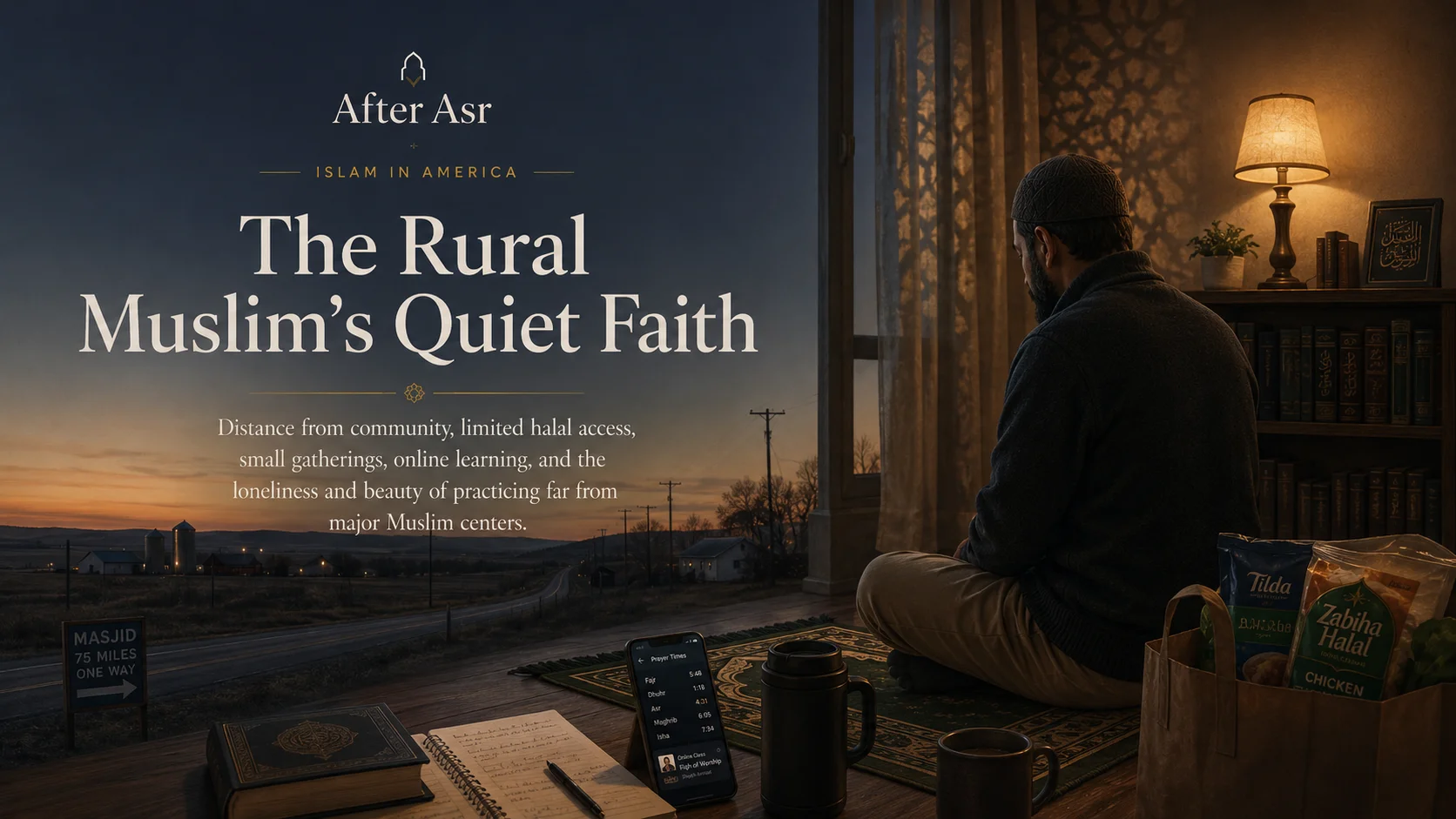
Distance from community, limited halal access, small gatherings, online learning, and the loneliness and beauty of practicing far from major Muslim centers.
Not every Muslim in America lives near a large masjid.
Not every Muslim has halal restaurants nearby, an Islamic school across town, several Jumu’ah options, Ramadan programs every night, Muslim doctors, Muslim neighbors, Muslim classmates, Muslim coworkers, Muslim grocery stores, or a calendar full of community events. Some Muslims live where the nearest masjid is an hour away, or two. Some live in towns where their family is the only Muslim family anyone knows. Some live on farms, in mountain towns, coastal villages, desert communities, small Southern cities, Midwestern counties, rural stretches of the West, and places where the adhan is not part of public sound, or even private familiarity beyond the phone.
Their Islam is often quiet.
It happens in living rooms, bedrooms, school offices, break rooms, barns, porches, parking lots, long drives, online classes, mailed books, small group chats, and family tables where Ramadan may be known only by the people sitting there. It happens when someone checks prayer times while the nearest Islamic center is counties away. It happens when a convert learns wudu from a video. It happens when a mother makes Eid feel special in a town where no store sells Eid decorations. It happens when a father drives children to Sunday school twice a month because weekly is impossible. It happens when a college student returns home for summer and realizes there is no MSA, no halal cafeteria, no Jumu’ah within lunch break.
Rural Muslim life can be lonely. It can also be spiritually beautiful.
It strips away some of the social reinforcement that many Muslims depend on. There may be no crowd to carry a person through Ramadan, no aunties to notice absence, no youth group to make faith feel normal, no restaurant where a child can order freely, no Muslim friend nearby to make Eid larger than the household. But in that quiet, another kind of sincerity can grow. A Muslim far from community learns that Allah is not far. A prayer offered alone in a small-town bedroom is not smaller before Him than a prayer offered in a crowded mosque. A family breaking fast at a kitchen table with no guests may still be surrounded by mercy. A convert saying shahadah with only one witness and a livestream may still be entering the same ummah.
The rural Muslim’s faith may not be visible to many people.
But it is known to Allah.
Distance as a daily reality
Distance shapes everything.
In a major Muslim center, a person may choose between several masjids. In rural life, the question may be whether one can reach any masjid at all. Jumu’ah may require leaving work early, driving far, or missing it when no congregation is accessible. Eid prayer may mean waking children before dawn for a long road trip. A janazah may require coordination across counties. A new Muslim may want to meet other Muslims but have no local gathering. A family may plan the entire weekend around a single Islamic class in another city.
This distance is not only geographical. It is emotional.
A Muslim may feel far from the visible ummah. They may watch photos of packed Ramadan nights in large mosques and feel both joy and ache. They may hear friends in other cities complain about crowded parking lots and wish they had that problem. They may listen to lectures about community while sitting alone. They may wonder whether their children will feel Muslim enough without regular Muslim peers. They may feel that Islamic life is happening elsewhere, in places with larger populations, more resources, and better infrastructure.
Communities in major cities should remember this. Not every Muslim can attend every program. Not every absence is laziness. Not every family missing Eid prayer is careless. Not every convert without community is failing to integrate. Sometimes the road is long, the gas is expensive, the shift schedule is strict, the children are tired, and the nearest mosque is farther than people imagine.
Distance requires creativity. Carpool networks. Regional gatherings. Monthly halaqahs. Hybrid classes. Traveling teachers. Online mentorship. Rotating Eid meetups. Shared calendars. Mosque outreach beyond city limits. If American Muslim institutions are serious about serving the whole ummah, they must think beyond the neighborhoods immediately around their buildings.
The rural Muslim should not have to feel forgotten because they live beyond the usual radius of community attention.
The prayer that does not need witnesses
There is a particular sincerity in prayers no one sees.
In large Muslim spaces, prayer is socially reinforced. People gather. The adhan is called. Rows form. The body is carried by collective movement. This is a mercy. Congregational prayer has its own virtue and beauty. But many rural Muslims pray most of their prayers alone or with only family.
This can feel isolating.
It can also deepen the meaning of standing before Allah.
No one is watching. No one is praising consistency. No one notices whether Fajr was prayed on time. No one sees the teenager making wudu before school. No one sees the convert struggling through Arabic syllables in a bedroom. No one sees the mother praying Isha after the children sleep. No one sees the elderly man facing the qiblah in a farmhouse miles from the nearest Muslim neighbor.
Allah sees.
This awareness is the foundation of faith everywhere, but rural life can make it more obvious. The Muslim cannot depend on communal momentum alone. They must build private rhythm. Prayer becomes less a public identity and more a hidden covenant.
This does not mean isolation is ideal. Muslims need community. The Prophet ﷺ taught the importance of congregation, brotherhood, learning, and mutual care. But when circumstances limit access, the believer should not imagine that their worship is spiritually inferior. A prayer offered alone out of necessity, with longing for the masjid, may carry a tenderness known only to Allah.
The rural Muslim learns that the earth is wide, and every clean place can become a place of sujood.
Halal far from halal markets
Food becomes one of the most practical challenges of rural Muslim life.
In larger Muslim communities, halal meat may be found at multiple stores. Restaurants may offer halal menus. Families may order from Muslim butchers or shop after Jumu’ah. In rural areas, halal access may require long drives, bulk orders, frozen shipments, vegetarian meals, seafood, careful label reading, or coordination with other families.
This shapes daily life.
A mother planning meals may have to stretch halal meat carefully. A father may drive to a distant city once a month with coolers in the trunk. A convert may not know where to begin and may rely on grocery store vegetarian options. A Muslim student may return to a small town and find that family gatherings revolve around foods they no longer eat. Children may face school lunches with few options. Eid meals may require planning weeks in advance.
Halal becomes visible as effort.
This effort can teach taqwa. A family learns that convenience does not define obedience. Children see that food choices matter. Converts learn that Islam enters the grocery aisle. A community may learn cooperation through shared orders and mutual support.
But the difficulty can also become tiring. Muslims with money can order online or travel. Muslims with limited income may struggle. Rural converts may feel overwhelmed. Families may make compromises out of confusion rather than knowledge. Some may become lax because access feels too hard. Others may become anxious because every ingredient seems uncertain.
Muslim communities should provide practical guidance for rural halal life. Reliable online suppliers where available. Basic fiqh education. Support for bulk meat purchases. Mosque-organized distribution days. Food pantry halal options. Clear advice for converts. Recipes that do not assume constant access to halal meat. Encouragement without harshness.
Halal should be taught as obedience, not as a burden one carries alone without help.
Ramadan with few Muslims nearby
Ramadan in a rural place can feel both intimate and lonely.
There may be no nightly taraweeh nearby. No crowded iftar hall. No children running between prayer rows. No community suhoor. No local Muslim restaurant extending hours. No public signs of the month. The town continues as usual while one household rearranges its life around fasting, prayer, Qur’an, and sunset.
For some families, this creates a deep home Ramadan. The kitchen becomes the center of sacred time. Parents and children break fast together without the distractions of constant events. Qur’an is recited in the living room. Taraweeh may be prayed at home. The family learns to create Ramadan atmosphere deliberately, through lights, books, charity jars, meal preparation, and du’a.
For others, the loneliness is heavy.
A convert may fast their first Ramadan alone. A student may eat suhoor quietly while roommates sleep. A family may long for community iftars but cannot drive nightly. Children may ask why Ramadan feels so small compared with holidays their classmates celebrate publicly. A Muslim worker may fast through long shifts with no one nearby who understands.
This is where wider Muslim community matters. Urban and suburban mosques can livestream reminders, but rural Muslims need more than passive content. They need connection. A weekly online iftar circle. Regional Ramadan meetups. Families invited for weekend iftars. Care packages for converts. Children’s online Ramadan classes. Phone calls from mentors. Local Muslim directories that help isolated families find one another.
Ramadan should not depend entirely on population density.
A small Ramadan can be spiritually immense. But no Muslim should be left alone simply because larger communities did not think to reach beyond themselves.
Eid when the town does not know
Eid in rural America can be difficult to make visible.
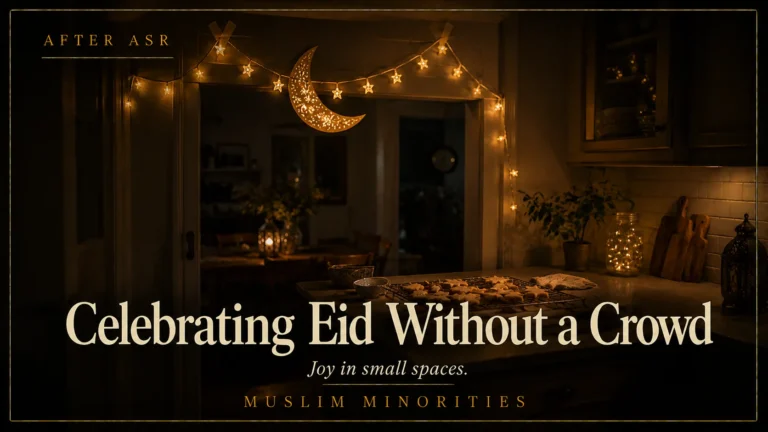
The school may not know. The workplace may not know. The neighbors may not know. There may be no Eid prayer nearby. No Muslim-owned bakery. No community festival. No large family gathering. A Muslim child may wake up excited and then watch the school bus arrive as usual. A convert may mark the day alone. A family may decorate the home, take photos, and drive hours for prayer if possible.
Eid becomes an act of intentional love.
A rural Muslim family may have to work harder to teach children that this day matters. They may request school absence, even if no one else does. They may bring sweets to a small classroom. They may plan a special breakfast. They may call relatives far away. They may host the only other Muslim family within driving distance. They may make Eid gifts simple but meaningful. They may pray at home if no congregation is accessible, according to proper guidance.
This effort is not lesser than crowded celebration. It may be more tender because it is chosen against the silence of the surrounding calendar.
Still, communities should help. Regional Eid prayers can be organized where clusters of rural Muslims exist. Mosques can send letters for schools and employers. Online Eid programming can include isolated families. Gift drives can include children outside major cities. Families in larger communities can invite rural Muslims to stay overnight before Eid prayer. Muslim organizations can create Eid guides for small-town families and converts.
The child in a small town deserves Eid joy too.
They should know that sacred celebration belongs to them, even if the nearest store has no sign of it.
Converts in isolated places
Rural converts often carry a particular loneliness.
A person may encounter Islam through reading, online lectures, a Muslim coworker, a college class, a friendship, a marriage, a crisis, or a quiet search. They may say shahadah online, over the phone, during a rare visit to a distant mosque, or with a small group of Muslims who barely know how to support them afterward. Then they return home to a town where no one else is Muslim.
The early questions can feel overwhelming.
How do I pray? Where do I find halal food? Do I tell my family? What do I do about holidays? Is there a mosque near me? How do I learn without falling into unreliable online spaces? How do I find Muslim friends? How do I fast Ramadan when everyone around me eats normally? What do I do for Eid? What if I make mistakes?
Online learning can be a mercy, but it can also be a maze. A rural convert may be exposed to conflicting opinions, harsh personalities, sectarian arguments, and advanced debates before learning the foundations. Without local community, they may cling to the loudest voice available. They may become overwhelmed or overly strict. Or they may drift because no one checks in.
Convert care must include rural converts.
Mosques should allow remote mentorship. National Muslim organizations should create beginner pathways that do not assume local access. Teachers should explain basics clearly. Communities should pair converts with reliable mentors by phone or video. Local Muslims, even if few, should be connected where safe and appropriate. Families in larger communities can adopt converts socially, inviting them for Ramadan and Eid when distance allows.
A convert in a small town is not a footnote. They are a trust.
Their loneliness should not be the price of their guidance.
Children raised far from Muslim density
Parents raising Muslim children in rural areas often carry quiet fear.
Will my children know other Muslims? Will they feel strange at school? Will they keep halal? Will they be embarrassed by prayer? Will they marry Muslims one day? Will they understand Islam as living guidance or as a private family rule? Will they resent what makes them different? Will they feel alone during Ramadan and Eid? Will they lose the language of the ummah because they rarely hear it around them?
These fears are real.
A Muslim child in a small town may be the only Muslim in their class. They may answer the same questions repeatedly. They may hear stereotypes before they have language to respond. They may feel pressure around school dances, dating, sports schedules, cafeteria food, sleepovers, holidays, and church-centered community life. They may be loved by neighbors and still feel religiously alone.
Parents cannot solve everything, but they can build a home with warmth.
Children need Islam to feel like mercy, beauty, rhythm, and belonging, not only restriction. Pray together. Make Ramadan visible. Make Eid joyful. Teach stories of the Prophets. Read Qur’an. Connect with Muslim children online and in person when possible. Visit the masjid even if not weekly. Attend regional camps or retreats. Invite Muslim families to stay. Teach children how to explain Islam without making them responsible for representing everything. Help them love their difference without becoming arrogant.
Most importantly, parents should not let anxiety turn Islam into constant fear. Children who are always told the outside world is dangerous may eventually feel trapped. They need boundaries, but also confidence. They need to know that Allah is with them in their school, not only in the distant masjid.
A child raised far from Muslim density can grow into strong faith if the home becomes a place of love, knowledge, and sincere practice.
Online learning as lifeline and risk
For rural Muslims, the internet has transformed religious life.
A person can attend classes from scholars across the world, listen to Qur’an recitation, join virtual halaqahs, learn Arabic letters, ask questions, find prayer times, order books, watch khutbahs, connect with converts, and feel part of a broader Muslim conversation. For someone far from a masjid, this access can be life-changing.
Online learning can keep a rural Muslim connected.
But it also carries risks. The internet does not distinguish between knowledge and performance. A new Muslim may encounter harsh debates before learning purification. A teenager may be shaped by influencers rather than teachers. A sincere seeker may confuse confidence with scholarship. Algorithms may reward outrage, certainty, and controversy. A person without local guidance may become spiritually dependent on personalities they have never met.
Rural Muslims need online learning with structure.
Choose reliable teachers. Begin with foundations. Avoid constant debate. Join classes that allow questions. Seek scholars connected to recognized learning traditions. Balance listening with practice. Do not let Islamic content replace prayer. Do not mistake scrolling reminders for study. Find real human mentorship when possible, even if through video calls.
Mosques and Islamic institutes should design programming for remote Muslims intentionally. Not as an afterthought. Rural Muslims may need beginner tracks, family classes, youth circles, convert support, and pastoral care online. Recordings are useful, but live connection matters too.
The internet can bring the ummah closer to the rural Muslim.
It can also bring confusion closer.
Guidance requires discernment.
The small gathering
There is a beauty in small Muslim gatherings.
Three families meeting for iftar in a town with no mosque. A handful of Muslims renting a library room for Jumu’ah when possible. A convert and a born Muslim studying together at a coffee shop. A family hosting Eid breakfast for the only Muslim student nearby. A group chat of six people reminding one another about prayer times, halal orders, and moon sightings. A living room halaqah where children recite short surahs while adults drink tea.
Small gatherings have a tenderness that large communities sometimes lose.
Everyone is noticed. Every absence matters. Food is simple. The conversation is direct. Children know the adults. Converts are not lost in a crowd. People may come from different backgrounds because there are too few Muslims to divide easily by ethnicity. A Somali family, a Black Muslim convert, a Pakistani doctor, a white convert, an Arab student, and a Turkish spouse may become community simply because Allah placed them near one another.
Smallness can build sincerity.
It can also bring strain. One conflict may divide the whole group. One family moving away may collapse the gathering. One person may carry too much leadership. Differences in practice may feel larger because there are fewer people. A convert may depend heavily on one mentor. A family may feel trapped if the only local Muslim group is unhealthy.
Small communities need adab and humility. They should avoid unnecessary disputes. They should focus on essentials. They should seek outside guidance when needed. They should share responsibility. They should not try to imitate large mosque programming beyond their capacity. A simple monthly gathering done consistently may be better than ambitious plans that burn everyone out.
Where there are only a few Muslims, every act of mercy becomes institution-building.
Rural mosques and fragile institutions
Some rural areas do have mosques, but they may be small, underfunded, and fragile.
A converted house. A rented room. A storefront. A small building near a highway. A mosque open only for Jumu’ah. A community led by volunteers with no full-time imam. A prayer space serving immigrants, students, converts, truck drivers, workers, and families scattered across a wide region.
These mosques carry enormous responsibility with limited resources.
They may not have youth programs, women’s classes, formal convert care, Ramadan every night, or administrative staff. The imam may be part-time. The board may be three exhausted people. The building may need repairs. The same volunteer may unlock doors, lead prayer, teach children, collect donations, and clean bathrooms.
Larger Muslim communities should not look down on these institutions. A small rural masjid may be the only place of sujood for miles. Its existence may preserve faith for families who would otherwise be isolated. It may introduce Islam to neighbors who have never met Muslims. It may bury the dead, host Eid, support converts, and provide Jumu’ah through sheer persistence.
Such mosques need support. Visiting teachers. Financial assistance. Used but good-quality Islamic books. Remote khutbah support where appropriate. Training for volunteers. Ramadan partnerships. Help with websites and communication. Youth camp scholarships. Connections to regional Muslim networks. Emergency funds for repairs.
A large mosque raising money for expansion might consider whether a small rural masjid nearby is struggling to keep the lights on.
The ummah is not measured only by its largest institutions.
Rural Muslims and public visibility
In a rural town, being Muslim can make a person very visible.
A hijabi woman may be known by strangers. A Muslim family may be asked questions everywhere. A child may become the “Muslim kid” at school. A convert may face gossip after changing dress, diet, or religious practice. A Muslim business owner may feel they represent Islam to the entire town. A family may experience kindness from neighbors, but also suspicion or ignorance.
Visibility in rural settings can be intimate. People may know one another personally. This can soften prejudice. A neighbor who knows the Muslim family may ask sincere questions, bring food during illness, or defend them from stereotypes. A teacher may become supportive once they understand Ramadan. A coworker may learn to respect prayer breaks. Small-town relationships can create trust that large anonymous cities do not.
But visibility can also be tiring. The Muslim may be asked to explain every global event. They may hear jokes. They may face church-centered assumptions. They may be invited repeatedly into religious spaces they cannot fully join. They may fear backlash if national news turns hostile toward Muslims. They may feel watched.
Rural Muslims need wisdom in public presence. Be kind without becoming the town’s Islam encyclopedia on demand. Set boundaries. Accept neighborliness where it is sincere. Explain when useful. Refuse offensive assumptions calmly. Build relationships before crisis. Let good character speak, but do not carry the burden of perfect representation.
The rural Muslim’s visibility can become a form of quiet da’wah, but it should not become a prison.
They are allowed to be human.
The rural Muslim woman
Rural Muslim women may experience isolation in particular ways.
A hijabi woman in a small town may be the most visible Muslim in the area. She may receive questions, stares, compliments, suspicion, or unwanted attention. She may struggle to find women’s classes, Muslim friends, modest clothing options, female teachers, or women’s support networks. A convert woman may need guidance on hijab, prayer, family, marriage, menstruation, and public identity without local sisters to ask. A mother may carry the work of making Islam visible at home almost alone.
If there is no nearby masjid, or if the small mosque has limited women’s facilities, she may feel especially disconnected. Her husband or sons may attend Jumu’ah when possible, while she remains home with children. She may watch online classes but lack embodied sisterhood. She may long for women who understand Ramadan fatigue, modesty, motherhood, marriage questions, and the social pressure of being visibly different.
Communities should be attentive to rural Muslim women. Online sisters’ circles. Mentorship networks. Regional women’s retreats. Convert support. Safe group chats. Visiting teachers. Child-friendly gatherings. Eid invitations. These can make a difference.
At the same time, rural Muslim women often build remarkable strength. They create home traditions, teach children, host gatherings, maintain modesty in unfamiliar environments, and carry Islam publicly with grace. Their labor is often unseen by larger communities.
Allah sees it.
The woman who keeps faith alive in a house far from Muslim density may be building more than she realizes.
Marriage and family formation far from community
Marriage can be difficult for rural Muslims.
There may be few or no local Muslim prospects. Families may depend on online introductions, distant networks, masjid referrals, conferences, apps, or relatives in other states. Converts may struggle even more because they may lack Muslim family advocates. Young Muslims raised in small towns may leave for college and face the question of whether they can return if they want to marry. Intercultural and interracial marriages may be more common in small communities simply because options are limited, which can be a blessing, but also requires support.
Parents may worry intensely. Will my child marry a Muslim? Will they have to move? Will they find someone who understands rural life? Will a spouse from a city be willing to live here? Will a convert be accepted by Muslim families elsewhere? Will distance from community strain the marriage?
These concerns are real.
Muslim communities need better marriage pathways that include rural Muslims. Locality should not determine whether a person can find a spouse. Remote premarital education, careful introductions, convert advocates, regional matchmaking with adab, and family support across distances can help.
Married rural couples also need support after marriage. They may not have Muslim elders nearby. They may need online classes, counseling referrals, parenting resources, and periodic community visits. A couple living far from Muslim community must be intentional about faith in the home. Prayer, halal, children’s education, Ramadan, and social boundaries cannot be outsourced to the masjid.
A rural Muslim marriage can be strong, but it should not be left unsupported simply because the couple lives far away.
The beauty of land, silence, and remembrance
Rural life can offer spiritual gifts.
Open skies. Long roads. Stars visible at night. Quiet mornings. Fields, mountains, forests, deserts, rivers, coastlines, and seasons that cannot be ignored. The created world may feel nearer. A person may walk outside before Fajr and feel the silence as mercy. A farmer may remember Allah while working land. A family may break fast on a porch as the sun lowers over trees. A convert may find that solitude, once lonely, becomes a place of du’a.
Islamic spirituality has always known the signs of Allah in creation.
The city has its own blessings: community, knowledge, congregation, service, density. But rural landscapes can teach dependence, patience, humility, and attention. The rain matters. The harvest matters. The distance between neighbors matters. The sky is not hidden by towers. The human being may feel smaller, and this can be good for the soul.
Rural Muslims should not imagine that spiritual seriousness only lives in large mosques or major Islamic centers. A person can remember Allah under a wide sky with a depth that crowded life sometimes obscures. A child can learn tawheed by watching seasons change. A family can connect Qur’anic language about earth, rain, animals, night, dawn, and provision to the world around them.
Isolation is painful when it cuts people off from community. But solitude, when held with worship, can become a teacher.
The rural Muslim may lack many resources.
They may also possess a kind of quiet that makes remembrance possible.
Not every rural place is the same
Rural Muslim life is diverse.
A Muslim family in Appalachia is not the same as one in the Great Plains. A Black Muslim community in a Southern town is not the same as a Somali family in a meatpacking region, a Turkish family running a small business, a Bosnian family in the Midwest, a white convert in a mountain county, a Latino Muslim in an agricultural town, or a South Asian physician in a rural hospital. Some rural Muslims are immigrants. Some are multigenerational Black Muslims. Some are converts. Some are married into Muslim families. Some are refugees placed in smaller cities. Some are military families near bases. Some are students in college towns that feel Muslim during the semester and empty afterward.
We should avoid romanticizing or flattening them.
Some rural Muslims experience kindness. Some experience hostility. Some love the quiet. Some feel trapped. Some are deeply rooted in small-town life. Some plan to leave as soon as possible. Some own land, farms, or businesses. Some struggle economically. Some are socially integrated. Some are isolated. Some have supportive non-Muslim neighbors. Some face intense suspicion.
There is no single rural Muslim story.
But there is a shared pattern of distance from Muslim infrastructure, and that distance shapes faith. To serve rural Muslims well, larger communities must listen before assuming what they need. Some may need halal access. Others need youth connection. Others need convert care. Others need visiting teachers. Others need help with burial arrangements. Others need nothing more than to be remembered and respected.
The first act of care is not a program.
It is attention.
Burial, illness, and emergency distance
Distance becomes especially serious in moments of illness and death.
A Muslim in a rural area may be hospitalized far from a Muslim chaplain. A family may not know whom to call for janazah. The nearest Muslim funeral service may be hours away. A convert’s non-Muslim relatives may not understand Islamic burial needs. A small community may not have people trained in ghusl. An elderly Muslim may die in a town where no one knows the rites. A rural family may face both grief and logistical panic.
This is where regional planning matters.
Muslim communities should create networks for end-of-life support beyond major cities. Lists of imams willing to travel. Funeral homes familiar with Islamic burial. Volunteers trained in ghusl. Emergency contact cards. Written burial wishes for converts and isolated Muslims. Hospital chaplaincy connections. Regional janazah funds. Guidance for non-Muslim families of converts. Transportation support.
Death reveals whether community is real.
A Muslim should not be left without Islamic burial support because they lived far from a metropolitan center. The obligation of janazah belongs to the community broadly. In America, fulfilling that obligation requires planning across distance.
Rural Muslims should also prepare. Write Islamic burial wishes. Inform trusted family or friends. Connect with the nearest mosque. Keep emergency numbers. Converts especially should not assume non-Muslim relatives will know what to do.
Thinking about death is not morbid. It is part of living as a Muslim.
In rural life, it is also practical mercy.
The mosque that visits
Many rural Muslims cannot come to the mosque often.
So sometimes the mosque must come to them.
Not always physically, though that matters. A visiting imam. A traveling teacher. A family from the city bringing iftar. A youth group doing service in a rural area. A regional Eid gathering closer to scattered families. A funeral team willing to travel. A chaplain visiting a rural hospital or prison. These efforts can make isolated Muslims feel remembered.
But the mosque can also visit through systems.
Livestreams. Online classes. Mentorship calls. Remote convert care. Regional mailing lists. Digital Ramadan programs. Islamic school packets. Youth pen-pal programs. Book shipments. Recorded khutbahs. Prayer time guides. Rural Muslim WhatsApp groups. Scholarship funds for retreats. Transportation assistance for major events.
A mosque that thinks this way understands that community is not only who appears in the building.
The masjid is a spiritual center, but its responsibility can extend beyond its walls. Muslims scattered across rural areas may still see that masjid as their closest anchor. They may donate. They may call for advice. They may come for Eid. They may need help once a year, and that help may mean everything.
A healthy American Muslim institution asks: who is outside our building but still within our trust?
Rural Islam and American belonging
Rural Muslims challenge narrow images of American Islam.
They remind us that Muslims are not only in big-city enclaves, university towns, suburban masjids, immigrant business districts, and metropolitan advocacy organizations. Muslims are also in farming counties, mountain towns, coastal communities, desert roads, small schools, rural hospitals, county jails, military areas, and places where the nearest halal sign may be a long drive away.
Their presence complicates both Muslim and non-Muslim assumptions.
To non-Muslims, rural Muslims show that Islam is not foreign to American landscapes. A Muslim can belong on a farm, in a small-town classroom, at a county fair, in a local clinic, on a fishing boat, in a rural fire department, on a ranch, at a roadside diner asking careful questions, or in a home where Qur’an is recited beside fields and forests.
To Muslims, rural Muslims show that American Muslim life cannot be built only for those in dense communities. If our institutions, media, curricula, and services assume urban or suburban access, we will fail part of the ummah. The American Muslim story must include the quiet believer far from the crowd.
Rural Muslim belonging does not require imitation of city Muslim life. It requires faithful practice where Allah has placed a person, with as much connection and support as possible.
The same qiblah unites the crowded masjid and the distant farmhouse.
The loneliness that can become du’a
Loneliness is real.
It should not be romanticized too quickly. A Muslim far from community may ache for companionship. A convert may cry after Eid prayer online. A teenager may feel like the only one. A mother may feel she is carrying the faith of the household alone. A father may worry that he cannot provide enough Islamic environment. An elderly Muslim may miss the sound of congregational prayer. A family may feel forgotten by larger mosques.
We should name this loneliness because naming it is part of mercy.
But loneliness can also become du’a.
A person who feels alone may speak to Allah with a directness that social busyness sometimes prevents. They may ask for community, for steadfastness, for their children, for a halal path, for knowledge, for a masjid, for one good Muslim friend. They may learn the names of Allah not as classroom material, but as lifelines: Al-Latif, the Subtle and Gentle; Al-Wadud, the Loving; Al-Wakil, the Disposer of affairs; As-Sami, the Hearing.
Loneliness should not be the permanent plan. Muslims should seek community where possible. Communities should reach the lonely. But while loneliness exists, it can be turned toward Allah rather than only inward toward despair.
The rural Muslim’s quiet faith may be formed in that turning.
What larger Muslim communities owe
Larger Muslim communities owe rural Muslims remembrance, respect, and practical care.
Remembrance means including them in du’a, planning, media, education, and institutional imagination. Respect means not treating them as less religious because they cannot attend programs often, or as backward because they live outside Muslim centers. Practical care means building systems that reduce isolation.
What might this look like?
Regional directories so families can find one another. Traveling teachers. Online classes designed for remote learners. Convert mentors. Rural Ramadan programs. Eid host networks. Halal bulk ordering systems. Janazah support networks. Chaplaincy outreach to rural hospitals and prisons. Youth retreats with scholarships. Family camps. Clear religious guidance for those without local imams. Encouraging city families to build friendships with rural families, not as charity projects, but as brothers and sisters.
This work does not require enormous institutions to begin. It requires a shift in attention.
Ask at the next mosque board meeting: who lives far from us but depends on us? Ask in the next Islamic school planning session: can remote children join? Ask in the next Ramadan plan: are there converts or rural families who need invitations? Ask in the next fundraiser: can part of this support smaller communities?
The ummah is not only where the parking lot is full.
The road to the masjid
There is a kind of love shown in a long drive to the masjid.
A family wakes early. Children sleep in the car. The road passes fields, gas stations, churches, forests, small towns, and long stretches of quiet. The parents have packed snacks, prayer clothes, maybe a cooler for halal groceries after the visit. They are going for Jumu’ah, or Eid, or a class, or simply because the children need to feel a Muslim crowd around them.
By the time they arrive, city Muslims may be complaining about parking.
The rural family is grateful just to be there.
This does not make them better. It simply reveals a sacrifice that should be seen. Access changes how people experience community. What is ordinary for one Muslim is a journey for another.
The long road to the masjid is part of American Muslim life. It should humble those who live close. It should remind institutions that their reach matters. It should remind rural Muslims that their effort is not wasted.
Every mile driven for Allah is known by Him.
A faith no less complete
The rural Muslim’s life may lack many things.
Frequent congregation. Halal convenience. Islamic schools. Muslim neighbors. Eid crowds. Youth groups. Scholars nearby. Women’s circles. Convert classes. Muslim bookstores. Regular janazah support. Easy marriage networks. The comfort of being socially normal.
But their Islam is not incomplete because their infrastructure is limited.
A person can know Allah in a small town. A child can love the Prophet ﷺ in a farmhouse. A convert can learn prayer in a trailer, apartment, dorm room, or porch. A family can build Ramadan at a kitchen table. A woman can wear hijab with dignity on a road where no one else does. A man can leave work for Jumu’ah once a month and long for more. A teenager can choose halal when classmates do not understand. A small group can gather and become, for one another, a mercy.
Islam is not owned by cities.
The same Qur’an recited in a grand mosque can be recited under a rural roof. The same qiblah gathers the believer. The same angels record. The same Lord hears.
Rural Muslims deserve support, but they should not see themselves as spiritually secondary. Sometimes faith far from the crowd has a strength the crowd needs to learn from. It is less visible, but not less real. Less resourced, but not less beloved. Less socially reinforced, but perhaps more consciously chosen.
The rural Muslim’s quiet faith is part of Islam in America.
It is the prayer in a house at the end of a long road.
The cooler packed for halal meat once a month.
The child explaining Ramadan to a teacher who has never taught a fasting student.
The convert whispering al-Fatihah alone.
The mother making Eid with paper decorations and immense love.
The father driving two hours for Jumu’ah.
The teenager logging into an online halaqah because there is no youth group nearby.
The small gathering in a living room where every person matters.
The old Muslim making du’a under a wide night sky.
A country this large will always have Muslims scattered across distance. The question is whether we will remember them as fully part of us. Whether our institutions will reach them. Whether our stories will include them. Whether our children will know that Islam grows not only where Muslims are many, but wherever a believer turns toward Allah with sincerity.
The rural Muslim may be far from the nearest masjid.
But no servant of Allah is far from Allah.
That truth is the beginning of their quiet beauty.