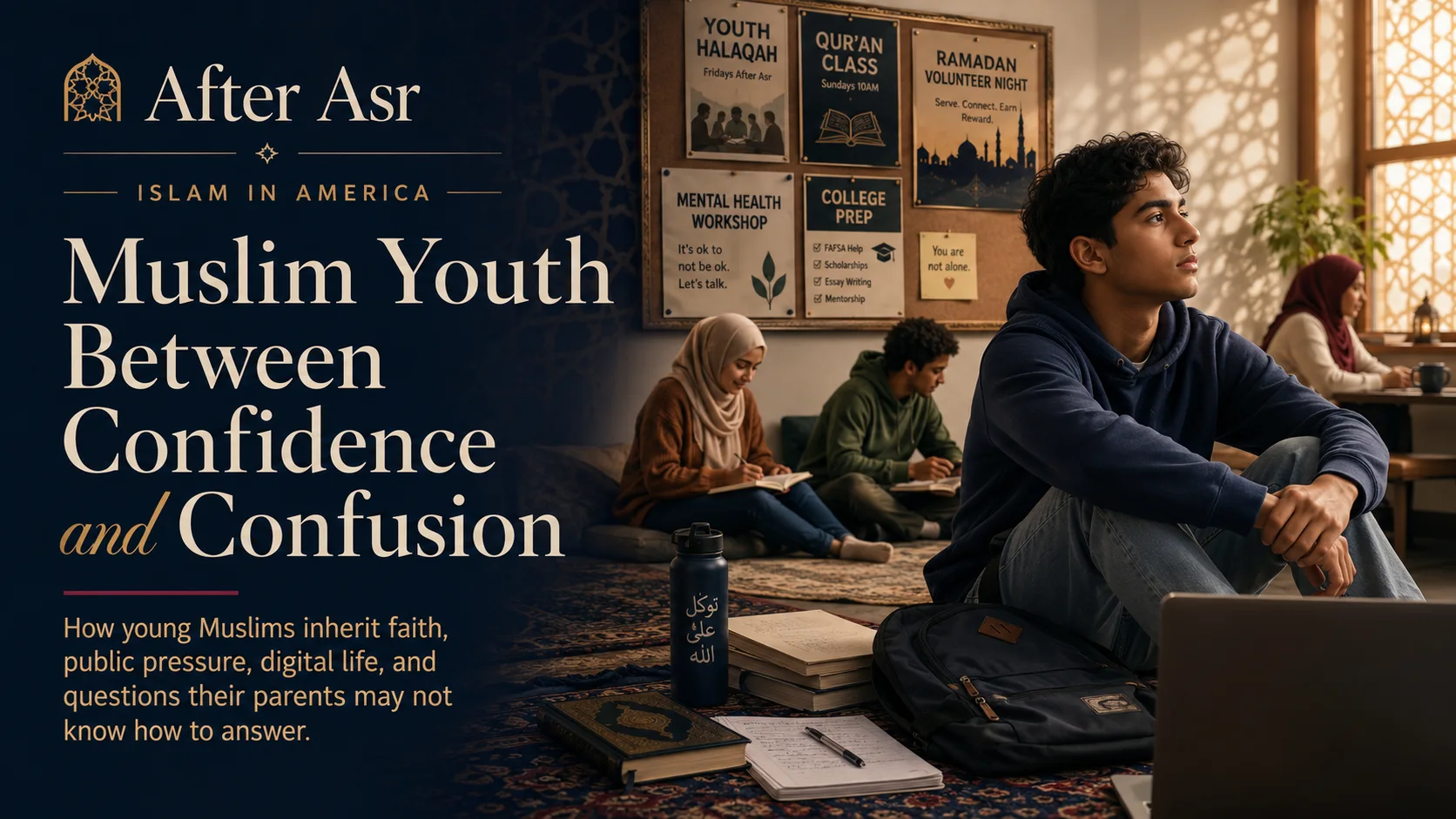
How young Muslims inherit faith, public pressure, digital life, and questions their parents may not know how to answer.
Many young Muslims in America know how to look confident.
They can explain Ramadan to a teacher. They can correct a classmate who thinks all Muslims are Arab. They can say “I’m Muslim” without lowering their voice. They can post Eid photos, share Palestine infographics, defend hijab online, attend an MSA event, wear a kufi or abaya with pride, and joke about “not even water” before the question is asked. Some know the language of representation better than their parents. Some can speak about Islamophobia, identity, culture, racism, and public misunderstanding with a fluency that older generations never had to develop.
But confidence is not the whole story.
Many of these same young Muslims carry confusion they do not always know how to name. They may be proud of Islam and uncertain about prayer. They may defend Muslims publicly while struggling privately with belief. They may know how to speak about community wounds but not how to sit with Qur’an. They may reject stereotypes but quietly absorb the moral assumptions of the culture around them. They may love their parents and feel that their parents do not understand their world. They may ask questions that elders hear as rebellion, when often they are asking whether the faith they inherited is deep enough to live by.
Young Muslims in America are not simply caught between “tradition” and “modernity,” as the tired phrase goes. They are living inside a far more complex field of pressures: family memory, mosque culture, digital life, public suspicion, racial identity, school environments, gender expectations, loneliness, activism, desire, doubt, and the constant demand to become a self before they have learned how to be a servant of Allah.
They are inheriting Islam in a country that often misunderstands Islam, and they are inheriting adulthood in an age that often misunderstands the human being.
This makes their confidence precious.
It also makes their confusion urgent.
The inheritance they did not choose
Young Muslims do not begin from nothing.
They inherit prayer rugs, names, stories, languages, family expectations, mosque memories, Ramadan habits, Eid joy, Qur’an recitation, cultural foods, warnings, hopes, fears, and sometimes wounds. Some inherit strong homes where Islam is lived with warmth. Some inherit homes where Islam is present but mostly as pressure. Some inherit immigrant sacrifices they are expected to honor. Some inherit Black Muslim legacies of dignity, struggle, and leadership. Some inherit convert family complexity, where Islam entered one life and changed many relationships. Some inherit parents who love Islam deeply but never received the tools to teach it with clarity.
This inheritance can be beautiful. A child who grows up hearing Qur’an, seeing prayer, eating suhoor half-asleep, attending Jumu’ah, visiting grandparents, and being loved by a mosque community receives gifts that cannot be measured easily. These memories may return years later when the young person feels far from Allah.
But inheritance can also be confusing.
A young Muslim may be told that Islam is perfect but see Muslims behaving cruelly. They may be taught that family is sacred but experience control, favoritism, or emotional distance. They may hear that the mosque is the house of Allah but feel unwelcome there. They may be told that race does not matter in Islam while watching marriage conversations shaped by racism. They may be taught that modesty is beautiful but hear it discussed mainly through shame. They may be told to respect elders but not see elders apologize.
Young people are observant. They notice contradictions.
When adults dismiss these observations, youth may begin to wonder whether Islam itself is contradictory. Often, what they are struggling with is not Islam, but the gap between Islam and the way Muslims live it. This distinction must be taught patiently. Islam is revelation. Muslim communities are human. The failures of Muslims may wound a person’s relationship to the community, but they do not define the truth of Allah’s guidance.
Youth need adults who can say this without defensiveness.
Yes, that was wrong.
Yes, Muslims can be racist.
Yes, parents can misuse religion.
Yes, mosque leaders can make mistakes.
Yes, culture is sometimes confused with Islam.
And yes, Islam is still true.
This honesty can save faith.
The pressure to be proud
There is a kind of Muslim pride that can strengthen young people.
It tells them they do not need to be ashamed of their names, families, prayers, food, clothing, or sacred days. It helps them withstand mockery. It allows them to answer questions without shrinking. It gives them courage to ask for Eid off, fast in school, wear hijab, avoid certain social spaces, and claim Muslim belonging in public.
But pride can become fragile when it is not rooted in worship.
A young person may become proud of being Muslim as an identity while remaining distant from salah. They may feel strongly about Muslim representation but not know the basics of aqeedah. They may defend the community online but not know how to repent privately. They may feel attached to the aesthetics of Islam: calligraphy, clothing, Ramadan décor, nasheeds, Islamic reminders, social media language, without being formed by the obligations of Islam.
This is not a reason to mock youth. It is a reason to guide them.
Public confidence can be an early doorway. A young Muslim who is proud to be Muslim may be closer to deeper commitment than adults realize. But someone must help them move from identity to submission. From “this is who I am” to “Allah is my Lord.” From defending Islam to obeying Allah. From representation to worship. From cultural belonging to spiritual discipline.
If adults only celebrate Muslim pride without teaching prayer, pride may remain shallow. If adults only criticize shallow pride, youth may feel unseen. The better approach is to honor the courage while inviting the heart deeper.
A young Muslim should be able to say, “I am Muslim,” with confidence.
But the greater formation is learning to say, “I belong to Allah,” with sincerity.
The questions parents did not expect
Many parents are startled by the questions their children ask.
Why do we believe the Qur’an is from Allah? Why does Islam teach this about gender? Why can’t Muslims date like everyone else? Why is hijab expected of women? Why do bad things happen if Allah is merciful? Why do some Muslims act racist? Why do I have to pray if I do not feel anything? Why do scholars disagree? Why is Islam true and not just what our family believes? Why do people online say religion is harmful? Why do I feel guilty all the time? Why does the mosque feel judgmental? Why did Allah create desire and then restrict it?
Some parents hear these questions and panic.
They may answer with anger, shame, or fear. “Do not ask that.” “That is haram to question.” “You are becoming too American.” “Who taught you this?” “You are embarrassing us.” “Just have faith.” “Because Allah said so.” The last answer may be true in a technical sense, but if given too early and without explanation, it may not help a young person who is trying to understand why submission itself is reasonable, beautiful, and true.
Parents should not be blamed for every poor response. Many are carrying their own fears. Some grew up in cultures where religious questions were not asked openly. Some never received serious Islamic education themselves. Some worry that one question will become disbelief. Some are exhausted from work, migration, racism, or family pressure. Some feel their children are being pulled into a world they cannot control.
But fear is not a curriculum.
Young Muslims need room to ask sincere questions. Not every question is sincere, and not every tone is respectful. But many questions that sound provocative are actually signs that a young person still cares enough to ask. The community must create pathways for these questions to be answered by people of knowledge, wisdom, and mercy.
A question ignored does not disappear. It goes elsewhere.
If parents cannot answer, they can say, “I do not know, but I will help you find someone trustworthy.” This sentence can preserve trust. It teaches humility. It shows that Islam is not afraid of inquiry. It tells the child that their question has a place inside the community, not only outside it.
Digital life and the formation of desire
No generation of Muslim youth before this one has carried so much of the world in the hand.
A phone is not just a tool. It is a teacher, a marketplace, a confessional booth, a theater, a mirror, a temptation, a mosque hallway, a debate stage, a dating arena, a school, a rumor mill, and a small machine of comparison. It delivers Qur’an recitation, Islamic reminders, scholars, lectures, and community. It also delivers pornography, envy, cynicism, mockery, cruelty, ideological confusion, consumerism, endless music, spiritual performance, and a constant invitation to be seen.
Digital life does not merely distract youth. It forms them.
It trains attention to be restless. It trains the self to perform. It trains desire to seek stimulation without patience. It trains young people to compare their bodies, clothes, vacations, friendships, marriages, homes, and religiosity to curated images. It turns religious learning into clips. It turns scholars into content personalities. It turns pain into posts. It turns anger into identity. It turns loneliness into scrolling.
Muslim parents often respond with rules, and rules have their place. But rules without formation are weak. A teenager may obey in front of parents and live another life in private. A young adult may know that certain content is harmful and still feel unable to stop. A youth may be ashamed, not guided.
Digital Islamic education must go deeper than “do not watch bad things.”
Young Muslims need to understand the rights of the eyes, the diseases of the heart, the value of hidden deeds, the danger of constant comparison, the spiritual impact of pornography, the ethics of speech, the permanence of digital harm, and the way algorithms shape desire. They need adults to speak honestly without humiliation. They need practical tools: phone boundaries, accountability, replacement habits, real friendships, exercise, worship routines, and safe spaces to seek help.
They also need beauty offline. A youth whose only relief from stress is a phone will return to the phone. A young Muslim needs community, meaningful work, physical activity, friendship, Qur’an, service, family warmth, and spaces where joy is not mediated by a screen.
The digital world is powerful, but it is not destiny. The heart can still be trained. The eyes can still be lowered. The phone can still be put down. But youth need more than warnings. They need a spiritual strategy for the age they are actually living in.
Activism, outrage, and the moral imagination
Many young Muslims are deeply aware of injustice.
They see images of war, occupation, racism, police violence, refugee suffering, anti-Muslim rhetoric, poverty, and hypocrisy. They watch Muslim pain debated by people who do not seem to value Muslim life. They feel anger, grief, and urgency. They want to do something. They want adults to stop being cautious. They want institutions to speak clearly. They want Islam to mean standing with the oppressed.
This moral energy can be a blessing.
A young Muslim who cares about injustice is not lost. The Prophet ﷺ taught concern for the oppressed, truth before power, and mercy for creation. Islam should produce people who cannot be indifferent to suffering.
But activism can become spiritually dangerous when it loses its center.
Outrage can become addictive. Public speech can replace private worship. Political identity can become stronger than Islamic knowledge. Young people can learn to condemn before they learn to pray with presence. They can be pulled into movements that speak powerfully about some injustices while normalizing moral assumptions Islam cannot accept. They can measure faith by volume, slogans, and public alignment. They can become unable to rest because rest feels like betrayal.
The answer is not to tell youth to stop caring. The answer is to teach them how to care as Muslims.
Verify before sharing. Pray before organizing. Make du’a for the oppressed. Learn history. Listen to scholars. Serve locally. Protect the tongue. Do not dehumanize. Do not let anger erase adab. Do not sacrifice Islamic principles for coalition acceptance. Do not make activism the only measure of sincerity. Remember that Allah does not need disobedience to bring justice.
Young Muslims need a moral imagination deeper than outrage. They need to know that changing the world begins with worship, character, knowledge, service, and patience, not only reaction.
Gender, sexuality, and the fear of honest teaching
Among the most difficult questions for many Muslim youth today are questions around gender, sexuality, desire, and identity.
The surrounding culture speaks about these matters with enormous confidence. It tells young people that desire reveals the self, that affirmation is love, that limits are harm, that identity must be declared, that the body is a project of self-expression, and that traditional religious boundaries are oppressive unless reinterpreted. These ideas enter schools, entertainment, social media, friendships, workplace training, and campus life.
Muslim youth are not encountering these questions from a distance. They are encountering them through friends, classmates, siblings, their own feelings, online communities, and public moral pressure. Some are confused. Some are struggling with desires they did not choose. Some fear being hated by their community. Some are angry at shallow answers. Some have absorbed cultural assumptions without realizing it. Some want to remain faithful but do not know how to speak about pain, loneliness, temptation, or identity.
Adults often respond in extremes.
Some panic and speak harshly, making youth feel that difficult feelings place them outside mercy. Others avoid the topic completely, leaving young people to be taught by the internet. Others soften Islam until it no longer says what it says, hoping to keep youth close through reinterpretation. None of these responses is enough.
Muslim youth need truthful, compassionate, serious teaching.
They need to know that Allah’s commands are real. That desire is not always identity. That struggle does not remove dignity. That sin is not solved by shame alone, but by repentance and support. That Islamic moral boundaries are not hatred. That people experiencing difficulty must not be mocked or dehumanized. That the nafs is not the lord. That the body belongs to Allah. That companionship, spiritual care, and mercy are necessary. That public ideologies should be evaluated by revelation, not absorbed because they sound kind.
This teaching requires knowledge and tenderness. It cannot be handled through slogans, fear, or silence.
If parents and mosques refuse to answer, youth will still receive answers. The only question is from whom.
Prayer as the center that often slips
The simplest measure of youth formation is also the one communities sometimes avoid asking plainly.
Are they praying?
Not because prayer is the only part of Islam. But because salah is the pillar that reveals whether Islam has moved from identity into daily submission. A young Muslim may attend events, post Islamic content, defend Muslims publicly, fast Ramadan, and still struggle to pray consistently. This struggle is common, and it should be addressed with seriousness and mercy.
Many youth do not leave Islam all at once. They drift through prayer first.
Fajr becomes difficult. Dhuhr is missed at school. Asr disappears in after-school activities. Maghrib is delayed. Isha becomes negotiable. Eventually prayer feels like something from childhood, or something to return to later, when life is less busy, less confusing, less socially demanding.
Adults sometimes respond with scolding. Scolding may produce temporary guilt, but guilt alone does not build love of salah. Young Muslims need to be taught why prayer matters, how to protect it, how to return after missing it, how to make wudu in public spaces, how to pray at school or work, how to handle embarrassment, how to rebuild consistency, and how to understand prayer as meeting Allah rather than merely fulfilling a rule.
Prayer should be made livable. This does not mean making it optional. It means helping youth build habits around real schedules. Schools and campuses need prayer accommodations. Parents need to model prayer. Mosques need to teach practical fiqh. Youth groups should pause for salah, not treat it as an interruption. Friends should remind one another gently. Communities should celebrate consistency, not only public activism or memorization.
A young Muslim who learns to return to prayer after failure has learned something essential: the door back to Allah is open.
The mosque as refuge or courtroom
For Muslim youth, the mosque can feel like refuge or courtroom.
At its best, the mosque gives them a place to belong. They find friends, mentors, Qur’an, sports, halaqahs, service, Ramadan nights, and adults who know their names. They learn that Islam is not only family pressure, but community life. They see people pray. They hear reminders. They experience sacred time.
At its worst, the mosque becomes a place where they feel watched, judged, scolded, and misunderstood. Girls may feel policed. Boys may feel suspected. Converts may feel exposed. Youth who are not already practicing may feel there is no room for them. Teenagers may be treated as problems to manage rather than souls to nurture. Questions may be met with panic. Energy may be treated as disrespect. Mistakes may become reputations.
Young people remember how the mosque made them feel.
This does not mean mosques should become permissive recreation centers. Youth need adab, boundaries, and correction. But correction must be connected to relationship. A young person who is corrected by someone who loves them may receive it. A young person who is corrected by strangers who only notice them when they are wrong may withdraw.
Mosques should ask: Do our youth feel known here? Do girls have dignified spaces? Do boys have mentors who teach manhood as service and restraint? Do converts and new Muslims find support? Do Black Muslim youth see their history honored? Do young people with questions know where to go? Are youth only invited when volunteers are needed, or are they formed as future trustees?
The mosque should not flatter youth. It should not fear them. It should raise them.
Parents between protection and control
Many Muslim parents in America are trying to protect children from real harms.
They see dating culture, drugs, pornography, alcohol, gender confusion, peer pressure, racism, Islamophobia, school environments, and digital dangers. They worry that one wrong friendship, one bad relationship, one online habit, or one campus environment could pull their child away from Islam. Their fear is not baseless.
But protection can become control when fear governs the home.
A parent may monitor everything, forbid everything, suspect every friend, dismiss every question, and use shame to enforce compliance. The child may obey outwardly while hiding inwardly. Or they may rebel, not only against the control, but against the Islam that was attached to it.
Parents need a better way.
Children require boundaries, but also trust. Supervision, but also conversation. Rules, but also explanation. Religious expectations, but also warmth. Parents should know their children’s friends, phones, schools, and struggles, but they should also build relationships strong enough that children can speak honestly before mistakes become crises.
This is especially important in adolescence. A teenager who cannot tell parents about confusion will seek counsel elsewhere. A daughter who fears only shame may hide harm. A son who is never allowed vulnerability may seek belonging in unhealthy places. A child who hears Islam mainly as restriction may not know its mercy.
Parents must protect without making the home a prison. They must guide without pretending children have no inner life. They must correct without humiliation. They must apologize when wrong. They must learn the world their children inhabit, not only condemn it from a distance.
The goal is not to control youth into appearing Muslim.
The goal is to help them love Allah enough to choose Islam when parents are not watching.
Black Muslim youth and the burden of erasure
Black Muslim youth carry particular layers of inheritance and pressure.
They may inherit the deep roots of Black Muslim history in America, while attending Muslim spaces where that history is barely taught. They may face racism in broader society and anti-Blackness within Muslim communities. They may hear Muslims speak passionately about oppression abroad while ignoring the realities of Black life nearby. They may be expected to explain racism to non-Black Muslims, or to quietly absorb social exclusion for the sake of unity.
This is unfair and spiritually harmful.
Black Muslim youth should not have to fight to be seen as central to American Islam. They should learn that their history is not peripheral. They should see Black Muslim scholars, imams, women teachers, organizers, and families treated as part of the community’s core memory. They should be able to enter Muslim youth spaces without feeling like guests inside someone else’s ethnic culture. They should be protected from jokes, assumptions, marriage racism, and erasure.
Non-Black Muslim youth also need this education. Anti-Blackness is learned early if it is not interrupted early. Children hear family comments. They notice social hierarchies. They absorb who is considered desirable, respectable, religious, or “good family.” Islamic education must challenge these patterns before they become adult prejudice.
A Muslim youth culture that does not confront anti-Blackness cannot claim to be confident in Islam. It has not yet submitted fully to the prophetic standard of human dignity.
Converts, mixed families, and youth without inherited maps
Some young Muslims are converts. Others are children of converts. Others come from mixed Muslim and non-Muslim families. Their experience can differ sharply from those raised inside established Muslim households.
A young convert may enter Islam while still living with non-Muslim parents, attending a school where no one understands, and trying to learn prayer from videos. A child of a convert may have one Muslim parent and one non-Muslim extended family network. A mixed family may celebrate Eid while navigating relatives who still expect old holidays. A young person may love Islam but feel that they do not have the cultural fluency of born Muslims.
These youth need careful belonging.
They should not be treated as less authentic because they lack inherited Muslim culture. They may not know the food, language, jokes, clothing, or mosque habits others assume. They may ask basic questions. They may feel lonely during Ramadan and Eid. They may have family tensions that born Muslims do not understand. They may also bring strengths: conscious faith, empathy for outsiders, ability to explain Islam in American language, and a deep appreciation for guidance.
Mosques and youth programs should make room for them without making them permanent beginners. Teach clearly. Explain assumptions. Invite them into families. Honor their non-Muslim relatives where appropriate. Help them build Muslim identity without requiring them to imitate an ethnic culture that is not theirs.
Islam is not inherited through culture alone. It is received through guidance. Convert youth remind the community of this truth.
The loneliness of being “good”
Some Muslim youth are visibly practicing and quietly lonely because of it.
They do not drink. They avoid parties. They do not date. They pray at school. They dress modestly. They try to lower their gaze. They fast. They attend halaqah. Adults may praise them as “good kids,” but this praise can feel isolating if no one sees the cost.
Being “good” in American youth culture can be lonely.
A young person may miss social events because they know the environment will not be right. They may feel awkward around peers who are dating or experimenting. They may fear being seen as judgmental. They may have desires they do not act on but still struggle with. They may feel pressure from Muslim peers who are less strict and from non-Muslim peers who see their boundaries as strange. They may be tired of always explaining.
Communities should not assume practicing youth are fine because they appear fine.
They need friendship, mentorship, joy, and spaces where obedience does not feel like social exile. They need to know that struggling with desire is not hypocrisy. They need halal recreation, healthy same-gender friendships, service opportunities, physical activity, and adults who can speak about temptation honestly. They need to be praised less as symbols and supported more as human beings.
A young Muslim who avoids haram should not be left with loneliness as their reward.
The community must help make obedience livable.
Doubt, shame, and the path back
Some youth struggle with doubt.
Doubt about Allah. Doubt about revelation. Doubt about moral teachings. Doubt after seeing Muslim hypocrisy. Doubt after trauma. Doubt after consuming online critiques. Doubt after studying science or philosophy in ways that seemed to leave no room for faith. Doubt after unanswered du’a. Doubt after feeling that religious people were unkind.
Doubt is frightening for families. But shame often makes it worse.
A young person who says, “I am struggling to believe,” needs seriousness, not panic. They should not be mocked, dismissed, or treated as already lost. Nor should doubt be romanticized as automatically courageous. Doubt can be sincere. It can also be fed by arrogance, sin, trauma, or confusion. Each case requires wisdom.
The community needs pathways for doubt: teachers who know aqeedah, mentors who can listen, counselors who understand faith, parents who can remain calm, books and classes that address foundations, and spaces where questions are answered without turning the young person into a spectacle.
Most importantly, youth need to know that returning is possible.
A person can drift and return. Miss prayers and return. Ask hard questions and return. Sin and return. Feel numb and return. Feel angry and return. The door of repentance is not a slogan for adults only. It is the most important door in youth formation.
If a young Muslim believes one mistake means they no longer belong, Shaytan has already taught them a lie.
What parents can learn from youth
Adults often speak about what youth need to learn. They should also ask what youth are revealing.
Youth reveal whether our Islamic education has been too shallow. Whether our mosques are welcoming. Whether our families confuse control with guidance. Whether our communities avoid difficult subjects. Whether we have taught Islam as worship or only identity. Whether our racial claims are truthful. Whether our digital strategies are realistic. Whether our marriage expectations are humane. Whether our leaders can answer questions without fear.
Young people are not always right. Their critiques can be immature, unfair, or shaped by the same culture that confuses them. But they are often noticing real gaps.
A wise community does not surrender to youth culture, but it listens to youth experience.
Ask them what questions they hear at school. Ask what makes the mosque feel distant. Ask what they are afraid to discuss. Ask what helps them pray. Ask what confuses them online. Ask what Ramadan feels like in their lives. Ask what they wish parents understood. Ask what kind of mentors they need.
Listening is not the same as agreeing. It is the beginning of guidance.
The Prophet ﷺ knew the people he addressed. He did not guide human beings as abstractions. Parents and leaders cannot guide youth they refuse to understand.
What youth must learn from elders
Youth also need humility toward those who came before.
It is easy to critique parents, mosques, immigrant communities, elders, and institutions. Some critique is deserved. But youth should not mistake imperfection for worthlessness. Many elders built with little support. Many parents carried migration, racism, poverty, trauma, and work pressure while trying to preserve Islam. Many mosque volunteers sacrificed time and money. Many teachers taught without training because no one else would. Many Black Muslim elders carried Islam in conditions younger Muslims have not studied deeply enough. Many converts before them lived with far fewer resources.
Youth should learn this history before dismissing it.
Humility does not require silence in the face of harm. It requires proportion. A young Muslim can say, “This must change,” while also saying, “May Allah reward those who built what we inherited.” They can repair without contempt. They can ask for better without denying sacrifice. They can lead without humiliating elders.
One day, if Allah gives them life, today’s youth will become the elders. Their own blind spots will be visible to another generation. This knowledge should soften their tone.
Building youth spaces with depth
Muslim youth need spaces that are not shallow.
Pizza nights have a place. Sports have a place. Social events have a place. But if youth programming is only entertainment, it will not sustain faith. If it is only lectures, it may not sustain belonging. If it is only warnings, it may not sustain love. If it is only activism, it may not sustain worship.
A strong youth space combines several things.
Prayer at the center. Serious study taught accessibly. Honest conversations. Mentorship. Service. Recreation. Emotional safety. Gender adab. Racial awareness. Convert inclusion. Digital literacy. Marriage preparation when appropriate. Leadership training. Qur’an. Seerah. Spiritual practices. Opportunities to ask questions and opportunities to carry responsibility.
Youth should not only consume programming. They should help build. Let them organize service projects, mentor younger children, help with Ramadan, visit elders, prepare reminders, clean the masjid, raise funds for the poor, and learn how institutions work. Responsibility creates belonging.
But adults must stay involved. Youth leading youth without mature support can become unstable. Adults controlling everything can suffocate growth. The better path is guided trust.
A youth program should not aim merely to keep young people busy. It should help them become Muslims who can live faithfully when no program is nearby.
Confidence rooted in Allah
The confidence young Muslims need is not the confidence of branding.
Not the confidence of being publicly impressive. Not the confidence of winning arguments. Not the confidence of having the right captions. Not the confidence of representation alone. Not the confidence of being seen as cool, balanced, moderate, authentic, radical, traditional, progressive, or anything else the age rewards.
They need confidence rooted in Allah.
This confidence is quieter and stronger. It knows that Islam is true even when Muslims are imperfect. It knows that prayer matters even when the heart feels distracted. It knows that desire is real but not sovereign. It knows that public opinion changes, but revelation does not. It knows that asking questions is allowed, but the self is not the measure of truth. It knows that being misunderstood by others does not erase being known by Allah. It knows that repentance is always possible.
This kind of confidence is built slowly.
At the family table. In the prayer room. In the masjid hallway. In the youth halaqah. In the car ride after a difficult conversation. In the phone placed face down. In the first sincere du’a after months of distance. In the teacher who answers without panic. In the parent who apologizes. In the friend who reminds gently. In the Qur’an verse that reaches the heart unexpectedly. In the fast kept when no one would know if it was broken.
Young Muslims do not need adults to pretend the world is simple.
They need adults to show that Islam is deep enough for the world as it is.
Between confidence and confusion
Muslim youth in America are not doomed.
They are also not automatically fine.
They are between confidence and confusion, and many are carrying both at once. They are more visible than previous generations, but visibility is not the same as rootedness. They are more fluent in public identity, but fluency is not the same as worship. They have more access to Islamic knowledge, but access is not the same as formation. They have more Muslim peers in some places, but community is not the same as belonging.
The response cannot be nostalgia. It cannot be panic. It cannot be control. It cannot be shallow celebration. It cannot be silence.
It must be serious love.
Love that teaches prayer.
Love that answers questions.
Love that tells the truth about sin and mercy.
Love that understands digital life.
Love that confronts racism.
Love that welcomes converts.
Love that honors parents without excusing harm.
Love that gives youth responsibility.
Love that builds mosques where they are known.
Love that directs them back to Allah, not merely back to culture.
A young Muslim standing in this age needs more than “be proud.” They need to know why they believe, how to worship, where to seek knowledge, how to repent, how to resist pressure, how to love the ummah without being consumed by its wounds, and how to live as a servant of Allah in public and private.
The world will keep asking them to define themselves.
Islam teaches them to begin elsewhere.
Not with the self.
With Allah.
If they inherit that, truly inherit it, not only as a name or memory or family expectation, then their confidence can survive confusion. And when they stumble, as all human beings do, they will know the path back.
That may be the most important inheritance we can give them.
Not certainty without questions.
But faith deep enough to carry questions back to the One who guides.