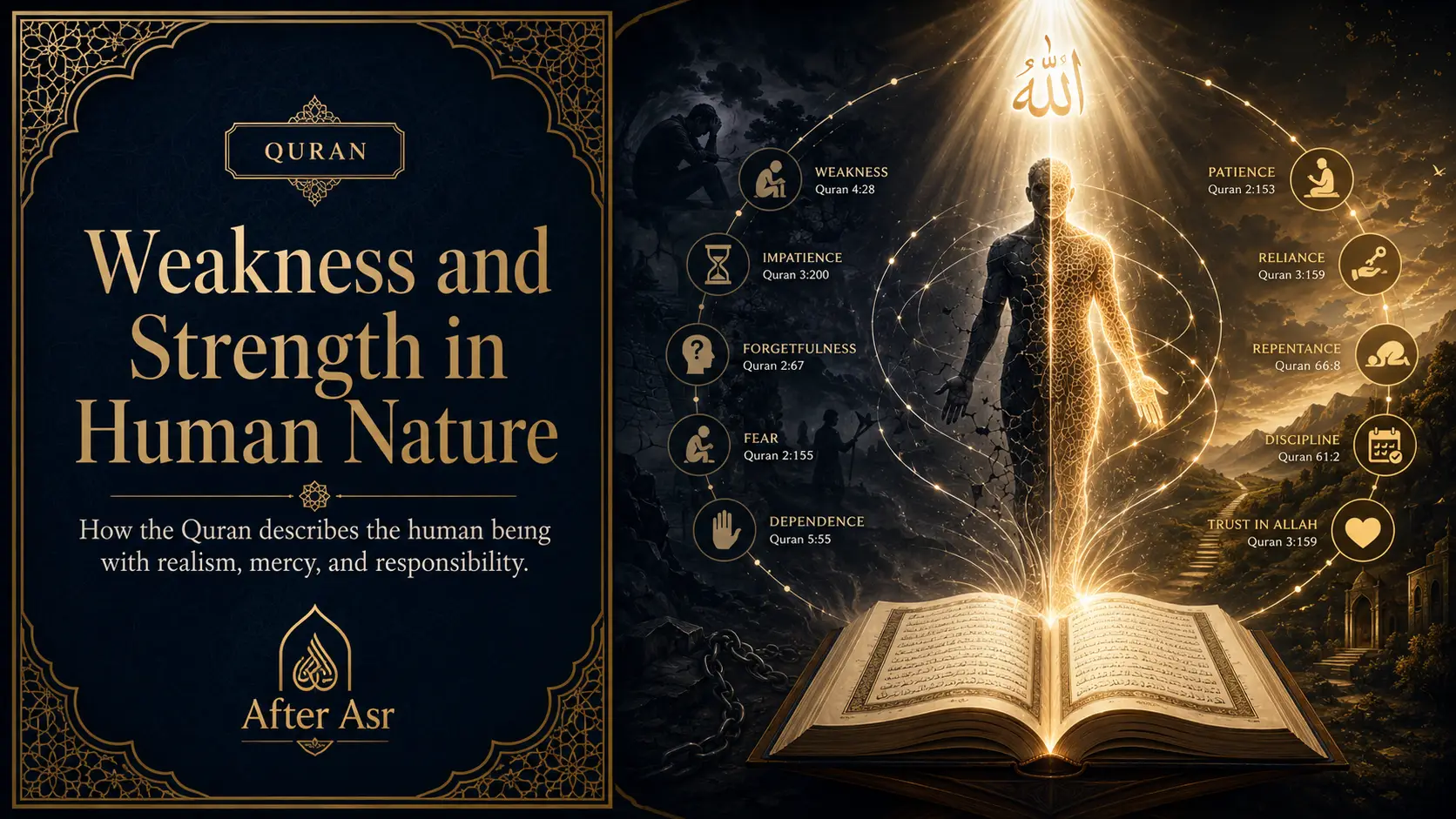
How the Quran describes the human being with realism, mercy, and responsibility.
The Quran describes the human being with a realism that refuses both flattery and contempt. It does not tell us that we are angels trapped in bodies, nor does it reduce us to appetite, survival, and instinct. It tells us that we are honored, created with purpose, entrusted with responsibility, and capable of knowing Allah. It also tells us that we are weak, impatient, forgetful, argumentative, prone to ingratitude, easily deceived by the world, and often unaware of our own dependence.
This balance is one of the Quran’s great gifts. Human beings tend to misunderstand themselves in opposite directions. Sometimes we exaggerate our strength. We imagine ourselves independent, self-made, morally clear, and in control. At other times, we collapse into despair and imagine our weakness as proof that we are worthless, incapable, or beyond repair. The Quran corrects both illusions. It tells the arrogant human being to remember their origin, their need, and their return to Allah. It tells the broken human being that weakness is not the end of the story, because Allah guides, forgives, strengthens, and raises whom He wills.
In the Quran, human weakness is not denied. It is named. But it is named within a larger vision of mercy, accountability, and transformation. We are weak, but we are not abandoned. We are tested, but not without guidance. We fall, but repentance is open. We fear, but reliance upon Allah is available. We are not self-sufficient, but dependence upon Allah is not humiliation. It is the truth that makes strength possible.
The Human Being Is Created Dependent
The first correction the Quran gives to human pride is the reminder of origin. The human being did not create himself. He did not choose the terms of existence, design his body, command his first breath, determine his parents, control his moment of birth, or guarantee his next heartbeat. Before the human being thinks, plans, builds, argues, worships, sins, or repents, he exists as a recipient.
This is not a small point. Much of human arrogance begins when dependence becomes invisible. A person grows strong, earns money, gains knowledge, builds status, and slowly begins to feel self-originating. They speak as though ability came from nowhere. They act as though provision is purely the result of intelligence. They forget how many conditions had to be granted before they could claim any achievement at all.
The Quran repeatedly returns the human being to dependence because dependence is the beginning of truthfulness. To know oneself correctly is to know that one is created, sustained, limited, and returning. This does not erase human effort. Islam does not deny planning, work, discipline, or excellence. But it places all effort under the reality of Allah’s sustaining power. Strength is real, but it is borrowed. Intelligence is real, but it is gifted. Opportunity is real, but it is opened. Life itself is not owned. It is entrusted.
Weakness Is Part of the Test
The Quran does not treat weakness as an accident outside the divine plan. Human beings are tested through their limitations. We tire, fear, desire, forget, grieve, become confused, and face pressure from within and without. These conditions are not meaningless. They are part of the arena in which faith becomes real.
Patience would have no meaning if the human being never suffered. Courage would have no meaning if fear did not exist. Gratitude would have no meaning if blessings were never noticed as gifts. Repentance would have no meaning if the human being never faced the truth of sin. Reliance upon Allah would remain theoretical if the servant never encountered situations beyond personal control.
This does not mean weakness should be romanticized. Weakness can lead people into sin, cowardice, despair, or injustice. But weakness can also become a doorway to humility. A person who knows their limits may ask Allah more sincerely. A person who sees their moral vulnerability may become less judgmental toward others. A person who experiences failure may finally stop worshiping their own competence. Weakness can either expose the nafs or soften the heart. The difference lies in whether the person responds with denial or return.
The Illusion of Self-Sufficiency
One of the most dangerous forms of human weakness is the illusion of strength. The Quran repeatedly warns against the person who sees himself as self-sufficient. This condition is spiritually dangerous because the person no longer feels the need to be guided, corrected, forgiven, or restrained. He may still believe in Allah verbally, but functionally he lives as though he is enough.
Self-sufficiency can appear in many forms. Wealth can produce it. Knowledge can produce it. Physical strength can produce it. Beauty can produce it. Religious reputation can produce it. Leadership can produce it. Even personal discipline can produce it if a person begins to admire their own control more than they thank Allah for protection.
The illusion of self-sufficiency is not strength. It is blindness. A person who forgets their dependence is not more powerful than others. They are less aware of reality. True strength begins when the servant knows that every breath, victory, insight, and act of obedience depends upon Allah. This knowledge does not make the believer passive. It makes them humble. They still act, but they no longer worship their action.
The Human Being Is Impatient
The Quran describes the human being as impatient, and this description is painfully recognizable. We want relief quickly, answers quickly, success quickly, change quickly, justice quickly, healing quickly, and certainty quickly. When delay enters, the heart becomes restless. We begin to question, complain, rush, force, or despair.
Impatience reveals a deeper issue: we often want reality to obey our timeline. We forget that Allah’s wisdom is not measured by our urgency. The child wants the fruit before it ripens. The sick person wants healing before the treatment has done its work. The believer wants the result before the test has completed its purpose. Impatience is not merely wanting good things. It is the demand that good arrive according to the schedule of the nafs.
The Quran teaches patience not because pain is unreal, but because the human being cannot see the whole picture. Patience is not pretending that hardship is easy. It is remaining faithful when hardship is not yet explained. It is refusing to disobey Allah because the answer has been delayed. It is trusting that the One who knows the beginning and the end is not absent from the middle.
The Human Being Is Forgetful
Forgetfulness is one of the most repeated human conditions in the Quran. We forget Allah after being rescued. We forget gratitude after being provided for. We forget death while planning for the world. We forget our own sins while noticing the sins of others. We forget the Hereafter when the dunya becomes loud. We forget promises made in moments of desperation once comfort returns.
This forgetfulness is not always intellectual. A person may know something and still live as though they do not know it. They may know death is certain, yet delay repentance. They may know Allah sees, yet sin privately. They may know wealth is temporary, yet allow it to define their worth. They may know the Quran is guidance, yet treat it as something to be visited only when life becomes unbearable.
The Quran responds to forgetfulness with remembrance. Prayer repeats. Recitation repeats. Warnings repeat. Stories repeat. Ramadan returns. Jumu’ah returns. The believer is not given a religion of one-time inspiration because the human being does not forget only once. We need repeated return because distraction is continuous. This is not a flaw in the structure of worship. It is mercy fitted to our nature.
The Human Being Is Argumentative
The Quran also describes the human being as argumentative. This is not a rejection of sincere questioning or careful reasoning. Islam values understanding, evidence, reflection, and knowledge. The problem is not honest inquiry. The problem is the kind of argument that becomes a shield against surrender.
The argumentative self can turn every command into a debate, every reminder into a technicality, every moral demand into a discussion about exceptions. It may not be seeking truth. It may be seeking escape. It may ask, “But what about this?” not because it wants clarity, but because clarity would require obedience. Such argumentation often hides the ego beneath intellectual language.
This remains relevant in every age. A person can use religious language to avoid religion, academic language to avoid humility, trauma language to avoid responsibility, political language to avoid personal repentance, or philosophical language to avoid worship. The Quran does not fear sincere thought, but it exposes evasive thought. The mind is a gift when it leads to truth. It becomes a weapon against the self when it is used to protect desire from guidance.
The Human Being Can Be Noble
The Quran names human weakness, but it does not define the human being only by weakness. It also speaks of human honor, responsibility, and potential. The human being can know Allah, worship Him, choose truth over desire, give when selfishness calls, forgive when revenge feels sweet, stand for justice when silence is safer, and repent after failure. This capacity is part of the dignity of the human being.
Islamic realism is not cynicism. The Quran does not say, “You are weak, therefore nothing can be expected of you.” It says, in effect, “You are weak, therefore seek Allah’s help, discipline yourself, remember your return, and do not trust the nafs without guidance.” Human beings are not angels, but they are not animals without moral responsibility either. We are accountable because we are capable of responding to guidance.
This is why the Quran’s commands are not insults to human weakness. They are signs that the human being can be addressed. Allah commands because the human being can obey by His help. Allah warns because the human being can turn back. Allah forgives because the human being can repent. Allah teaches because the human being can learn.
Strength Through Submission
The Quran’s understanding of strength is very different from the world’s. The world often associates strength with domination, self-assertion, emotional invulnerability, wealth, influence, and the ability to satisfy one’s will. The Quran presents a deeper strength: the strength to submit to Allah when the nafs resists.
It takes strength to restrain anger when one has the ability to wound. It takes strength to forgive when forgiveness is appropriate and revenge is available. It takes strength to admit wrong when pride demands defense. It takes strength to obey Allah when desire is intense. It takes strength to speak truth when silence is profitable. It takes strength to remain patient when the outcome is delayed. It takes strength to be unseen by people and still sincere before Allah.
Submission is sometimes imagined as weakness because it involves surrender. But surrender to Allah frees the believer from surrendering to lesser things. The person who submits to Allah does not have to submit absolutely to public opinion, appetite, fear, status, or resentment. They are not without struggle, but they have a higher loyalty. That higher loyalty is the root of Quranic strength.
Strength Is Not Harshness
Some people confuse strength with hardness. They think a strong believer must be emotionally cold, severe in speech, suspicious of gentleness, and unmoved by pain. This is not the Quranic model. The prophets were strong, but they were not cruel. The Prophet Muhammad, peace and blessings be upon him, carried the heaviest message with patience, mercy, courage, and tenderness. His strength did not require the death of compassion.
In fact, harshness is often a cover for weakness. A person may be harsh because they cannot control their anger. They may mock others because they fear vulnerability. They may refuse apology because their ego is fragile. They may dominate because they cannot persuade. They may call cruelty “truth” because they have not learned discipline of the tongue.
Quranic strength is morally disciplined. It can be firm without being unjust. It can correct without humiliating. It can oppose falsehood without loving aggression. It can carry pain without turning pain into oppression of others. Strength in Islam is not the absence of mercy. It is the ability to remain upright under the command of Allah.
Weakness Can Become an Excuse
Although the Quran acknowledges weakness, it does not allow weakness to become an excuse for permanent irresponsibility. A person may say, “I am only human,” in a way that leads to humility and repentance. That is good. But the same phrase can be used to normalize sin, avoid effort, or dismiss harm. “I am only human” can become a shield against change.
The Quran’s realism is not permissiveness. Yes, the human being is weak. Yes, desire is real. Yes, fear is real. Yes, trauma, pressure, and habit can make obedience difficult. But difficulty does not erase responsibility. It may affect how a person is judged by Allah, whose knowledge is perfect, but it does not turn every surrender to the nafs into innocence.
This balance is important. Religious discourse can sometimes be too harsh, ignoring real human vulnerability. Modern discourse can sometimes be too indulgent, treating every weakness as identity and every desire as truth. The Quran gives a wiser path. It recognizes weakness, opens repentance, commands effort, and never denies Allah’s mercy.
Strength Can Become a Test
Just as weakness can be a test, strength can be a test as well. A person may be tested by poverty, but also by wealth. They may be tested by illness, but also by health. They may be tested by being ignored, but also by being admired. They may be tested by lacking power, but also by gaining it.
Strength often reveals hidden dangers. When people have power, they discover whether they are just. When they have wealth, they discover whether they are generous. When they have knowledge, they discover whether they are humble. When they have beauty, they discover whether they are grateful or vain. When they have influence, they discover whether they serve truth or seek control.
This is why the Quran does not allow us to envy strength too quickly. What looks like blessing may be trial. What looks like ease may be exposure. A person may be given exactly what reveals the disease of their heart. Another may be deprived of what would have destroyed them. The believer learns to ask not only for strength, but for strength that is guided, purified, and used in obedience to Allah.
The Strength of Repentance
Repentance is often misunderstood as a sign of weakness. In reality, sincere repentance requires courage. It requires a person to face themselves without disguise. It requires admitting that the nafs was wrong, that desire misled, that harm may have been done, and that Allah’s command was higher than one’s excuses.
Many people would rather continue performing strength than repent. They defend, minimize, blame, distract, intellectualize, or harden themselves. Repentance breaks that false strength. It brings the person low before Allah, and in that lowering there is honor. The servant who returns is stronger than the ego that refuses to bow.
The Quran repeatedly opens the door of repentance because human beings repeatedly need to come back. Repentance does not mean the struggle is over. It means the direction has changed. A person may repent from the same weakness many times while continuing to fight sincerely. They should not despair. The weakness is real, but so is Allah’s mercy.
The Strength of Patience
Patience is one of the most misunderstood forms of strength. It is not passivity, numbness, or pretending not to hurt. Quranic patience is steadfastness under Allah’s command. Sometimes it means enduring hardship without despair. Sometimes it means restraining the self from sin. Sometimes it means continuing obedience when enthusiasm fades. Sometimes it means refusing revenge. Sometimes it means working for justice without becoming unjust.
Patience is difficult because it often has no audience. Anger is visible. Reaction is visible. Complaint is visible. Patience may be hidden inside a person’s chest while they continue doing what is right. Allah knows this hidden struggle. The world may see only that someone remained quiet, but Allah knows the storm they restrained.
The impatient person may look powerful because they act quickly, speak sharply, and demand immediate outcome. But the patient person may possess a deeper strength: mastery over the self for the sake of Allah. Such strength is not dramatic in the worldly sense, but it is weighty in the Quranic scale.
The Strength of Reliance Upon Allah
Tawakkul, reliance upon Allah, is not the abandonment of effort. It is the placing of the heart’s dependence where it belongs after effort has been made. The believer plans, works, seeks means, and acts responsibly, but does not worship the means. They understand that outcomes belong to Allah.
This reliance is a form of strength because it frees the person from being destroyed by uncertainty. The believer does not know the future, but knows the Lord of the future. They do not control every result, but they are not spiritually orphaned. When doors close, they grieve but do not conclude that Allah has disappeared. When doors open, they rejoice but do not forget the Opener.
Reliance upon Allah is especially important because human weakness becomes most obvious when control fails. Illness, loss, betrayal, death, delay, and uncertainty all reveal the limits of planning. Tawakkul does not remove the pain of those moments, but it gives the heart a place to stand. The believer’s strength is not that they control everything. It is that they belong to the One who does.
Community and Human Weakness
The Quranic view of human nature also explains why community matters. Human beings are weak alone. We forget, become discouraged, normalize habits, and lose perspective. Righteous companionship can remind, correct, encourage, and protect. A healthy community helps the individual remain oriented toward Allah.
But community can also amplify weakness when it is built on heedlessness, arrogance, gossip, materialism, or performance. People become shaped by the circles they sit in. A person may begin to see sin as normal because everyone around them laughs at it. They may begin to see arrogance as confidence because their environment rewards it. They may begin to see religious seriousness as excessive because their companions mock it.
The believer must therefore be attentive to social influence. Strength is not only an individual trait. It is supported or weakened by surroundings. Good company does not make a person perfect, but it makes return easier. Bad company does not force sin, but it makes sin feel lighter. The Quranic human being is responsible, but also deeply influenceable. Wisdom requires recognizing both.
The Strong Servant Still Needs Allah
Perhaps the most important point is this: even the strong servant remains dependent on Allah. Spiritual maturity does not remove need. If anything, it deepens awareness of need. The more a believer grows, the more they recognize how easily they could fall without Allah’s protection. They do not trust themselves absolutely. They ask Allah for firmness, sincerity, forgiveness, and a good ending.
This protects the believer from spiritual arrogance. A person may overcome one weakness and then become proud of their discipline. That pride becomes a new weakness. A person may gain knowledge and then look down on those who struggle. That contempt becomes a disease. A person may become known for righteousness and then secretly depend on being seen as righteous. That reputation becomes a test.
The strong believer is not the one who no longer needs Allah. The strong believer is the one who knows their need and lives accordingly.
Conclusion
The Quran’s description of human weakness and strength is neither flattering nor despairing. It tells the truth about us. We are dependent, impatient, forgetful, argumentative, easily deceived, and vulnerable to desire. We are also honored, responsible, capable of repentance, able to worship, able to love truth, able to resist the nafs, and able to become strong through submission to Allah.
Weakness becomes dangerous when it is denied, excused, or allowed to rule. Strength becomes dangerous when it is admired as self-sufficiency. The Quran teaches a better path: recognize weakness, seek Allah’s help, discipline the self, repent often, use strength as a trust, and never forget that every good within us is from Allah’s mercy.
The human being is not saved by pretending to be strong.
Nor is the human being doomed by admitting weakness.
The servant becomes strong when weakness leads to humility, humility leads to reliance, reliance leads to obedience, and obedience leads back to Allah.