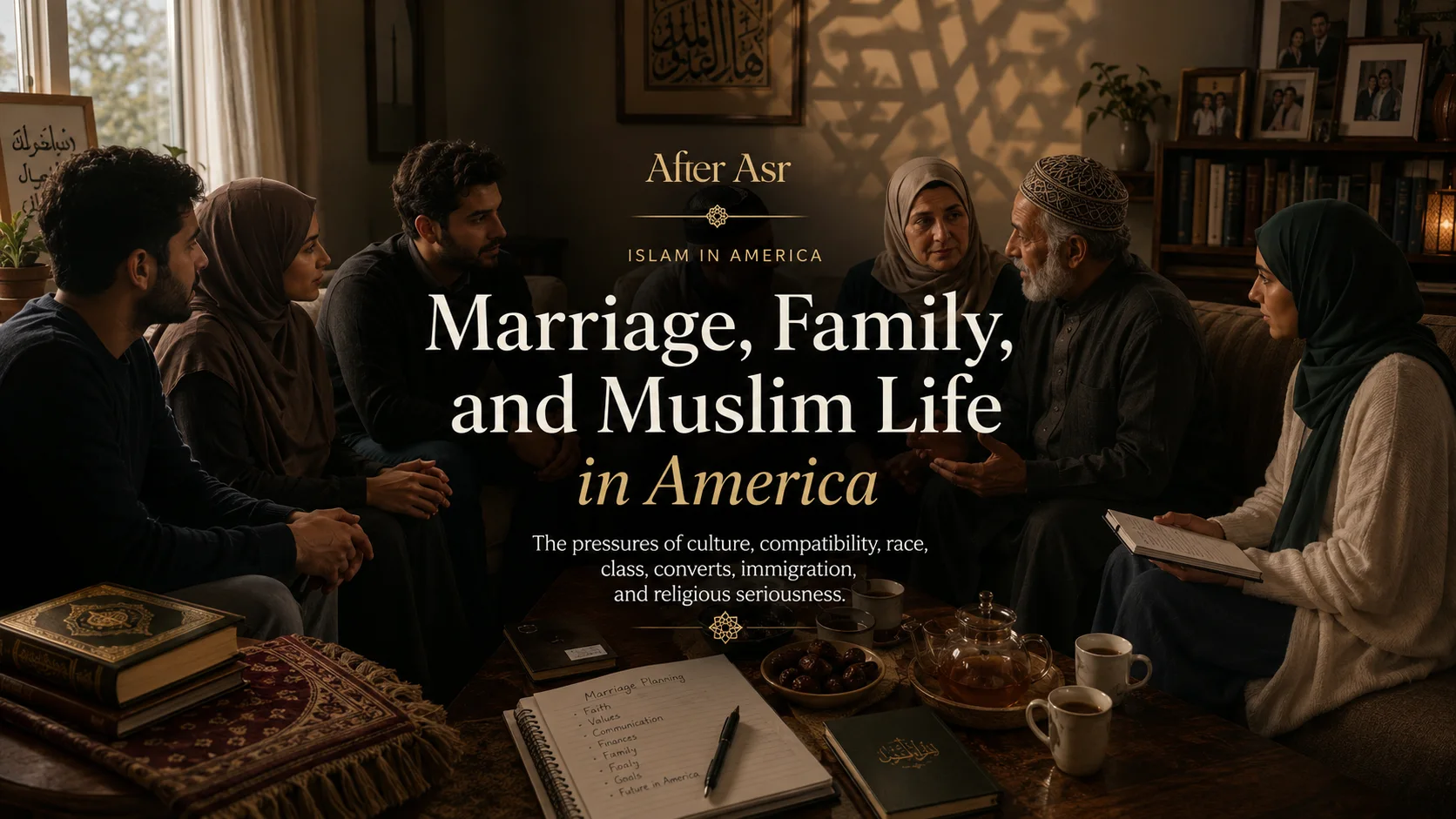
The pressures of culture, compatibility, race, class, converts, immigration, and religious seriousness.
Marriage in American Muslim life is often spoken about with urgency.
Parents worry. Young adults grow tired. Imams are asked to mediate. Aunties know someone who knows someone. WhatsApp groups circulate biodata. Muslim dating apps promise efficiency but often deliver exhaustion. Converts wonder where they fit. Immigrant families try to preserve expectations brought from elsewhere. American-born Muslims negotiate between religious boundaries and a culture of casual intimacy. Black Muslims, Latino Muslims, white Muslims, Arab Muslims, South Asian Muslims, African Muslims, and others encounter one another in masjids, campuses, workplaces, and online spaces, but not always across family tables. People speak of deen, character, chemistry, culture, class, education, race, immigration status, parental approval, mahr, weddings, timelines, and fear.
Beneath all of this is a quieter truth: Muslims in America are trying to form families in a society that often makes family formation difficult.
The surrounding culture offers many scripts. Romance as self-discovery. Marriage as personal fulfillment. Dating as trial and error. Desire as identity. Career as the center of adulthood. Independence as moral maturity. Family as optional support rather than sacred responsibility. Divorce as failure or freedom, depending on who tells the story. Children as lifestyle choice. Elders as interference. Religion as preference.
Islam offers another frame. Marriage is not merely romance, culture, or social achievement. It is a covenant, a mercy, a protection, a responsibility, and a place where faith is tested in the ordinary. It is where character becomes visible after the wedding clothes are put away. It is where families meet, not only two individuals. It is where rights and mercy must live together. It is where love must be disciplined by worship, patience, honesty, and accountability before Allah.
But Muslim marriage in America is not simple. It sits at the intersection of multiple pressures: culture, compatibility, race, class, converts, immigration, gender expectations, parental fear, and religious seriousness. To speak honestly about it requires more than slogans. It requires tenderness, courage, and a willingness to separate Islam from the habits Muslims sometimes place around it.
Marriage as worship, not status management
One of the first things Muslims must recover is the spiritual seriousness of marriage.
Marriage is not only a milestone. Not only a family event. Not only a wedding. Not only a solution to loneliness. Not only protection from haram. Not only the respectable next step after education and employment. Not only a cultural announcement that a family has done what families are expected to do.
Marriage is worship when entered and lived for Allah.
This does not make it easy or sentimental. Worship is often difficult. Marriage brings another person’s rights into the center of daily life. It asks people to manage money, desire, anger, family expectations, household labor, children, illness, disappointment, forgiveness, and growth. It reveals whether someone’s religious language has become character. It tests whether a person who speaks beautifully in public can be gentle in the kitchen, honest with money, patient in conflict, and humble when corrected.
American Muslim communities sometimes speak intensely about getting married, but less consistently about becoming marriageable in the Islamic sense. A person may know what they want in a spouse but not what they owe as a spouse. They may know their preferred ethnicity, height, income, education, and religious appearance, but not how they respond under stress. They may want a “practicing spouse” while neglecting the practice of mercy, responsibility, or emotional maturity themselves.
The question should not only be, “Who can I marry?”
It should also be, “What kind of servant of Allah am I becoming before I ask someone to build a life with me?”
This shift changes the conversation. Marriage becomes less about managing status and more about preparing for amanah, a trust.
Culture as gift and obstacle
Culture shapes Muslim marriage deeply.
It shapes how families meet, who initiates, what questions are asked, what weddings look like, how elders are involved, what counts as respect, how mahr is discussed, what roles husbands and wives are expected to play, how conflict is handled, whether divorce is spoken of with mercy or shame, and whether a couple is allowed to build a home different from their parents’ homes.
Culture can be a gift. It can provide structure, beauty, continuity, family involvement, modesty, ceremony, language, food, and a sense that marriage is not merely private romance but a joining of families. It can protect young people from being left alone to navigate desire and commitment without support. It can remind couples that marriage is larger than the individual self.
But culture can also become an obstacle when it is treated as religion.
Some families make marriage unnecessarily difficult through expectations that Islam did not require. Ethnic restrictions. Excessive weddings. Unrealistic mahr negotiations. Demands around education, profession, tribe, caste, nationality, language, skin tone, family reputation, or immigration status. Suspicion toward converts. Disapproval of interracial marriage. Preference for wealth disguised as concern for stability. Control over adult children disguised as parental rights.
When culture becomes heavier than Islam, people suffer.
Young adults delay marriage because they cannot afford the performance around marriage. Converts feel unwanted because they do not bring the “right” family background. Black Muslims face anti-Blackness in marriage discussions. Women are judged by standards that men escape. Men are valued by income more than character. Divorced people are treated as damaged. Families reject good matches because they do not fit inherited expectations.
A faithful community does not need to erase culture. It needs to place culture beneath revelation.
Families can preserve beauty without sanctifying prejudice. They can honor elders without enabling control. They can celebrate weddings without creating debt. They can prefer shared background without making ethnicity an idol. They can ask about compatibility without turning class into worth. They can involve parents without making adult children prisoners of fear.
Islam should judge culture. Culture should not judge Islam.
Compatibility is not sameness
Muslim marriage conversations often use the word compatibility, but compatibility is not always understood well.
Some assume compatibility means sameness: same ethnicity, same language, same education level, same class, same family style, same national background, same food, same community, same personality, same religious exposure. Similarity can help. Shared language, culture, family expectations, and life experience may reduce friction. It is not wrong to consider these things.
But compatibility is not sameness.
Two people can come from the same culture and be deeply incompatible in character, goals, emotional maturity, religious seriousness, money habits, family boundaries, and conflict style. Two people from different backgrounds can build a strong marriage if they share values, communicate honestly, respect one another’s families, and place Allah above ego.
Real compatibility asks deeper questions.
How do you pray? How do you repent? How do you handle anger? What does leadership mean to you? What does mercy mean to you? How do you speak when disappointed? What does money mean in your family? How do you understand gender roles and household labor? How involved should parents be? How will children be raised? How do you handle race, culture, and class? What are your expectations around work, education, relocation, intimacy, conflict, and community life? What does Islamic growth look like to you?
American Muslims need better premarital conversations. Not interrogations designed to create fear, but serious guided discussions before emotions, family pressure, or wedding plans make honesty harder. Imams, counselors, mentors, and mature married couples can help. Communities should normalize premarital education, not only wedding preparation.
Marriage is not strengthened by avoiding difficult questions. It is strengthened by asking them with adab before they become wounds.
Race and the marriage test
Marriage is where many Muslim communities discover whether their talk of equality is real.
A mosque may celebrate diversity in prayer, but when marriage is discussed, racial hierarchies emerge. Families who praise Bilal ibn Rabah, may Allah be pleased with him, may resist a Black spouse for their child. Communities that speak against Islamophobia may practice anti-Blackness in private. People who say “we are all Muslim” may suddenly care deeply about skin tone, ethnicity, family origin, or what relatives will say.
This is a spiritual scandal.
The problem is not that families consider compatibility. The problem is when race becomes a barrier where deen and character should carry decisive weight. The problem is when anti-Blackness is disguised as “cultural preference.” The problem is when darker skin, Black American identity, African origin, or certain ethnic backgrounds are treated as social liabilities. The problem is when Muslims condemn racism publicly but allow it to shape marriage privately.
Black Muslims in America have carried Islam on this land for centuries. To treat Black Muslims as unsuitable marriage partners while benefiting from the foundations they helped build is not only hypocrisy. It is a failure of religious understanding.
Interracial and intercultural marriages are not automatically easy. Families may need to navigate language, food, expectations, children’s identity, and social assumptions. But difficulty is not the same as impermissibility. Many families reject good matches not because of real incompatibility, but because of prejudice, fear, and reputation.
Muslim communities must speak about this clearly. Parents need to examine their hearts. Young people need courage and wisdom. Imams need to name racism in marriage, not only racism in society. Families need to stop using “what will people say” as though people are more important than Allah.
Marriage reveals what communities really believe about human dignity.
Class, education, and the economics of marriage
Class pressure has become one of the major forces shaping Muslim marriage in America.
Families want stability. That is understandable. Marriage requires financial responsibility. Islam does not dismiss material realities. A spouse should consider whether the household can be sustained, whether debts exist, whether expectations are realistic, and whether both people understand money.
But stability is not the same as status.
Many marriage searches now reflect a narrow vision of success: certain degrees, certain incomes, certain professions, certain neighborhoods, certain family reputations. Doctors, engineers, lawyers, tech workers, business owners, and highly educated professionals may be treated as more marriageable, while teachers, tradespeople, service workers, artists, community workers, or people still building their lives are undervalued. A man may be dismissed because he is not yet wealthy enough. A woman may be judged by educational status and appearance at the same time. Families may speak of deen, then choose by class.
This harms the community.
It delays marriage. It creates unrealistic expectations. It makes young people feel they must become financially impressive before they can become emotionally and spiritually responsible. It burdens men with status anxiety. It burdens women with the expectation to be educated, attractive, modest, professionally successful, family-oriented, and endlessly adaptable. It turns marriage into an economic sorting system.
Weddings add another burden. Some families spend beyond their means to meet cultural expectations. Couples begin married life with debt, resentment, or exhaustion. A wedding meant to announce a sacred covenant becomes a performance for guests.
Muslims need a simpler, more truthful marriage economy. Responsible financial planning, yes. Extravagance, no. Stability, yes. Class arrogance, no. Mahr with dignity, yes. Competitive display, no. Honoring guests, yes. Burdening families, no.
The barakah of a marriage is not measured by the venue.
Converts and the question of belonging
Converts often face unique difficulty in Muslim marriage.
Some are welcomed warmly into the community but treated hesitantly when marriage becomes serious. Families may worry about their background, relatives, cultural habits, Islamic knowledge, past life, or whether they will remain Muslim. Some concerns may be practical and worth discussing. A convert may need support, education, and time to become grounded. But too often, hesitation becomes prejudice.
A convert may be loved as a story but not wanted as a spouse.
This is deeply painful. The community celebrates their shahadah, calls them brother or sister, praises their courage, and then quietly excludes them from family life. They may not have Muslim parents to advocate for them. They may not understand marriage processes. They may be vulnerable to being rushed, idealized, or exploited. Convert women may face men who romanticize them but do not protect them. Convert men may struggle to be taken seriously by families. Converts of all backgrounds may be treated as spiritually inspiring but socially uncertain.
Communities need better systems. Convert mentorship should include marriage education. Families considering a convert should ask real questions with mercy, not suspicion. Converts should be guided toward Islamic learning, stable community, and wise counsel before marriage. Born Muslims should not use converts to escape family expectations or pursue novelty. Converts should not be treated as less worthy because they entered Islam later.
A convert brings a history, a family, a culture, and a soul guided by Allah. They are not blank. They are not trophies. They are not risks by default. They are Muslims.
If a community truly believes Islam makes people brothers and sisters, it must learn how to include converts in the most intimate structures of belonging: marriage, family, and home.
Immigration, papers, and vulnerability
Marriage in American Muslim communities is sometimes shaped by immigration realities.
A spouse may be overseas. A family may seek someone from the home country. A student visa may be expiring. A refugee may carry trauma and legal uncertainty. A citizen may be asked to marry someone who needs status. A couple may genuinely love one another while also navigating immigration paperwork. Families may pressure children to marry relatives abroad. Some people may exploit marriage for papers. Others may be unfairly suspected of doing so because they are immigrants.
This area requires caution and compassion.
Immigration can make marriage more complex, not less real. Long-distance engagement, visa delays, cultural adjustment, financial sponsorship, language barriers, homesickness, employment restrictions, and family separation can place enormous pressure on a couple. A spouse arriving in America may become dependent socially, financially, and legally. If the marriage is unhealthy, that dependence can become dangerous.
Communities must protect vulnerable spouses. Imams and families should not treat immigration marriage as merely paperwork. Questions of consent, compatibility, financial responsibility, legal rights, isolation, abuse, and support systems matter. A person should not be pressured into marriage to solve another family’s immigration problem. Nor should immigrants be treated as suspicious simply because legal status is part of their reality.
For some families, marrying someone from abroad is a way to preserve language, culture, and religious expectations. This can work beautifully when done with honesty and care. It can also create hardship when the American-born spouse and overseas spouse have very different assumptions about gender, family, work, independence, and community life. These differences must be discussed before marriage, not discovered after.
Immigration is not just a legal category. It becomes part of the marriage’s emotional and spiritual life.
Religious seriousness and the appearance of deen
Muslims often say they want a spouse with deen.
But what do they mean?
Sometimes deen is reduced to visible signs: hijab, beard, mosque attendance, Arabic phrases, family reputation, memorized surahs, social media posts, or involvement in Muslim organizations. These signs may matter, but they are not enough. A person can look religious and still lack mercy. A person can speak beautifully and still be controlling. A person can attend the masjid and still lie, belittle, manipulate, neglect obligations, or refuse accountability. A person can know many rulings and still be harsh.
Religious seriousness must be tested by character.
Does this person pray? Do they protect obligations? Do they tell the truth when it costs them? How do they treat parents, workers, servers, siblings, and people they are not trying to impress? How do they handle anger? Can they apologize? Do they understand rights? Are they seeking knowledge, or only using religious language to win arguments? Do they show mercy? Do they respect boundaries? Are they teachable?
The Prophet ﷺ taught that character matters. Communities should take this seriously. A family should not be dazzled by religious appearance while ignoring patterns of cruelty. Nor should they dismiss a sincere Muslim who is growing because they do not match a cultural image of piety.
Religious seriousness also includes shared direction. Two people do not need to be identical in practice, but they should understand where they are headed. If one person wants a home centered on prayer and Islamic learning, while the other sees Islam as cultural identity, conflict will come. If one spouse wants children raised with strong Islamic boundaries and the other wants looser assimilation, conflict will come. If one wants to grow and the other resents growth, conflict will come.
Marriage cannot be built on religious ambiguity forever.
Women, expectations, and double burdens
Muslim women in America often carry contradictory expectations around marriage.
They are encouraged to pursue education, careers, religious knowledge, modesty, family responsibility, beauty, emotional intelligence, and community service. Then they may be told they are too educated, too old, too independent, too opinionated, too religious, not religious enough, too career-focused, not domestic enough, too visible, too quiet, too American, too cultural, or too difficult.
Many are expected to contribute financially but also carry most domestic labor. They are told to seek a righteous husband, but sometimes pressured to overlook poor character if the man has status. They may be blamed for being unmarried while facing limited serious options. Divorced women, widows, single mothers, and women over a certain age are often treated unfairly in marriage markets shaped by youth, beauty, and family reputation.
This is not only a social problem. It is a moral problem.
Islam honors women as servants of Allah, not as marriage commodities. Marriage is important, but a woman’s worth is not suspended until she becomes a wife. Communities must stop speaking about unmarried women as though they are problems to be solved. They must stop excusing men’s immaturity while demanding women’s perfection. They must stop treating women’s education and strength as threats. They must stop using religion to pressure women into unsafe or unsuitable marriages.
At the same time, Muslim women, like Muslim men, need honest preparation for marriage: communication, rights, responsibilities, finances, family boundaries, intimacy, conflict, and spiritual growth. Empowerment language alone is not enough. Islamic maturity requires humility, service, and accountability from everyone.
A healthy marriage culture protects women’s dignity before, during, and after marriage.
Men, provision, and emotional formation
Muslim men also face real pressures, though they are different.
Many are told they must provide, lead, marry young, control desire, build a career, satisfy parents, avoid haram, be religious, and carry financial responsibility in an economy that makes stability difficult. Some feel they cannot marry until they reach a level of income that may take years. Some feel judged by families who value salary more than character. Some struggle with loneliness but lack spaces to speak honestly. Some absorb distorted ideas of masculinity from culture, online personalities, or reactionary religious content.
A man may know he is expected to lead but not have been taught how leadership in Islam is tied to service, mercy, consultation, and accountability.
Provision matters. Responsibility matters. But provision is not only income, and leadership is not domination. A husband who earns well but humiliates his wife has failed. A man who speaks about qawwamah but does not control his temper has misunderstood. A man who wants obedience but avoids emotional maturity is not ready. A man who wants a righteous wife should ask whether his own character creates safety for righteousness to flourish.
Muslim communities need better spaces for men’s formation. Not spaces that feed grievance, mock women, or reduce marriage to authority. Spaces that teach prayer, work ethic, sexual discipline, emotional restraint, financial planning, household responsibility, fatherhood, conflict, humility, and prophetic character.
Men do not need to be shamed for struggling. They need to be called upward with seriousness.
The community needs men who are not only marriage-seeking, but marriage-worthy.
Parents, fear, and control
Parents are central to Muslim marriage, but their role can become complicated in America.
Many parents fear for their children. They fear divorce, abuse, financial instability, cultural loss, religious weakness, racism, family shame, and poor choices. Immigrant parents may also fear that children raised in America do not understand marriage deeply enough. Converts’ parents may fear Islam itself. Black Muslim parents may fear their children entering families that carry anti-Blackness. Parents who sacrificed greatly may feel they deserve a decisive voice.
Parental concern can be loving. It can also become controlling.
Islam honors parents, but adult children are not property. Parents should guide, advise, investigate character, make dua, and protect their children from clear harm. They should not use emotional pressure, threats, manipulation, or cultural pride to block good marriages. They should not demand obedience in matters where their objections are rooted in race, class arrogance, or reputation rather than religious concern.
Young adults, for their part, should not dismiss parents as obstacles simply because they ask difficult questions. Parents may see things emotion hides. They may understand family systems, money, character, and long-term consequences more clearly than a couple caught in hope. Their concerns deserve respectful hearing, even when their conclusions are wrong.
The best marriage process includes parents without making them tyrants. It gives young adults agency without making them reckless. It seeks counsel, prays istikhara, investigates character, and keeps Allah at the center.
Family involvement is a mercy when governed by taqwa. It becomes a trial when governed by fear and ego.
Divorce, stigma, and mercy
No discussion of Muslim marriage in America is complete without divorce.
Divorce exists in Muslim communities, whether people speak of it honestly or not. Some divorces happen because of abuse, betrayal, neglect, incompatibility, addiction, family interference, emotional immaturity, financial strain, or spiritual mismatch. Some happen after sincere effort. Some are necessary. Some are mishandled. Some leave children wounded. Some free people from harm. Some become sites of cruelty when families weaponize shame.
Communities often speak much about marriage and too little about divorce with mercy and justice.
A divorced person should not be treated as defective. A divorced woman should not be socially punished while men move forward easily. A divorced man should not be assumed broken, but he should also not be excused from accountability if he caused harm. Children of divorce should be supported. Single parents should be included. Remarriage should be normalized where appropriate. Abuse should not be hidden to preserve family reputation.
Islam provides guidance for divorce because Allah knows human beings. The existence of divorce in the Shariah is not a failure of Islam. It is a mercy for situations where marriage cannot fulfill its purpose or where harm must end.
But divorce must be handled with taqwa. Financial rights, custody, emotional conduct, truthful speech, and family boundaries matter. Communities need trained mediators, counselors, imams with pastoral skill, and referral networks for legal and safety issues. Not every marital problem should be handled by untrained elders. Not every marriage should be saved at any cost.
A marriage culture that stigmatizes divorce too harshly may trap people in harm. A culture that treats divorce casually may weaken commitment. The Islamic path is neither cruelty nor carelessness. It is seriousness with mercy.
The wedding and the marriage
American Muslim communities often invest more energy in weddings than in marriages.
The wedding is visible. The marriage is daily. The wedding has photos, clothes, food, décor, speeches, and guests. The marriage has bills, dishes, laundry, prayer, fatigue, misunderstandings, intimacy, in-laws, children, illness, forgiveness, and the slow discovery of another person’s weaknesses.
This mismatch creates trouble.
Families may spend months planning a wedding and very little time preparing the couple for conflict, rights, expectations, finances, household labor, sexuality, fertility, religious growth, and family boundaries. A couple may begin married life emotionally attached but practically unprepared. The community may celebrate the event but disappear when the marriage struggles.
A better culture would make premarital education normal. Not as a sign of problems, but as part of seriousness. Couples should learn Islamic rights and responsibilities, communication, money management, conflict skills, emotional regulation, intimacy ethics, in-law boundaries, parenting expectations, and when to seek help. Parents should also receive education on how to support without interfering.
Weddings should be joyful, but they should not become burdensome performances. A simple, dignified wedding may carry more blessing than an extravagant event that leaves families strained. The nikah itself should not be overshadowed by spectacle.
The community should ask: are we preparing people for a day, or for a life?
Single Muslims and communal dignity
Marriage is important, but not everyone is married.
Some are single by choice. Some are searching. Some are divorced. Some are widowed. Some are converts without networks. Some are caring for parents. Some are older and tired of being treated as unfinished. Some desire marriage deeply and feel pain every time the topic arises. Some struggle with loneliness, desire, and community spaces built around families.
Muslim communities must stop treating single adults as temporary people.
A person’s dignity before Allah is not dependent on marital status. The unmarried Muslim still needs community, spiritual growth, friendship, service, and belonging. They should not be viewed only through the question of when they will marry. They should not be excluded from family-centered gatherings. They should not be infantilized. They should not be used as volunteers because they are assumed to have more time.
At the same time, communities should care about helping people marry well. This includes creating dignified avenues for introductions, mentorship, marriage education, and family involvement. But care must not become pressure.
Single Muslims are not failed families. They are part of the community now.
A mosque that only knows how to serve married couples with children is not yet serving the ummah fully.
Building better marriage pathways
American Muslims need better pathways to marriage.
The old systems do not always work. Family networks may be too narrow. Ethnic circles may exclude. Apps can be exhausting and superficial. MSAs are temporary. Mosques may avoid involvement out of fear of liability or drama. Imams are overburdened. Parents may not know how to help in an American context. Converts may have no advocates. Divorced people may be overlooked. People from smaller communities may have few options.
A healthier approach would include several layers.
Premarital education before engagement pressure. Community introduction systems with privacy and seriousness. Mentors for young adults. Convert marriage support. Guidance for parents. Discussions about race and class. Clear processes for involving wali or family. Counseling referrals. Background and character checks handled with adab. Spaces for divorced and widowed Muslims to seek remarriage without shame. Honest conversations about finances, fertility, disability, mental health, and prior trauma.
This work should not be treated as gossip management. It is community care.
Marriage is too important to be left to algorithms, chance, or auntie networks alone. At the same time, no system can remove risk. People must still pray, investigate, seek counsel, and make decisions with humility. The goal is not perfect control. The goal is better support.
A community that wants strong families must build the pathways that help families begin well.
Family as a site of mercy
The Muslim family is not meant to be a private kingdom of control. It is meant to be a site of mercy, worship, and responsibility.
A husband and wife are not competitors for dominance. Parents are not dictators. Children are not extensions of parental ego. In-laws are not owners of the couple. Elders are not burdens. Women are not servants. Men are not machines. Everyone stands before Allah with rights and duties.
In America, where family life is often strained by individualism, work pressure, mobility, and loneliness, Muslim families can offer something deeply needed: homes where worship structures time, elders are honored, children are taught, guests are welcomed, marriage is taken seriously, and mercy is practiced.
But Muslim families can only offer this if they are honest about their own wounds. Abuse must be named. Racism must be confronted. Control must be distinguished from care. Cultural expectations must be weighed against Islam. Men and women must both be called to taqwa. Children must be raised with love of Allah, not only fear of shame. Converts must be included. Divorce must be handled with justice. Class arrogance must be resisted.
The family is too sacred to protect with lies.
A Muslim home should be a place where Islam makes people safer, not more afraid.
Returning marriage to Allah
The pressures around Muslim marriage in America are real. Culture, compatibility, race, class, converts, immigration, family expectations, gender roles, religious seriousness, loneliness, desire, and public social pressures all meet in one of the most intimate decisions a person can make.
There are no simple fixes.
But there is a center.
Marriage must return to Allah.
Not in slogans. In process, intention, standards, conduct, and repair. Ask what Allah loves, not only what people expect. Ask whether a match is pleasing to Allah, not only whether it impresses relatives. Ask whether a wedding carries barakah, not only whether it photographs well. Ask whether a spouse has character, not only credentials. Ask whether objections are Islamic or prejudiced. Ask whether culture is serving deen or replacing it. Ask whether family involvement is merciful or controlling. Ask whether the marriage pathway protects the vulnerable. Ask whether the community is making halal easier or harder.
If Muslims return marriage to Allah, the conversation changes.
A Black Muslim spouse is not rejected because of racism disguised as preference.
A convert is not treated as socially lesser after being spiritually welcomed.
A good man is not dismissed because he lacks prestige.
A good woman is not punished for age, education, divorce, or strength.
Parents advise without tyranny.
Young adults choose without arrogance.
Weddings become dignified.
Premarital education becomes normal.
Divorce is handled with justice.
Single Muslims remain honored.
Families become places of mercy.
This is not idealism. It is work. Some of it will be painful. Some families will resist. Some communities will change slowly. Some people will still make choices shaped by fear, ego, class, and prejudice. But every generation has to decide which inherited pressures it will continue and which it will submit to Allah for correction.
Marriage in America will continue to test Muslims because it gathers so much of life into one covenant: faith, body, money, family, culture, race, class, law, immigration, desire, children, and the future. But perhaps that is why it matters so much.
A marriage is not only two people finding one another.
It is a place where the community’s real beliefs become visible.
What do we truly honor?
What do we truly fear?
Whose dignity do we protect?
Whose pain do we dismiss?
What do we call Islam when it is only culture?
What do we call preference when it is really prejudice?
What do we sacrifice for appearances?
What do we preserve for Allah?
The answers will shape not only couples, but the future of Muslim life in America.
A community that wants strong families must first become truthful.
Then merciful.
Then brave enough to build marriage around worship, not around the anxieties of people.