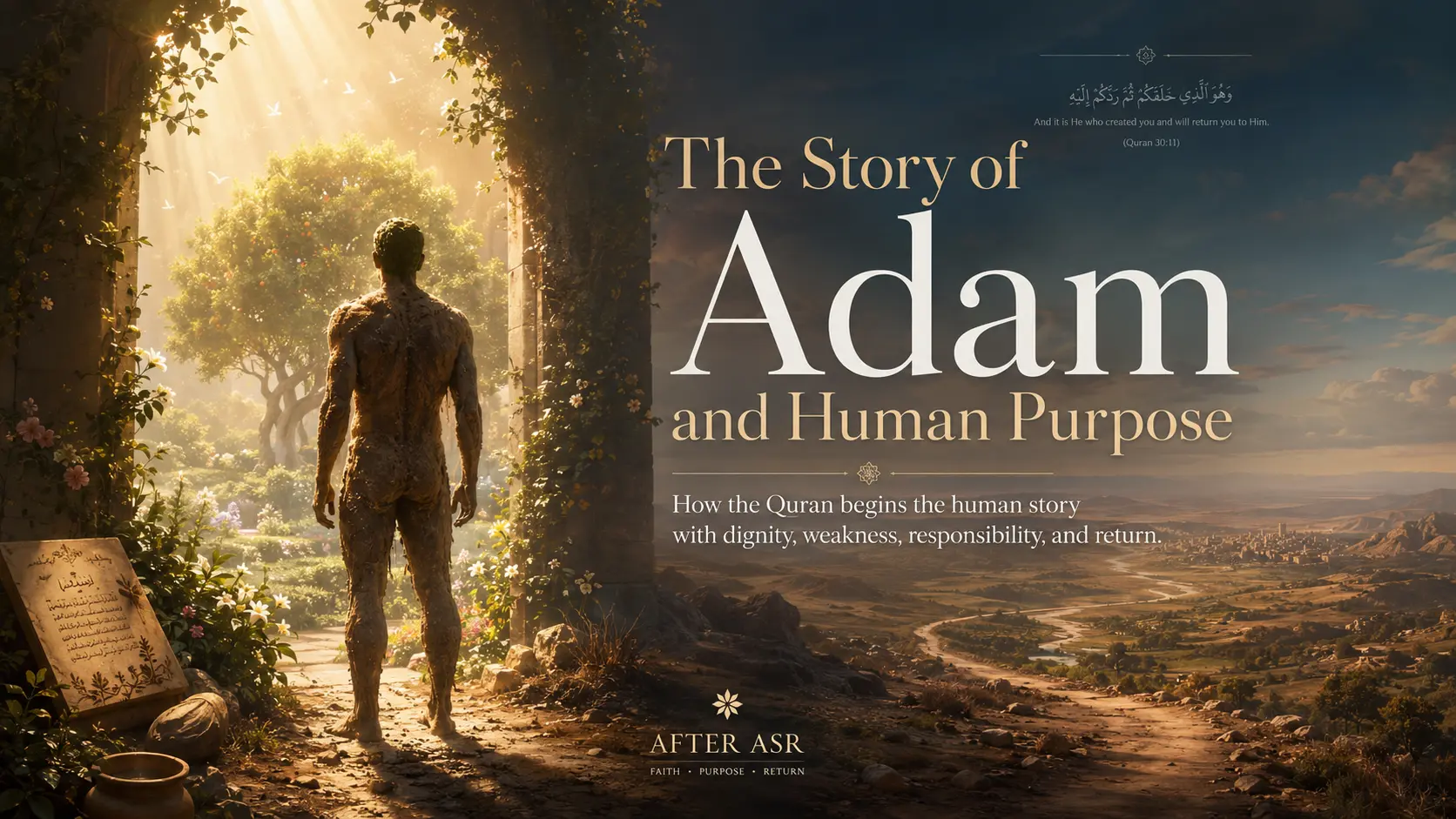
How the Quran begins the human story with dignity, weakness, responsibility, and return.
The story of Adam, peace be upon him, is not simply the story of the first human being. In the Quran, it is the story of what it means to be human at all. It introduces questions that every generation must face: What are we? Why were we created? What makes human beings honored? Why do we struggle with temptation? Why does knowledge matter? Why do we forget? What is the role of repentance? What does it mean to live on earth as a servant of Allah?
The Quran does not present Adam’s story as a mythic tale detached from daily life. It presents it as a foundational account of human purpose. In Adam’s creation, we learn that the human being is not an accident. In the angels’ question, we learn that human life carries moral seriousness. In Adam’s being taught names, we learn that knowledge is part of human distinction. In the refusal of Iblis, we learn the danger of arrogance. In the slip of Adam and Hawwa, peace be upon them both, we learn the reality of human weakness. In their repentance, we learn that the human story is not defined by the fall, but by the possibility of return.
The story begins before any human civilization, before nations, languages, economies, governments, and histories. Yet it explains all of them. Every human life is still unfolding inside the meanings first revealed through Adam: honor, test, choice, error, repentance, guidance, and accountability.
The Human Being Is Created With Purpose
The Quran’s account of Adam begins by refusing meaninglessness. The human being does not appear as a random biological event without moral direction. Adam is created by Allah, addressed by Allah, taught by Allah, honored by Allah, and placed into a life of responsibility by Allah. This gives human existence a foundation that no social theory, personal ambition, or cultural identity can replace.
To be human is not merely to be alive. Animals are alive. Plants are alive. The human being is created with a particular moral and spiritual vocation. We are creatures of body and soul, earth and breath, weakness and responsibility. We need food, sleep, shelter, and companionship, but we are not reducible to those needs. We are capable of knowing, worshiping, obeying, disobeying, repenting, building, corrupting, remembering, and forgetting.
This is why the Quran’s vision of human purpose is both dignifying and demanding. Human beings are honored, but honor is not permission for arrogance. They are entrusted, but trust is not ownership. They are given ability, but ability is not independence. The story of Adam teaches that our purpose begins not with self-invention, but with being created and addressed by Allah.
The Question of the Angels
In the Quranic account, when Allah announces the creation of a khalifah on earth, the angels ask about one who may cause corruption and shed blood, while they glorify and sanctify Allah. Their question is not rebellion. It reveals the seriousness of the human role. Human beings are capable of terrible harm. The angels’ words point toward a reality that history would repeatedly confirm: human beings can corrupt, kill, oppress, betray, and destroy.
Yet Allah knows what they do not know.
This response is profound. It does not deny the danger within human nature. The Quran is never sentimental about us. It knows what we are capable of. But it also reveals that the human being cannot be judged only by the possibility of corruption. Allah knows the capacity for faith, repentance, knowledge, patience, justice, sacrifice, love, worship, and sincere return. Human beings may shed blood, but they may also stand in prayer through the night. They may corrupt the earth, but they may also feed the hungry, forgive enemies, teach truth, raise families with mercy, defend the oppressed, and return to Allah after failure.
The story therefore gives a balanced view of humanity. We are not angels, and Islam does not ask us to pretend we are. But neither are we only creatures of violence and appetite. Allah created human beings with a purpose that includes risk, responsibility, and the possibility of moral greatness.
Adam and Knowledge
One of the most striking features of Adam’s story is that Allah teaches him the names. Before the story turns to temptation, it turns to knowledge. Adam’s distinction is not presented first through physical power, wealth, lineage, or domination. It is connected to being taught by Allah.
This matters deeply. Knowledge is part of human honor, but only when it remains connected to its Source. The human being is not honored by information alone. Information can be used for arrogance, manipulation, exploitation, or self-glorification. The honor of knowledge lies in receiving truth as a trust from Allah and using it in ways that serve worship, justice, and responsibility.
The fact that Adam is taught also reminds us that human beings begin as learners. We do not originate truth within ourselves. We receive, discover, name, categorize, remember, and understand by Allah’s permission. The modern world often celebrates knowledge while forgetting the Giver of knowledge. The story of Adam restores humility. To know is not to become independent of Allah. To know truly is to recognize dependence more clearly.
Knowledge in the Quran is not meant to inflate the ego. It is meant to increase awe, gratitude, obedience, and moral clarity. Adam’s story places learning at the beginning of human purpose, but it does not separate learning from servanthood.
The Honor Given to Adam
The command for the angels to prostrate to Adam, by Allah’s command, is one of the clearest signs of human honor in the story. This prostration was not worship of Adam. Worship belongs to Allah alone. It was an act of obedience to Allah and an honor granted to Adam by divine command.
This moment teaches that human dignity is not self-generated. It is given by Allah. That means human worth does not depend on race, wealth, nationality, beauty, productivity, social approval, or public visibility. The human being is honored because Allah honored the human being. This is a stronger foundation than any dignity granted by society, because society can withdraw its recognition whenever fear, politics, prejudice, or convenience demands it.
At the same time, this honor is not a license for pride. Adam is honored, but Adam remains a servant. His dignity does not make him divine, self-sufficient, or beyond command. The Quranic understanding of dignity is always joined with servanthood. The human being is noble not because he has no Lord, but because his Lord honored him with purpose, knowledge, responsibility, and the possibility of nearness.
The Refusal of Iblis
The story of Adam cannot be understood without the refusal of Iblis. When commanded to prostrate, Iblis refuses out of arrogance. He sees himself as superior and judges Adam by the material of creation. He compares fire and clay, and from that comparison he builds rebellion.
This is one of the Quran’s most important lessons about arrogance. Iblis does not deny Allah’s existence. His failure is not atheism. His failure is refusal to submit. He knows enough to be accountable, but his knowledge does not humble him. He argues, compares, resents, and places his own judgment above Allah’s command.
This is a permanent warning. A person can believe in Allah verbally and still resist Allah’s command when the ego feels threatened. A person can possess knowledge and still become ruined by pride. A person can speak religious language and still be serving the self. Iblis shows that the deepest spiritual danger is not always ignorance. Sometimes it is arrogance in the presence of knowledge.
His comparison also becomes the root of many human corruptions. Racism, classism, tribal arrogance, national superiority, and contempt for others often begin with the same disease: judging worth by a false scale and refusing to accept the honor Allah gives. The story of Adam therefore exposes the satanic logic behind superiority.
Human Weakness and the Slip
Adam and Hawwa, peace be upon them both, are placed in the Garden and given a command. They are warned about Shaytan. Yet they slip. This moment is essential because it reveals human weakness without turning weakness into hopelessness.
The Quran does not describe human beings as incapable of obedience, but it does show that we are vulnerable to forgetfulness, desire, persuasion, and false promises. Shaytan does not always invite through obvious ugliness. He beautifies, whispers, promises permanence, and makes disobedience appear beneficial. The human being is tested not only by clear evil, but by evil disguised as gain.
The slip of Adam teaches that human weakness is real. Even with honor, knowledge, and warning, the human being can forget. This should make us humble. No one should feel safe from temptation simply because they know better. Knowing better helps, but the nafs, Shaytan, and the desire for what appears beneficial can still overcome a person if they are not protected by Allah.
Yet the story also teaches that a slip is not the same as final ruin. The human story includes falling, but it also includes return.
Adam Is Not Iblis
One of the most important contrasts in the story is the difference between Adam and Iblis after wrongdoing. Both disobey in different ways, but their responses reveal their realities. Iblis refuses, argues, and blames. Adam receives words from Allah and repents.
This distinction is central to understanding human purpose. The believer is not expected to live without ever making mistakes. The believer is expected not to respond to mistakes with satanic arrogance. The difference between the path of Adam and the path of Iblis is not that one encountered a test and the other did not. The difference is what happened after disobedience.
Iblis says, in effect, “I am right.” Adam says, in effect, “I have wronged myself.” Iblis looks outward with blame. Adam turns inward with repentance. Iblis becomes more distant through pride. Adam is brought back through humility.
This is one of the most merciful teachings in the Quran. The human being will fail. The question is whether failure leads to excuse-making or repentance. Adam’s story teaches us that the door back to Allah is part of human purpose from the beginning.
Repentance as Human Dignity
Repentance is sometimes misunderstood as humiliation. In reality, repentance is one of the great dignities of the human being. It means the servant is not trapped inside the worst moment of their life. It means sin does not have the final word if the person returns sincerely. It means the human being can recognize wrong, seek forgiveness, and begin again.
Adam’s repentance is foundational because it shows that Allah did not create human beings to be flawless machines. He created servants who would be tested, who might fall, and who could return. Repentance is not an afterthought in the human story. It is part of the path.
This should reshape how we understand ourselves. A person who sins should not say, “I am finished.” Nor should they say, “It does not matter.” Both responses are wrong. Sin matters deeply, but Allah’s mercy is greater than sin. The correct response is neither despair nor carelessness. It is repentance.
The story of Adam teaches that the human being’s greatness is not in never needing Allah’s mercy. It is in knowing how desperately mercy is needed and returning to Allah with humility.
Earth as the Place of Responsibility
After Adam’s slip and repentance, human beings are sent to earth. Earth is not presented as a meaningless exile. It is the place where human purpose unfolds. It is the place of worship, family, work, struggle, justice, temptation, remembrance, forgetfulness, repentance, and preparation for the Hereafter.
This gives earthly life seriousness. We are not placed here simply to consume, compete, enjoy, build reputation, or survive. We are here to live as servants of Allah. The earth is a test, but it is also a trust. Human beings can cultivate it, corrupt it, care for it, exploit it, build upon it, and answer for what they did with what Allah gave them.
The story of Adam gives the dunya its correct meaning. This life is not permanent, but it matters. It is not ultimate, but it is morally weighty. It is not our final home, but it is where the path to the final home is chosen. Every prayer, injustice, kindness, betrayal, repentance, act of gratitude, and moment of heedlessness belongs to this earthly test.
Guidance Comes With the Human Journey
When Adam and his descendants are sent to earth, the Quran connects human life with guidance. Humanity is not left to wander blindly. Allah sends revelation, messengers, reminders, and signs. This is part of His mercy.
This means human purpose cannot be understood through instinct alone. Desire will not guide us safely. Social approval will not guide us safely. Personal opinion will not guide us safely. Even intelligence, without revelation, can become lost or arrogant. The human being needs guidance from the Creator because the Creator knows the human being fully.
The story of Adam therefore makes revelation essential to human purpose. We were not placed on earth to invent meaning from nothing. We were placed here to receive and respond to guidance. The Quran is not an external addition to human life. It is the light by which human life is properly understood.
Human Purpose Is Worship
The broader Quranic teaching is clear: human beings were created to worship Allah. Adam’s story prepares us to understand what worship means. Worship is not limited to ritual, though ritual worship is central and irreplaceable. Worship is the orientation of the entire self toward Allah. It includes prayer, remembrance, obedience, gratitude, repentance, justice, restraint, reliance, and sincerity.
Adam’s story shows the elements of worship in human life. Knowledge must lead to humility. Honor must lead to gratitude. Weakness must lead to reliance. Sin must lead to repentance. Earthly life must lead to responsibility. Guidance must lead to obedience. The human being fulfills purpose when life is returned to Allah in all its dimensions.
This is a very different purpose from the one offered by much of the modern world. Modern life often teaches the human being to seek self-expression, pleasure, status, productivity, identity, or autonomy as the highest end. The Quran teaches that the highest end is servanthood to Allah. This servanthood does not erase the human being. It completes the human being.
Adam and the Meaning of Human Equality
Because all human beings descend from the same origin, the story of Adam also carries a profound lesson about human equality. No race, tribe, nation, or class can claim a separate creation that makes it inherently superior. Human beings differ in language, color, culture, wealth, ability, and circumstance, but none of these differences changes the basic truth of shared origin and shared return.
The arrogance of Iblis is therefore not only a spiritual warning. It is a social warning. Whenever human beings build hierarchies of worth based on origin, material, race, bloodline, or worldly status, they repeat the logic of comparison that led Iblis into rebellion. The Quranic measure of superiority is not clay or fire, tribe or nation, wealth or poverty. It is taqwa, and taqwa is known fully to Allah.
Adam’s story should make racism and inherited superiority feel spiritually repulsive. To degrade another human being on the basis of what Allah created is not only a social error. It is a failure to understand the One who created all.
The First Story Is Also Our Story
The power of Adam’s story is that it keeps repeating in human life. Not literally in its original form, but morally and spiritually. We are honored, then tested. We are warned, then tempted. We know something, then forget it. We slip, then face the choice between excuse and repentance. We live on earth, surrounded by signs, desires, responsibilities, and guidance. We are followed by an enemy who wants our ruin, but we are also called by a Lord who opens the door of return.
Every person lives some version of this pattern. A person knows prayer matters, then neglects it, then must return. A person knows arrogance is dangerous, then falls into it, then must humble themselves. A person knows a desire is harmful, then follows it, then must repent. A person knows life is temporary, then forgets, then is reminded by death, illness, loss, or revelation.
Adam’s story is not distant. It is the pattern beneath our own spiritual lives.
The Purpose of the Human Being Is Not Perfection Without Need
The story of Adam corrects a false idea of religious life: that the ideal human being is someone who never experiences weakness, temptation, or need. The Quranic ideal is not independence from Allah. It is truthful dependence upon Allah.
Human beings are not angels. We do not worship Allah as angels do. Our path includes desire, forgetfulness, struggle, repentance, patience, and return. This does not lower our purpose. It defines it. The servant who struggles against the nafs for Allah, repents after sin, seeks knowledge, resists arrogance, and returns repeatedly may be beloved to Allah.
The goal is not to pretend we do not need mercy. The goal is to know our need and live accordingly. Adam’s story teaches us that human purpose includes return after falling. That return is not a failure of the story. It is part of the story’s mercy.
Conclusion
The story of Adam and human purpose is the Quran’s first great lesson about who we are. We are created, not accidental. Honored, but not self-sufficient. Taught, but still dependent. Capable of worship, but vulnerable to temptation. Placed on earth, but not made for earth alone. Tested by desire, pride, forgetfulness, and Shaytan, but given guidance, repentance, and the possibility of returning to Allah.
Adam’s story does not teach us to despise human nature. It teaches us to understand it. Our weakness is real, but so is our dignity. Our sins are serious, but so is Allah’s mercy. Our earthly life is temporary, but it is filled with purpose. Our enemy is real, but guidance is real too.
The human being is not defined by the fall.
The human being is defined by the call to rise through repentance, worship, knowledge, humility, and return.
In Adam’s story, the Quran gives us the beginning of human history. More importantly, it gives us the beginning of human meaning: we come from Allah, we live by His guidance, we struggle on earth, and to Him we return.