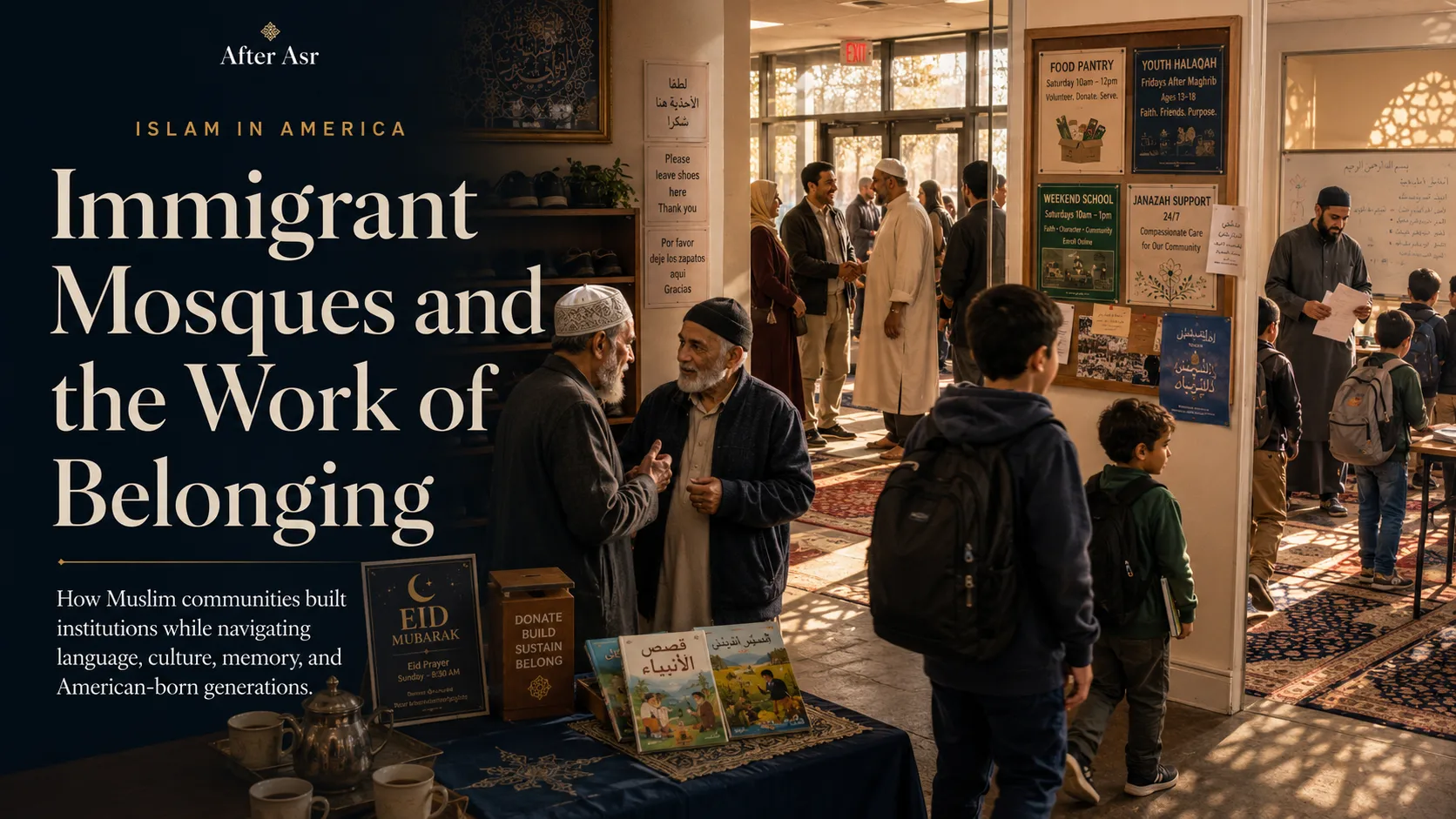
How Muslim communities built institutions while navigating language, culture, memory, and American-born generations.
Many immigrant mosques in America began with a practical question.
Where can we pray?
Before the dome, before the sign, before the website, before the weekend school, before the parking lot complaints, before the youth programs and community dinners and Eid logistics, there was often a small group of Muslims trying to find a clean room, a borrowed hall, a university classroom, a storefront, an apartment living room, a church basement, a rented office suite, or someone’s garage where they could stand shoulder to shoulder before Allah.
They came with accents, degrees, recipes, grief, ambition, children, suitcases, loneliness, Qur’ans wrapped carefully, and memories of places where the adhan belonged to the soundscape of life. Some came for graduate school. Some came for work. Some came fleeing war, poverty, political instability, or persecution. Some came intending to return home, then stayed. Some built businesses. Some drove taxis. Some worked in hospitals, factories, universities, restaurants, gas stations, laboratories, and convenience stores. Some sent money back to family across oceans. Some raised children in a language their parents had not grown up speaking.
The mosque became more than a prayer space because immigrant life required more than prayer space.
It became a place to preserve faith, language, food, marriage networks, funeral rites, children’s education, Ramadan rhythms, and the memory of a world left behind. It became a shelter from loneliness and a school for belonging. It became an institution built by people who were trying to be faithful in a land that offered opportunity but did not naturally carry their sacred rhythms.
Today, many American Muslims inherit immigrant-built mosques without knowing how fragile their beginnings were. The carpet beneath their feet may have been paid for through years of small donations. The building may have been purchased after long debate. The weekend school may have been started by parents who had no curriculum but great fear that their children would forget Islam. The first imam may have been part-time, underpaid, overburdened, or simply the most knowledgeable person available.
These mosques are blessings. They are also complicated. They carry beauty, sacrifice, culture, memory, and sometimes unresolved tensions. To understand Islam in America honestly, we must understand immigrant mosques not as foreign outposts, but as living institutions where Muslims have worked, imperfectly and sincerely, to build belonging.
The mosque as memory
For many immigrants, the mosque carried memories that could not fit into luggage.
A certain style of recitation. A Ramadan food. A language used in greeting elders. A way of sitting after prayer. A children’s class that resembled madrasa back home. A fundraiser that felt like village cooperation. A lecture style shaped by another country’s scholars. A wedding custom. A janazah practice. The smell of tea after Isha. The feeling of hearing one’s mother tongue in a public place after a week of English.
These things mattered because migration often involves loss.
People lose proximity to parents, siblings, teachers, childhood friends, graves, familiar streets, social status, professional recognition, and the ease of being understood without explanation. They may gain safety, opportunity, education, and stability, but gain does not erase loss. The mosque becomes one of the few places where memory can breathe.
This is why immigrant mosque culture can be emotionally powerful. It is not only about preference. It is about continuity. A father who insists that children learn his language may be trying to preserve more than words. A mother who cooks for iftar may be feeding memory as much as hunger. An elder who wants the khutbah in Arabic, Urdu, Bengali, Somali, Turkish, Bosnian, Farsi, or another language may be seeking not exclusion, but recognition. A community that celebrates Eid with familiar foods and sounds may be saying, “We are still ourselves.”
But memory can also become heavy when it is confused with Islam itself.
Not every inherited habit is sacred. Not every cultural preference must be preserved in the mosque. Not every language expectation can serve a multilingual community. Not every tradition from elsewhere fits the American context unchanged. A mosque that becomes primarily a museum of one community’s past may struggle to serve the Muslims growing up in its present.
The challenge is not whether memory belongs in the mosque. It does. The challenge is whether memory serves worship, belonging, and transmission, or whether it becomes a wall.
The first generation’s sacrifice
It is easy for later generations to critique immigrant mosques. Some critiques are necessary. But critique without gratitude becomes shallow.
The first generation often built with limited resources and little guidance. They were not handed manuals on how to create American Islamic institutions. They learned zoning laws, nonprofit rules, fundraising, school systems, tax documents, insurance, building codes, security concerns, and interfaith relations while also working, raising families, and navigating life in a new country.
Many were not trained administrators. Many were not scholars. Many were not fluent in English. Many carried trauma, homesickness, or the pressure of supporting relatives abroad. Yet they built. They bought buildings, organized Jumu’ah, found teachers, arranged janazahs, collected donations, started weekend schools, invited scholars, hosted iftars, and created spaces where their children could learn that they were not alone.
Some did this after long shifts. Some did it with children sleeping in the back of the masjid. Some did it while facing suspicion from neighbors. Some did it while learning how to speak to city officials who did not understand why parking mattered on Friday. Some did it while being dismissed as foreign, accented, or strange.
Their work deserves respect.
Respect does not mean refusing to name mistakes. It means naming mistakes without erasing sacrifice. It means understanding that some of what younger Muslims experience as dysfunction was born from scarcity, fear, and improvisation. It means remembering that the people who built imperfect institutions still built institutions.
A community matures when it can say two things at once: may Allah reward those who carried this before us, and may Allah help us repair what now needs repair.
Language as bridge and barrier
Language is one of the most tender issues in immigrant mosques.
For the first generation, heritage languages often carry intimacy. They are the languages of mothers, fathers, lullabies, jokes, scoldings, poetry, religious lessons, village memory, and grief. To hear them in the mosque can feel like home. For elders, especially those less comfortable in English, a mosque without their language may feel like another place where they are disappearing.
For American-born children, the same languages can carry mixed feelings. Some love them. Some understand but cannot speak. Some feel embarrassed by their own weakness. Some resent being corrected. Some associate heritage language with pressure, family conflict, or religious lessons they did not understand. Some sit through lectures in languages they barely follow, then drift from the mosque because the mosque sounds like it belongs to their parents, not to them.
For converts and Muslims from other backgrounds, language can become a quiet barrier. They may attend a masjid where everyone is friendly in theory, but social life happens in a language they do not know. Announcements are made in English, but real belonging happens elsewhere. A convert may stand beside worshippers in prayer, then feel alone during tea because conversations close around shared language. A Black Muslim, Latino Muslim, white Muslim, or Muslim from another ethnicity may wonder whether the mosque sees them as family or visitor.
This is not always intentional exclusion. Language naturally gathers people. But unintentional exclusion still hurts.
A mature immigrant mosque does not shame elders for needing their language, nor does it ignore younger generations who need English. It creates bridges. It offers bilingual programming where possible. It ensures khutbahs and core classes are accessible. It translates announcements. It encourages children to honor heritage languages without making fluency the price of belonging. It teaches elders that English-language Islamic education is not betrayal. It teaches youth that their parents’ languages are not obstacles to Islam, even if Islam must also be taught clearly in the language they understand best.
Language should carry memory. It should not lock the door.
Culture and the confusion with religion
Every mosque has culture. The question is whether the community knows it.
Immigrant mosques often carry cultural habits from particular regions: food, dress, marriage customs, gender expectations, leadership styles, fundraising habits, teaching methods, social etiquette, attitudes toward elders, child discipline, class assumptions, and ideas about religious authority. Some of these habits are beautiful and compatible with Islam. Some are neutral. Some are harmful. Some may have made sense in one country but create confusion in another.
The problem comes when culture is treated as religion.
A young person may be told a certain marriage custom is Islamic when it is actually ethnic. A convert may be corrected for not following a cultural expectation that has little to do with worship. Women may be restricted in ways that owe more to community habit than Islamic law. Black Muslims may be made to feel outside the mosque because Islam is wrapped in another people’s cultural codes. American-born children may reject Islam because what they were actually resisting was cultural pressure mislabeled as religion.
This confusion has caused real harm.
To distinguish Islam from culture does not mean attacking culture. Culture is one of the ways human beings live. Islam does not demand that Muslims become culturally blank. Food, language, clothing, poetry, family customs, and regional manners can all enrich community life when they remain in their proper place.
But revelation must be higher than culture.
A mosque should be able to say, “This is how our community has often done it, but it is not required by Islam.” It should be able to welcome Muslims who do not share its cultural habits. It should be able to teach children what is obligatory, recommended, permissible, disliked, forbidden, and merely customary. It should be able to correct harmful practices even when elders prefer them. It should be able to honor parents without sanctifying every inherited expectation.
The immigrant mosque becomes healthier when it stops fearing this distinction. Islam is not weakened when culture is placed in its proper category. It is clarified.
The American-born child in the immigrant masjid
The American-born child often grows up between affection and distance.
The mosque may be where they learned al-Fatihah, broke fasts, made friends, attended Eid, memorized short surahs, helped stack chairs, and heard elders say their name with warmth. It may also be where they felt misunderstood, scolded, bored, culturally out of place, or treated as less serious because their English was stronger than their Arabic, Urdu, Somali, Bengali, Turkish, or another family language.
They may love the mosque and still feel it was not built for them.
This is one of the central challenges of immigrant Muslim institutions: the children for whom the mosque was built become adults whose needs differ from the builders’ expectations. The first generation may have built the mosque to preserve Islam for their children. The children may then ask for English khutbahs, youth counseling, mental health awareness, women’s access, convert care, racial inclusion, professional administration, transparent governance, and programming that addresses American life directly.
The first generation may hear these requests as rejection. The second generation may experience resistance as dismissal. Both may be wounded.
The parent thinks, “We sacrificed everything so you could have this masjid.”
The child thinks, “Then why does it feel like my questions do not belong here?”
This gap requires mercy on both sides. American-born Muslims should not despise the communities that raised them simply because those communities were imperfect. They should learn the history, honor sacrifice, and serve before only criticizing. Elders should not treat every request for change as ingratitude. They should understand that preservation requires adaptation. A mosque that cannot speak to its own children may eventually preserve only a building.
The goal is not for American-born generations to erase immigrant memory. The goal is for them to inherit it wisely, then help build institutions that can carry Islam forward in the language, questions, and realities of their lives.
The convert at the edge of the ethnic mosque
Converts often reveal what immigrant mosques do not realize about themselves.
A masjid may believe it is welcoming because people smile at newcomers. But the convert may notice what insiders do not: social circles are ethnic, announcements assume prior knowledge, classes move too quickly, cultural expectations are unexplained, marriage networks are closed, and after the shahadah celebration, no one knows what happens next.
The convert may enter Islam through the Qur’an, through a friend, through study, through marriage, through hardship, or through a quiet opening of the heart. They may come to the masjid seeking worship and family. Instead, they may feel like an honored guest who never becomes a relative. People praise their conversion but do not invite them for Eid. They are asked to tell their story but not taught how to pray steadily. They are admired for choosing Islam but expected to navigate Muslim culture alone.
This is not always due to cruelty. Sometimes immigrant communities simply assume that Muslim life is learned through family, because that is how many of them learned it. The convert has no Muslim grandmother, no childhood Ramadan memories, no inherited vocabulary, no auntie network, no cousin to explain what is happening in the prayer hall. They need intentional care.
Immigrant mosques have a special opportunity here. If they can learn to welcome converts deeply, they become more Islamic and more American at the same time. They begin to distinguish religion from culture. They learn to explain what they inherited. They rediscover the beauty of basics. They become less like ethnic associations and more like houses of Allah.
A convert should not remain at the edge of the mosque because they entered through a different door.
Black Muslims and the immigrant mosque
The relationship between immigrant mosques and Black Muslims is one of the most important and painful questions in American Muslim life.
Black Muslims are foundational to Islam in America. Their history predates many immigrant communities by centuries. Their institutions, struggles, scholarship, and leadership have shaped the landscape into which immigrants arrived. Yet in many immigrant-led mosques, Black Muslims have not always been treated as central. They may be welcomed as individuals while Black Muslim history is ignored. They may be included in prayer rows but excluded from leadership. Their concerns about racism may be acknowledged publicly and dismissed privately. Their knowledge may be undervalued when compared with overseas credentials or ethnic familiarity.
This is not a small matter. It is a test of truth.
An immigrant mosque that does not understand Black Muslim history will misunderstand America. It may imagine itself as the beginning of Islam in its region when there were Black Muslims praying, organizing, teaching, and struggling long before. It may speak about Islamophobia while failing to address anti-Blackness. It may want public respect while neglecting the very communities whose struggles expanded the moral space Muslims now occupy.
Repair requires more than inviting a Black speaker occasionally. It requires teaching Black Muslim history in weekend schools. Building relationships with Black-led masjids. Supporting Black Muslim institutions materially. Addressing marriage racism. Including Black Muslims in leadership and teaching. Listening when concerns are raised. Learning from Black Muslim scholarship, not only Black Muslim suffering.
Immigrant Muslims do not honor their own sacrifices less by honoring Black Muslim foundations more. Gratitude is not a limited resource. Truth widens the community.
Women’s labor in immigrant mosques
Many immigrant mosques were built, in part, by women whose names are not always remembered.
Women cooked for fundraisers, taught children, organized Eid programs, raised money, hosted halaqahs, welcomed new families, cared for the sick, prepared food after funerals, preserved language at home, taught Qur’an, maintained social networks, and held families together through migration. Some were professionals who also carried community labor. Some were mothers who turned homes into classrooms. Some were elders whose wisdom guided younger women. Some were young women who translated between generations.
Yet women’s authority has not always matched women’s labor.
In some immigrant mosques, women are expected to serve but not decide. They are asked to teach children but not shape educational policy. They are asked to organize food but not sit on boards. They are praised for sacrifice but given inadequate prayer spaces. They are relied upon for convert care, family support, and youth guidance, but not treated as central to institutional planning.
This mismatch creates quiet resentment and spiritual harm.
A mosque cannot build belonging while treating half the community as guests in decision-making. Women’s spaces are not decorative additions. They are part of the masjid’s moral health. Girls notice whether their mothers are respected. Boys notice whether women’s labor is taken for granted. Converts notice whether sisters are welcomed or merely managed. Families notice whether the mosque is designed for real human needs.
Honoring women in immigrant mosques does not mean abandoning Islamic boundaries. It means applying Islamic dignity with seriousness. It means accessible prayer spaces, serious education, inclusion in consultation, protection from harassment, support for mothers, respect for female teachers, and recognition of women’s knowledge.
The immigrant mosque owes much of its survival to women. Its future depends on whether it can honor them truthfully.
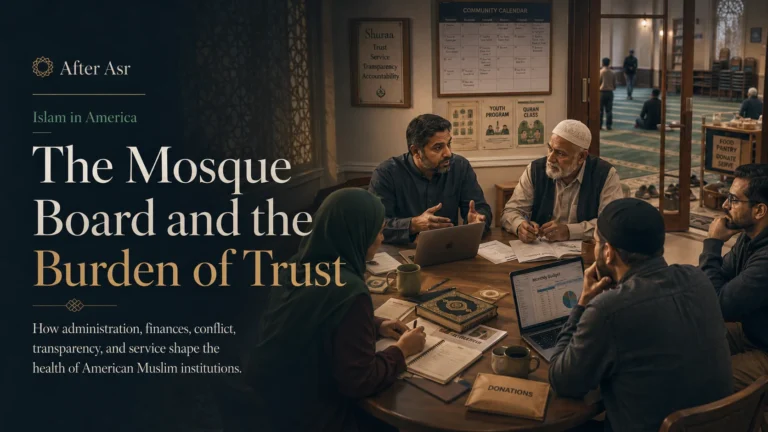
The mosque board and inherited leadership styles
Many immigrant mosques struggle with governance because leadership styles were carried from other contexts into American nonprofit life.
In some communities, elders make decisions informally. In others, donors hold influence without clear accountability. In others, boards are elected but participation is limited to those with time, status, or social networks. Some communities operate through personal trust rather than written processes. Some avoid conflict until it erupts. Some treat criticism as disrespect. Some lack transparency around finances, hiring, curriculum, or long-term planning.
These problems are not unique to immigrant mosques. But migration can intensify them.
People arrive with different assumptions about authority, consultation, institutions, and public disagreement. Some come from countries where religious institutions were state-controlled, politically sensitive, or socially hierarchical. Others come from places where elders were rarely challenged openly. Then they find themselves running nonprofit organizations in America, under legal and cultural expectations they may not fully understand.
The next generation often asks for transparency, term limits, professional administration, youth representation, women’s participation, child safety policies, and clearer communication. These requests can feel threatening to those who built the institution through personal sacrifice. But healthy governance is not ingratitude. It is protection.
A mosque is an amanah. Its leadership should reflect trust, competence, accountability, and humility. Personal sacrifice does not make someone permanently entitled to authority. Youthful critique does not automatically make someone ready to lead. Communities need both memory and systems. Elders should mentor successors. Younger leaders should learn before taking charge. Boards should document processes. Donors should give without ownership. Members should criticize with adab and serve with commitment.
Good governance is spiritual work because it protects the community from ego, confusion, and harm.
The weekend school as preservation project
Many immigrant mosques poured energy into weekend schools because they feared their children would lose Islam.
The fear was understandable. Public schools did not teach Qur’an. American holidays dominated the calendar. Children spoke English more fluently than their parents. Television, music, dating culture, peer pressure, and secular assumptions entered the home. Parents worried that without structured Islamic education, children would drift into a world where Islam became a family memory rather than a living path.
So they built weekend schools.
Often with volunteer teachers. Borrowed classrooms. Inconsistent curriculum. Homemade worksheets. Children of different ages grouped together. Parents teaching after a full week of work. Elders correcting recitation. Youth helping younger students. Snacks, discipline problems, late arrivals, and occasional moments of real beauty.
These schools preserved more than facts. They gave children Muslim friends. They made the masjid familiar. They taught basic worship. They created memories of Ramadan crafts, seerah stories, Arabic letters, and teachers who cared.
But many weekend schools now need renewal. Children growing up in America need more than memorization and simple identity reinforcement. They need to understand belief, worship, character, public pressure, digital life, gender questions, race, relationships, and what it means to be Muslim in this society. They need teachers trained in both content and pedagogy. They need curriculum that distinguishes Islam from culture. They need classrooms where questions are not treated as threats.
The immigrant weekend school was often born from preservation. Its next stage must be formation.
Preservation says, “Do not forget.”
Formation says, “Know, love, practice, and carry forward.”
Both are needed.
Youth who do not want to inherit only nostalgia
Young Muslims often appreciate their parents’ sacrifices more deeply as they age. But they may resist being handed nostalgia as if it were guidance.
Stories of “back home” can be meaningful. They can teach humility, gratitude, and continuity. But young Muslims born or raised in America do not live in the world their parents remember. They need Islam for their world. They need to know how to pray in a college dorm, how to navigate relationships at work, how to think about student debt, how to respond to anti-Muslim jokes, how to understand gender debates, how to choose a spouse across culture, how to seek knowledge online, how to remain Muslim when no one is watching.
If elders only offer nostalgia, youth may feel unseen. If youth only reject nostalgia, they lose memory.
The work of belonging requires translation between generations. Elders can say, “This is what we feared losing.” Youth can say, “This is what we are facing now.” Both can listen. The goal is not to recreate the old country in America, nor to surrender to every American norm. The goal is to live Islam faithfully here.
This requires new kinds of programming. Youth halaqahs with serious content. Mentorship beyond lectures. Spaces for questions. Marriage preparation rooted in Islam and aware of American realities. Mental health literacy. Service projects that connect faith with responsibility. Leadership training. Study of Black Muslim history. Convert care. Professional ethics. Spiritual retreats. Qur’an taught as guidance, not only recitation.
Young Muslims do not need less Islam. They need Islam taught with enough depth to meet the life they actually live.
The immigrant mosque and public America
Many immigrant mosques eventually had to learn public American life.
A mosque cannot remain entirely inward when it needs zoning approval, parking solutions, school accommodations, police communication, neighbor relationships, interfaith partnerships, media responses, funeral logistics, and civic recognition of Eid. Leaders who once focused mainly on serving their own community found themselves speaking to city councils, school districts, reporters, churches, synagogues, and local nonprofits.
This public engagement was not always comfortable. Some communities came from countries where public religious or political speech carried risk. Some elders preferred privacy. Some feared attention after national crises. Some did not want the mosque associated with politics. Some did not know how to explain Islam in English. Some were pressured to condemn, reassure, or represent Muslims after events they had nothing to do with.
Over time, many immigrant mosques developed civic fluency. They hosted open houses. Organized food drives. Invited neighbors to iftar. Worked with local officials. Requested Eid recognition. Participated in disaster relief. Built relationships with law enforcement while also navigating concerns around surveillance and trust. This was part of becoming rooted.
But public engagement also carries dangers. A mosque can become so focused on being acceptable to outsiders that it neglects internal formation. It can highlight diversity while ignoring internal inequality. It can present polished public faces while converts, youth, women, or Black Muslims feel unheard. It can treat interfaith dinners as success while weekend school remains weak.
Public belonging must be built on private health. Otherwise the mosque becomes fluent outwardly and fragile inwardly.
The food table as theology and tension
Food is never just food in immigrant mosques.
It carries memory, hospitality, identity, and love. The iftar table may hold biryani, kabsa, sambusas, lentil soup, qahwa, chai, dates, baklava, chicken, rice, salads, sweets, and foods tied to particular homelands. For elders, these foods can make Ramadan feel less lonely. For children, they become part of American Muslim memory. For newcomers, they can be an introduction to the community’s warmth.
Food can be theology in action when it becomes hospitality. Feeding the fasting person. Sending plates to elders. Making space for students. Welcoming converts. Sharing across families. Making sure no one leaves hungry. This is beautiful.
But food can also reveal tension.
Who cooks? Often women. Who pays? Often the same donors. Who is invited? Often insiders. Who eats first? Sometimes men, elders, or those closest to the serving line. Who cleans? Often the same volunteers. Whose foods are considered normal? Whose dietary needs are ignored? Does the convert know what anything is? Does the Black Muslim family feel included, or are they guests at someone else’s cultural table? Do children associate the mosque with generosity or chaos?
The food table can unite, but it can also expose hierarchy.
A thoughtful mosque treats food as service, not performance. It diversifies menus where possible. It explains dishes without embarrassment. It ensures converts and newcomers are invited into the meal socially, not only physically. It creates cleanup teams that include men and youth. It honors women’s labor. It remembers the poor. It avoids extravagance. It lets food carry love without turning culture into ownership.
Hospitality is not complete until people feel they belong at the table.
American-born leadership and the fear of loss
As American-born Muslims enter leadership, immigrant mosque communities often face anxiety.
Will they preserve the religion? Will they respect elders? Will they keep the language? Will they understand the sacrifices made? Will they change the mosque too much? Will they become too American? Will they know enough Islam? Will they care for the older generation? Will they maintain ties to the wider ummah?
Some fears are sincere. Some are exaggerated. Some are rooted in love. Some are rooted in control.
American-born leadership is necessary because American-born Muslims understand the context in ways their parents may not. They know school systems, workplace culture, digital life, youth struggles, legal structures, public communication, and the language of younger generations. They may be better positioned to build institutions that serve the future. But they also need grounding. Context without Islamic knowledge can drift. Confidence without humility can become arrogance. Critique without service can become emptiness.
The best leadership transition is not a takeover. It is mentorship.
Elders should share history, relationships, institutional knowledge, and spiritual lessons. Younger leaders should bring administrative skill, English-language teaching, cultural fluency, and new program models. Scholars and qualified teachers should guide both. Women should be included meaningfully. Black Muslims and converts should not be treated as afterthoughts. Governance should become clearer, not merely younger.
The question is not whether immigrant mosques will change. They will. The question is whether change will be guided by worship, knowledge, memory, and justice, or by frustration alone.
A mosque for one ethnicity or a house of Allah
An immigrant mosque may begin by serving one ethnic community because that is who gathered, donated, and built it. This is understandable. People naturally organize with those they know. Shared language and culture make early institution-building easier.
But once the building is a masjid, the question widens.
Is it still, in practice, the house of one ethnicity? Or is it truly a house of Allah?
This question cannot be answered by the sign outside. It is answered by experience. Can a convert enter and be guided? Can a Black Muslim family join without feeling peripheral? Can a Muslim from a different ethnicity serve on the board? Can women participate meaningfully? Can youth ask questions? Are announcements accessible? Are classes open to all? Is marriage culture exclusionary? Are community resources distributed fairly? Are social circles porous? Does the mosque’s leadership see non-ethnic members as owners of the community, or guests?
A masjid may legally belong to a nonprofit, financially depend on a donor base, and culturally reflect its founders. But spiritually, it belongs to Allah. That reality should discipline every ethnic attachment.
This does not require erasing founding cultures. A mosque can honor the people who built it. It can keep heritage language classes, cultural foods, and regional traditions where appropriate. But it cannot make those things the price of belonging. The prayer row teaches a truth the lobby must learn: Muslims stand before Allah together.
A mosque that wants barakah should make room for the people Allah sends.
The pain of being between
Many second-generation Muslims live with the pain of being between.
Between parents’ language and their own. Between gratitude and frustration. Between Islamic belief and cultural inheritance. Between American public life and private family expectations. Between elders who fear loss and peers who normalize compromise. Between love for the mosque and disappointment in its limitations. Between wanting change and fearing they will dishonor those who sacrificed.
This between-ness can produce wisdom if guided well. It can also produce distance if ignored.
Second-generation Muslims can become translators, not only of language, but of worlds. They can help elders understand the questions youth are asking. They can help youth appreciate the sacrifices elders made. They can help converts navigate ethnic mosques. They can help institutions become more transparent. They can help distinguish Islam from culture. They can create English-language Islamic spaces without severing connection to heritage. They can build bridges to Black Muslim communities and other Muslim groups.
But they cannot do this if they are only criticized from both sides.
Communities should recognize the emotional labor of being between. The young adult who translates for parents at the doctor’s office may also be translating the mosque’s future. The sister who understands both auntie culture and American professional life may see needs others miss. The brother who grew up in weekend school and now has children may know what worked and what failed. Their perspective is not betrayal. It is inheritance becoming conscious.
Belonging across generations is not automatic. It must be built with listening, patience, and shared worship.
When the old country changes too
One hidden complexity of immigrant mosque life is that the memory of the old country may remain frozen while the country itself changes.
Parents may preserve the Islam, customs, and social expectations of the time and place they left. Meanwhile, relatives back home adapt, cities change, religious education shifts, politics evolve, and younger generations abroad become different too. The immigrant community may imagine itself preserving authenticity, while actually preserving a memory shaped by migration.
This does not make the memory false. It makes it partial.
Children may sense this. They visit their parents’ homeland and discover that people there are not exactly as their parents described. Some are more religious. Some less. Some more modern. Some more traditional. Some customs have changed. Some expectations have loosened. Some problems are the same. The child returns to America realizing that “back home” was never a simple measuring stick.
This can be disorienting, but also freeing.
It helps communities understand that Islam is not identical to any one country’s past. It also helps elders hold memory with humility. What they preserved may be precious, but it is not always universal. What children question may not be rejection of Islam, but recognition that inherited culture is historically situated.
The mosque can become a place where memory is honored without being frozen. Where elders tell stories, but do not demand that children live inside them unchanged. Where youth learn roots, but also learn that the deepest root is Islam itself.
The immigrant mosque as American Muslim inheritance
Despite its tensions, the immigrant mosque is one of the great inheritances of Islam in America.
It represents sacrifice, longing, work, generosity, fear, courage, and love. It represents people who refused to let their children grow up without prayer space. People who turned rented rooms into communities. People who held iftars before halal restaurants were easy to find. People who taught Arabic with photocopies. People who argued in board meetings because they cared, even when they lacked better tools. People who gave money they could have sent elsewhere. People who buried loved ones far from the soil of their birth. People who learned to say “zoning approval” and “nonprofit status” and “fire marshal inspection” because the masjid needed them to.
To inherit such a mosque is not to inherit perfection. It is to inherit work.
The next generation must decide what to do with it. They can abandon it in frustration. They can preserve it without reflection. Or they can receive it as an amanah: a trust that must be thanked, examined, repaired, widened, and renewed.
The best future for immigrant mosques is not to become cultureless. It is to become more truly Islamic, and therefore more capable of honoring culture without being ruled by it. More capable of serving elders and youth. More capable of welcoming converts. More capable of learning from Black Muslim foundations. More capable of supporting women’s leadership and dignity. More capable of teaching in English while respecting heritage languages. More capable of being rooted in America without being diluted by America.
Belonging as a spiritual project
Belonging is not built by architecture alone.
A mosque can have a beautiful building and still leave people lonely. It can have full Ramadan programs and still neglect converts. It can have many languages and still fail to communicate. It can have diverse prayer rows and still maintain divided social worlds. It can have youth events and still not hear youth. It can have women volunteers and still not respect women’s voices. It can have immigrant memory and still not know how to hand that memory forward.
Belonging is built through adab.
Through greeting people by name. Teaching in language they understand. Making room at the table. Explaining without condescension. Consulting those affected by decisions. Honoring elders without allowing harm. Welcoming children without letting chaos rule. Supporting converts beyond shahadah. Learning the history of Black Muslims. Treating women’s spaces as central. Creating systems that outlast personalities. Sharing leadership. Apologizing when needed. Remembering that the masjid belongs to Allah.
Immigrant mosques have already done something remarkable. They made Islam visible and livable for millions of Muslims in America. They gave children a place to hear Qur’an. They gave families a place to break fast. They gave the dead a place to be prayed over. They gave newcomers a place to look for home.
Now the work continues.
The next stage is not only building mosques. It is building belonging inside them.
A belonging deep enough for the elder who misses home.
The child who speaks English first.
The convert who knows no one.
The Black Muslim whose roots here are older than the institution itself.
The woman whose labor has long sustained the community.
The youth with difficult questions.
The refugee carrying grief.
The professional with little time.
The family barely paying rent.
The imam carrying everyone’s expectations.
The volunteer stacking chairs after the event.
The mosque that can hold all of them with justice and mercy will not simply be an immigrant mosque, though it may honor immigrant sacrifice beautifully.
It will be what every masjid is meant to be: a house where people come from many roads and remember together that they belong first to Allah.