
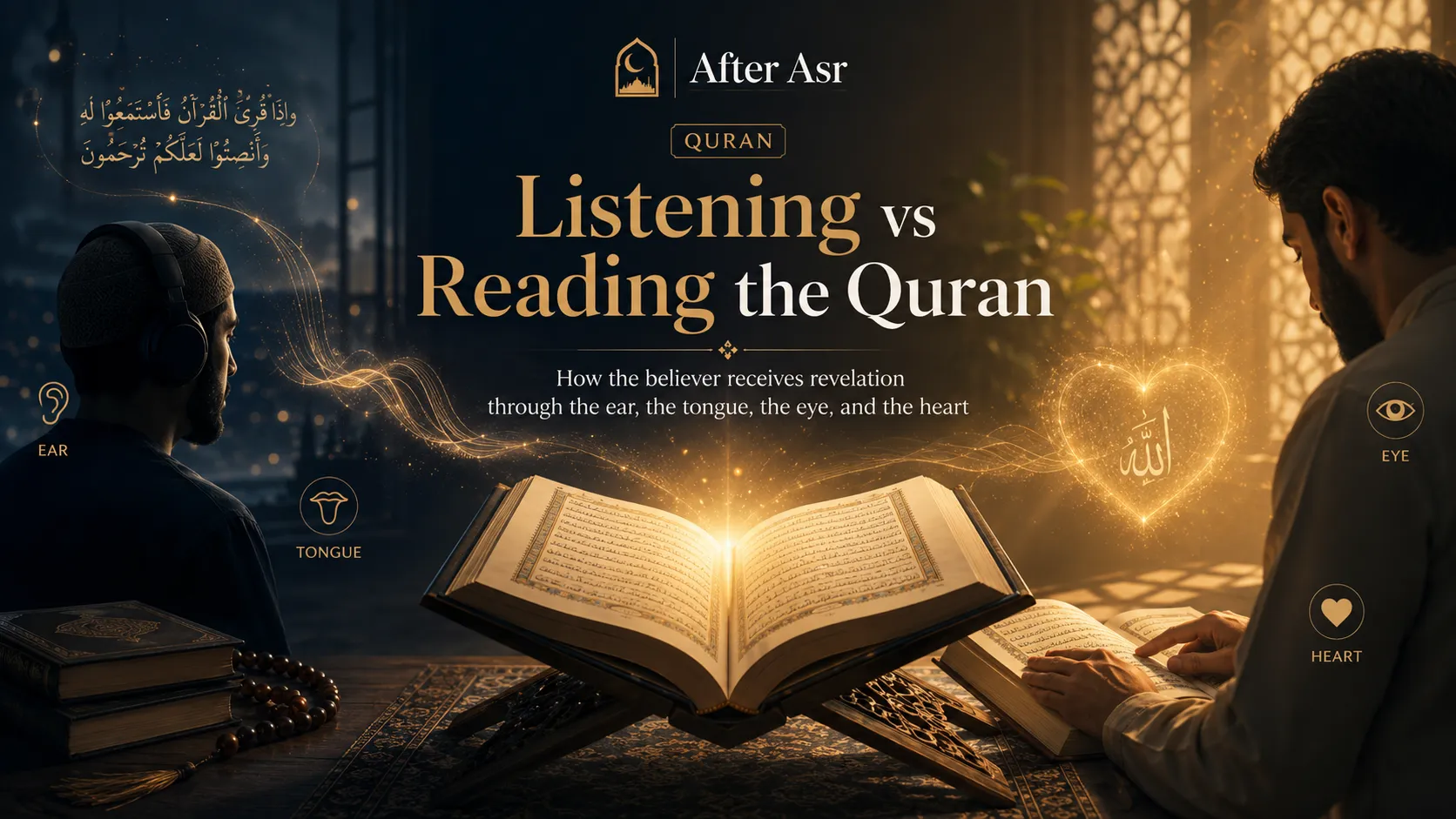
How the believer receives revelation through the ear, the tongue, the eye, and the heart.
The Quran is not only a text to be read silently. It is revelation to be recited, heard, memorized, reflected upon, studied, and lived. A Muslim’s relationship with the Quran often enters through sound before it enters through analysis. A child hears recitation before understanding grammar. A worshiper hears verses in prayer before studying tafsir. A grieving person may be moved by a reciter’s voice before they can explain why a particular passage reached them. The Quran is not merely information delivered through language. It is divine speech that addresses the whole human being.
This is why the question of listening versus reading should not be treated as a competition. Both matter. Listening and reading are not enemies. They are different doors into the same revelation. Listening may soften the heart, restore attention, and bring the Quran into moments where reading is difficult. Reading may deepen focus, allow reflection, support study, strengthen recognition of wording, and build personal discipline. Reciting with the tongue adds another dimension, because the believer is not only receiving the Quran, but participating in its sound through worship.
A mature relationship with the Quran makes room for all of these. The ear receives. The tongue recites. The eye follows. The mind reflects. The heart responds. The limbs obey. The goal is not to choose one form in order to neglect the others. The goal is to let the Quran enter life through every doorway Allah has made available.
The Quran Was Revealed to Be Heard
The Quran came into the world through recitation. The Prophet Muhammad, peace and blessings be upon him, received revelation, recited it, taught it, prayed with it, and conveyed it to people who heard it before many of them ever held written pages. Its sound is not incidental to its nature. The Quran’s rhythm, force, repetition, pauses, warnings, promises, and beauty are part of how it addresses the human being.
Listening therefore has a sacred place. A person who listens attentively is not engaging the Quran in a lesser way simply because their eyes are not on the page. Listening can awaken awe. It can make the heart still. It can allow the meanings of familiar verses to arrive differently. In prayer, the believer often receives the Quran first as a listener, standing behind the imam and letting revelation pass through the ear into the heart.
There are times when listening reaches places that reading does not. A person may be too tired to read deeply, but able to listen. A person may be ill, driving, cooking, walking, or resting, and listening allows the Quran to remain present. A recitation heard regularly can become part of the atmosphere of a home, a commute, a morning routine, or a night of worship.
The danger is not listening. The danger is listening without attention so often that the Quran becomes background noise. Revelation should not be reduced to ambience. Even when listening casually at times, the believer should also preserve moments of intentional listening, where the heart knows that Allah’s words are being recited and deserves presence.
Reading Slows the Soul Down
Reading the Quran brings another kind of benefit. It slows the reader. The eyes move across the words. The page or screen holds the attention in one place. The reader can pause, return to a verse, notice repetition, compare meanings, read translation, consult tafsir, and ask what the passage is doing. Reading invites a kind of deliberate encounter that listening does not always produce, especially when listening happens while multitasking.
In a distracted age, this matters. Many people are constantly hearing something: music, podcasts, videos, conversations, notifications, arguments, and background noise. Listening can be powerful, but it can also become passive. Reading requires a more direct act of attention. The believer chooses to sit with the Quran and give it space.
Reading also helps the believer build familiarity with the structure of the Quran. Surahs become recognizable. Verses are seen in relation to what comes before and after. The reader begins to notice where certain themes appear, how stories unfold, how warnings are framed, and how mercy returns repeatedly. This visual and textual familiarity supports reflection and protects against treating verses as isolated quotations.
A person who only listens may love the sound of the Quran, but still remain distant from its meanings and structure. Reading helps the believer enter the text with greater awareness.
Reciting Is Different From Merely Reading
In English, people often say “reading the Quran,” but in Muslim practice, reading often means reciting. Recitation is not only silent comprehension. It is the tongue giving voice to revelation. This matters because Quranic engagement is devotional as well as intellectual. The believer recites not only to gather meaning, but to worship Allah through His words.
Reciting with the tongue trains the body into worship. The mouth forms the words. The breath slows. The voice carries revelation. The servant becomes involved in the act, not only as a thinker but as a worshiper. This is why even a person who does not understand every word should not abandon recitation. The Quran’s Arabic recitation has its own place in worship, prayer, memorization, and spiritual formation.
At the same time, recitation should not become disconnected from understanding forever. A believer may begin with recitation, but should also seek meaning according to their ability. The words recited in prayer should become increasingly known. The repeated surahs should be understood. The tongue and heart should grow closer together over time.
Reciting without understanding is not worthless. But reciting while seeking understanding is deeper.
Listening Can Build Love
Many Muslims first fall in love with the Quran through listening. A beautiful recitation can open the heart. The voice of a skilled reciter, especially when joined with humility and proper tajweed, can make the listener feel the majesty, tenderness, warning, and rhythm of revelation. Sound can make the Quran feel near.
This is especially important for people who feel intimidated by reading Arabic or who have a strained relationship with study. Listening may be the first doorway back. A person who has been away from the Quran may begin by listening during a quiet evening. A person who feels spiritually dry may hear a passage and feel something soften. A person who does not yet know how to read Arabic may still build attachment through recitation.
But love must eventually move toward response. If listening produces only emotion and no change, the relationship remains incomplete. The purpose of being moved by the Quran is not simply to enjoy beauty. It is to return to Allah. A recitation that brings tears should also invite repentance, gratitude, obedience, and reflection.
Beauty in recitation is a mercy. It should carry the listener toward the One who revealed the words, not only toward admiration of the voice.
Reading Can Build Responsibility
Reading often makes the Quran harder to avoid. When a person sits with the words and meanings, the message becomes specific. Commands appear. Warnings appear. Descriptions of the heart appear. Stories expose patterns. The Hereafter becomes difficult to keep distant. Reading can turn vague religious feeling into concrete responsibility.
This is one reason some people prefer listening without ever reading meanings. Sound can move the heart, but meaning can confront the nafs. A person may enjoy recitation while resisting the verse that asks them to change. Reading translation and tafsir may remove the comfort of distance. It tells the believer what is being said, not only how beautiful it sounds.
This confrontation is mercy. The Quran was not revealed to remain emotionally impressive but practically ignored. It came to guide. Reading helps the believer ask: What is Allah commanding here? What is being warned against? What excuse is being exposed? What quality is being praised? What must I do after knowing this?
A relationship with the Quran should include moments where the reader cannot escape being addressed.
Listening While Distracted
One modern habit deserves attention: playing Quran constantly while giving it little attention. Many Muslims do this out of love and respect. They want the home, car, or workplace to be filled with Quran rather than empty noise. This can be beautiful when done with reverence. But there is also a risk that the Quran becomes background sound that the heart no longer notices.
The believer should be careful. Allah’s words deserve better than being treated as spiritual wallpaper. If Quran is playing while people are speaking over it, ignoring it, laughing loudly, or treating it as ambient sound, the purpose may be lost. This does not mean Quran can only be played in absolute silence, but it does mean the listener should maintain adab.
A helpful balance is to have times of background exposure and times of intentional listening. Let the home hear Quran, but also gather the heart at certain moments. Turn off distractions. Listen to a passage. Read the translation. Let the recitation be received, not merely present.
The issue is not whether Quran is heard often. The issue is whether it is honored while being heard.
Reading Without Presence
Just as listening can become passive, reading can become mechanical. A person may move through pages quickly, complete portions, and still have little inward engagement. The eyes pass over the words, the tongue recites, but the heart is elsewhere. Reading can become a task rather than an encounter.
This does not mean mechanical reading has no value at all. Sometimes a person maintains a routine during spiritual dryness, and that discipline may itself be good. Not every recitation will feel powerful. The believer should not abandon the Quran simply because the heart feels dull. But they should also not become content with permanent absence of attention.
Reading with presence requires slowing down sometimes. Pause at a verse. Repeat it. Read the meaning. Ask what it teaches about Allah. Ask what it reveals about the self. Ask what decision it should affect. The goal is not to turn every reading session into a long study, but to keep the heart awake enough that reading remains worship, not only motion.
The Quran deserves both consistency and presence.
The Role of Translation in Listening and Reading
For non-Arabic speakers, translation plays a major role in both listening and reading. Listening to Arabic recitation can be spiritually powerful, but pairing it with translation can deepen the experience. A person may listen to a passage in Arabic, then read its meaning. Or they may use a recitation with translated captions. Or they may listen to the Arabic while following a translation in a mushaf or app.
Reading translation directly can also make the Quran feel more immediately understandable. It helps the reader engage themes, stories, warnings, and calls to worship. But translation should be approached with humility. It is a doorway into meaning, not the full reality of the Quran’s Arabic. Difficult verses should be studied with reliable tafsir and scholarly guidance.
A practical habit is to combine forms: recite or listen in Arabic for worship and connection, then read translation for meaning, then return to the Arabic with greater awareness. Over time, the sound and meaning begin to meet. Words become familiar. Repeated phrases become recognizable. Prayer becomes deeper because the heart understands more of what the tongue recites.
Listening Supports Memorization
Listening is one of the strongest supports for memorization. Repeated hearing helps the Quran settle into memory. Children often memorize through hearing before reading fluently. Adults can also benefit from listening repeatedly to the same surah or passage, especially from one reciter, until rhythm and structure become familiar.
This form of listening is active. The listener is not simply letting sound pass by. They are absorbing, repeating, correcting pronunciation, and preparing the tongue to recite. Listening teaches flow, pauses, and melody. It can also help those who struggle with reading Arabic script but still want to memorize.
However, memorization should not rely on listening alone if reading is possible. Following the text helps prevent mistakes and strengthens visual memory. The best method often combines listening, reading, reciting aloud, reviewing with someone qualified, and understanding the meaning.
Memorized Quran becomes a companion in prayer and daily life. Listening can help place it in the heart, but recitation and review keep it alive.
Reading Supports Reflection
Reading is especially important for reflection because it allows the believer to stop. Listening moves forward unless paused. Reading allows the eye to remain on a verse. The reader can sit with a word, notice a phrase, look at the surrounding passage, or compare translations. This is why reflective engagement often requires reading, even if listening first opened the heart.
Reflection needs time. A verse about mercy may need to be held. A warning may need to be allowed to disturb the nafs. A story may need to be reread in light of one’s own situation. A command may require thinking about what action must change. Reading gives the believer the ability to remain with the verse rather than letting it pass.
This does not mean reflection cannot happen through listening. It can. A verse heard in prayer may strike the heart deeply. But reading gives the listener a way to return to what was heard, examine it, and let it work more carefully within the self.
Listening may awaken. Reading may deepen.
The Quran in Prayer Combines Both
Prayer brings listening, reciting, standing, bowing, prostrating, and inward attention together. When praying alone, the believer recites. When praying behind an imam in audible prayer, the believer listens. In both cases, the Quran is not being engaged as detached study. It is being received in worship.
This should remind us that the Quran’s purpose is not only comprehension, though comprehension is essential. The Quran is meant to bring the servant before Allah. In prayer, verses about mercy are heard while standing as a servant. Warnings are heard while preparing to bow. Descriptions of the Hereafter are heard before placing the face on the ground. The body itself responds to revelation.
Improving one’s relationship with the Quran should therefore improve prayer. Listening outside prayer can make prayer more familiar. Reading meanings can make recitation in prayer more alive. Memorization can expand what is recited. Reflection can make standing before Allah more conscious.
The forms support one another.
Different Seasons Need Different Doors
A believer’s life changes. There may be seasons of strong reading, seasons of more listening, seasons of memorization, seasons of study, seasons of review, seasons of weakness, and seasons of return after neglect. A person should not treat one form as the only valid form for every moment.
A new Muslim may begin with translation and listening. A busy parent may rely more on listening during the day and reading small portions at night. A student of Arabic may focus on vocabulary and recitation. A memorizer may listen heavily for review. Someone grieving may need slow recitation and verses of mercy. Someone heedless may need to read warnings carefully. Someone confused may need tafsir.
The point is not to create a rigid hierarchy that makes people feel guilty for receiving the Quran through different doors. The point is to avoid using one door as an excuse to close the others forever. If listening is easy, let it lead to reading. If reading is regular, let it lead to listening with presence. If recitation is strong, let it lead to understanding. If translation is helpful, let it lead to deeper study.
A living relationship grows in more than one direction.
The Danger of Consuming Quran Without Obeying It
Whether listening or reading, the greatest danger is receiving the Quran without responding to it. A person may listen beautifully and read regularly, yet resist the transformation the Quran demands. The heart may enjoy the sound, admire the language, complete portions, and still avoid repentance, justice, humility, and obedience.
The Quran was not revealed for passive consumption. It was revealed for guidance. Listening should lead to attention. Reading should lead to reflection. Reflection should lead to action. Action should lead to greater sincerity. Sincerity should lead back to Allah.
This does not happen all at once. The believer grows slowly. But the direction must be there. After listening or reading, ask: What did I hear? What did I learn? What did it expose in me? What does Allah want from me? What should I stop, begin, repair, or remember?
The Quran is not honored only by beautiful sound or careful reading. It is honored by surrender.
Making Both Part of Daily Life
A practical relationship with the Quran may include both listening and reading in simple ways. Listen during a commute, then read a few verses with translation later. Recite a small portion after Fajr, then listen to the same portion during the day. Read tafsir once a week, and listen to the surah throughout the week. Memorize a short passage by combining repeated listening with looking at the text.
The routine does not have to be complicated. The key is sincerity and consistency. A person may choose one reciter for memorization, one translation for daily meaning, one tafsir source for study, and one regular time for reading. Over time, the Quran becomes present in the ear, tongue, eye, and heart.
The believer should be realistic but not lazy. Start where you are, then grow. If you only listen now, begin adding a small reading portion. If you only read silently, begin listening with attention. If you recite without meaning, begin learning repeated words. If you read translation only, begin honoring Arabic recitation as well.
Each door strengthens the others.
Conclusion
Listening and reading the Quran are not rivals. They are complementary ways of receiving revelation. Listening connects the believer to the Quran as recited speech, softening the heart through sound and making revelation present in moments when reading may not be possible. Reading allows deeper attention, reflection, study, and engagement with meaning. Reciting with the tongue adds worshipful participation, while understanding brings the heart closer to what is being recited.
The danger is not choosing one form at a particular time. The danger is becoming passive in any form. Listening can become background noise. Reading can become mechanical. Recitation can become disconnected from meaning. Study can become information without surrender. Every form needs presence, humility, and response.
The Quran is meant to enter the whole human being. The ear hears it. The tongue recites it. The eye follows it. The mind reflects on it. The heart is corrected and softened by it. The limbs are meant to act upon it.
A believer should listen when listening opens the heart. Read when reading deepens understanding. Recite when the tongue can worship. Study when confusion needs clarity. Reflect when the heart needs direction. Return after absence. Continue after dryness. Grow without arrogance and begin without shame.
The goal is not merely to say, “I listened,” or “I read.”
The goal is to become someone who received the Quran and allowed it to lead them back to Allah.