
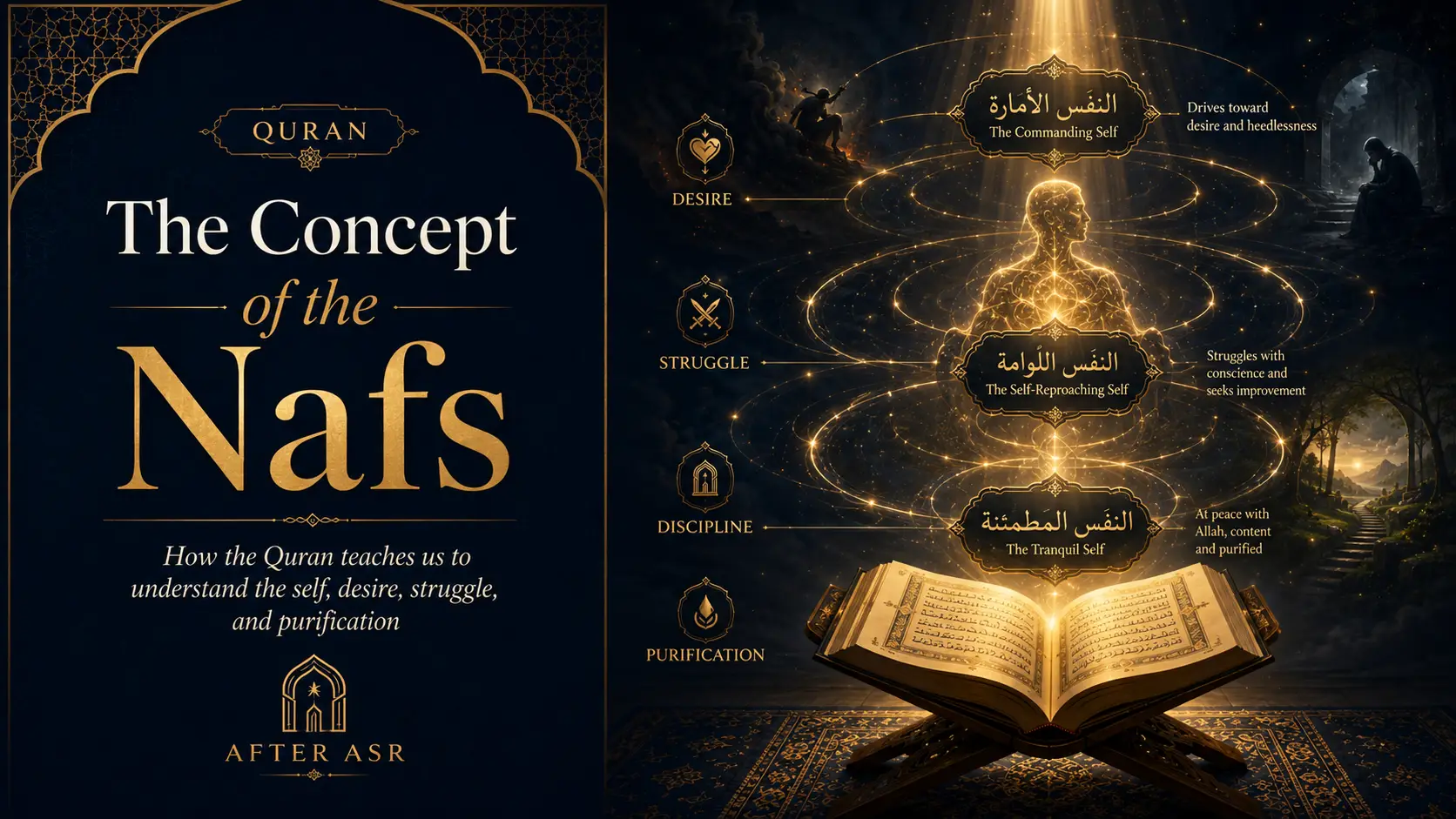
How the Quran teaches us to understand the self, desire, struggle, and purification.
The Quran does not describe the human being in shallow terms. It does not treat us as purely rational minds, purely physical bodies, or purely spiritual souls untouched by desire. It speaks about the human being with a realism that is both sobering and merciful. We are capable of worship, gratitude, patience, courage, repentance, and nearness to Allah. We are also capable of envy, arrogance, self-deception, appetite, heedlessness, and rebellion. Any serious Quranic view of the human being must hold both truths together.
This is where the concept of the nafs becomes essential. The word is sometimes translated as “self,” “soul,” or “ego,” though no single English word captures all of its meanings in every context. In Quranic usage, the nafs can refer to the person, the inner self, the soul, or the inward dimension of human responsibility. It is the self that desires, chooses, justifies, repents, struggles, obeys, resists, remembers, and will one day be held accountable before Allah.
To understand the nafs is to understand that the human being is not spiritually neutral. There is an inward struggle taking place. The self is pulled by desire, fear, pride, comfort, resentment, and worldly attachment. It is also called by revelation, conscience, remembrance, repentance, and longing for Allah. The Quran does not ask us to pretend this struggle is not real. It teaches us how to name it, discipline it, and seek purification from the One who knows us better than we know ourselves.
The Nafs Is Not Automatically Evil
A common mistake is to speak about the nafs as if it is simply evil. That is too simple. The Quran’s view is more careful. The nafs is not something the human being can discard, nor is it a demon separate from the person. It is part of the human being’s inner reality. It can command toward evil, blame itself after wrongdoing, or reach tranquility through submission to Allah. It can become corrupt, but it can also be purified.
This matters because Islam does not teach hatred of the self in the sense of denying human dignity or despising the fact that we have needs, emotions, and desires. Hunger is not evil. Rest is not evil. Love is not evil. Wanting safety, companionship, beauty, and relief is not evil. The problem begins when the self becomes unrestrained, when desire becomes a master, when the ego refuses correction, and when the human being treats personal appetite as though it has the right to define truth.
The Quran does not call us to destroy the self. It calls us to discipline and purify it. A purified self still eats, sleeps, works, marries, feels, grieves, rejoices, and desires. But these human realities are brought under guidance. They are no longer allowed to rule as idols.
The Commanding Self
The Quran refers to the self that commands toward evil, often called al-nafs al-ammarah. This is the self in a state of uncontrolled desire and self-justification. It does not merely experience temptation. It pushes toward it. It argues for it. It makes sin appear reasonable, necessary, deserved, harmless, or even virtuous.
This is one of the most important spiritual insights in the Quran. The self does not always tempt crudely. It often speaks with sophistication. It may say, “You have suffered, so you deserve this.” It may say, “Everyone does it.” It may say, “This is not really arrogance, it is confidence.” It may say, “This is not greed, it is ambition.” It may say, “This is not revenge, it is justice.” It may say, “You can repent later.”
The commanding self is dangerous because it turns desire into an argument. It does not only pull the person toward wrongdoing. It also helps the person feel justified while doing wrong. This is why spiritual struggle requires more than identifying obvious sins. It requires learning the language of one’s own self-deception.
The Blaming Self
The Quran also mentions the self that blames itself, often called al-nafs al-lawwamah. This is the self that recognizes wrongdoing and feels inward blame. It is not yet fully at peace, but it is not dead. It still has moral sensitivity. It can sin, but it cannot sin comfortably forever. It feels the wound of distance from Allah.
This self is familiar to anyone who has felt regret after speaking harshly, delaying prayer, betraying a trust, looking at something unlawful, wasting time, envying someone, or choosing ego over truth. The blaming self says, “What have I done?” It is troubled by the gap between what the person claims to believe and how the person actually lives.
This inward blame can be a mercy when it leads to repentance. It means the heart is still responsive. The person has not fully normalized the wrong. They may have fallen, but they have not made peace with the fall.
Yet this blame must be guided properly. If it leads to repentance, repair, humility, and renewed effort, it is beneficial. If it becomes despair, self-hatred, paralysis, or the belief that Allah will never accept return, then it has been distorted. The Quran does not awaken conscience in order to crush the servant. It awakens conscience so the servant will come back.
The Tranquil Self
The Quran also speaks of the self at peace, often called al-nafs al-mutma’innah. This is one of the most beautiful descriptions of the human being in revelation. It is the self that has found rest in Allah, the self that is no longer being torn apart by every desire, fear, public opinion, or worldly loss. It is not a self without struggle, but a self whose deepest orientation has been settled.
Tranquility does not mean the believer never feels grief, anxiety, temptation, or pain. The prophets themselves experienced fear, sadness, longing, and hardship. Quranic tranquility is deeper than emotional comfort. It is the inward stability that comes from knowing one’s Lord, trusting His promise, accepting His wisdom, returning after sin, and refusing to let the dunya become ultimate.
The tranquil self has learned that it belongs to Allah. It does not need to win every worldly contest. It does not need to be praised by everyone. It does not need every desire to be fulfilled immediately. It does not collapse when tested, because its foundation is not the test. It grieves, but it returns. It struggles, but it remembers. It sins, but it repents. It lives in the world, but it does not worship the world.
The Nafs and Desire
The nafs is closely connected to desire. Desire is not always sinful. Many desires are natural and can be fulfilled lawfully. Islam does not ask the human being to become inhuman. It gives desire a moral frame. It says that desire must be governed by revelation, not revelation governed by desire.
The modern world often treats desire as identity, truth, or destiny. It tells people to follow what they feel, express what they want, and resist anything that limits personal appetite. The Quran offers a more honest view. Desire can be real without being righteous. It can be powerful without being wise. It can feel personal without being sacred. A person may deeply want something that harms the soul.
This does not mean a believer should panic because they feel desire. Feeling temptation is part of the human test. The moral question is what the person does with it. Do they feed it, justify it, organize life around it, and call it freedom? Or do they recognize it, seek Allah’s help, restrain themselves when necessary, and choose what is better?
The nafs becomes dangerous when desire is given authority. It becomes purified when desire is disciplined by love of Allah, fear of Allah, and hope in what Allah has promised.
The Nafs and the Ego
Although the nafs is broader than the modern idea of ego, ego is one of its most recognizable expressions. The ego wants to be right, admired, obeyed, defended, and centered. It dislikes correction. It turns advice into insult. It compares constantly. It feels threatened by another person’s blessing. It seeks religious knowledge not only to submit, but sometimes to win arguments and appear superior.
This is why the nafs can corrupt even religious activity. A person may pray and become impressed with themselves. They may give charity and crave recognition. They may study Islam and become harsh toward those who know less. They may speak about sincerity while secretly enjoying their image as a sincere person. The ego is capable of wearing Islamic clothing.
This is not a reason to abandon worship or knowledge. It is a reason to purify intention. The cure for ego is not to stop doing good. The cure is to do good while fearing the hidden diseases that can enter it. The believer must ask, “For whom am I doing this? What do I want from people? Why am I upset when no one notices? Why do I feel pleased when others appear lower than me?”
Such questions are uncomfortable, but they are part of serious spiritual life.
Self-Knowledge Is Not Self-Worship
In recent years, many people have become interested in self-knowledge, personality, trauma, emotional patterns, and inner healing. Some of this can be useful. Islam does not require a person to be ignorant of their own psychology. Understanding one’s patterns can help a person repent more sincerely, manage anger, avoid temptation, repair relationships, and seek help when needed.
But the Quranic view of the nafs also warns against turning self-knowledge into self-worship. The goal is not endless fascination with the self. The goal is purification of the self before Allah. A person can spend years analyzing their feelings while never disciplining their desires. They can name every wound while refusing to stop wounding others. They can explain every behavior while avoiding repentance.
The Quran teaches a balanced self-knowledge. Know yourself enough to recognize your weaknesses, temptations, excuses, and needs. But do not make the self the center of existence. The self is not the Lord. The self is the servant. It must be understood so that it can be guided, not worshiped so that it can rule.
The Nafs and Shaytan
The Quran speaks about Shaytan, and it also speaks about the nafs. These are related but not identical. Shaytan whispers, beautifies evil, invites to disobedience, and tries to lead the human being away from Allah. The nafs contains desires and weaknesses that may respond to those whispers. Shaytan may call, but the self may choose to listen.
This distinction matters because people often externalize blame. They say, “Shaytan made me do it,” as though they had no participation. But the Quranic view of responsibility does not allow the human being to escape so easily. Shaytan invites. The nafs inclines. The person chooses. Accountability remains.
At the same time, the believer should not underestimate either enemy. Shaytan knows where to whisper, and the nafs knows what it wants to hear. A person’s recurring sins often reveal the places where these two forces meet: pride, anger, lust, greed, despair, envy, laziness, or love of praise. Spiritual maturity requires learning one’s own vulnerable points and seeking Allah’s protection before temptation becomes overwhelming.
The Nafs and Discipline
Purifying the nafs requires discipline. This word may sound severe to modern ears, but discipline is not cruelty. It is mercy applied over time. A person disciplines the body through healthy habits, the mind through study, and the soul through worship, restraint, remembrance, and repentance.
Prayer disciplines time and ego. Fasting disciplines appetite. Zakah disciplines wealth. Hajj disciplines comfort, status, and control. Lowering the gaze disciplines desire. Guarding the tongue disciplines anger and vanity. Seeking forgiveness disciplines pride. Serving others disciplines selfishness. Remembering death disciplines worldly delusion.
The nafs resists discipline because discipline limits its false authority. It wants ease without responsibility, pleasure without consequence, and recognition without sincerity. But if the nafs is never disciplined, it does not become free. It becomes enslaved to whatever desire is strongest in the moment.
True freedom is not doing whatever the nafs wants. True freedom is no longer being ruled by every impulse the nafs produces.
The Nafs and Repentance
Repentance is one of the central ways the nafs is purified. Sin leaves marks. Repeated sin can normalize distance from Allah. But repentance interrupts this process. It forces the self to stop defending itself and return to truth.
The nafs dislikes honest repentance because repentance humbles it. It requires admitting wrong, abandoning excuses, and accepting that Allah’s command is higher than desire. When other people have been harmed, repentance may also require apology, restitution, correction, and changed conduct. This is difficult because the ego would rather feel guilty privately than repair publicly.
But repentance is also mercy for the nafs. It prevents sin from becoming identity. It tells the self, “You are not required to remain what you became in your worst moments.” The door of return is open. The nafs can be cleansed. The person can begin again, not by denying the past, but by bringing it before Allah with humility.
A person who repents often is not necessarily a failure. They may be a person whose nafs is still alive enough to return.
The Nafs and Accountability
The Quran’s teaching on the nafs is inseparable from accountability. Every soul will return to Allah. Every person will face the truth of what they chose, loved, pursued, excused, concealed, and repented from. This accountability gives the struggle with the nafs urgency.
Without accountability, self-purification becomes optional self-improvement. With accountability, it becomes one of the central tasks of life. The question is not merely whether a person feels peaceful, emotionally balanced, or socially successful. The question is whether the self is being prepared to stand before Allah.
This changes everything. A person may win arguments while losing their soul to arrogance. They may gain followers while losing sincerity. They may become admired while becoming inwardly diseased. They may satisfy every appetite while becoming less capable of worship. The Quran forces us to ask harder questions than the world asks.
What is this doing to my nafs?
Is this making me more truthful or more false?
More grateful or more entitled?
More humble or more impressed with myself?
Closer to Allah or more comfortable without Him?
The Nafs and Society
The nafs is personal, but its effects are social. A society is not only shaped by laws and institutions. It is also shaped by the condition of human selves within it. Greedy selves build exploitative markets. Arrogant selves build oppressive hierarchies. Envious selves destroy trust. Undisciplined selves normalize shamelessness. Fearful selves remain silent before injustice. Performative selves turn religion into image.
This is why Islam does not separate personal purification from public righteousness. A corrupt nafs does not stay private. It eventually enters marriages, families, businesses, politics, mosques, schools, and courts. Likewise, a purified nafs becomes a source of mercy, justice, generosity, patience, and trustworthiness in the world.
A community that wants justice but neglects purification will eventually reproduce the same diseases under new slogans. A person who wants to reform society while refusing to reform the self may become another expression of the disease they claim to oppose. The Quranic path calls for both: inward purification and outward responsibility.
The Nafs Cannot Purify Itself Alone
The Quran teaches human responsibility, but it does not teach self-sufficiency. The nafs does not purify itself by personal willpower alone. The servant must strive, but guidance and purification come from Allah. This protects the believer from both laziness and arrogance.
It protects from laziness because effort is required. A person cannot simply say, “Allah will purify me,” while feeding every desire and avoiding every discipline. It protects from arrogance because effort itself is dependent on Allah’s help. A person who becomes more disciplined, sincere, or obedient should not admire themselves as though they created their own guidance. They should thank Allah and ask Him to keep their heart firm.
This is why dua is essential in the struggle with the nafs. The believer asks Allah for a sound heart, for protection from the evil of the self, for sincerity, for firmness, for forgiveness, and for guidance. The struggle is real, but the servant is not alone in it.
Signs of a Nafs Being Purified
The purification of the nafs is not always dramatic. Often, it appears gradually. A person becomes quicker to repent. They become less defensive when corrected. They feel less need to be praised. They become more careful with the tongue. They begin to dislike sins they once defended. They give more quietly. They apologize more honestly. They become less impressed by status and more concerned with sincerity. They remember Allah more often in ordinary moments.
These signs should not become a new source of vanity. The moment a person becomes impressed with their purification, they are facing another test. Still, it is useful to recognize that change may be happening even when the struggle remains. A purified nafs is not one that never feels temptation. It is one that increasingly refuses to let temptation become its lord.
Progress may be uneven. There may be old sins, repeated battles, setbacks, and seasons of weakness. But the believer continues. The struggle itself, when carried with sincerity and repentance, is part of the path to Allah.
Conclusion
The concept of the nafs is one of the Quran’s most important teachings about the human being. It tells us that the self is a place of struggle. It can command toward evil, blame itself after wrongdoing, or find tranquility in Allah. It can become diseased by desire, ego, greed, envy, and arrogance, but it can also be purified through revelation, worship, repentance, discipline, remembrance, and Allah’s mercy.
To understand the nafs is to stop being naive about oneself. Good intentions do not remove the need for vigilance. Religious identity does not remove the danger of ego. Knowledge does not automatically purify desire. Public righteousness does not guarantee inward sincerity. The self must be watched, trained, corrected, humbled, and returned to Allah again and again.
But the Quran’s teaching is not hopeless. The nafs can change. The self that once obeyed desire can learn obedience to Allah. The self that once justified sin can learn repentance. The self that once chased praise can learn sincerity. The self that once lived in agitation can find tranquility.
The task of life is not to pretend the struggle does not exist.
The task is to struggle truthfully, seek Allah’s help, and return until the self that once resisted guidance becomes a self at peace with its Lord.