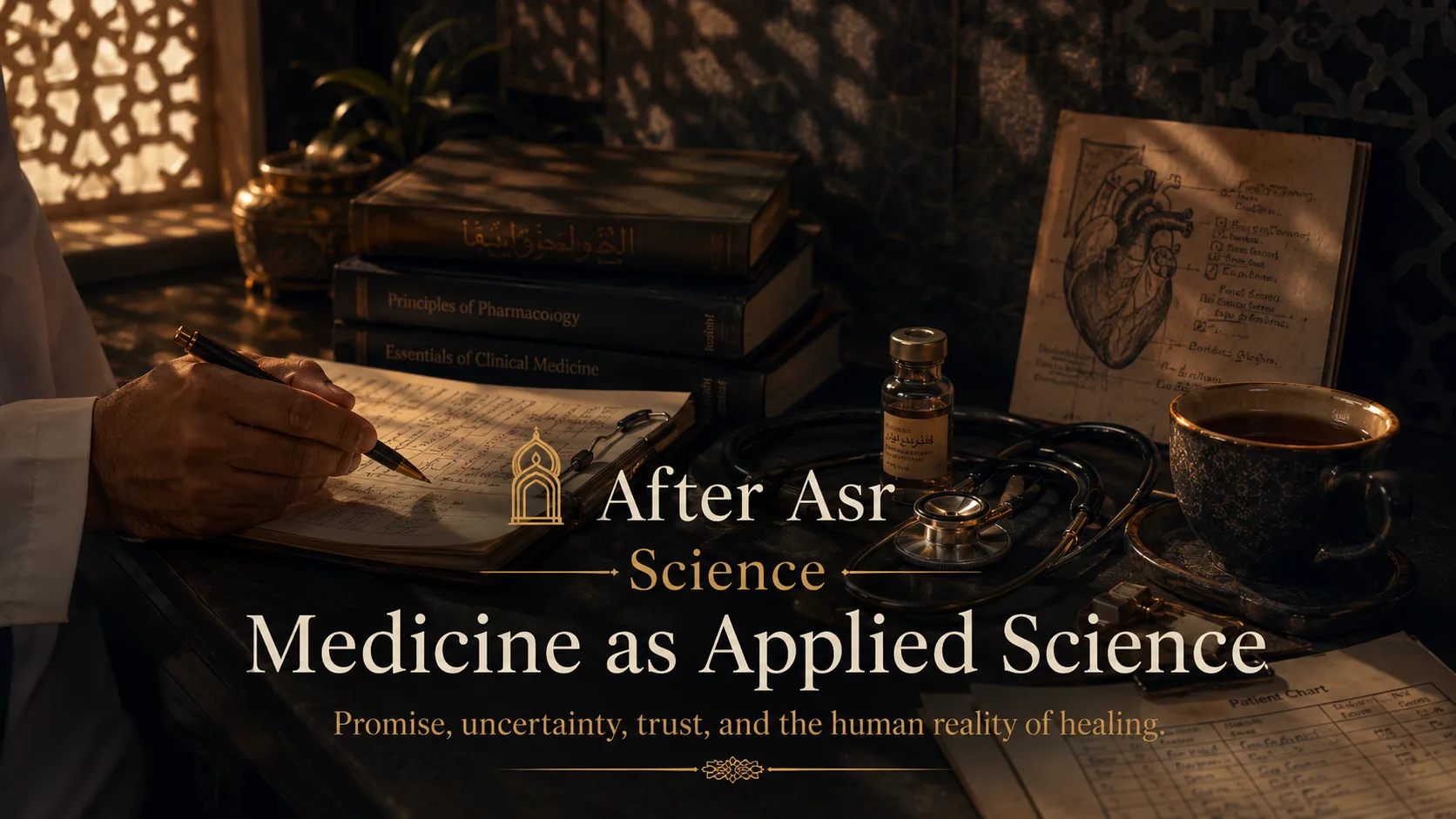
Promise, uncertainty, trust, and the human reality of healing
Medicine begins before the prescription.
It begins in the moment a person realizes that something in the body is not as it should be. A pain that does not leave. A fever that rises. A weakness that feels unfamiliar. A heartbeat that seems too fast. A child who will not eat. A parent who forgets more than before. A diagnosis whispered over the phone. A test result waiting unread in a patient portal.
In that moment, science becomes personal.
Not science as a textbook. Not science as a debate. Not science as a distant laboratory filled with instruments and statistics. Medicine is science carried into the fragile human body. It is research translated into treatment, anatomy translated into care, chemistry translated into dosage, probability translated into guidance, and knowledge placed beside fear.
Medicine is one of the clearest examples of applied science. It takes what human beings have learned about cells, organs, infection, injury, genetics, chemistry, behavior, nutrition, pain, immunity, and disease, then asks how that knowledge can reduce suffering.
This is a noble task.
But medicine is also humbling because the body is not a machine that always responds as expected. A treatment may work for many but fail for one. A test may clarify one question while opening another. A physician may know much and still not know enough. A patient may follow every instruction and still not heal as hoped.
Medicine carries promise, but not omnipotence.
It carries knowledge, but also uncertainty.
It requires trust, but not blind trust.
It serves the body, but must never forget the person.
To understand medicine well, we must understand both its power and its limits.
The mercy of applied knowledge
Modern medicine has reduced forms of suffering that once defined ordinary life.
Infections that once killed quickly can often be treated. Surgeries that would have been unbearable can be performed under anesthesia. Complicated births can be monitored. Broken bones can be set with precision. Blood pressure can be managed. Diabetes can be tracked. Cancers can be screened, staged, treated, and sometimes cured. Pain can be relieved. Premature infants can survive. Imaging can reveal what no human eye could see from the outside.
None of this should be treated casually.
Behind even a simple medicine is a long chain of inquiry. Someone studied the body. Someone identified a mechanism. Someone tested a compound. Someone observed side effects. Someone compared outcomes. Someone refined dosage. Someone monitored safety. Someone trained a physician, pharmacist, nurse, or technician.
Medicine is not merely a product. It is accumulated human effort in the service of healing.
This should produce gratitude. A person who has taken antibiotics for an infection, received anesthesia before surgery, used an inhaler during an asthma attack, or watched a loved one stabilized in an emergency room has experienced knowledge becoming mercy.
Faith does not require us to dismiss this. A believer can say healing ultimately belongs to God while still recognizing the means through which healing may come. Medicine is not a rival to divine mercy. It can be one of the created means through which mercy is experienced.
The doctor treats. The medicine acts through known and unknown processes. The body responds. The outcome remains with God.
This balance is important. Without it, we may fall into either arrogance or fatalism. Arrogance imagines medicine controls life. Fatalism refuses the means of care while claiming trust in God. A more faithful posture acts responsibly while knowing that human effort is never sovereign.
The body as a living complexity
Medicine humbles us because the body is deeply complex.
A body is not a collection of separate parts arranged like pieces in a drawer. It is an interconnected living system. The heart affects the kidneys. Sleep affects immunity. Stress affects digestion. Hormones affect mood. Nutrition affects healing. Inflammation affects the whole person. A medication intended for one problem may influence another.
The body remembers, adapts, compensates, resists, repairs, and sometimes fails.
This complexity is why medical knowledge requires patience. Symptoms can have many causes. A headache may be dehydration, stress, infection, vision strain, blood pressure, medication side effect, or something more serious. Fatigue may be poor sleep, anemia, depression, thyroid disease, grief, overwork, or a combination of many things.
A good physician must think scientifically, but also carefully. She must ask questions, examine patterns, consider likelihoods, rule out danger, and remain open to revision.
The patient often wants certainty. This is understandable. Illness creates fear, and fear wants an answer. But the body does not always reveal itself immediately. Sometimes medicine proceeds step by step, not because doctors are careless, but because the truth must be approached through evidence.
Testing, observation, follow up, and revision are not signs that medicine is weak. They are signs that the body deserves careful attention.
A rushed answer can be comforting in the moment and dangerous in reality.
The difference between treatment and healing
Medicine often treats, but healing is larger than treatment.
Treatment may reduce fever, shrink a tumor, stabilize blood sugar, repair tissue, manage pain, or lower inflammation. These are real goods. They matter deeply.
But healing also touches the person’s fear, trust, relationships, dignity, patience, hope, and sense of meaning. A patient can receive technically excellent treatment and still feel abandoned. Another patient can face a serious illness while feeling held by family, faith, community, and compassionate care.
This does not mean emotional support replaces medical treatment. It means the human being is not only a body with symptoms.
Medicine can become cold when it forgets this. A patient becomes “the kidney case,” “the diabetic,” “the stroke in room four,” “the noncompliant patient,” or “the difficult family.” Language that begins as shorthand can become a habit of dehumanization.
But the patient is not the disease.
The patient is someone’s child, spouse, parent, friend, neighbor, or teacher. The patient has sins and hopes, memories and regrets, private fears and unfinished plans. The patient may be worried about money, childcare, work, transportation, immigration status, disability, shame, or whether they will be treated with respect.
A scan cannot capture all of this. A lab result cannot summarize it. A diagnosis cannot contain it.
Medicine as applied science must remain medicine for persons, not merely intervention upon bodies.
Evidence and the individual patient
Modern medicine relies heavily on evidence.
This is a strength. Evidence helps protect patients from guesswork, superstition, marketing, and personal bias. Clinical trials, epidemiology, statistical analysis, and treatment guidelines help physicians understand what tends to work, what tends to harm, and what risks should be considered.
But evidence often speaks in patterns across groups. The patient sitting in the room is an individual.
This creates one of medicine’s central tensions.
A treatment may be effective for most patients with a certain condition, but not all. A side effect may be rare, but devastating for the person who experiences it. A risk may be statistically low, but emotionally heavy for a patient with a particular history. A guideline may be useful, but the person in front of the doctor may have multiple conditions, unusual circumstances, or values that must be heard.
Good medicine uses evidence without letting evidence erase the individual.
This requires judgment. It requires conversation. It requires explaining benefits and risks in a way the patient can understand. It requires asking what matters to the patient, not only what the chart recommends.
Science can tell us what is generally likely. Wisdom must help apply that knowledge to this person, in this moment, with these fears, these responsibilities, and these limits.
That application is not mechanical. It is moral.
The burden of uncertainty
Patients often experience uncertainty as suffering.
Waiting for test results can be more emotionally exhausting than receiving an answer. Not knowing whether pain is serious can make the mind circle endlessly. Unclear symptoms can make a person feel trapped between fear and embarrassment. A patient may wonder whether to worry, whether to wait, whether to seek another opinion, whether to trust the doctor, whether the doctor truly listened.
Uncertainty is not a minor part of medicine. It is everywhere.
A physician may be uncertain because symptoms are early. A test may be inconclusive. A disease may behave unusually. A treatment may have uncertain benefit. A patient may have multiple overlapping problems. Medical research itself may be incomplete.
The honest practice of medicine requires admitting uncertainty without abandoning responsibility.
This is difficult. Patients need confidence from their doctors. Doctors may feel pressure to sound certain. Institutions may reward efficiency over explanation. Families may demand clear answers that do not yet exist.
But false certainty is dangerous.
It may lead to premature diagnosis, unnecessary treatment, overlooked warning signs, or broken trust later. A doctor who can say, “I do not know yet, but here is how we will investigate,” is not weak. That may be exactly the kind of honesty a patient needs.
Uncertainty should not be used as an excuse for neglect. It should be handled with structure, communication, and care.
The patient needs to know: What are we watching for? What are the possibilities? What would make this urgent? What is the next step? When should I return? What do we know, and what remains unclear?
Uncertainty becomes less frightening when it is not faced alone.
Trust is necessary, but not blind
Medicine depends on trust.
A patient trusts the physician’s training. The physician trusts the lab. The lab trusts the equipment. The pharmacist trusts the prescription. The nurse trusts the chart. The hospital trusts protocols. The public trusts regulators, manufacturers, researchers, and institutions.
Modern medicine is a vast network of trust.
When that trust works, care becomes possible. When trust breaks, even good advice may be rejected.
But trust in medicine should not mean blind surrender. Patients have a right to ask questions. They have a right to understand their diagnosis, treatment options, side effects, costs, alternatives, and the consequences of waiting. They have a right to seek a second opinion. They have a right to be spoken to with dignity.
At the same time, questioning should not become the performance of expertise without knowledge. A patient can ask sincere questions without assuming that a few online searches equal medical training. A patient can advocate for himself without treating every doctor as an enemy. A patient can be cautious without becoming consumed by suspicion.
Trust and questioning are not opposites.
The best medical relationships make room for both. A good doctor welcomes thoughtful questions. A good patient listens with humility. Both understand that the goal is not for one side to win an argument. The goal is care.
Trust is built through competence, honesty, attention, and respect.
Why some people distrust medicine
Medical distrust does not appear from nowhere.
Some people distrust medicine because they have been dismissed, misdiagnosed, rushed, stereotyped, overcharged, ignored, or treated like a problem instead of a person. Some communities carry historical wounds from unethical research, unequal access, racial bias, forced procedures, neglect, or exploitation. Some patients have had pain minimized. Some have been told their symptoms were anxiety when something serious was happening. Some have seen profit placed above care.
These experiences matter.
It is too easy for institutions to respond to distrust by calling people ignorant. Sometimes people are misinformed. Sometimes they are frightened by false claims. But sometimes distrust is a wound before it becomes a worldview.
Medicine must respond with humility.
Public trust is not restored only by repeating facts louder. It is restored by truthful communication, accountability, better access, cultural humility, patient listening, and a willingness to acknowledge harm.
At the same time, past harm should not lead us into reckless rejection of all medical knowledge. Distrust can protect a person from being naive, but it can also make a person vulnerable to alternative forms of exploitation. False cures, conspiracy marketing, untested treatments, and charismatic misinformation often prey on people who have been hurt by institutions.
A wounded person still deserves reliable care.
The answer to medical distrust is not blind trust. It is trustworthy medicine.
The ethics of medical power
Medicine gives some people power over the bodies of others.
This power is necessary, but it is also dangerous.
A surgeon cuts into the body. A psychiatrist may influence a person’s understanding of the self. A physician may recommend treatment that alters the course of someone’s life. A hospital may decide who receives limited resources. Researchers may ask people to participate in trials. Public health officials may recommend policies affecting millions.
Because medicine is powerful, it must be governed by ethics.
The patient is not raw material for professional ambition. The poor are not testing grounds for the wealthy. The disabled are not burdens whose dignity can be discounted. The elderly are not disposable. The unborn, the dying, the chronically ill, and the mentally distressed all require moral seriousness.
Medicine must ask not only, “Can we do this?” but also, “Should we do this, in this way, to this person, under these conditions?”
Scientific ability does not automatically create moral permission.
A society may become able to extend life, end life, select traits, alter reproduction, monitor behavior, predict disease risk, or allocate care by algorithm. Each ability brings ethical questions. Medicine must not be allowed to drift into technical power without moral boundaries.
Faith has a vital role here. It reminds us that the body is a trust, life has sanctity, suffering people retain dignity, and not every possible intervention honors the human being.
Medicine needs science. It also needs conscience.
The role of the patient’s story
A good diagnosis often begins with listening.
Before the test, before the scan, before the prescription, there is the story. When did this begin? What does it feel like? What makes it better or worse? What changed recently? What are you afraid of? What have you tried? What do you think may be happening?
The patient’s story is not an inconvenience before the real medicine begins. It is part of the medicine.
Of course, stories can be incomplete. Patients forget, misinterpret, minimize, exaggerate, or struggle to describe symptoms. But data can also be incomplete. A normal test does not always mean nothing is wrong. A scan may miss what the patient’s lived experience reveals over time.
Medicine works best when story and data are brought together.
The physician must interpret both. The patient’s words need clinical knowledge. The clinical findings need human context. The art of medicine is partly the art of listening to both the body and the person.
This is why rushed medicine can become unsafe. A five minute visit may not reveal the grief behind fatigue, the medication confusion behind symptoms, the domestic stress behind poor sleep, the food insecurity behind uncontrolled diabetes, or the fear that kept a patient from seeking help earlier.
Efficiency has value, but not when it erases the patient.
Medicine and social reality
The body does not live outside society.
A person’s health is shaped by housing, income, food, work, stress, family support, pollution, transportation, education, violence, discrimination, loneliness, and access to care. A doctor can prescribe healthy food, but what if the patient cannot afford it? A doctor can recommend rest, but what if the patient works two jobs? A doctor can advise follow up, but what if transportation is unreliable? A doctor can prescribe medication, but what if the cost is impossible?
Medicine that ignores social reality may blame the patient for conditions the patient did not create alone.
This does not remove personal responsibility. People do make choices that affect health. But choices are made within conditions. Some people have more options than others. Some are born into neighborhoods, diets, stressors, and medical access that shape the body long before an individual decision is made.
Applied science should not only treat disease after it appears. It should also ask why disease is distributed the way it is.
Who is exposed to pollution?
Who lacks preventive care?
Who lives far from hospitals?
Who works in unsafe conditions?
Who cannot afford medication?
Who is believed when they report pain?
Who is studied, and who is neglected?
These questions are scientific and moral at the same time.
Medicine is not only what happens in the clinic. It is also what a society chooses to protect or ignore.
Faith at the bedside
Illness often awakens spiritual questions.
A person may ask, “Why me?”
A parent may ask, “Why my child?”
A patient may wonder whether illness is punishment, test, purification, warning, mercy, or mystery. A family may pray for healing while trying to accept uncertainty. A dying person may review an entire life in silence.
Medicine cannot answer all of this.
A doctor can explain pathology, but not the full meaning of suffering. A medication can relieve pain, but not necessarily fear of death. A surgery can remove disease, but not always the spiritual loneliness that illness exposes.
This is where faith matters deeply.
Faith does not make illness easy. It does not erase grief. It does not guarantee the outcome a person wants. But it gives suffering a horizon wider than the hospital room. It teaches that the body is not the whole self, that pain is seen by God, that patience has meaning, that prayer is never wasted, that death is not disappearance, and that mercy may be present even when cure is not.
Faith also protects the patient from being reduced to medical success or failure.
If the disease improves, the person is not merely lucky. If the disease worsens, the person is not worthless. If cure is not possible, care remains obligatory. If the body declines, dignity remains.
A believer can seek treatment fully and still say: I belong to God.
Healing is not always cure
One of the hardest truths in medicine is that healing and cure are not always the same.
Cure means the disease is removed or resolved. Healing may include cure, but it can also include peace, acceptance, reconciliation, relief, dignity, forgiveness, or the ability to live meaningfully with what remains.
This distinction matters especially for chronic illness, disability, terminal disease, mental health struggles, and aging.
If medicine only values cure, then patients who cannot be cured may feel abandoned. But if medicine understands care more deeply, then the work continues even when cure is no longer possible. Pain can be managed. Fear can be addressed. Family can be supported. Spiritual needs can be honored. The patient can be treated as a whole person until the final breath.
Palliative care, hospice care, rehabilitation, counseling, and long term support remind us that medicine is not only about defeating disease. It is also about accompanying human beings through vulnerability.
Sometimes the most important medical question is not, “How do we extend life at any cost?” but, “What does care require now?”
This question demands both science and wisdom.
The problem with medical certainty online
The internet has changed the patient experience.
A person can search symptoms at midnight and become convinced of the worst possibility. He can join forums, watch videos, read studies, compare treatments, and encounter both helpful education and dangerous misinformation. He can become more informed, but also more anxious.
Online medical information can empower patients. It can help them ask better questions and recognize warning signs. But it can also create false confidence.
A list of symptoms is not a diagnosis. A personal testimony is not clinical evidence. A supplement claim is not proof. A study abstract is not medical training. A social media doctor may be simplifying, selling, exaggerating, or speaking outside context.
Medicine online often removes the very thing medicine needs most: the relationship between evidence and the individual person.
The body on the screen is general. The body in the clinic is specific.
A responsible patient can use online resources as a starting point, but not as a replacement for qualified care. A responsible physician can recognize that patients will search online and help them understand what information is reliable.
The goal is not to shame people for searching. The goal is to help them search wisely.
Gratitude without naivety
We should be grateful for medicine, but not naive about it.
Medicine has saved lives and caused harm. It has relieved suffering and sometimes ignored suffering. It has produced extraordinary knowledge and sometimes served profit, power, or prejudice. It contains both compassion and bureaucracy, both brilliance and blind spots.
A mature view can hold this complexity.
We can honor doctors and still advocate for patients.
We can value research and still demand ethical safeguards.
We can trust evidence and still ask about conflicts of interest.
We can use medicine and still remember that healing belongs to God.
We can critique systems without rejecting the knowledge that protects life.
This balanced posture is badly needed.
Some people worship medicine as though death itself can be defeated by expertise. Others reject medicine as though all modern care is corrupt. Both responses are too simple.
Medicine is a human field built around a sacred vulnerability: the body in need.
That field deserves gratitude, reform, humility, and moral seriousness.
The physician as servant of healing
At its best, the physician is not a mechanic of the body, but a servant of healing.
This does not mean every physician must be sentimental or spiritually expressive. Medicine requires technical competence. A kind but incompetent doctor is dangerous. But competence without compassion is also incomplete.
The physician enters a patient’s life at moments of exposure. The body may be undressed, examined, cut, scanned, questioned, medicated, or monitored. Private fears become medical notes. Family secrets may surface. Weakness becomes visible.
This requires adab.
A doctor should know that the patient’s vulnerability is a trust. A nurse should know that tenderness is not extra. A technician should know that a procedure may be routine for the staff but terrifying for the patient. A receptionist should know that a harsh word can deepen fear before the appointment even begins.
Every person in medicine participates in the moral atmosphere of care.
Applied science becomes humane when the people applying it remember the dignity of the one receiving it.
The patient as active participant
The patient also has responsibilities.
A patient should speak honestly, ask questions, follow instructions as best as possible, disclose medications and supplements, report side effects, and seek clarification when confused. A patient should not demand antibiotics for every illness, ignore dosage instructions, stop treatment without discussion, or hide important information out of embarrassment.
This is not about blaming patients. It is about recognizing that healing often requires participation.
Medicine is not done only to a person. Often, it is done with a person.
The patient must live with the treatment after leaving the clinic. He must take the pill, change the diet, attend the follow up, monitor the symptom, rest the injury, manage stress, or ask for help. This can be difficult, especially when life is chaotic or resources are limited.
Compassionate medicine supports patient responsibility without shaming human struggle.
A good healthcare system should make it easier for people to do what care requires.
Where medicine meets the soul
Medicine shows us that human beings are both strong and fragile.
The body can heal wounds, fight infection, adapt to injury, carry children, build immunity, and endure astonishing hardship. It can also be undone by a clot, a cell, a fall, a mutation, a shortage of oxygen, a tiny organism, or time itself.
This should humble us.
Health is not fully owned. It is entrusted. Strength is not permanent. Youth is not permanent. Control is not permanent. The body that carries us through life will one day require care, and eventually it will return to the earth.
Medicine can delay some losses. It can soften some suffering. It can treat many wounds. It can extend life. But it cannot make us immortal.
This is not a failure of medicine. It is the truth of human life.
The purpose of medicine is not to make us forget death. It is to serve life faithfully within its limits.
For the believer, this gives medicine its proper place. We seek treatment because life is a trust. We accept limits because life is not ultimate. We care for the sick because mercy is required. We prepare for death because return to God is certain.
Science helps us treat the body. Faith helps us understand the body’s place within the journey of the soul.
Medicine with humility
Medicine as applied science is one of humanity’s great responsibilities.
It asks us to study carefully, treat ethically, communicate honestly, and care tenderly. It asks researchers to pursue truth without exploiting the vulnerable. It asks doctors to apply evidence without forgetting the person. It asks patients to seek help without surrendering their dignity. It asks society to make healing available not only to those who can afford comfort.
Medicine is full of promise. We should not minimize that promise. Every healed infection, every safe birth, every relieved pain, every restored breath, every extended life is meaningful.
But medicine is also full of uncertainty. We should not hide that uncertainty. The body is complex, knowledge is incomplete, and outcomes are not fully in human hands.
Between promise and uncertainty stands trust.
Trust in skilled care.
Trust built through honesty.
Trust strengthened by humility.
Trust purified by accountability.
Trust that acts through means while knowing that final outcomes belong to God.
Medicine is not merely science applied to the body. It is knowledge applied to vulnerability.
And vulnerability is sacred territory.
The clinic, the hospital room, the pharmacy counter, the home care visit, the bedside prayer, the waiting room silence, the hand held before surgery, the family gathered around a diagnosis, all of these are places where science meets the human condition.
If medicine is practiced well, it does not make us arrogant. It makes us careful.
Careful with bodies.
Careful with words.
Careful with hope.
Careful with fear.
Careful with power.
Careful with the trust of those who come seeking help.
Healing is never only technical. It is moral, relational, and spiritual.
The medicine may be measured in milligrams.
The treatment may be guided by research.
The diagnosis may be written in clinical language.
But the person receiving care remains more than a case.
They are a human being, held between weakness and mercy, knowledge and uncertainty, treatment and trust, life and return.
And in that space, medicine becomes more than applied science.
It becomes a test of how gently knowledge can touch the wounded.
About the Author
Dr. Safiyyah Rahman is the Science & Society Essayist for After Asr, writing at the intersection of scientific inquiry, ethics, faith, and human responsibility. Her work explores how knowledge shapes not only what we understand about the world, but how we live within it.


