
Why no honest story of Islam in America can begin without Black Muslim history, struggle, scholarship, and leadership.
Any honest story of Islam in America must begin before the immigrant mosque, before the suburban Islamic center, before the campus Muslim Student Association, before the halal restaurant district, before the national advocacy organization, before the Eid proclamation, before the public school Ramadan accommodation, before the polished language of Muslim representation.
It must begin with Black Muslims.
Not as a footnote. Not as a chapter to be acknowledged politely before moving on. Not as a symbolic origin story brought out for speeches and commemorative posts. Black Muslim history is not decorative memory. It is foundational. It is part of the soil from which Islam in America has grown, suffered, endured, organized, taught, corrected, and called people back to dignity before many of today’s institutions existed.
This foundation includes enslaved African Muslims who carried Islam into the Americas under conditions designed to strip them of name, language, family, religion, and selfhood. It includes literate Muslims whose Arabic manuscripts survived against every expectation. It includes people who held traces of prayer, fasting, Qur’an, modesty, names, memory, and discipline under bondage. It includes later Black Muslim movements that restored religious identity, challenged white supremacy, built institutions, published newspapers, opened schools, fed families, disciplined communities, and gave spiritual language to people whom America had told they were less than human.
It includes masjids in Black neighborhoods. Prison prayer circles. Street da’wah. Mothers teaching children. Men rebuilding lives through Islam. Women sustaining institutions. Scholars and imams carrying communities with limited resources. Families who made Islam not an abstract theology, but a way to stand upright in a country that repeatedly denied their dignity.
If we begin the story of Islam in America anywhere else, we do not merely make a historical mistake.
We misunderstand the community we are trying to describe.
Islam was not waiting at the airport
A common public imagination treats Islam in America as a religion that arrived recently, carried mainly by immigrants from Arab, South Asian, African, or other Muslim-majority societies. Immigration is an important part of the story. Immigrant Muslims built many institutions, preserved languages, funded mosques, raised families, and expanded the visibility of Muslim life in extraordinary ways.
But Islam was not waiting at the airport to enter America.
It was already here, carried by enslaved African Muslims long before the United States became the country Muslims now navigate. Some were scholars. Some were farmers. Some were artisans. Some were soldiers, merchants, teachers, or students before capture. Some knew Qur’an. Some wrote Arabic. Some preserved Islamic names. Some were forced into Christianized structures while holding memory privately. Some left traces that historians can still read. Many left no record, not because they had no faith, but because slavery was designed to erase records, names, families, and sacred continuity.
This matters because the common story of Islam as foreign does not only come from non-Muslims. Sometimes Muslims repeat it without realizing. A mosque history may begin with the first immigrant families in town, while ignoring earlier Black Muslim presence nearby. A school curriculum may teach children about Muslims around the world but barely mention enslaved African Muslims in America. A public panel may include immigrant achievement stories but leave out Black Muslim institutions that predate them. A young Muslim may grow up thinking American Islam began with their parents’ migration, not with centuries of Black struggle and spiritual endurance.
This is not only unfair to Black Muslims. It weakens everyone’s understanding.
When Muslims forget that Islam has been woven into the deepest wounds of America, they become more vulnerable to the claim that Islam is permanently outside the American story. When they remember, they see something truer: Islam has been present here through oppression, survival, moral struggle, and the search for liberation. It has been part of America’s conscience, not only its diversity.
The enslaved Muslim as witness
The enslaved African Muslim stands as one of the most morally serious figures in American Muslim memory.
Not because we should romanticize suffering. Slavery was not a setting for inspirational simplicity. It was violence. It was family separation, forced labor, sexual exploitation, cultural destruction, bodily terror, legal dehumanization, and spiritual assault. To speak of enslaved Muslims with reverence does not mean softening what was done to them. It means refusing to let what was done to them define the whole of who they were.
Some enslaved Muslims left written evidence of their faith. Others left hints through names, practices, oral memory, and the observations of those around them. Many were forced into conditions where Islamic practice could not be openly sustained. They were separated from communities, deprived of teachers, punished for literacy, and placed under systems that sought to replace their religious identity.
Yet even fragments matter.
A written Arabic page. A remembered name. A description of prayer. A refusal of pork. A habit of fasting. A trace of Qur’an. A disciplined bearing. These fragments testify that Islam in America began not in comfort, but under enormous pressure. They also remind us that religious continuity is not always institutional. Sometimes it survives in the body, memory, language, and longing of people denied the structures that normally sustain faith.
This should humble American Muslims today.
Many of us worry about maintaining Islam amid school calendars, work schedules, media misrepresentation, and cultural pressure. These are real challenges. But before us were Muslims who tried to remember Allah under conditions designed to annihilate their freedom. Their presence does not make our struggles small, but it gives them scale. It reminds us that Islam here has already survived more than inconvenience. It has survived brutality.
The enslaved Muslim is not merely a tragic figure. He or she is a witness: to the truth that Islam cannot be reduced to immigration, to the depth of Black Muslim roots, and to the responsibility of later Muslims not to forget those who carried faith when carrying it cost almost everything.
Black Muslim revival and the search for dignity
In the twentieth century, Black Muslim movements emerged in a country still structured by segregation, racial terror, economic exclusion, and the afterlife of slavery. These movements were not all the same. Their theologies, methods, language, and relationship to Sunni Islam varied. Some require careful distinction and critique. But no honest account can deny their historical force.
They gave language to dignity in communities where dignity had been systematically assaulted.
For many Black Americans, Islam became a way to reject the names, categories, habits, and spiritual injuries imposed by white supremacy. It offered discipline where society had expected disorder. It offered community where people had been fragmented. It offered modesty, sobriety, family responsibility, economic cooperation, and moral seriousness in neighborhoods abandoned or exploited by larger systems. It gave people a way to stand upright, speak clearly, dress with dignity, eat with intention, and see themselves as accountable to God rather than inferior before men.
The wider Muslim community must speak about this history with both gratitude and precision. Not every movement’s theology can be accepted as Islamic orthodoxy. Not every leader was beyond criticism. But it is possible to distinguish theological correction from historical dismissal. Many people came to Sunni Islam through paths shaped by Black Muslim movements. Many families were stabilized, many lives reoriented, many communities organized, and many public assumptions shattered.
Malcolm X, may Allah have mercy on him, remains one of the most widely recognized figures in this history, but he should not become the only name people know. When one figure carries the entire weight of representation, the broader community disappears. Black Muslim life includes countless unnamed teachers, mothers, fathers, imams, organizers, business owners, prisoners, chaplains, writers, students, and local leaders whose work did not become famous but shaped American Islam at the ground level.
A community is not built only by icons. It is built by people who keep showing up.
The masjid in the Black neighborhood
To understand Islam in America, one must understand the Black masjid as a community institution.
In many places, Black Muslim communities built masjids that were not only prayer spaces. They were schools, neighborhood anchors, reform centers, food networks, bookstores, counseling spaces, marriage support systems, janazah organizers, and places where people learned to speak, dress, work, and live differently. They were often built with limited wealth, local labor, and deep commitment.
These masjids carried the challenges of their surrounding neighborhoods: poverty, policing, addiction, incarceration, unemployment, family strain, racism, and community violence. But they also carried resilience. They taught Qur’an in cities where public schools often failed children. They offered brotherhood to men returning from prison. They gave women networks of spiritual and practical support. They taught children that being Black and Muslim was not a contradiction, not a novelty, and not an imported identity. They hosted study circles, fed people, buried the dead, and tried to hold families together.
Their work was not always polished. Institutions formed under pressure rarely are. There were conflicts, leadership struggles, resource limitations, and human mistakes. But the existence of imperfection should not make later communities dismiss the depth of what was built.
Many immigrant Muslims arrived in America and found that Black Muslims had already carved out religious space in a hostile environment. In some cities, Black Muslim communities had already fought for recognition, established prison rights, built public familiarity with Islam, and shown that Muslims were not theoretical outsiders. The ground was not empty.
Yet too often, immigrant communities built parallel institutions without learning from or joining with the Black Muslim communities already present. Sometimes this was due to language, culture, or neighborhood separation. Sometimes it was due to anti-Blackness. Sometimes it was due to ignorance. Whatever the cause, the result has been painful: the people whose history makes American Islam possible are too often treated as peripheral within American Muslim spaces.
This must be named because it must be repaired.
Anti-Blackness inside Muslim spaces
It is not enough for Muslims to condemn racism in America while ignoring anti-Blackness in Muslim communities.
Anti-Blackness can appear in marriage preferences, mosque leadership patterns, social circles, jokes, assumptions about converts, attitudes toward Black neighborhoods, policing language, school discipline, donor priorities, and whose Islamic knowledge is treated as authoritative. It can appear when Black Muslims are praised publicly but not trusted privately. When their history is invoked but their leadership is sidelined. When their pain is acknowledged in general but dismissed in specific. When immigrant Muslims speak about racism as an American problem while carrying their own inherited prejudices into the masjid.
This is spiritually dangerous.
Islam does not erase racism simply because Muslims recite verses about human equality. The Qur’an and Sunnah provide the truth, but communities must still submit to it. A person can believe in Islamic brotherhood and still carry racist habits. A mosque can be diverse and still unequal. A community can celebrate Bilal ibn Rabah, may Allah be pleased with him, while failing Black Muslims standing in front of them.
The contradiction is not in Islam. It is in Muslims failing to live Islam.
Repair begins with truth. Not vague diversity language. Not occasional panels. Not using Black Muslim speakers only during Black History Month. Not treating racism as a public relations concern. Repair requires communities to ask: Who is leading? Who is teaching? Who is invited into decision-making? Whose scholarship is studied? Whose pain is believed? Whose children are protected? Whose neighborhoods are served? Whose marriages are discouraged? Whose presence is treated as normal rather than symbolic?
Anti-Blackness is not only a social issue. It is a disease of the heart and a violation of Islamic moral order. It must be addressed with repentance, education, policy, leadership change, family conversations, and spiritual seriousness.
A Muslim community that refuses to address anti-Blackness cannot honestly claim to honor the foundation of Islam in America.
Black Muslim scholarship and religious authority
Black Muslims have not only struggled and organized. They have taught.
They have produced imams, scholars, chaplains, teachers, Qur’an instructors, writers, translators, organizers, and community intellectuals whose work has shaped generations. Some studied overseas. Some learned in local masjids. Some emerged from prison study circles. Some came through Black Muslim movements and later deepened in Sunni scholarship. Some built schools. Some served as chaplains in prisons, hospitals, and universities. Some taught children in neighborhoods others ignored. Some wrote, translated, preached, and counseled in language that reached American hearts with unusual directness.
This matters because religious authority in America has often been racialized, even when Muslims do not admit it.
An immigrant accent may be treated as more “authentic” than a Black American voice, even when the Black scholar has deeper knowledge of the American context. Overseas training may be respected, as it should be, but local community wisdom may be undervalued. Black imams may be expected to speak on race and prisons, but not invited to teach theology, fiqh, spirituality, or Qur’an to broader audiences. Black Muslim women scholars and teachers may be even more overlooked, despite carrying immense educational and pastoral labor.
A community that wants Islamic knowledge to flourish in America must honor Black Muslim scholarship as scholarship, not only testimony.
The American context requires teachers who understand both the tradition and the terrain. Black Muslim scholars and imams have often had to teach Islam amid poverty, racism, incarceration, family crisis, public suspicion, and the daily moral pressures of American life. Their knowledge has been tested in difficult places. Their language often carries a clarity born from direct contact with struggle.
To ignore that is a loss for everyone.
Prison Islam and the moral seriousness of return
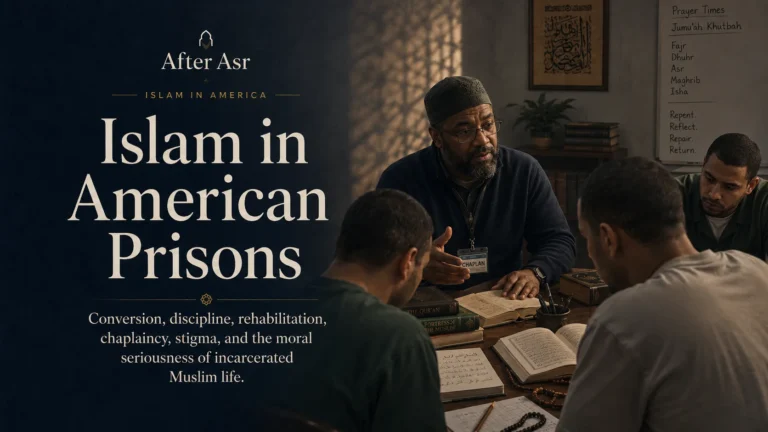
No honest story of Black Muslims in America can ignore prisons.
Islam has had a profound presence in American prisons, especially among Black men, though not only Black men. For many, prison became the place where they encountered discipline, prayer, Qur’an, Arabic, brotherhood, fasting, and a new sense of accountability before Allah. This reality is complicated. It involves suffering, state violence, crime, repentance, stigma, transformation, and the hard question of what communities owe those who return.
For some people, Islam in prison was not a trend or identity marker. It was a lifeline. It gave structure to days designed to degrade the human being. It gave men a way to clean themselves physically and spiritually in environments of danger and despair. It gave language for repentance. It gave a community of brothers trying to live differently within walls. It gave a reason to resist the worst parts of prison culture.
But Muslim communities outside often fail returning citizens.
A man may leave prison with prayer, Qur’an, and hope, only to find employment barriers, family strain, housing instability, suspicion, and mosques unsure how to receive him. He may be respected in theory as someone who changed, but avoided in practice. His knowledge may be dismissed because of his past. His needs may be treated as too complicated. His reentry may depend on a few under-resourced community members.
This is not only a social failure. It is a spiritual test.
If Islam teaches repentance, then communities must make room for people who are repenting. This does not mean ignoring accountability, safety, or the rights of victims. It means refusing to treat a person’s worst chapter as the only truth about them. Black Muslim prison work has long understood this moral seriousness. The wider community should learn from it.
The future of Islam in America must include prison chaplaincy, reentry support, family care, legal advocacy, employment pathways, and masjids capable of receiving those who return with dignity and wisdom.
Black Muslim women and the labor of continuity
Black Muslim women have carried American Islam in ways that are too often underrecognized.
They have taught children, built families, organized schools, sustained masjids, written, studied, led women’s circles, supported prisoners and returning citizens, cared for elders, challenged racism, preserved modesty and dignity under public scrutiny, and held communities together through hardship. They have navigated both racism outside Muslim spaces and sexism or marginalization inside them. They have often been expected to serve while being underprotected, to represent strength while carrying exhaustion, to speak about pain while making others comfortable.
Their labor is not secondary.
Any story that centers Black Muslim men as public leaders but overlooks Black Muslim women as builders, scholars, mothers, teachers, and organizers remains incomplete. The home, the classroom, the women’s circle, the prison visitation network, the community kitchen, the youth program, the bookstore, the neighborhood school, and the quiet counseling conversation are all sites of Islamic history.
Black Muslim women have also shaped the moral language of American Islam. They have challenged communities to confront racial injustice, gendered harm, family breakdown, and spiritual superficiality. They have raised children who carried Islam into new generations. They have preserved beauty without needing public applause.
To honor Black Muslim women is not merely to mention them. It is to listen to them, study them, support them, protect their spaces of learning, include their leadership, and stop treating their labor as endless.
The next generation needs to know their names, and also learn from their methods.
The convert question and the Black Muslim center
Many discussions of converts in America forget that Black Muslims have long been central to conversion narratives.
Conversion to Islam among Black Americans has often carried layers of spiritual awakening, racial dignity, moral discipline, family restructuring, and liberation from imposed identities. It has not always been the quiet private conversion story that some imagine, though it can be that too. It has often been communal, public, and socially consequential. Islam gave many Black converts not only a new set of beliefs, but a new way to inhabit the self.
This history should deepen how American Muslims think about conversion.
A convert is not simply someone joining an existing immigrant or ethnic community. Converts have helped build American Islam. They have changed the community’s language, priorities, and public presence. Black converts especially have shown that Islam in America is not merely inherited from abroad. It is chosen, lived, argued for, and rebuilt in American conditions.
When immigrant Muslims treat converts as guests, they misunderstand the house. Converts are not visitors in American Islam. They are among its architects.
This matters today as Latino, white, Black, Indigenous, Asian, and people of many backgrounds continue entering Islam. The community should not view them as additions to a preexisting ethnic order. Their questions may reveal what needs repair. Their presence may expose cultural confusion. Their sincerity may renew born Muslims. Their struggles may challenge the community to become more truly Islamic and less merely inherited.
Black Muslim history teaches that conversion is not marginal. It is foundational.
Black Muslim leadership and the wider ummah
Black Muslim leadership has often been local, practical, and morally direct.
It has had to be. Communities facing racism, poverty, policing, incarceration, and family crisis do not have the luxury of abstraction. Leadership must answer real needs. How do we keep young men alive and disciplined? How do we support mothers? How do we teach children? How do we protect marriages? How do we help people leave addiction? How do we bury the dead? How do we maintain prayer in the face of despair? How do we speak to America without begging for dignity?
This kind of leadership has much to teach the wider ummah.
Sometimes affluent Muslim communities imagine leadership as programming, branding, fundraising, and institutional expansion. These matter, but they are not enough. Leadership is also pastoral courage. It is knowing the names of people in pain. It is visiting prisons. It is settling disputes. It is teaching with language people can understand. It is addressing racism without fear of donors. It is telling the truth about family dysfunction. It is helping people repent. It is making Islam livable for people who are not socially polished.
Black Muslim leadership often carries this street-level seriousness. Not always perfectly, but often with a rooted understanding that Islam must transform actual lives, not merely decorate public identity.
The wider Muslim community should not only invite Black Muslim leaders to speak about race. It should learn from how they build, teach, organize, and endure.
The danger of symbolic inclusion
One of the easiest mistakes today is symbolic inclusion.
A community adds a Black Muslim speaker to a panel. A school mentions enslaved African Muslims during one unit. A mosque posts about Malcolm X once a year. An organization uses a diverse photo. A conference includes a session on race. These things may be good, but they can also become substitutes for deeper change.
Symbolic inclusion asks: Did we mention them?
Real inclusion asks: Did we change how we understand ourselves?
If Black Muslim history is foundational, then it should shape Islamic education all year, not only during commemorative moments. If Black Muslim leadership matters, then Black Muslims should be part of governance, teaching, curriculum, strategy, and public representation. If anti-Blackness is a spiritual disease, then communities need ongoing work in families, marriage conversations, school discipline, hiring, mosque culture, and leadership development. If Black Muslim scholarship is real, then it should be studied alongside other scholarship. If Black Muslim communities are struggling with underfunded institutions, then wealthier Muslim communities should ask what solidarity requires materially.
Symbolic inclusion can make people feel morally complete too quickly. It allows a community to say, “We acknowledged it,” without asking what acknowledgment demands.
The goal is not to perform concern. The goal is to tell the truth and live differently because of it.
Immigrant Muslims and the duty of humility
Immigrant Muslims and their descendants owe Black Muslims more than occasional appreciation.
They owe humility.
Many immigrant families arrived in America after civil rights struggles had already altered the legal and social landscape. They benefited, whether they knew it or not, from battles fought by Black Americans and other marginalized communities. They built mosques in a country where Black Muslims had already made Islam publicly legible in many places. They entered universities, professions, and neighborhoods shaped by histories they did not always study. They sometimes experienced racism themselves, but also sometimes adopted anti-Black attitudes from their countries of origin or from American social hierarchies.
Humility begins by acknowledging this.
It does not require immigrant Muslims to diminish their own sacrifices. Many endured hardship, discrimination, poverty, war, displacement, and loneliness. Their work matters. Their institutions matter. Their children’s struggles matter. But their story is not the whole story, and in America it is not the first story.
Immigrant Muslims should teach their children that Black Muslim history is part of their inheritance too. Not because they are Black, but because they are Muslim in America. They should visit Black-led masjids, study Black Muslim scholars, build genuine relationships, support institutions materially, confront anti-Black family attitudes, and refuse marriage racism disguised as cultural preference.
Humility is not guilt. It is truthfulness with responsibility.
Black Muslims and American belonging
Black Muslims complicate the question of Muslim belonging in America in a necessary way.
When Muslims are told they are foreign, Black Muslims expose the lie. Their roots are not recent. Their claim to America does not depend on immigration paperwork, model minority success, or polite public approval. Their families have shaped this country through suffering, labor, culture, faith, resistance, and leadership. They are not guests.
At the same time, Black Muslim history also challenges shallow American belonging. It reminds us that being rooted in America does not mean being treated justly by America. It exposes the gap between national ideals and lived reality. It teaches that one can belong to a place and still speak against its sins. One can be deeply American and refuse America’s myths. One can seek justice here without worshipping the nation.
This is a gift to all American Muslims.
Many Muslims are still trying to answer the question, “Can we belong here?” Black Muslims have lived a deeper answer: belonging is not the same as comfort, and dignity is not granted by approval. It is possible to be rooted, critical, faithful, and unwilling to disappear. It is possible to call America home without making America holy. It is possible to build institutions in a land that has wounded you.
That moral complexity should shape the entire Islam in America conversation.
The children who need the full story
Muslim children in America need to learn that Black Muslim history is not optional.
A child should know that Islam in America did not begin with their parents’ mosque. They should know about enslaved African Muslims. They should know about Black Muslim movements and their impact. They should know about Malcolm X, but also beyond Malcolm X. They should know about Black imams, scholars, women teachers, prison chaplains, community builders, and local histories. They should know that some of the earliest Muslims on this land were Black people whose faith survived in fragments under oppression.
This education changes how children see Islam and America.
For Black Muslim children, it can affirm that they are not peripheral to the ummah. Their history is not an add-on. Their presence is not diversity. Their people have carried Islam here from the beginning.
For non-Black Muslim children, it can correct inherited ignorance and arrogance. It can teach gratitude. It can challenge anti-Blackness before it hardens. It can help them understand that the masjid is not the property of one ethnic group. It can make them better inheritors of American Islam.
For convert children and mixed families, it can offer a wider sense of belonging. For all children, it can make the story truer.
Islamic schools, weekend schools, youth programs, khutbahs, and family conversations should include this history naturally and repeatedly. Not as a political insertion. As part of religious and communal honesty.
A generation taught the full story may build differently.
From recognition to repair
Recognition is necessary, but it is not enough.
Recognizing Black Muslim centrality should lead to repair in how communities allocate attention, money, leadership, curriculum, and care. It should lead to stronger support for Black-led institutions. It should lead to anti-racism work grounded in Islam, not imported as a slogan. It should lead to better representation on boards and teaching platforms. It should lead to serious study of Black Muslim scholarship. It should lead to relationships between immigrant and Black Muslim communities that are not occasional or optics-driven.
Repair may be uncomfortable because it moves from speech to sacrifice.
It may require wealthy communities to support underfunded masjids without trying to control them. It may require families to confront marriage racism. It may require schools to revise curricula. It may require organizations to ask why their leadership is not representative. It may require Muslims to stop using Black Muslim pain as evidence of diversity while leaving Black Muslims to carry the burden of explanation.
It may also require Black and non-Black Muslims to build trust slowly, honestly, and locally. Trust cannot be demanded. It must be earned. Where harm has occurred, apology may be needed. Where ignorance exists, education is needed. Where resources are unequal, material support is needed. Where leadership is exclusionary, structural change is needed.
The goal is not guilt. The goal is justice, love, and truth.
A foundation still living
The phrase “Black Muslim foundation” should not suggest that Black Muslims belong only to the past.
Foundations are not museum pieces. They hold up living structures.
Black Muslims are not merely historical proof that Islam is American. They are present-tense leaders, scholars, parents, teachers, organizers, students, artists, professionals, chaplains, business owners, youth mentors, and seekers of Allah. They are building now. Teaching now. Correcting now. Serving now. Struggling now. Raising children now. Asking hard questions now. Reimagining institutions now.
To honor the foundation is to honor the living community.
This means listening to Black Muslims not only when discussing slavery, civil rights, Malcolm X, prisons, or racism, but also when discussing theology, spirituality, education, family, youth, media, finance, civic life, and the future of Islam in America. It means refusing to place Black Muslims in a narrow category of “race speakers” while others are treated as universal Muslim authorities.
Black Muslim life is not only about oppression. It is about worship, beauty, humor, scholarship, family, creativity, discipline, tenderness, and hope. It includes suffering, but is not reducible to suffering. It includes critique, but is not reducible to critique. It includes history, but is not trapped in history.
The foundation is alive.
Beginning honestly
To begin the story of Islam in America with Black Muslims is not to exclude anyone else.
It is to tell the truth in the right order.
Immigrant Muslims belong in the story. Converts of every background belong. Refugees belong. Latino Muslims, white Muslims, Arab Muslims, South Asian Muslims, African immigrants, Southeast Asian Muslims, Turkish Muslims, Bosnian Muslims, Iranian Muslims, Afghan Muslims, Somali Muslims, and others belong. The story is wide. But width without foundation becomes confusion.
Black Muslim history gives American Islam its deepest roots, its sharpest moral questions, and some of its strongest examples of faith under pressure. It teaches that Islam here is not merely about representation, integration, or accommodation. It is about dignity before Allah in a society that has often denied dignity to human beings. It is about worship under constraint. It is about rebuilding the self after humiliation. It is about community as discipline and mercy. It is about speaking truth when the public story is false.
No honest story can begin elsewhere.
And no faithful future can be built while treating that foundation lightly.
American Muslims should say this clearly, teach it consistently, and live as though it matters. Not because Black Muslims need symbolic praise from others to be central. Their centrality is already true. The question is whether the rest of the community will become truthful enough to recognize it.
If Islam in America is to mature, it must remember who carried it before it was respectable, before it was visible in professional spaces, before it had national organizations, before it had suburban campuses, before it could be marketed as diversity.
It must remember the enslaved Muslim writing Arabic under bondage.
The Black imam teaching in a storefront masjid.
The mother raising children in discipline and faith.
The prisoner learning to pray in a cell.
The sister organizing meals and classes.
The elder who kept the doors open.
The scholar whose authority was overlooked.
The community that built without applause.
The foundation is not beneath us in the sense of being behind us.
It is beneath us in the sense that we are standing on it.