Navigating public Muslim identity with confidence and restraint
Amina adjusts her hijab in the bathroom mirror before heading into the job interview. She’s worn it since she was sixteen, a visible commitment to her faith that she’s never questioned. But she’s also calculated. Today’s scarf is a neutral navy, professionally styled, paired with a tailored blazer. She knows she’s already going to stand out. There’s no need to make it harder than it already is.
Down the street, Kareem debates whether to attend Friday prayer. His office is only ten minutes from the mosque, and he could easily make Jumu’ah during lunch. But he’s new to the company, still proving himself, and he’s not sure how his absence will be perceived. Will they see it as religious devotion or lack of commitment? He decides to go, but he won’t mention it. He’ll just say he’s stepping out for lunch.
Across town, Layla scrolls through her social media feed, carefully curating what she posts. She wants to share her thoughts on the latest news about Palestine, but she’s also aware that anything she says will be scrutinized more heavily because she’s visibly Muslim. Her name, her profile picture in hijab, they all mark her. She types out a passionate post, then deletes it. She rewrites it more carefully, more measured. Then she deletes that too and posts a picture of her coffee instead.
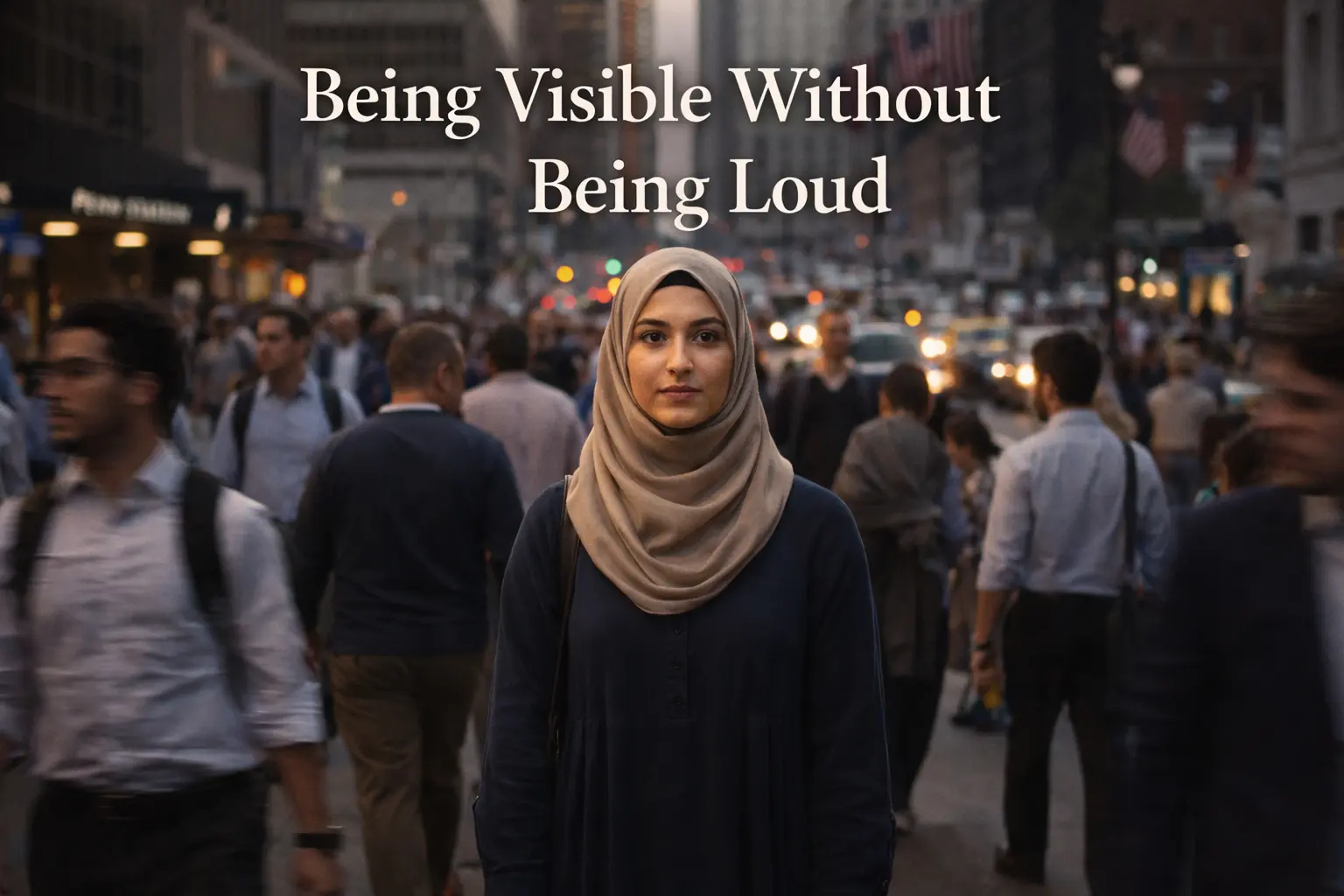
This is the calculus that many American Muslims perform daily: how to be authentically themselves while managing the weight of representation, how to express their identity without inviting discrimination, how to be visible without being loud. It’s a balance that requires constant adjustment, shaped by geography, profession, personality, and the ever-shifting political climate. And it’s exhausting.
The Burden of Representation
To be visibly Muslim in America is to carry the weight of 1.8 billion people on your shoulders. You are never just yourself. You are a representative, an ambassador, a walking embodiment of Islam whether you asked for that role or not. Your behavior, your words, your successes and failures all reflect on the entire community in ways that would never apply to your non-Muslim peers.
The hijabi woman who’s rude to a cashier isn’t just having a bad day. She’s confirming stereotypes about Muslim women being oppressed and angry. The bearded man who speaks sharply in a meeting isn’t just being assertive. He’s feeding fears about Muslim male aggression. The Muslim teenager who gets in trouble at school isn’t just a kid making mistakes. They’re evidence that Muslim families don’t raise their children right.
This hypervisibility creates a pressure to be perfect that is both impossible and unfair. Muslim parents tell their children to be on their best behavior in public, to smile more, to be extra polite, to never give anyone a reason to think badly of Muslims. Adult Muslims police their own tone, their facial expressions, their level of enthusiasm about their faith. The goal is to be visible enough to represent Islam positively but not so visible that you attract negative attention.
The calculation changes based on context. In diverse urban areas, visible Muslim identity might barely register. In small towns or conservative regions, it can feel like a beacon drawing stares and comments. After acts of terrorism committed by people claiming Islamic motivation, the pressure intensifies. Muslims find themselves walking on eggshells, hyperaware that any misstep might be magnified.
Some respond by retreating, making themselves smaller and quieter. They downplay their Muslim identity in professional settings, avoid political conversations, and keep their faith largely private. Others double down, refusing to hide or apologize, wearing their identity proudly regardless of who’s uncomfortable with it. Most fall somewhere in between, reading each situation and adjusting accordingly.
Strategic Visibility
Many American Muslims have developed what might be called strategic visibility, the art of being authentically Muslim while minimizing friction. This doesn’t mean hiding one’s faith, but rather presenting it in ways that are legible and non-threatening to the broader society.
Muslim women choose hijab styles that are fashionable and professional, demonstrating that modesty and style aren’t mutually exclusive. They become doctors, lawyers, and engineers, proving through their presence that Muslim women are educated and ambitious. They excel in their fields not just for personal achievement but to counter stereotypes about Muslim women being submissive or uneducated.
Muslim men grow beards but keep them neatly trimmed. They might wear kufis to the mosque but baseball caps in other settings. They speak eloquently about their faith when asked but don’t proselytize uninvited. They aim to be the kind of Muslims that make non-Muslims think, “Oh, that’s what a Muslim looks like? They seem normal.”
This strategy has its critics. Some argue it’s a form of respectability politics, trying to make Islam palatable to the dominant culture by conforming to its standards of acceptability. They point out that the need to perform non-threatening Muslim identity reinforces the assumption that Muslims are threatening by default. Why should Muslims have to prove they’re not dangerous? Why is the burden on them to make others comfortable?
But defenders of strategic visibility see it as pragmatic navigation of real constraints. In a society where Islamophobia is pervasive and Muslims face tangible discrimination, being thoughtful about how you present your identity isn’t weakness or capitulation. It’s survival. It’s choosing your battles. It’s recognizing that you can be both proud of your faith and wise about when and how you express it.
The Hijab as Statement and Target
No aspect of Muslim identity is more visible or more politicized than the hijab. For many Muslim women, wearing it is a straightforward act of worship, a commandment from Allah that they fulfill without overthinking. But in America, the hijab is never just religious practice. It’s a political statement, a feminist issue, a security concern, a diversity talking point, all whether the woman wearing it wants it to be or not.
The hijab makes Muslim women instantly recognizable. They can’t blend in, can’t choose when to be visibly Muslim and when to pass. This visibility brings both benefits and burdens. Muslim women in hijab become the face of Islam to many non-Muslims. They’re stopped in grocery stores and asked questions about their faith. They’re invited to speak on panels about Muslim women’s experiences. They become default representatives.
But they’re also the primary targets of anti-Muslim hate crimes. Studies consistently show that visibly Muslim women, particularly those in hijab, experience more harassment and discrimination than Muslim men. They’re called terrorists, told to go back to their country, have their hijabs pulled, and face violence simply for being identifiable as Muslim.
This creates an impossible situation. The very act of wearing hijab, meant to be about modesty and devotion to God, becomes about courage and defiance. Muslim women must decide whether to wear it knowing it might cost them job opportunities, subject them to harassment, or put them in physical danger. Some choose to wear it anyway, refusing to let fear dictate their practice. Others remove it, not out of lack of faith but out of very reasonable concern for their safety or livelihood.
The community sometimes judges both choices harshly. Women who wear hijab are told they’re making things harder for themselves and the community. Women who don’t are questioned about their commitment to Islam. There’s no winning, no choice that doesn’t carry weight.
Names and Identity Markers
For Muslims with distinctly Islamic names, visibility is unavoidable from birth. Ahmed, Fatima, Muhammad, Khadijah, these names announce Muslim identity before you ever open your mouth. They appear on resumes, in email signatures, on name tags, making anonymity impossible.
Studies show that job applicants with Muslim-sounding names receive fewer callbacks than identical candidates with Anglo names. Muslims know this. They’ve lived it. Some respond by adopting Anglicized nicknames, Mohamed becomes Mo, Khadijah becomes Kay. Others use initials or middle names that sound less distinctly Muslim. It’s a small adjustment that might open doors that would otherwise remain closed.
But it’s also a loss. Your name is part of your identity, often carrying religious significance or family history. Changing it, even slightly, feels like denying something essential about yourself. It’s a compromise between being who you are and being who you need to be to navigate American society successfully.
Some Muslims refuse to make this compromise. They keep their full names, pronunciation and all, and correct people as many times as necessary. This is its own form of resistance, an insistence that American space must expand to include them rather than them shrinking to fit into existing space. But it comes with costs, the exhaustion of constantly correcting mispronunciations, the knowledge that your name might be the reason you didn’t get an opportunity.
Social Media and Curated Identity
The digital age has added new dimensions to the question of Muslim visibility. Social media allows Muslims to connect with each other, build community, and express their faith publicly. But it also creates permanent records of everything you say, searchable and shareable, potentially used against you.
Muslim Americans have learned to be careful online. They think twice before posting about political issues, knowing that employers and law enforcement might be watching. They avoid certain keywords that might trigger surveillance algorithms. They’re aware that one angry tweet, one poorly worded post, could go viral and define them forever.
This self-censorship is particularly acute around issues related to Palestine, foreign policy, or critiques of American wars in Muslim-majority countries. Muslims know that expressing solidarity with Palestinians or criticizing U.S. military action might be read as supporting terrorism, even when they’re clearly talking about human rights and international law. So they moderate their language, add disclaimers, or simply stay silent on issues they care deeply about.
Young Muslims especially feel this tension. They’ve grown up in the age of social media, where sharing your life online is normal. But they also can’t be as unfiltered as their non-Muslim peers. They have to think about how their posts reflect on their community, whether their religious identity makes their words carry different weight, whether being authentic online is worth the potential consequences.
Some create separate accounts, one for public professional life and one for private expression among trusted Muslim friends. Others simply avoid controversial topics entirely, keeping their online presence focused on food, travel, and uncontroversial observations. The cost is that their full selves, their political convictions, their anger at injustice, their complex thoughts about being Muslim in America, remain hidden.
The Professional Balancing Act
In professional settings, the question of Muslim visibility takes on particular urgency. Muslims want to advance in their careers, but they also don’t want to hide fundamental parts of who they are. They navigate requests to attend happy hours where alcohol is served, office parties during Ramadan, networking events that conflict with prayer times.
Some Muslims are strategic about when they reveal their religious identity. They wait until they’ve proven their competence before mentioning that they pray or fast. They build relationships with colleagues first, establishing themselves as likable and capable, before introducing the Muslim part of their identity. The hope is that by the time people know they’re Muslim, they already like and respect them too much for stereotypes to stick.
Others are upfront from the start. They block off prayer times on their calendars, decline alcohol at work events with a simple “I don’t drink,” and request time off for Eid without elaborate explanations. They figure that if an employer or colleague can’t handle their Muslim identity, better to know that early than to discover it after they’ve invested years in a relationship.
Both approaches have risks. Being too strategic might mean constantly managing others’ perceptions, never fully relaxed or authentic at work. Being too upfront might mean facing discrimination or being passed over for opportunities. There’s no risk-free way to be visibly Muslim in professional America.
Teaching the Next Generation
Muslim parents grapple with how to raise children who are confident in their identity without being naive about the challenges they’ll face. They want their kids to be proud Muslims, but they also want to protect them from the hurt of discrimination.
Some parents emphasize resilience, teaching children that yes, people will treat you differently because you’re Muslim, but you can’t let that stop you. Be excellent, be kind, be undeniably good at what you do, and eventually people will see past their prejudices. It’s a hopeful message, though one that places enormous pressure on children to be exceptional rather than simply allowed to be ordinary.
Other parents teach code-switching, the ability to navigate between Muslim community spaces where you can be fully yourself and mainstream spaces where you need to modulate your identity. It’s a survival skill, but it can also feel like teaching children to be two different people depending on who’s watching.
Still others shelter their children as long as possible, keeping them in Muslim schools or homeschooling them, trying to delay the moment when they’ll have to confront Islamophobia directly. But eventually, those children grow up and enter a world that isn’t as accepting as their protective bubble was.
Finding the Balance
There’s no perfect way to be visibly Muslim in America. Every approach involves trade-offs. Being loud and unapologetic about your identity might inspire some but alienate others. Being quiet and strategic might open doors but require exhausting performance. Most Muslims move between these poles depending on context, feeling their way through each situation.
What unites these different strategies is the recognition that Muslim identity in America requires conscious navigation. You can’t just be Muslim, you have to decide how to be Muslim in each space you enter. This meta-awareness, this constant calculation, is itself a burden that non-Muslims rarely have to carry.
But it’s also produced a generation of Muslims who are thoughtful about their identity, articulate about their faith, and resilient in the face of hostility. They’ve learned to be visible without being loud, to claim space without demanding it, to be confidently Muslim while reading the room.
It’s not how it should be. In an ideal world, Muslims could simply exist without having to strategize about how their existence will be perceived. But in the world as it is, American Muslims have become experts at navigating visibility, at being authentically themselves while protecting themselves, at showing up fully while knowing exactly what showing up costs.
They are visible by choice and by circumstance, loud when necessary and quiet when wise, always calculating but refusing to disappear. And in that careful, conscious navigation, they are writing a new chapter in the long story of what it means to be Muslim in America.